
Bridging the Gap Between Business Needs and Technical Execution with Forward Deployment Teams

Bridging the Gap Between Business Needs and Technical Execution with Forward Deployment Teams

A business leader rarely walks into a technology meeting saying, “We need a new data architecture.”

They are more likely to say:

“Why does this report still take three days?”

“Why can’t our teams get a reliable view of the data?”

“We have an AI pilot. Why can’t we get it into production?”

Those questions start with business outcomes. But solving them often requires work across data, cloud, AI, applications and infrastructure. That is where the gap appears.

Business teams understand what needs to change. Engineering teams understand how technology works. When those worlds remain separated, technology investments can take longer to deliver value.

Forward Deployment Engineering brings those worlds closer together.

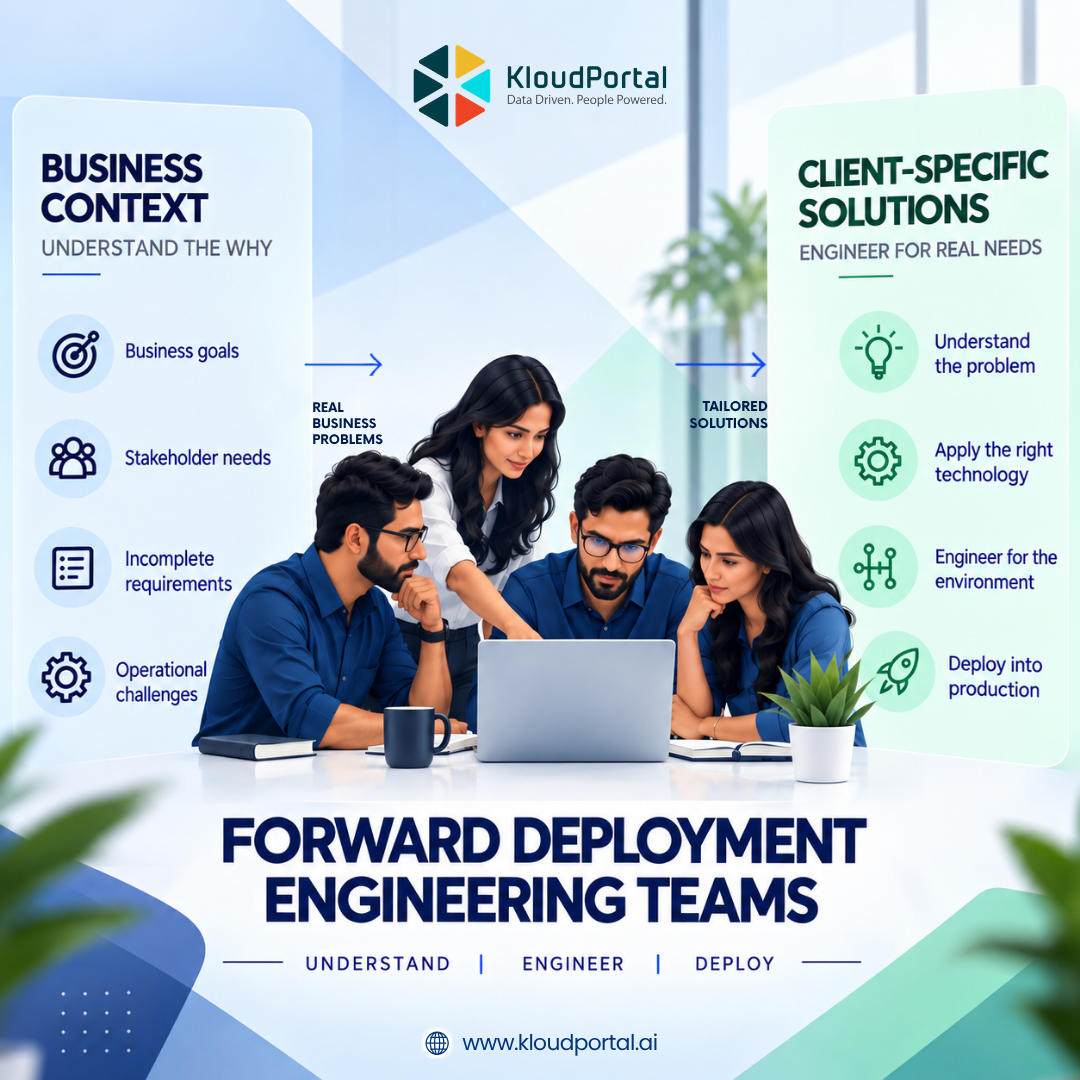
Forward deployment teams work close to the business problem, understand the environment and engineer around the organization’s reality.

The Real Problem Is Often Between the Requirements

Consider an enterprise trying to improve customer intelligence. The business wants a single, reliable view of customers. The technology team discovers customer information across CRM, ERP, operational databases and external applications.

Some data arrives in batches; other information needs to move in real time. Teams may even use different definitions for the same metric.

The original requirement—“give us better customer intelligence”—has now become a data integration, architecture, governance and engineering challenge.

This is where projects can slow down. The business understands the outcome, but the technical team must translate it into hundreds of engineering decisions.

A forward deployment team sits in that space.

Turning Business Language Into Engineering Decisions

A Forward Deployment Team moves between two conversations.

The business might say: “We need information faster.”

“We need information faster” becomes questions about ingestion, processing, architecture, latency, data quality and infrastructure.

When an approach isn’t practical, the team explains what that means for the business outcome. That translation cannot always happen through documents and handoffs. It often happens through continuous collaboration.

The team sees the workflow, examines the data, talks to users, identifies constraints and adjusts the architecture as new information emerges.

The result is a shorter loop:

Business Need → Technical Discovery → Solution Design → Engineering → Feedback → Production

Technology Should Follow the Business Problem

This approach also changes how technology decisions are made.

An enterprise may need Snowflake for a scalable data foundation, Databricks for data engineering or AI workloads, or Solace for real-time, event-driven requirements. But the starting point shouldn’t be the platform. It should be the problem.

The architecture might involve one technology or several. The important question is whether it fits the organization’s data, systems, workflows and operational requirements.

Modern data engineering therefore needs people who understand how technologies work together to produce an outcome.

The Engineering Capability Behind the Model

FDE also changes what organizations should expect from an engineering team. Technical expertise is essential. But it isn’t sufficient.

Engineers working in this model need to understand:

✓
Enterprise data architectures
✓
Cloud platforms

✓
Data pipelines and integration
✓
AI and machine learning workflows

✓
Security and governance
✓
Production operations

They also need to be comfortable with incomplete requirements, changing priorities and direct interaction with business teams.

This is why KloudPortal is building trained Forward Deployment Engineering and AI-native teams. The focus is on modern data, data pipelines, cloud, AI technologies and applying that expertise inside real enterprise environments.

The objective isn’t simply to provide engineers who know Snowflake, Databricks or cloud platforms. It is to provide trained engineering capability that can understand the problem, work within the client’s environment and take the solution towards production.

Why AI Makes This Even More Important

The business-technology gap becomes even more visible with AI. A prototype can demonstrate that an AI model or agent can perform a task. Production introduces different questions. logy industry.

u
  • What enterprise data should it access?
  • How should its outputs be evaluated?
  • What systems does it need to interact with?
  • What permissions should it have?
  • How should its actions be monitored?
  • Who owns the workflow when something goes wrong?

These are not questions a model alone can answer. They require data, application integration, cloud infrastructure, security, governance and AI engineering to work together.

AI-native teams therefore need to think beyond the model and turn AI capability into a reliable business workflow.

Why Forward Deployment Is Gaining Momentum in 2026

The industry is increasingly moving toward this model.

  • AWS launched a Forward Deployed Engineering program for partners in June 2026, describing a move toward embedded teams that put production AI systems into customer environments under real data and governance requirements.
  • Accenture has launched FDE programs with Microsoft, SAP and ServiceNow, with the stated focus on moving AI from experimentation and pilots into enterprise production.
  • OpenAI’s current FDE roles span discovery, technical scoping, system design, build and production rollout, with success tied to production adoption and measurable workflow impact.

Together, these developments point to a growing focus on engineering capability that connects technology to business execution.

From Technical Execution to Business Outcomes

A successful Forward Deployment Team should not be measured simply by headcount or how quickly code was written.

The better questions are:

  • Did the business problem get solved?
  • Did the workflow become faster or more reliable?
  • Did the data become usable and trusted?
  • Did the AI use case reach production?
  • Can the organization operate and extend the solution?
These are the measures that connect engineering work to business value.

At KloudPortal, this is the direction behind our Forward Deployment Engineering and AI-native teams: trained engineering capability deployed around real enterprise problems, with the technical depth to build and productionize the solution. The technology may be Snowflake, Databricks, Solace, cloud, AI or a combination.

Have a Business Problem to Solve?

Bring us the problem. We bring our trained engineering teams to build the solution.

Frequently Asked Questions

What is a Forward Deployment Team?

A cross-functional engineering team that works closely with a client to understand a business problem, design the solution and take it toward production.

How do Forward Deployment Teams bridge business and technology?

They translate business objectives into engineering requirements and validate the solution against real workflows with business and technical stakeholders.

How are Forward Deployment Teams different from staff augmentation?

Staff augmentation primarily adds technical capacity. Forward Deployment Teams are structured around solving a defined business problem and delivering a production outcome.

What technologies can Forward Deployment Teams work with?

Depending on the requirement, teams can work across Snowflake, Databricks, Solace, cloud platforms, data engineering, AI and platform engineering. The technology follows the business need.

Why are AI-native engineering teams important?

They combine AI expertise with data, cloud, application and production engineering capabilities, helping enterprises move AI use cases beyond prototypes into reliable business workflows.
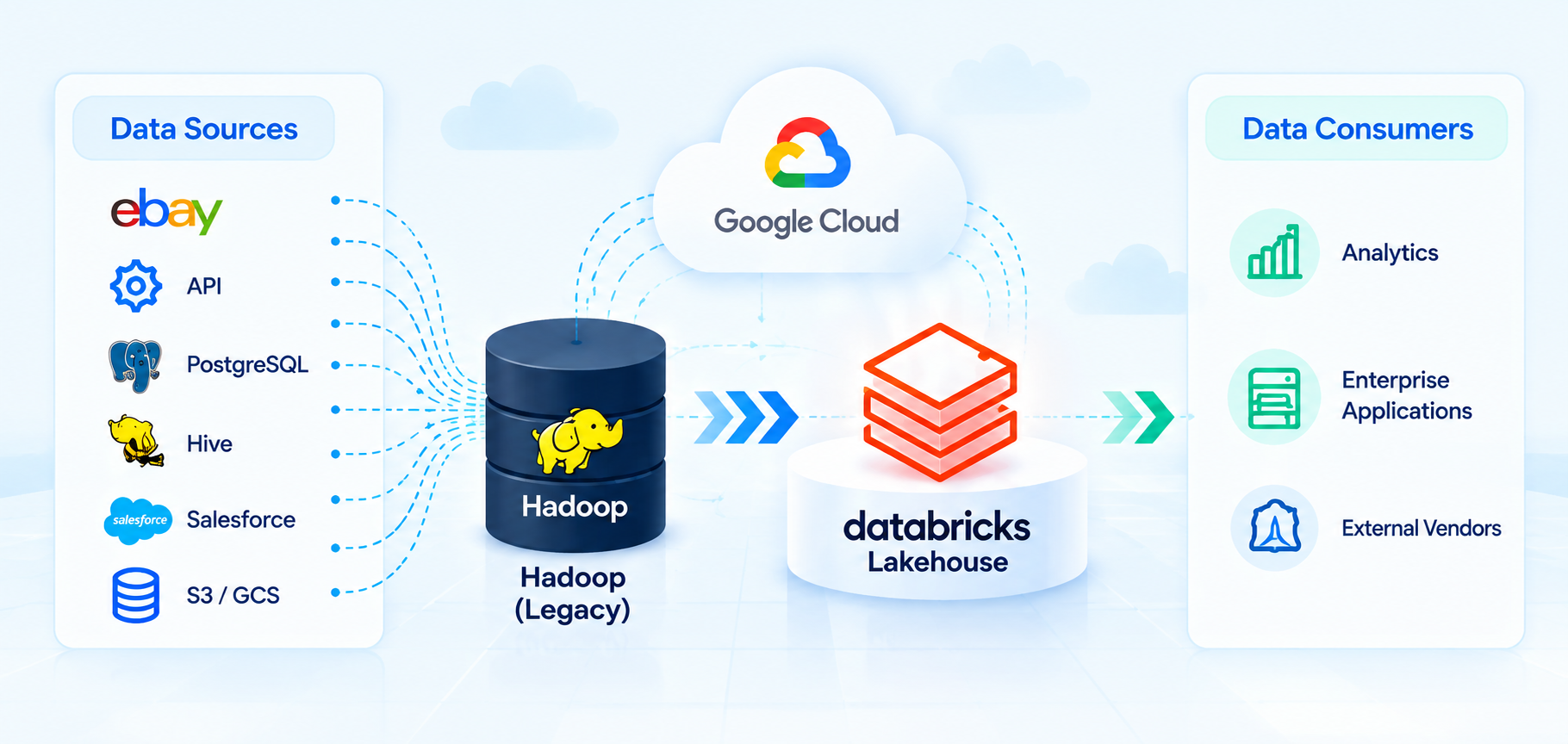
Migration Hadoop data to Databricks for ‘Gumtree’

Migration Hadoop data to Databricks for ‘Gumtree’

Migrating Hadoop data to Databricks for Gumtree

Gumtree DWH migration from legacy ebay systems to a scalable Lakehouse solution powered by Databricks and Google Cloud.

18 TB

Data Volume

5

Data Sources

25

Team Size

6 Months

Pipeline Build

Challenge

The Business Challenge

Gumtree needed to modernize its existing data warehouse environment by migrating data from legacy eBay systems to a cloud-based lakehouse architecture. The existing environment posed challenges in terms of high operational costs, complex infrastructure management, diverse data formats, scalability limitations, and the need for real-time data sharing with external vendors and enterprise applications.
The objective was to determine whether this process could be automated while maintaining accounting logic, mathematical accuracy and traceability to the underlying transactions.
icon1

Legacy Data Infrastructure

Existing data workloads were dependent on legacy Hadoop-based infrastructure, creating challenges around maintenance, scalability and modernization.

icon2

High Operational Costs

Maintaining hardware and IT infrastructure increased operational overhead and limited the ability to optimize resources dynamically.
icon

Diverse Data Formats

Needed to handle structured and semi-structured data across multiple formats. (JSON, Avro, ORC, Parquet, XML).
icon4

Scalability & Workload Isolation

Different application workloads required greater isolation and scalability to support growing data and processing requirements.
share

Real-Time Data Sharing

Business required the ability to share data in real-time with external vendors and other enterprise applications

Solution

A Modern Lakehouse on Databricks and Google Cloud

We designed and implemented a scalable lakehouse architecture on Databricks, hosted on Google Cloud, to migrate data from eBay systems. The solution leverages Databricks data pipelines and Parquet support to accelerate migration, enable workload isolation, and support multiple data formats.
Solution for Migration to Hadoop

Impact

Business Impact

The migration enabled Gumtree to move from a legacy Hadoop environment to a modern, scalable cloud-based lakehouse architecture.

Faster Data Delivery

Databricks data pipelines took less than 6 months to build, helping accelerate the migration.

Reduced Operational Costs

Lower hardware maintenance and IT infrastructure costs through Databricks cloud architecture.

Support for Multiple Data Types

Store and process structured and semi-structured data (JSON, Avro, ORC, Parquet, XML).

Greater Scalability

Application-level workload isolation provides more scalability and efficient resource utilization.

Real-Time Data Sharing

Easily share data in real time with external vendors and other enterprise applications within the organization.

TECHNOLOGY

Technology Approach 

Google Cloud

Cloud infrastructure foundation

Databricks

Lakehouse platform

Databricks Data Pipelines

Ingestion, transformation, and processing

Parquet

Optimized storage format

Enterprise Integrations

APIs, PostgreSQL, Hive, Salesforce, S3, GCS

Ready to Modernize Your Data Platform?

Move from legacy systems to a scalable lakehouse with Databricks and Google Cloud.

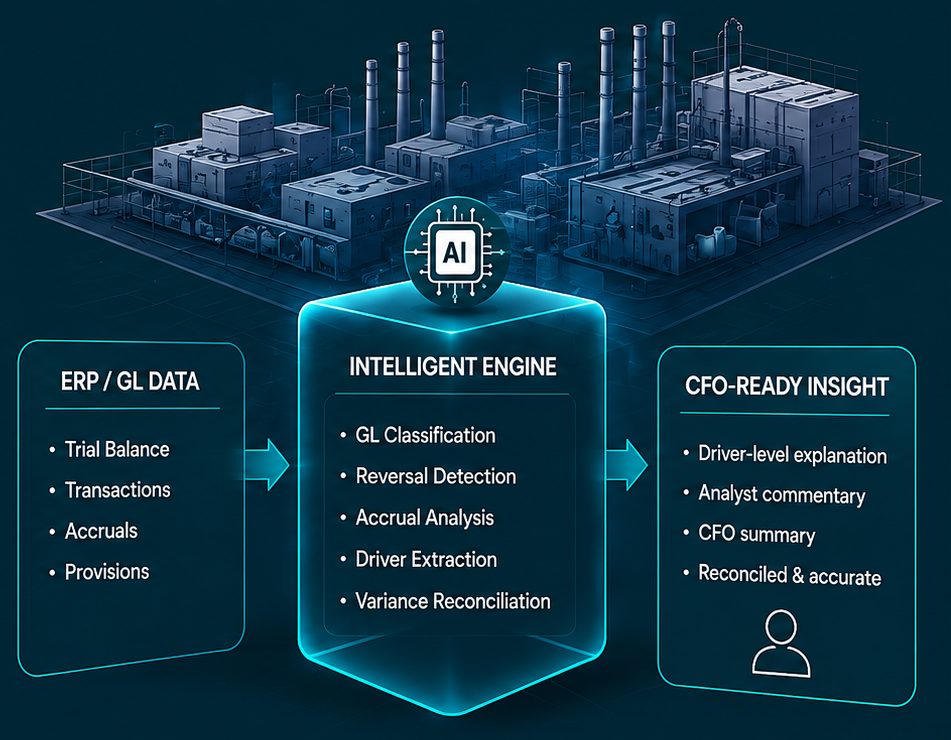
From GL Data to CFO Insight: Automating Financial Variance Analysis for Manufacturing

From GL Data to CFO Insight: Automating Financial Variance Analysis for Manufacturing

From GL Data to CFO Insight: Automating Financial Variance Analysis for Manufacturing

Turning complex transaction-level financial data into explainable, CFO-ready insights through intelligent automation.

Industry

Manufacturing

Function

Finance

Engagement

POC / Feasiblity

Solution

Financial Data Automation

From GL Data to CFO Insight: Automating Financial Variance Analysis for Manufacturing

Turning complex transaction-level financial data into explainable, CFO-ready insights through intelligent automation.

Industry

Manufacturing

Function

Finance

Engagement

POC / Feasiblity

Solution

Financial Data Automation

THE BUSINESS CHALLENGE

The client’s finance team spent significant time manually analyzing General Ledger movements, reconciling balances and preparing monthly variance commentary. With thousands of transactions, reversals, accruals and provisions contributing to a single GL movement, the process was complex, time-consuming and prone to inconsistency.

The objective was to determine whether this process could be automated while maintaining accounting logic, mathematical accuracy and traceability to the underlying transactions.

Large volume of transactions with reversals, accruals and provisions

Different accounting treatments for Balance Sheet and P&L accounts

Multiple line items contributing to one GL movement

Need for business explanations, not just numerical differences
High manual effort and long month-end cycle

THE SOLUTION

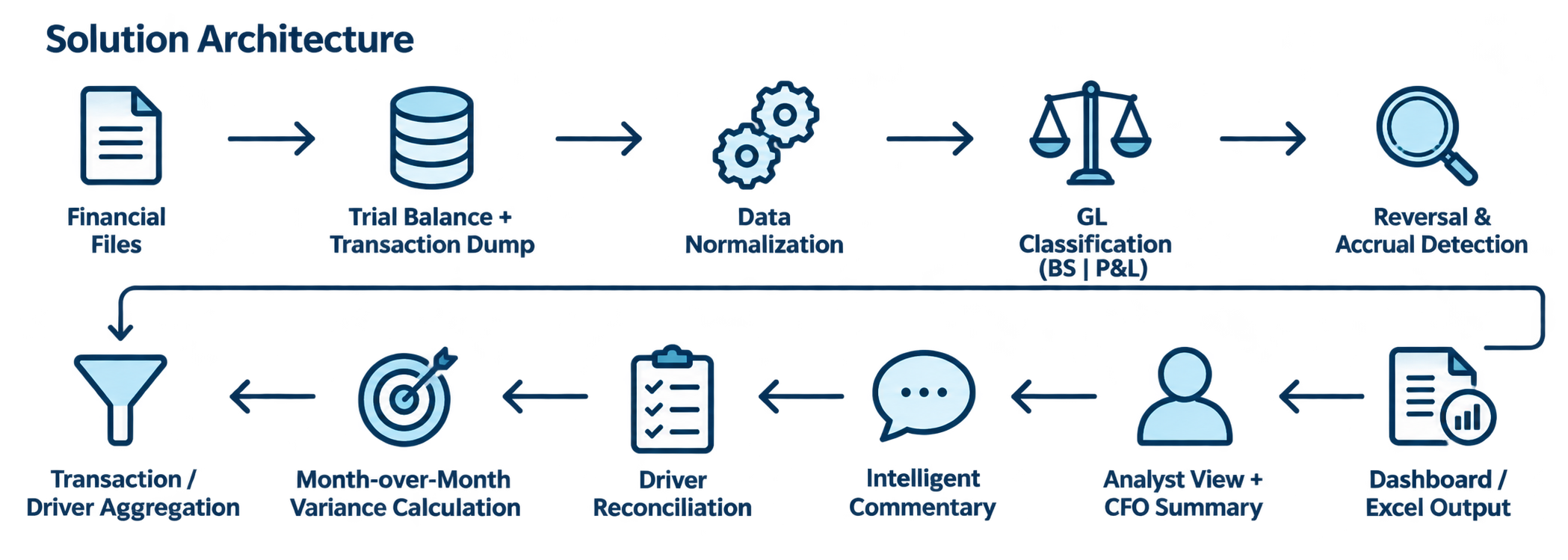
We built an intelligent GL Variance & Commentary automation framework that combines financial rules, transaction-level analysis, text normalization and intelligent commentary generation.

DATA SOURCE

Trial Balance

  • Current & comparison balances
  • GL descriptions
  • Overall GL variance

Transaction Dump

  • Transaction level details
  • Drivers behind the variance
  • Reversals, accruals, provisions

HOW IT WORKS

Ingest Financial Data

Upload Trial Balance and transaction dump along with base & comparison months.

Understand & Classify

Apply accounting logic for Balance Sheet (GL 1–4) and P&L (GL 5–6) accounts.

Normalize & Identify

Detect reversals, accruals, provisions and normalize text to extract meaningful drivers.

Calculate Movement

Aggregate transactions by driver and calculate month-over-month movements.

Generate Commentary

Create analyst-level and CFO-level commentary with quantified drivers and explanations.

Deliver Insights

View in dashboard and download Analyst & CFO commentaries (Excel).

From Numbers to Business Explanation

Example: GL 40000021

Driver Aug Accrual (LC) Sep Accrual (LC) Movement (LC)
Freight OL -2.63M -3.86M +1.23M
Engg OL -4.25M -4.54M +0.29M
IT OL -0.06M -0.29M +0.23M
Other movements — — -0.40M
Total +1.34M

The calculated movement reconciled exactly to the Trial Balance variance.

Analyst Commentary (Detailed)

The balance increased by $1.34M primarily due to higher accruals in Freight OL (+$1.23M) and Engineering OL (+$0.29M), partially offset by lower IT OL accruals (+$0.23M) and other offsetting movements (-$0.40M).

CFO Commentary (Business Summary)

Accruals increased by $1.34M mainly due to higher freight and engineering accruals, partially offset by lower IT accruals.

RESULTS FROM POC

11/11

GLs Tested

100%

Achieved ≥80% Variance Coverage

100%

Achieved ≥90% Variance Coverage

100%

Mathematical Accuracy Verified

80–90%+

Target Variance Explanation Coverage Achieved

BUSSINESS IMPACT

Reduced Manual Analysis

Automates the initial investigation of GL movements, reducing manual transaction review.

Faster Variance Review

Moves from manual analysis to a structured, repeatable variance workflow.

Greater Explainability

Quantifies drivers and explains why the variance occurred, not just that it changed.

Better Traceability

End-to-end traceability from Trial Balance → Drivers → Movement → Commentary.

CFO-Ready Insights

Two levels of output: Analyst detail and concise, business-focused CFO summary.

TECHNOLOGY APPROACH

Financial Data Processing

Large volume of transactions with reversals, accruals and provisions

Intelligent Data Processing

Text normalization, classification, reversal detection, accrual/provision handling

Analytics & Visualization

GL variance analysis, driver reconciliation, coverage measurement, interactive dashboard

AI Enhancement Layer

LLM-powered commentary generation with prompt tuning & cost optimization

Ready to Automate Your Financial Reporting?

Let’s turn your financial data into explainable insights that save time and drive better decisions.

From Business Problem to Production: How Forward Deployment Engineering Accelerates Data and AI Projects 

From Business Problem to Production: How Forward Deployment Engineering Accelerates Data and AI Projects 

A company wants to make better decisions from its data. It invests in a modern data platform, brings in the right tools, and starts building. A few months later, the technology is in place—but the business problem hasn’t really changed.

The reports are still slow. Data still has to be pulled from multiple systems. Teams still struggle to get a reliable view of what is happening. An AI pilot may even be working, but getting it into a production workflow proves far more difficult than building the initial prototype.

This is a familiar problem in enterprise technology: the distance between having the right technology and making it work for the business.

The answer isn’t necessarily another platform or another proof of concept. Often, what is needed is an engineering team that can work close enough to the business to understand the problem, close enough to the technology to design the right solution, and close enough to the production environment to make that solution work.

That is the idea behind Forward Deployment Engineering (FDE).

Instead of treating engineers as people who receive requirements and return a finished implementation, FDE puts them alongside the teams facing the problem. They work through the data, systems, workflows and constraints together, making engineering decisions as they learn what the business actually needs.

For data and AI projects, this can fundamentally change how a solution gets built. The question shifts from “What technology should we implement?” to “What needs to be engineered to solve this problem?”

And that is where the journey from business problem to production begins.

The Hard Part Begins After the Technology Is Chosen

Consider what happens when an enterprise decides to modernize its data platform.

Choosing Snowflake or Databricks may be an important decision, but it is rarely the hardest one. The real work begins when engineers have to connect the platform to the company’s existing environment.

Data might come from an ERP, CRM, operational databases, APIs and legacy applications. Some workloads may run in batches while others require real-time processing. Different teams may define the same business metric differently.

Now the project isn’t simply about implementing a data platform. It is about engineering the connections, pipelines, governance, and workflows that allow the platform to deliver business value. That is where having engineers close to the problem becomes valuable.

From Requirements to Real-World Engineering

In a conventional delivery model, teams often define requirements first and hand them to an engineering team.

But data and AI projects rarely remain that simple. An engineer may discover that the required data is incomplete. A legacy dependency may change the architecture. A business user may reveal that the original workflow doesn’t match how the process actually operates.

With forward deployment, those discoveries become part of the delivery process rather than late-stage surprises.

The team can ask:

  • What are we trying to solve?
  • What does the existing environment allow us to do?
  • What needs to change to make the solution work?

That creates a tighter cycle between discovery, engineering and feedback.

The Technology Follows the Problem

This approach also changes how technologies such as Snowflake, Databricks, and Solace fit into an enterprise solution.

A business may need Snowflake to create a scalable and governed data foundation. Databricks may be required for large-scale data engineering, machine learning or AI workloads. Solace can become relevant when applications and systems need real-time event-driven communication.

The point isn’t to implement all three.

The point is to determine which combination of technologies solves the actual business problem. That requires engineers who understand the individual platforms but can also connect them into a broader architecture.

In a modern enterprise environment, data engineering, cloud, AI, integration and platform engineering increasingly overlap.

Building Deployment-Ready Teams

This is where Forward Deployment Engineering differs from simply adding resources to a project.

A forward-deployed engineer needs technical depth, but also needs to be comfortable working with ambiguity and directly with client teams.

They need to understand:

  • Enterprise data architectures
  • Cloud platforms
  • Data pipelines and integration
  • AI and machine learning workflows
  • Security and governance
  • Production operations

Just as importantly, they need to understand why the solution is being built.

This is why KloudPortal is developing trained Forward Deployment Engineering and AI-native teams. Engineers are trained across modern data, cloud and AI technologies and prepared to work within real enterprise environments.

The objective isn’t to provide engineers who simply know a technology. It is to build teams capable of applying that knowledge to a client’s specific problem.

From AI Prototype to Production Capability

AI makes this distinction even more important. Building an AI prototype can happen relatively quickly. Making it useful inside an enterprise is a different challenge. An AI application may need access to governed enterprise data, integration with existing applications, monitoring, evaluation, security controls and a reliable operating model.

The model is only one part of the solution.

An AI-native engineering team therefore needs to think beyond the model and engineer the data, applications, infrastructure and workflows around it. This is where forward deployment can shorten the path from experimentation to production.

Why FDE Is Becoming Important in 2026

This delivery model is gaining momentum across the technology industry.

In June 2026, AWS announced a $1 billion investment in Forward Deployed Engineering, including a partner-led FDE model focused on helping customers build and deploy production AI systems within their real operating environments.

OpenAI has similarly described FDE roles around customer discovery, technical scoping, system design, development, and production rollout.

The broader shift is clear: Enterprises increasingly need engineering teams that can bridge the gap between technology capability and business execution.

Measuring What Actually Matters

A successful data or AI engagement shouldn’t be measured simply by whether a platform was deployed or a prototype was completed.

The better questions are:

  • Did the business get the information it needed faster?
  • Did the process become more efficient?
  • Did the AI use case make it into production?
  • Can the solution scale and be operated reliably?

These are the measures that connect engineering work to business outcomes, and they are what make Forward Deployment Engineering more than another delivery model.

From Engineering Capability to Business Outcome

The future of enterprise data and AI won’t be determined by the platforms organizations choose alone.

It will depend on whether they have the engineering capability to turn those platforms into solutions that work in the real world.

That is the capability KloudPortal is building through trained Forward Deployment Engineering and AI-native teams—teams that can work within client environments, understand complex data and technology challenges, and engineer solutions using the right combination of technologies.

Sometimes that solution may involve Snowflake. Sometimes Databricks. Sometimes Solace. Often, it requires several engineering disciplines working together.

The technology changes according to the problem. The objective doesn’t – because enterprises don’t ultimately need another technology implementation. They need the problem solved.

Understand the problem. Build the right solution.

Take it to production. Deliver the outcome.

Ready to put this approach into action? Let’s bring in Forward Deployment Engineering teams from KloudPortal.

Frequently Asked Questions

What is Forward Deployment Engineering?

Forward Deployment Engineering places engineers close to a client’s business and technology environment so they can understand a problem, build the solution and take it toward production.

How is FDE different from staff augmentation?

Staff augmentation primarily adds technical capacity. FDE focuses on solving a defined business problem and delivering an outcome through a specialized engineering team.

What technologies can FDE teams work with?

Depending on the requirement, teams can work across Snowflake, Databricks, Solace, cloud platforms, data engineering, AI and platform engineering. Technology selection follows the problem.

Why are AI-native engineering teams important?

AI-native teams use AI throughout engineering and solution development while maintaining the security, governance, testing and reliability required for enterprise production environments.
Snowflake for Enterprise Data Platforms: Blueprint by KloudPortal 

Snowflake for Enterprise Data Platforms: Blueprint by KloudPortal 

Modern enterprises are generating more data than ever before. Customer interactions, IoT devices, SaaS applications, operational systems, and AI models are continuously producing information that businesses need to analyze quickly and securely.

While many organizations have adopted cloud data platforms, simply moving data to the cloud isn’t enough. A successful Snowflake enterprise data platform requires a well-designed architecture that delivers scalability, governance, performance, and cost efficiency all while supporting future AI initiatives.

At KloudPortal, we believe architecture should enable business outcomes, not just technology adoption — an approach reflected across our Data & AI services. Here’s the blueprint we recommend for building an enterprise-ready Snowflake data platform.

Why Enterprises Are Standardizing on Snowflake

Snowflake has evolved far beyond a cloud data warehouse. Today, it serves as a unified platform for data engineering, analytics, data sharing, machine learning, and AI applications.

Its separation of storage and compute allows organizations to scale workloads independently, ensuring consistent performance without infrastructure complexity.

11,000+ customers worldwide, including hundreds of the Global 2000
Source: Snowflake FY2026 financial results (investors.snowflake.com)

However, technology alone doesn’t guarantee success. The real differentiator is how the platform is architected.

Architecture Blueprint for a Modern Snowflake Enterprise Data Platform

Instead of viewing Snowflake as a standalone warehouse, enterprises should treat it as the foundation of a complete data ecosystem.

1. Unified Data Ingestion Layer

Every enterprise has data coming from multiple sources: ERP and CRM systems, business applications, APIs, streaming platforms, IoT devices, and third-party data providers.

A scalable architecture begins with standardized ingestion pipelines. Recommended practices include:

  • Automated batch and real-time ingestion
  • Metadata-driven pipelines
  • Schema evolution handling
  • Data quality validation before loading

This creates a reliable foundation for downstream analytics.

2. Layered Data Architecture

Rather than loading everything into a single database, KloudPortal recommends a layered architecture that improves governance and maintainability.

Layer Purpose
Raw Stores source data without transformation
Curated Cleansed, validated, and standardized data
Business Domain-specific models for reporting
Consumption Dashboards, AI models, APIs, and applications
This approach makes data lineage easier to understand while simplifying maintenance and future enhancements.

3. Compute Isolation for Performance

One of Snowflake’s biggest strengths is independent virtual warehouses. Instead of running every workload on the same compute cluster, enterprises should isolate workloads such as ELT pipelines, business intelligence, data science, AI workloads, and ad-hoc analytics.

Benefits include:

  • Better performance
  • Reduced resource contention
  • Easier workload management
  • Improved cost visibility

This architecture allows each team to scale independently without affecting others.

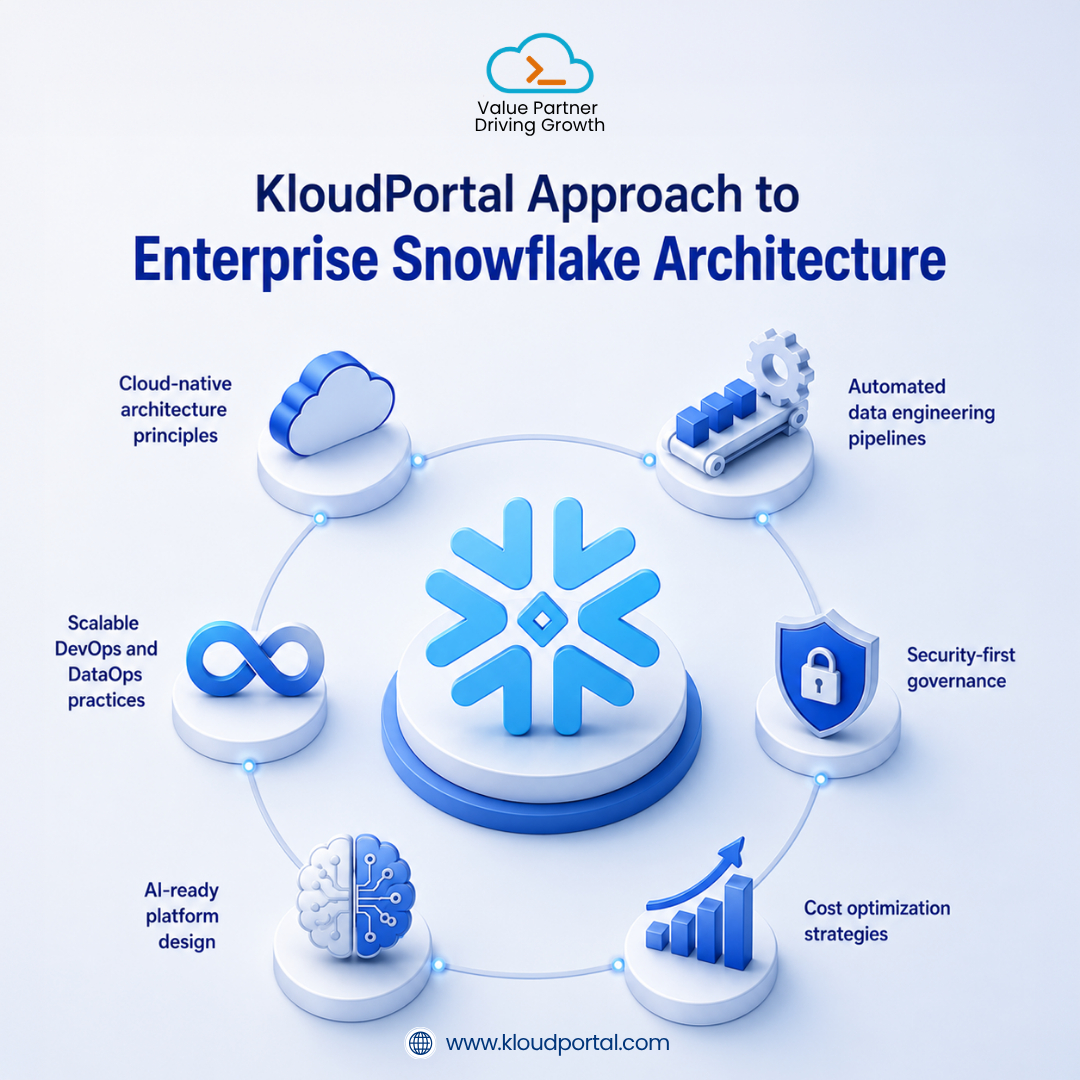
KloudPortal Approach to Enterprise Snowflake Architecture

4. Enterprise Data Governance

As organizations expand their data ecosystem, governance becomes essential. A strong governance framework should include role-based access control, data masking policies, row-level and column-level security, data classification, lineage tracking, and audit monitoring.

Snowflake’s governance capabilities, combined with proper architectural planning — including the compliance frameworks we implement through GRC Solutions — help enterprises maintain compliance while enabling secure self-service analytics.

5. AI-Ready Data Foundation

Many organizations are investing in AI but struggle because their data isn’t ready. An enterprise architecture should prepare data for predictive analytics, Retrieval-Augmented Generation (RAG), AI assistants, recommendation engines, and machine learning pipelines.

High-quality, governed, and discoverable data significantly improves AI outcomes while reducing project risk. Building an AI-ready foundation today ensures organizations can adopt emerging capabilities without re-architecting tomorrow.

Common Architecture Mistakes to Avoid

Even successful Snowflake implementations can face long-term challenges when architectural fundamentals are overlooked.

  • Treating Snowflake as only a reporting database
  • Mixing production, development, and testing workloads
  • Poor warehouse sizing
  • Lack of metadata management
  • Weak governance policies
  • Manual pipeline management
  • No cost monitoring strategy

Addressing these issues early helps organizations avoid technical debt and unnecessary cloud spending.

KloudPortal Approach to Enterprise Snowflake Architecture

At KloudPortal, we design Snowflake architectures that are secure, scalable, and built to support long-term business growth. Our approach combines modern cloud engineering practices with automation, governance, and AI readiness to help organizations maximize the value of their data platform.

  • Cloud-Native Architecture Principles – Design resilient, scalable, and high-performance data platforms using cloud-native best practices.
  • Automated Data Engineering Pipelines – Build metadata-driven, automated ELT/ETL pipelines for reliable and faster data delivery.
  • Security-First Governance – Implement robust access controls, data governance, compliance, and monitoring from the ground up.
  • Cost Optimization Strategies – Optimize Snowflake warehouse sizing, auto-suspend policies, storage, and query performance to reduce operational costs.
  • AI-Ready Platform Design – Create architectures that seamlessly support AI, machine learning, analytics, and generative AI workloads.
  • Scalable DevOps and DataOps Practices – Enable faster deployments, version control, CI/CD, infrastructure as code, and continuous monitoring for enterprise-scale operations.

Rather than delivering isolated implementations, we help organizations establish a long-term data foundation that can support analytics, operational reporting, and future AI initiatives — as reflected in our case studies with enterprise clients across banking, manufacturing, and supply chain.

What a Future-Ready Snowflake Platform Looks Like

An enterprise-ready Snowflake platform should enable:

  • ✓ Trusted data across business domains
  • ✓ Faster analytics without infrastructure bottlenecks
  • ✓ Secure collaboration between teams
  • ✓ Simplified governance and compliance
  • ✓ Efficient compute utilization
  • ✓ Seamless integration with AI and machine learning workloads

When these architectural components work together, organizations can accelerate decision-making while maintaining control over performance, security, and costs.

Conclusion

A successful Snowflake enterprise data platform is not defined by the number of datasets migrated or dashboards created. It is defined by the architecture that supports long-term scalability, governance, operational efficiency, and AI innovation.

By adopting a structured architecture blueprint, enterprises can reduce complexity, improve data reliability, and maximize the value of their Snowflake investment.

At KloudPortal, we work with organizations to design and implement scalable Snowflake architectures that align with business goals while preparing data platforms for the next generation of analytics and AI.

Building a new platform or modernizing an existing one?
Investing in the right architecture today creates a stronger foundation for tomorrow.

Talk to our data engineering team — kloudportal.com/contact-us

Frequently Asked Questions

What is a Snowflake enterprise data platform?

A Snowflake enterprise data platform is a cloud-native architecture that centralizes data for analytics, reporting, governance, and AI while providing independent scaling of storage and compute.

Why is architecture important for Snowflake implementations?

A well-designed architecture improves performance, security, governance, scalability, and cost optimization, ensuring the platform can support enterprise growth and future AI initiatives.

What are the key layers in a Snowflake architecture?

A typical architecture includes Raw, Curated, Business, and Consumption layers to organize data, improve governance, and simplify analytics.

How does KloudPortal help enterprises with Snowflake?

KloudPortal helps organizations design scalable, governed, and AI-ready Snowflake enterprise data platforms using cloud-native data engineering, automation, governance best practices, and cost optimization strategies.

We use cookies to ensure that we give you the best experience on our website. If you continue to use this site we will assume that you are happy with it.

Cookies settings
Accept
Privacy & Cookie policy
Privacy & Cookies policy
Cookie name Active

Privacy Policy

What information do we collect?

We collect information from you when you register on our site or place an order. When ordering or registering on our site, as appropriate, you may be asked to enter your: name, e-mail address or mailing address.

What do we use your information for?

Any of the information we collect from you may be used in one of the following ways: To personalize your experience (your information helps us to better respond to your individual needs) To improve our website (we continually strive to improve our website offerings based on the information and feedback we receive from you) To improve customer service (your information helps us to more effectively respond to your customer service requests and support needs) To process transactions Your information, whether public or private, will not be sold, exchanged, transferred, or given to any other company for any reason whatsoever, without your consent, other than for the express purpose of delivering the purchased product or service requested. To administer a contest, promotion, survey or other site feature To send periodic emails The email address you provide for order processing, will only be used to send you information and updates pertaining to your order.

How do we protect your information?

We implement a variety of security measures to maintain the safety of your personal information when you place an order or enter, submit, or access your personal information. We offer the use of a secure server. All supplied sensitive/credit information is transmitted via Secure Socket Layer (SSL) technology and then encrypted into our Payment gateway providers database only to be accessible by those authorized with special access rights to such systems, and are required to?keep the information confidential. After a transaction, your private information (credit cards, social security numbers, financials, etc.) will not be kept on file for more than 60 days.


Do we use cookies?

Yes (Cookies are small files that a site or its service provider transfers to your computers hard drive through your Web browser (if you allow) that enables the sites or service providers systems to recognize your browser and capture and remember certain information We use cookies to help us remember and process the items in your shopping cart, understand and save your preferences for future visits, keep track of advertisements and compile aggregate data about site traffic and site interaction so that we can offer better site experiences and tools in the future. We may contract with third-party service providers to assist us in better understanding our site visitors. These service providers are not permitted to use the information collected on our behalf except to help us conduct and improve our business. If you prefer, you can choose to have your computer warn you each time a cookie is being sent, or you can choose to turn off all cookies via your browser settings. Like most websites, if you turn your cookies off, some of our services may not function properly. However, you can still place orders by contacting customer service. Google Analytics We use Google Analytics on our sites for anonymous reporting of site usage and for advertising on the site. If you would like to opt-out of Google Analytics monitoring your behaviour on our sites please use this link (https://tools.google.com/dlpage/gaoptout/)

Do we disclose any information to outside parties?

We do not sell, trade, or otherwise transfer to outside parties your personally identifiable information. This does not include trusted third parties who assist us in operating our website, conducting our business, or servicing you, so long as those parties agree to keep this information confidential. We may also release your information when we believe release is appropriate to comply with the law, enforce our site policies, or protect ours or others rights, property, or safety. However, non-personally identifiable visitor information may be provided to other parties for marketing, advertising, or other uses.

Registration

The minimum information we need to register you is your name, email address and a password. We will ask you more questions for different services, including sales promotions. Unless we say otherwise, you have to answer all the registration questions. We may also ask some other, voluntary questions during registration for certain services (for example, professional networks) so we can gain a clearer understanding of who you are. This also allows us to personalise services for you. To assist us in our marketing, in addition to the data that you provide to us if you register, we may also obtain data from trusted third parties to help us understand what you might be interested in. This ‘profiling’ information is produced from a variety of sources, including publicly available data (such as the electoral roll) or from sources such as surveys and polls where you have given your permission for your data to be shared. You can choose not to have such data shared with the Guardian from these sources by logging into your account and changing the settings in the privacy section. After you have registered, and with your permission, we may send you emails we think may interest you. Newsletters may be personalised based on what you have been reading on theguardian.com. At any time you can decide not to receive these emails and will be able to ‘unsubscribe’. Logging in using social networking credentials If you log-in to our sites using a Facebook log-in, you are granting permission to Facebook to share your user details with us. This will include your name, email address, date of birth and location which will then be used to form a Guardian identity. You can also use your picture from Facebook as part of your profile. This will also allow us and Facebook to share your, networks, user ID and any other information you choose to share according to your Facebook account settings. If you remove the Guardian app from your Facebook settings, we will no longer have access to this information. If you log-in to our sites using a Google log-in, you grant permission to Google to share your user details with us. This will include your name, email address, date of birth, sex and location which we will then use to form a Guardian identity. You may use your picture from Google as part of your profile. This also allows us to share your networks, user ID and any other information you choose to share according to your Google account settings. If you remove the Guardian from your Google settings, we will no longer have access to this information. If you log-in to our sites using a twitter log-in, we receive your avatar (the small picture that appears next to your tweets) and twitter username.

Children’s Online Privacy Protection Act Compliance

We are in compliance with the requirements of COPPA (Childrens Online Privacy Protection Act), we do not collect any information from anyone under 13 years of age. Our website, products and services are all directed to people who are at least 13 years old or older.

Updating your personal information

We offer a ‘My details’ page (also known as Dashboard), where you can update your personal information at any time, and change your marketing preferences. You can get to this page from most pages on the site – simply click on the ‘My details’ link at the top of the screen when you are signed in.

Online Privacy Policy Only

This online privacy policy applies only to information collected through our website and not to information collected offline.

Your Consent

By using our site, you consent to our privacy policy.

Changes to our Privacy Policy

If we decide to change our privacy policy, we will post those changes on this page.
Save settings
Cookies settings