
Which Companies Provide Data Engineers to Tech Companies in India 

Which Companies Provide Data Engineers to Tech Companies in India 

India has become a global leader in data engineering talent. As technology companies expand their AI initiatives, modern data platforms, and real-time analytics, they depend on a variety of sources to quickly and efficiently hire, deploy, or enhance their data engineering workforce. These sources include IT services firms, staffing companies, specialized data engineering partners, and emerging pod-based platforms.

This blog provides a clear, up-to-date overview of the companies that provide Data Engineers to tech companies in India.

Why India Is a Global Hub for Data Engineering Talent

India’s dominance in data engineering is driven by three key factors:

  • A large pool of cloud-native and AI-ready engineers
  • Strong adoption of modern data stacks (Snowflake, Databricks, BigQuery, Apache Spark, Kafka)
  • Cost-efficient yet high-quality enterprise delivery models

According to recent industry estimates, India accounts for over 30% of the global data engineering workforce, with demand growing at more than 25% year-on-year as companies accelerate AI, analytics, and platform modernization initiatives. This demand has given rise to multiple categories of companies providing data engineers to tech firms.

How Tech Companies Hire Data Engineers in India

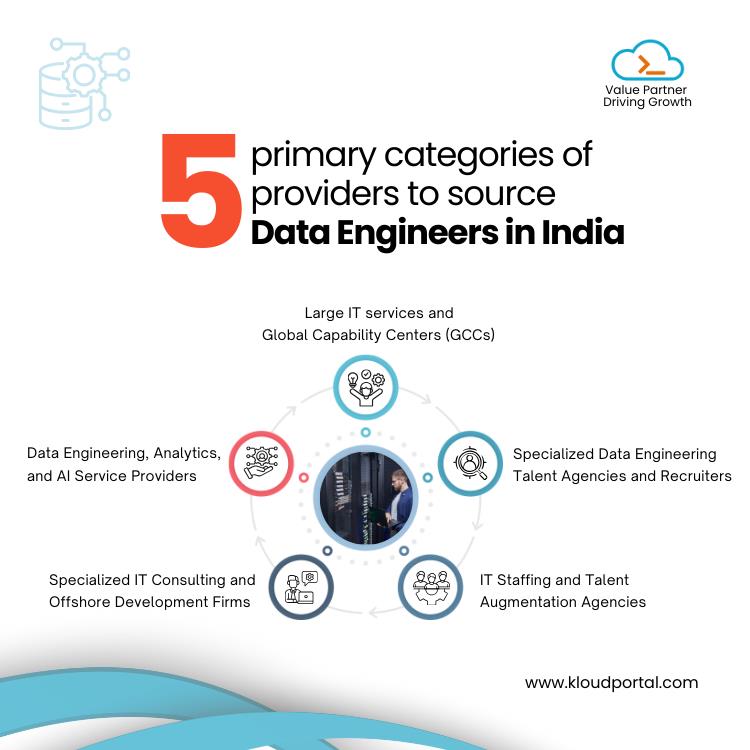
Tech companies source Data Engineers in India through five primary categories of providers. Each model serves a distinct purpose depending on scale, speed, and technical complexity.

1. Large IT services and Global Capability Centers

These organizations supply Data Engineers at enterprise scale and are typically chosen for large, multi-year transformation programs

  • Tata Consultancy Services (TCS) – Provides enterprise-grade data engineers for cloud data migration, data platforms, and pipeline modernization.Infosys – Known for large-scale data engineering through its cloud and analytics platforms, supporting legacy modernization and AI initiatives.
  • Infosys – Known for large-scale data engineering through its cloud and analytics platforms, supporting legacy modernization and AI initiatives.
  • Accenture India – Delivers end-to-end data engineering and big data solutions for Fortune 500 technology and enterprise clients.
  • Wipro – Focuses on R&D-heavy data engineering, IoT data streams, and AI-ready data layers.
  • HCLTech – Supplies data engineers for cloud-native data platforms, product engineering, and large enterprise systems.
  • LTIMindtree – Strong in Snowflake, Databricks, and modern data platform implementations following the LTI–Mindtree merger.

2. Data Engineering, Analytics, and AI Service Providers

These mid-sized and boutique firms focus deeply on data engineering, analytics, and AI, making them popular with startups and mid-market tech companies.

  • Fractal Analytics – Prominent analytics and AI firm offering data engineering capabilities focused on decision science.
  • Mu Sigma – Known for managing large-scale data platforms and analytics systems using its proprietary problem-solving framework.
  • Tiger Analytics – Specializes in ETL frameworks, governed data pipelines, and real-time dashboards across BFSI, retail, and healthcare.
  • Sigmoid – Recognized for real-time data engineering and high-performance data lake architectures.
  • Tredence – Focuses on data modernization and last-mile AI-driven analytics solutions.
Data Engineering Talent Providers in India

3. Specialized IT Consulting and Offshore Development Firms

These companies combine staffing with delivery, allowing tech companies to embed data engineers directly into ongoing projects or managed development teams.

  • ValueCoders – Offshore development partner offering pre-vetted Indian data engineers for scalable data pipelines, ETL frameworks, and analytics platforms
  • SuntechIT Global – Specializes in recruiting remote data engineering talent from India and integrating them into global client teams.
  • MindInventory – Provides data engineers as part of full-stack software, cloud, and analytics development teams on a project or remote-hiring basis.
  • Nimap Infotech – Offers flexible hiring of data engineers focused on scalable data architectures, data processing, and analytics enablement.

4. IT Staffing and Talent Augmentation Agencies

When tech companies need to scale teams quickly with contract or contract-to-hire Data Engineers, these staffing firms are commonly used.

  • Collabera – Frequently used by Global Capability Centers (GCCs) in Bengaluru and Hyderabad to staff cloud, data, and AI teams.
  • Allegis Group (TEKsystems) – Global IT staffing leader supplying high-end data engineering and analytics talent.
  • TeamLease Services – One of India’s largest staffing firms with a strong IT recruitment vertical.
  • Quess Corp – High-volume staffing provider supporting enterprise IT and technology hiring.
  • Adecco India – Global workforce solutions company offering IT and data engineering recruitment services.
  • Wisemonk – Employer of Record (EOR) platform enabling international tech companies to hire and manage remote Indian data engineers without setting up a local entity.

5. Data Engineering Talent Agencies and Recruiters

These companies focus specifically on recruiting, vetting, and placing data engineering and analytics professionals with startups, product companies, and enterprises.

  • Datavruti – Specialized recruiter focused exclusively on data, analytics, and AI roles, placing data engineers, architects, ETL/ELT developers, and analytics talent with startups and enterprises.
  • Camsdata – India-based staffing agency providing data engineers, big data engineers, cloud data engineers, and database specialists on contract and full-time models.
  • Cybotrix Technologies – Data engineering recruitment partner operating across NCR and major tech hubs, supplying big data, cloud, and analytics engineers to IT and product firms.
  • Cerebraix – AI-driven talent acquisition platform offering rapid matching of contract, freelance, and full-time data engineering profiles.
  • KloudPortal – Data engineering recruitment partner in Hyderabad, India, focused exclusively on data, analytics, and AI roles, placing data engineers, architects, ETL/ELT developers, and analytics talent with startups and enterprises.

Conclusion

India remains one of the top global hubs for hiring data engineers in 2026, offering tech companies access to skilled, cloud-native, and AI-ready talent. From large IT services firms and staffing providers to specialized data engineering and analytics partners, organizations have multiple models to scale data teams efficiently. As demand for modern data platforms, real-time analytics, and AI infrastructure continues to rise, choosing the right data engineering partner is critical for building scalable, future-ready data systems.

If you’re a tech company or GCC looking to hire Data Engineers in India without long ramp-up cycles, explore KloudPortal’s data engineering hiring services and accelerate your AI and analytics initiatives.
Webflow CMS vs. Ghost CMS vs. WordPress CMS

Webflow CMS vs. Ghost CMS vs. WordPress CMS

By Durga

Today, having a website is essential for both businesses and individuals in the digital landscape. Creating and maintaining a website can feel overwhelming, especially without coding knowledge. This is where a Content Management System (CMS) comes in as a lifesaver!

CMS has revolutionized how we build and manage websites. From personal blogs to complex e-commerce sites, a good CMS can make a significant difference in efficiency, functionality, and user experience. Among the myriad options available, Webflow, Ghost, and WordPress stand out as popular choices, each with its unique features and benefits.

Ready to pick the right CMS for your website? This blog will deep dive into Webflow, Ghost, and WordPress, which will equip you to make an informed decision. Let’s start!

Key Takeaways

  • Your choice of a CMS should align with your specific needs. Webflow is best suited for design-focused websites, Ghost is an excellent option for content-heavy sites, and WordPress provides extensive customization options for various website types.
  • All CMS options offer several advantages, including ease of use, scalability, cost-effectiveness, SEO-friendliness, and customization.
  • Each popular CMS has unique strengths. Webflow provides visual design tools, Ghost focuses on speed and performance, and WordPress offers a vast plugin library and extensive themes.

What Is A Content Management System?

Content Management Systems (CMS) have become game-changers. These software applications empower users to create, edit, and publish website content, all without needing to write a single line of code. With user-friendly interfaces that break down technical barriers, CMS platforms make website management accessible to everyone – from established businesses to passionate bloggers. This ease of use is why A CMS has become the go-to solution for anyone looking to build and maintain a strong online presence.

Why Do Companies Use CMS?

A Content Management System is essential for creating, managing, and modifying digital content without needing specialized technical knowledge. Here are a few reasons why companies opt for a CMS:

  • Ease of Use: A CMS offers non-technical users user-friendly interfaces to create and manage content efficiently.
  • Scalability: As businesses grow, their websites need to scale up. A CMS facilitates easy content updates and additions, ensuring the website evolves with the business.
  • Cost-Effective: Reducing the need for extensive technical support saves costs on development and maintenance.
  • SEO-Friendly: Most CMS platforms come with built-in SEO tools to help optimize content and improve search engine rankings.
  • Customization: With a variety of plugins and themes, a CMS can be customized to meet specific business requirements.
Why Do Companies Use CMS?

Why You Should Consider Webflow as a CMS?

Webflow is known for its robust design capabilities and versatile content management features. Here are some reasons to choose Webflow:

Visual Design Flexibility

  • Webflow offers a visual development platform that enables designers to create responsive and stunning websites without needing to write code.
  • Its intuitive drag-and-drop interface and pre-built components allow users to craft custom designs that are both aesthetically pleasing and highly functional.

CMS Collections

  • Webflow’s CMS Collections feature allows users to set up custom content structures, making it especially beneficial for websites that require dynamic content like blogs, portfolios, or product listings.
  • This functionality lets users manage and update content seamlessly without altering the design.

Hosting and Security

  • Webflow includes built-in hosting on a global network of servers, ensuring fast load times and high security.
  • This integrated approach simplifies site management and reduces the need for third-party hosting services.

Why Should Ghost Be Your Content Creation Ally?

Ghost is a streamlined CMS primarily focused on professional publishing. Here’s why it might be the right choice for you:

Performance and Speed

  • Ghost is built with modern technologies like Node.js, which ensures high performance and speed.
  • It’s optimized for delivering content quickly, making it ideal for content-heavy sites.

Markdown Support

  • Ghost supports Markdown, which simplifies content creation for writers.
  • Markdown presents a straightforward syntax for text formatting, enhancing the ease of composing and structuring text content.

SEO and Social Sharing

  • Ghost comes with strong built-in SEO features, such as automatic XML sitemaps, metadata management, and canonical tags.
  • It also supports social sharing cards, facilitating easy content sharing on social media platforms.

Why WordPress Fits Any Website

WordPress is globally the most popular CMS, powering many websites. Here’s why it’s a go-to choice for many:

Extensive Plugin Ecosystem

  • WordPress provides a vast collection of plugins that enhance its functionality.
  • Whether you need SEO tools or e-commerce solutions, there’s a plugin available for almost any feature you could require.

Themes and Customization

  • With thousands of themes to choose from, WordPress makes it easy for users to customize their site’s appearance.
  • Whether you need a simple blog or a sophisticated e-commerce site, there’s a theme that can be tailored to suit your requirements.

Community and Support

  • WordPress has a large and active community. This means extensive documentation, tutorials, forums, and professional support options are available, making it easier to troubleshoot and enhance your site.

Selecting the Right CMS for Growth

Choosing the right CMS depends on your specific needs and technical expertise:

  • Choose Webflow if you prioritize design flexibility and a visual development interface. It’s ideal for designers who want to create custom, responsive websites without coding.
  • Choose Ghost if you need a fast, performance-oriented platform focused on publishing. It’s perfect for bloggers, writers, and content-driven sites.
  • Choose WordPress if you require extensive customization options and a wide range of plugins. It’s suitable for almost any type of website, from blogs to e-commerce sites, especially if you prefer a more traditional CMS with robust community support.

Conclusion

Each of these CMS platforms – Webflow, Ghost, and WordPress – has its distinct advantages. Webflow excels in design capabilities, Ghost is notable for its performance and publishing focus, and WordPress is unique for its extensive customization options and supportive community.

To choose the best platform for your website, evaluate your requirements, technical skills, and the specific features you need.

Frequently Asked Questions (FAQs)

Which CMS is best for non-technical users?

Webflow and WordPress are great for non-technical users due to their user-friendly interfaces. Webflow offers a visual drag-and-drop interface, while WordPress boasts a huge variety of themes and plugins that simplify customization.

Can I use these CMS platforms for e-commerce sites?

Yes, all three CMS platforms can support e-commerce sites. WordPress has numerous e-commerce plugins like WooCommerce, Webflow provides e-commerce features within its platform, and Ghost, while primarily focused on publishing, can be extended for e-commerce with integrations.

Which CMS is the most cost-effective for small businesses?

WordPress is often considered the most cost-effective due to its open-source nature and the availability of free plugins and themes. However, the choice depends on specific business needs, as Webflow and Ghost offer different pricing models and unique features that might suit different requirements.

5 Cost Reduction Techniques For Growing Businesses In 2022

5 Cost Reduction Techniques For Growing Businesses In 2022

The year 2022 is challenging for many businesses due to the Ukraine war, the rising inflation, and due to the COVID-19 pandemic effect. The profits and growth of the businesses are flattened more than at any time. Businesses need to focus on some strategies through an organized approach to reduce business costs without impacting the quality of their products and services, secure business growth and maximize revenue generation.

What is cost reduction in a business?

Cost reduction in a business is defined as reducing supply expenses and business costs to deliver maximum profits. This procedure involves diagnosing and reducing expenditures that do not add value to the company’s products or services and, therefore, optimizing these procedures to improve efficiency.

What is the aim of cost reduction in a Business?

Cost Reduction aims to cut off the unnecessary expenses during the production process, storage, distribution, and selling of the product. These reducing costs increase the company’s revenue, such as profit margin and net profit. Thus, using cost reduction techniques has many benefits for business growth.

What is the importance of cost reduction?

Here are some points about the importance of cost-cutting –

High operating costs can lead to distress when the business is poor and doesn’t generate enough revenues, which will weigh down the profits.

High operating costs also increase the product’s price, often making them lose to their market competitor.

Companies with lower costs attain higher profits and can transfer the savings to their customers even after staying competent and profitable. Thus helping companies to grow without overspending on publicity or marketing.

Adapting the right strategies is always essential for cost reduction.

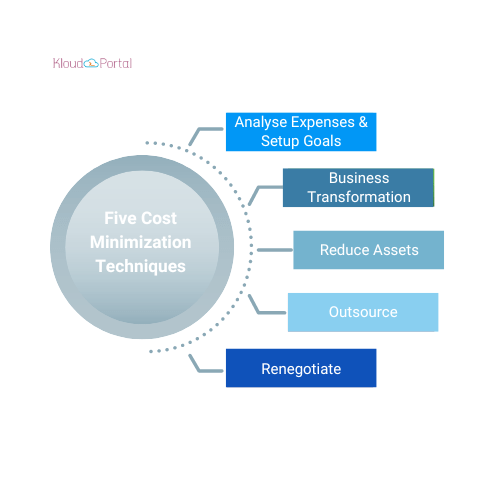
What are the five cost minimization techniques?

Below we discuss the five most effective cost minimization techniques that hugely impact your business profitability. So, let’s explore the different methods to help you grow efficiently.

  1. Analyse business expenses and setup realistic goals –Tracking business expenses will help control and maintain variable costs. Evaluating all the expenses data will help the company quickly identify the waste. Establish specific, clear, and realistic goals before looking at cost minimization. To measure progress and establish milestones, you can quickly see success.
  2. Business transformation – Digital technology has the benefit of increasing productivity and helping businesses turn into considerable long-term savings. Using digital technologies in all business areas creates new or modified operational processes. Therefore, help companies to meet changing culture or market requirements and customer experiences. Digital transformation also effectively helps businesses to improve revenue and efficiency by optimizing spending.
  3. Reduce “Real” or “Physical” assets –If you work in a big office, evaluate if you still need that big and rigid set-up. Virtual offices and co-working spaces can drastically reduce rental and office maintenance costs. Lockdown time has taught us to work both remotely and effectively. Other options would be to move to a more affordable area and incur lesser maintenance costs.
  4. Outsource –Another cost-cutting strategy would be to identify non-core, mundane, and repetitive work and assign them to external consultants and freelancers. This will reduce the cost and also helps you focus more on the more important aspects of running your business. It might be worth noting that much software like book-keeping, CRM, etc., reduces employee dependency and costs.
  5. Renegotiate –Negotiating with your suppliers and contractors to give further discounts is another way to reduce your overall costs. Asking your suppliers for incentives for early payments can reduce the overall costs. You can gain leverage with your suppliers if you indicate that you are looking for large orders or long-term relationships.

Wrap up

Adapting the right strategies is always essential to reduce costs as companies can drive their business forward with new affordable technologies.

  • Cutting costs increases revenue and improves small businesses bottom line.
  • To identify cost reduction, we should focus on the major elements such as Savings in production cost per unit. However, the quality of the product should also be focused on.
  • An essential factor in expanding your profit margin is to reduce business costs.
  • Make smart choices to deploy cost minimization.
  • Make accountability and transparency part of your cost-cutting strategy and part of your company’s operating structure to gain control over expenses.

At KloudPortal, we are focused on helping our customers with result-oriented marketing strategies. We also write curated articles to help our clients and industry experts acquire knowledge on the latest Marketing trends across all the industry segments. Now that you are here, why not check out our other articles [Virtual Influencers Who Are They & How Do They Work] & [Product Marketing Strategy For SaaS Startups]. If you would like to work with us for your marketing needs, please reach us here


1. Cutting costs

5 Major Benefits of Cloud Computing

5 Major Benefits of Cloud Computing

What we cover in this blog?

Cloud Computing is simply the technology that uses remote servers hosted over the internet called ‘Cloud’ to manage, process and store data instead of using the local servers.

Cloud computing has become growingly popular and widespread in recent years though it has been in the market for two decades. It is speedily becoming a necessity for organizations as it seems to save time and money, data security, and increase customer delight. Therefore, large portions of organizations are now turning to the cloud, weighing its benefits over traditional IT data centers and infrastructure.

Organizations need large storage to store data in databases. So, in the past, companies managed their servers, networks, and databases in a physical data center. But now, industries of all geographies are turning to cloud services. Cloud technology allows customers to access all features of the applications over the internet without having to keep the applications on their systems.

So, suppose an organization is planning or already using cloud services; in that case, it is vital to understand the basics and the benefits of cloud computing to make exclusive use of cloud-powered solutions. Cloud computing is of mainly four types – private, public, hybrid cloud, and community cloud. These cloud environments are deployed and defined according to the infrastructure and services needed.

Cloud computing services are broadly classified into four categories: platform as a service (PaaS), infrastructure as a service (IaaS), software as a service (SaaS), and serverless computing.

In this blog, you will discover the major advantages of Cloud Computing which will help reduce the maintenance cost
ofyour IT systems. So let’s explore!!

Major 5 benefits

Here are some of the benefits of Cloud computing we would like to share for you to consider.

Data security and quality control:

While adopting a cloud-computing solution, many organizations might have security concerns about how their data is being protected because all the data is kept onsite. Cloud offers data security more efficiently than a conventional system and has significantly advanced security features that ensure the data is securely handled and stored.The cloud environment is protected based on the category of cloud computing used in data centers.
Managing information is what the organization looks for, and the cloud’s ability to provide excellent data management is its most useful attribute. In a cloud-based system, data consistency is maintained and will have a clear record of any updates or updates.

Cloud computing is a necessity for organizations as it seems to save time and money, data security, and increase customer delight.

Cost reduction and efficiency:

Cloud Computing benefits are Cost savings. As it does not need any time and money on physical installations thus helps to reduce substantial costs. Cloud offers access to the latest services giving it a competitive edge over its competitors. Cloud applications allow faster deployment and quick service within a short time.

Reliability and increased collaboration:

Reliability is crucial for any business. Cloud uses its five design principles in the reliability pillar to create workloads that can consistently and optimally monitor the apps and software throughout their entire lifecycle.

Employee collaboration is a top priority in organizations. Cloud computing makes this point a simple process as team members can easily view and share information securely in the cloud platform. Some services connect employees across the organization by providing collaborative social media space, which increases interest and improves effective collaboration.

Storage and loss prevention:

Authentic cloud storage is more beneficial than traditional storage as it provides accessibility, easy sharing, and collaboration via the internet. The stored data is also easier to restore and back up when needed.

Loss of valuable data is a crucial part of the organization. Various reasons like viral infections, malfunction, or hardware deterioration lead to data loss if it is saved locally permanently. However, with a cloud-based server, all the uploaded information remains safe and easily accessible from anywhere with a broadband connection.

Mobility, agility, and flexibility:

Cloud allows easy and quick access to data for storing and retrieving information anytime or anywhere in the world over broadband. It ensures flexibility, easy accessibility, and scalability to businesses.
In cloud computing, the applications are rapidly developed, tested, and constantly launched in the changing environment. A cloud-based infrastructure is more flexible and increases the organization’s productivity by ensuring that data is always accessible using web-enabled devices such as laptops, smartphones, and notebooks.

Apart from the above major benefits, Cloud Computing has also some other advantages over traditional IT infrastructure, which include-

  • Web-based interfaces and control
  • On-Demand self-service
  • Always available
  • Provide you with low-cost software
  • Offers advanced online security
  • Allows pay-per-use
  • Fast and effective virtualization
  • API access available
  • Scales automatically adjust to the increase in demand
  • Multi-Tenancy
  • Location and device independence
  • Offers resilient computing

Takeaway

  • Cloud computing is a rapidly growing technology that almost every organization is switching to for growth and improving services.
  • Cloud services like Amazon Web Services (AWS), Microsoft Office 365, and Dropbox provide resources over the internet, including databases, servers, storage, networking, analytics, and software.
  • Clouds save businesses money, time, and other resources to maintain their IT infrastructure.
  • Cloud computing offers modern businesses advantages, including efficiency, flexibility, security, scalability, reduced costs, and increased collaboration.

At KloudPortal, we are focused on helping our customers with result-oriented marketing strategies. We also write curated articles to help our clients and industry experts acquire knowledge on the latest Marketing trends across all the industry segments.

Now that you are here, why not check out our other articles [ Content Marketing vs. Influencer Marketing: How to use both to achieve your marketing goals ] & [ Online Reputation Management (ORM) Services: What It Is & Why You Need] as well? If you would like to work with us for your marketing needs, please reach us here.
Contact us for more info.


1. Cloud Computing

Top 5 SEO trends of 2021 that are hard to ignore

Top 5 SEO trends of 2021 that are hard to ignore

Search engine optimization (SEO) is one of the effective ways of any marketing plan to improve traffic and attract users to your business. As SEO is constantly changing, sometimes it might be difficult to keep up with the latest Google search trends that boost rankings and improve your site’s visibility on the search engines. However, it is essential to be up-to-date, and the benefits are worth the effort.

Search engine optimization is a set of metrics for optimizing your website to drive more organic traffic, improve the visibility of your website and achieve high rankings in search engine results pages (SERPs). Good SEO practices increase the quality of your website by making it faster, user-friendly, and easier to navigate.

Top 5 SEO trends in 2021

In this blog, you will discover the list of top five SEO trends for 2021 to improve your website’s rankings on the search engine results page. Let’s have a look!

1. Boot up voice search

The SEO community is buzzing about voice search, which will enhance your chances of appearing in featured snippets. Over 27% of the entire global population uses voice search, and its popularity is increasing.

One of the key reasons for its popularity is the precision of voice transcription. The introduction of Alexa, Siri, Cortana, and smart speakers such as Apple HomePod, Amazon Echo, have also contributed to the increase in the popularity of voice search. Voice searches are often specific and long-tail keywords, so make sure that your content will tailor to the pure language.

Therefore, optimizing your content for voice searches would be the best strategy to succeed in the search results, which will continue to trend in 2021.

2. Dominate with Artificial intelligence

Another trend to consider is Artificial intelligence. Similar to most industries, AI is changing SEO as well. From Alexa to Siri, Artificial intelligence spreads everywhere, and it is the future. Personalization of AI provides the users with the focused content they are searching for. Many companies like Frase, HubSpot, and MarketMuse are providing AI-based solutions which help companies with their SEO efforts. So, AI is becoming a significant trend in the content marketing industry. AI-driven content will deliver the best results for the searched queries, such as AI-powered chatbots.

3. Courting Core web vitals for UX

Google introduced Core web vitals as a ranking factor in 2021 shows that incorporating page experience into your SEO is an increasingly important metric to improve your website’s performance, maintain search rankings ahead of the algorithm updates, and improve user experience and conversions.

Core web vitals are a set of metrics used for measuring the overall user experience on a website, such as interactivity, loading, page speed, and visual stability. Many popular tools like Lighthouse and PageSpeed Insights are dedicated to give more concrete recommendations for UX improvement and help websites better rankings.

4. Video marketing dominate the digital marketing

Video marketing dominates digital marketing in 2021

People like to watch a short video rather than reading a long page of written content. After Google, YouTube is the second most popular search engine with more than a billion users. Google recognizes this, so web pages with a video supporting written content will often appear on the first page of results.

So it’s high time to get started and optimize your video content using keywords to reach the targeted audience. Make sure not to overload the description with keywords but provide a user-friendly narration of your channel.

5. Visibility through local search optimization

Local SEO took a hit in 2020 because COVID-19 has encouraged people to rely on their smartphones to get nearby results. Therefore, over the past few months, local search has become increasingly important, and people started supporting small local businesses. Google has always supported searches related to local businesses by using ‘search near me’. Hence, Add your business information to local listings across multiple search directories for all your locations to improve your local search rankings.

Conclusion

The SEO performance of a website depends on many metrics. It is essential to implement the latest SEO trends while optimizing SEO to maintain your site’s rankings well in the SERPs.

If you are concerned about your website’s SEO or rankings, check out our SEO Strategy and Services. Our leading digital marketing agency is a one-stop solution for your multiple problems. Contact us today to get a quote on our SEO Services.

We use cookies to ensure that we give you the best experience on our website. If you continue to use this site we will assume that you are happy with it.

Cookies settings
Accept
Privacy & Cookie policy
Privacy & Cookies policy
Cookie name Active

Privacy Policy

What information do we collect?

We collect information from you when you register on our site or place an order. When ordering or registering on our site, as appropriate, you may be asked to enter your: name, e-mail address or mailing address.

What do we use your information for?

Any of the information we collect from you may be used in one of the following ways: To personalize your experience (your information helps us to better respond to your individual needs) To improve our website (we continually strive to improve our website offerings based on the information and feedback we receive from you) To improve customer service (your information helps us to more effectively respond to your customer service requests and support needs) To process transactions Your information, whether public or private, will not be sold, exchanged, transferred, or given to any other company for any reason whatsoever, without your consent, other than for the express purpose of delivering the purchased product or service requested. To administer a contest, promotion, survey or other site feature To send periodic emails The email address you provide for order processing, will only be used to send you information and updates pertaining to your order.

How do we protect your information?

We implement a variety of security measures to maintain the safety of your personal information when you place an order or enter, submit, or access your personal information. We offer the use of a secure server. All supplied sensitive/credit information is transmitted via Secure Socket Layer (SSL) technology and then encrypted into our Payment gateway providers database only to be accessible by those authorized with special access rights to such systems, and are required to?keep the information confidential. After a transaction, your private information (credit cards, social security numbers, financials, etc.) will not be kept on file for more than 60 days.

Do we use cookies?

Yes (Cookies are small files that a site or its service provider transfers to your computers hard drive through your Web browser (if you allow) that enables the sites or service providers systems to recognize your browser and capture and remember certain information We use cookies to help us remember and process the items in your shopping cart, understand and save your preferences for future visits, keep track of advertisements and compile aggregate data about site traffic and site interaction so that we can offer better site experiences and tools in the future. We may contract with third-party service providers to assist us in better understanding our site visitors. These service providers are not permitted to use the information collected on our behalf except to help us conduct and improve our business. If you prefer, you can choose to have your computer warn you each time a cookie is being sent, or you can choose to turn off all cookies via your browser settings. Like most websites, if you turn your cookies off, some of our services may not function properly. However, you can still place orders by contacting customer service. Google Analytics We use Google Analytics on our sites for anonymous reporting of site usage and for advertising on the site. If you would like to opt-out of Google Analytics monitoring your behaviour on our sites please use this link (https://tools.google.com/dlpage/gaoptout/)

Do we disclose any information to outside parties?

We do not sell, trade, or otherwise transfer to outside parties your personally identifiable information. This does not include trusted third parties who assist us in operating our website, conducting our business, or servicing you, so long as those parties agree to keep this information confidential. We may also release your information when we believe release is appropriate to comply with the law, enforce our site policies, or protect ours or others rights, property, or safety. However, non-personally identifiable visitor information may be provided to other parties for marketing, advertising, or other uses.

Registration

The minimum information we need to register you is your name, email address and a password. We will ask you more questions for different services, including sales promotions. Unless we say otherwise, you have to answer all the registration questions. We may also ask some other, voluntary questions during registration for certain services (for example, professional networks) so we can gain a clearer understanding of who you are. This also allows us to personalise services for you. To assist us in our marketing, in addition to the data that you provide to us if you register, we may also obtain data from trusted third parties to help us understand what you might be interested in. This ‘profiling’ information is produced from a variety of sources, including publicly available data (such as the electoral roll) or from sources such as surveys and polls where you have given your permission for your data to be shared. You can choose not to have such data shared with the Guardian from these sources by logging into your account and changing the settings in the privacy section. After you have registered, and with your permission, we may send you emails we think may interest you. Newsletters may be personalised based on what you have been reading on theguardian.com. At any time you can decide not to receive these emails and will be able to ‘unsubscribe’. Logging in using social networking credentials If you log-in to our sites using a Facebook log-in, you are granting permission to Facebook to share your user details with us. This will include your name, email address, date of birth and location which will then be used to form a Guardian identity. You can also use your picture from Facebook as part of your profile. This will also allow us and Facebook to share your, networks, user ID and any other information you choose to share according to your Facebook account settings. If you remove the Guardian app from your Facebook settings, we will no longer have access to this information. If you log-in to our sites using a Google log-in, you grant permission to Google to share your user details with us. This will include your name, email address, date of birth, sex and location which we will then use to form a Guardian identity. You may use your picture from Google as part of your profile. This also allows us to share your networks, user ID and any other information you choose to share according to your Google account settings. If you remove the Guardian from your Google settings, we will no longer have access to this information. If you log-in to our sites using a twitter log-in, we receive your avatar (the small picture that appears next to your tweets) and twitter username.

Children’s Online Privacy Protection Act Compliance

We are in compliance with the requirements of COPPA (Childrens Online Privacy Protection Act), we do not collect any information from anyone under 13 years of age. Our website, products and services are all directed to people who are at least 13 years old or older.

Updating your personal information

We offer a ‘My details’ page (also known as Dashboard), where you can update your personal information at any time, and change your marketing preferences. You can get to this page from most pages on the site – simply click on the ‘My details’ link at the top of the screen when you are signed in.

Online Privacy Policy Only

This online privacy policy applies only to information collected through our website and not to information collected offline.

Your Consent

By using our site, you consent to our privacy policy.

Changes to our Privacy Policy

If we decide to change our privacy policy, we will post those changes on this page.
Save settings
Cookies settings