A complete guide on Google’s page title update 2021

A complete guide on Google’s page title update 2021

Google has come back again with a new update called the page title update. Google’s Danny Sullivan has confirmed that Google is updating the way it creates page titles for SERPs. Our blog is a complete guide for you to know all about this update and how it works? So, let’s find out.

Users use one of the major approaches to determine which search results might be relevant to their query by examining the titles of listed web pages. Therefore, Google search makes great efforts to provide the best titles in search results to connect searchers effectively with the content produced by webmasters and publishers.

Hence, Google was displaying dynamic page titles in the SERP through minor adjustments based on the query issued. But now it has introduced a new system for producing titles regardless of the query.

What is Google’s Page title update and how it impacts SEO?
 

Google's page title update is dynamic and reciprocates to changes done to HTML tags


The page title tag reveals the search engine and the users about the nature of the information available on their web page. It is placed in the head section under the meta tag in HTML. The title tag is what customers can see in the SERPs above URL when searching for a query. Therefore, it is very important for improving SEO.

As we all know, Google has announced a new algorithm update to SEO experts which might encourage website owners and publishers to take a different approach while creating page titles to improve readability and increase the relevance in search results. In this case, a more relevant title will get more clicks.

With the new update, the Google search engine will no longer generate web page titles based on the query; instead, it will produce page titles that best suit all documents in general irrespective of what the user searches.

Ever since the new algorithm update is live in search results, the experts within the SEO community have extensively documented and observed that Google is indeed rewriting page titles by using other text on the page and Google’s Danny Sullivan has also confirmed this. He says that the new algorithm update is using more than HTML text to replace the page titles in instances when it considers a page’s HTML title tag doesn’t adequately describe the page.

Google reviews the other text contained in the page such as the header tags, H1 tags or main visual title on a page, and any other notable text throughout the content that users see when they visit the page. It may also consider the text within links. Sullivan further demonstrated that Google is rewriting title tags because often page title tags fail in describing a page’s topic well. They can be either stuffed with keywords, or too lengthy and sometimes contain no text or boilerplate text.

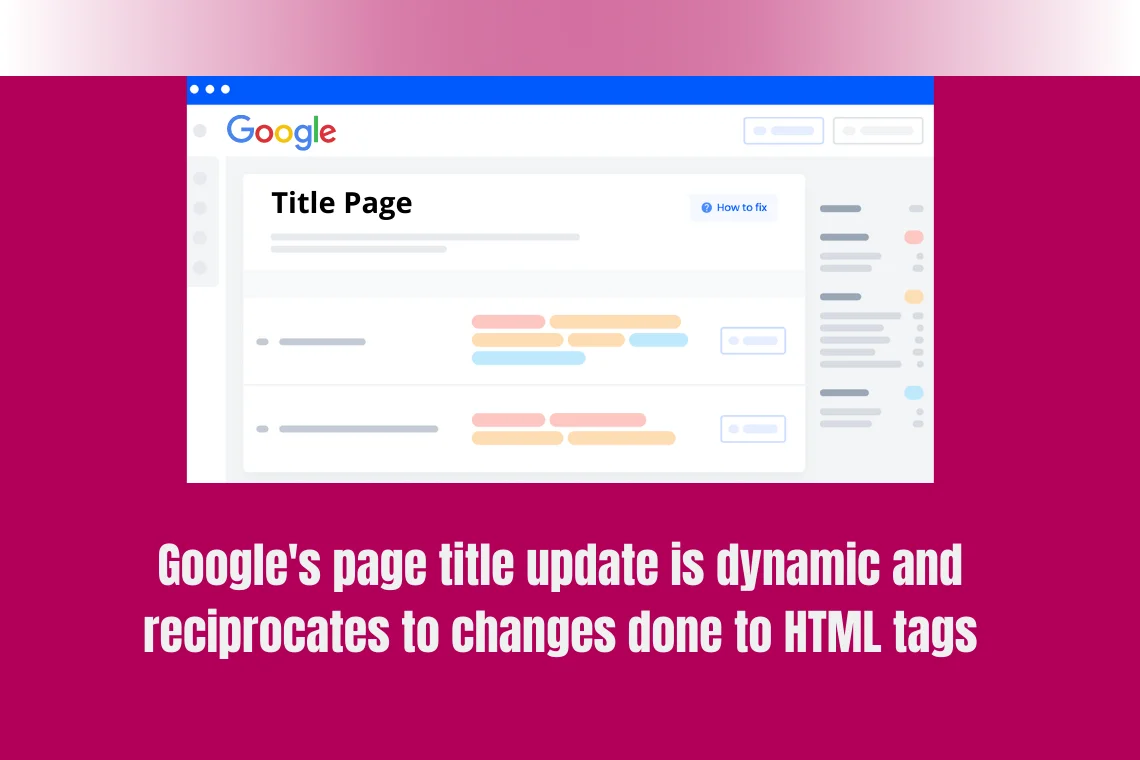
Thus, Google’s latest page title update is more dynamic and reciprocates to any changes done to HTML tags. It shows that even when you modify the HTML title tag of a page, Google will consider the updated text and react accordingly.

Can we opt out of this update?

There are no exceptions to Google’s new system and websites can’t opt-out of having Google rewriting their page titles. However, Sullivan proposes that Google should provide a feature in the Google search console for website owners to choose whether they want the search engine to replace their HTML title tags or not and can also have the option to retain a few of their original page titles.

Finally, Google believes that the new update creates titles that are easier to read and searchers would prefer the update over Google’s previous method of generating titles.

Conclusion

Although Google is considering a different approach to generate web page titles, webmasters should never conclude that optimizing HTML title tags is not worth it. 80% of the time the original HTML title tags will still be considered. So, webmasters should always focus on creating unique and optimized HTML titles.

If you are concerned about your website’s SEO or rankings, check out our SEO Strategy and Services. Our leading digital marketing agency is a one-stop solution for your multiple problems. Contact us today to get a quote on our SEO Services.

1. Page Title Update, Search Engine Journal 2. Using More Than HTML Text, Developers.google.com
5 ways in which third-party reviews can improve your SEO

5 ways in which third-party reviews can improve your SEO

The main goal of Google’s algorithm is to assess a website by measuring E-A-T that is Expertise, Authority, and Trust. Google reviews play a key role in measuring ‘T’ in E-A-T that is Trust. The positive reviews from real-life customers signal to Google that your business is trustworthy and thus eventually improve your brand image.

As per various studies, it is evident that third-party reviews play an immense role in improving search ranking and SEO efforts. In this blog, we will discuss the five ways in which third-party reviews are helpful for your SEO.

What is a third-party review?

A third-party review is a review presented on websites other than your website for example third-party review sites like Facebook, Google and Yelp which help customers to know your brand. These reviews are very useful because this allows customers to know your business, instils trust, and exhibits the credibility of your product or services.

Nowadays, consumers rely upon third-party review sites which offer invaluable insight from an unbiased perspective to evaluate the brand reputation and are also beneficial in attracting potential customers. Hence, it shows that a large number of positive and genuine reviews would bring on improved rankings on search engine results pages.


Positive and genuine third-party reviews can improve ranking


5 ways in which third-party reviews can be beneficial

  1. Reciprocate to both positive and negative reviews
  • Responding to both negative and positive reviews shows customers that you appreciate their feedback.
  • Use negative reviews as an opportunity to improve and win back that customer.
  • It is difficult to respond to every review. So, creating a corporate-approved template would be the best option.
  • Your responses to customers, send signals to Google that your business is actively escalating all reviews and you value your customers, which is great for your SEO strategy.
  1. Build on your review score

There are various approaches to enhance your overall review score for your business.

  • The first thing is to take a look at your business listing and optimize the items that need attention. This will improve your local search rank and site traffic thus leaving you with a higher review score.
  • Responding to all of your reviews makes the reviewer have a favourable view of your business which may lead to recommending your business to family or friends and thus improve sales.
  1. Emphasize the volume of reviews
  • High-quality, positive reviews from customers appear to be more trustworthy and will improve the business’s visibility that might also make the potential customer visit your location.
  • A solid review gathering strategy can help you bridge the gap of having too few reviews and can also help authorize your business with search engines.
  • The ideal way is to ask customers to leave their honest feedback regarding their experience but it is important not to violate any policies such as paying in exchange for reviews, disallowing negative reviews etc.
  1. Focus on review velocity
  • Review velocity refers to how often you get new reviews. A regular flow of new reviews provides your business with new content.
  • Customers also prefer to read new reviews to learn more about your business as they believe old reviews are no longer relevant.
  • Encourage happy customers to leave feedback by sending an email or a follow-up text to keep a steady stream of up-to-date reviews.
  1. Reckon with the content of your reviews
  • Google continuously relies on business information to deliver accurate and timely results to searchers. Some of that information may be obtained from the review content such as the location of your business etc.
  • Additionally, a review with positive language from a local customer sends signals to Google that your business is trustworthy.
  • Reviews on third-party platforms drive traffic to your website and increase exposure, credibility to your business.

Conclusion

Third-party reviews act as credibility standards for online businesses. They are less manipulated than reviews that are shown directly on your website. The quantity and frequency of third-party reviews are the most important local SEO signals that help determine the place of any business in their local SEO plan because more positive reviews will probably boost your business’s local ranking.

If you are concerned about your website’s SEO or rankings, check out our SEO Strategy and Services. Our leading digital marketing agency is a one-stop solution for your multiple problems. Contact us today to get a quote on our SEO Services.
1. Third-party review sites, Search engine journal
2. Reviews would bring on improved rankings, Theleverageway

5 common SEO myths you should know about

5 common SEO myths you should know about

Search engine optimization(SEO) is a set of rules for optimizing the website to achieve higher rankings and search visibility on the search engine results page. Every webmaster needs to understand SEO for the success of any online business. SEO helps website owners to perceive what users are searching for so that they can create quality content to satisfy their intent and get more traffic. Following good SEO practices make it easier for webmasters to increase the usability of a website and provide the right signals to search engine crawlers.

On the other hand, even today some SEO myths continue in the marketing industry tricking digital marketers, webmasters, and publishers as the need for SEO continues to rise. To ensure that you stay on track, here are the five most common SEO myths vs realities you should know about.

 SEO Myths Debunked

5 common misconceptions you should know about SEO

1.If you have optimized for Google, you don’t need to do for all other search engines

Myth: If the page content is optimized for Google then you don’t need to worry about optimizing for other search engines.

Reality: Google search comprises the highest share in the search market, however, Bing is improving steadily. If you are targeting 100% web traffic, then you should optimize your website for at least the top three search engines.

Unlike Google, Bing works differently and deserves your attention. So it is clear that if you optimize only for Google then it doesn’t mean that you are covered for other search engines like Bing.

2. Longer content boosts your SEO rankings

Myth: Create high-quality long-form content to improve search engine rankings or to rank well in search results.

Reality: Publishing timely, relevant and well-researched long content is great but it alone will not help you to get to the top of Google search results. As far as SEO is concerned, various other factors contribute to a high-quality website.

People consider in-depth content as valuable but in reality, most long content is not so valuable for the user. However, if you keep in mind a few tips like focusing on the user’s intent, experience and gaining quality backlinks then long-form content does rank well and can improve your traffic.

3. Repeating keywords is very important in SEO

Myth: We often hear that SEO is all about repeating targeted keywords frequently in the content to get noticed.

Reality: This is a myth that marketers hear the most but it is partly true. The SEO process involves other much deeper activities than just repeating the targeted keywords in the content multiple times to get noticed. Just repeating the keywords will not make your site rank higher as search engines no longer use search keywords alone to rank pages.

4. Social signals don’t affect rankings

Myth: Social signal is not a ranking factor and doesn’t impact your rankings

Reality: According to Google’s John Mueller social signals don’t directly impact your site rankings probably because social signals are easy to manipulate. But both Bing and Google use data from social networks to determine where to rank and how useful your site is. Social metrics play an essential role in bringing your brand on social platforms where you can get thousands of likes and shares which will increase your search traffic.

5. Google penalize for duplicate content

Myth: If you have content on your website that is duplicated elsewhere on the web then Google will penalize you.

Reality: Essentially, having content that is taken from another website might not help you outrank the other page. The search engines may determine the original copy that is more relevant to the search query and as there is no benefit of having both your site gets suppressed. Thus this is not a penalty but the algorithm doing its job. However, some other issues might land you in trouble if you don’t have the legal right to use that content.

Conclusion

In our blog, the most common SEO myths are debunked for you. SEO is a challenging and ever-changing process. Understanding the facts about SEO will help you to create a more effective and efficient SEO strategy for your website which in turn will boost your search rankings.

If you are concerned about your website’s SEO or rankings, check out our SEO Strategy and Services. Our leading digital marketing agency is a one-stop solution for your multiple problems. Contact us today to get a quote on our SEO Services.
1. Most common SEO myths, Neilpatel
2. High-quality long-form content, Search engine journal

A complete guide on broken links and ways to fix it

A complete guide on broken links and ways to fix it

Have you ever experienced a situation when you clicked on a link to visit a particular site but the page ended up with a 404 error message? These links are referred to as broken or dead links.

When users follow links from or to your website, they expect certain content to be available to them on the page but instead if they point to a page that cannot be found or no longer exists then it makes the user experience very unpleasant.

Therefore, it is essential to understand what broken links are and their impact on your SEO. Our blog is a complete guide that provides everything you need to know about broken links and the ways to fix them. So, let’s get started!

What are broken links?

Broken links, also known as dead links, are hyperlinks on a webpage to another webpage that is no longer accessible due to various reasons. Broken links can either be outbound links or internal links. Having excessive broken links on a website is often termed as ‘link rot’. There are various reasons why some links may no longer work, the common causes include:

  • The linked page does not exist anymore (error 404).
  • The webmaster incorrectly entered the URL address like misspelt or mistyped etc.
  • The external website has been permanently deleted and is no longer available.
  • The webpage access is restricted by the website owner.
  • The website may have server issues.
  • The webpage was moved but was not redirected to the new page.
  • The website is blocked by a firewall or any other similar software

Effect of a broken link on your SEO

Broken links will not impact your overall SEO but will affect your Google search results. When you have dead or broken links, it will cause low-quality search engine results and user experience. Therefore, your SEO rankings will lower and your website traffic might decline significantly. Hence, fixing broken links will help you retain viewers and boost traffic flow from search engine hits.

Let us see how to check for broken links on your website and repair them.

Tools used to find and fix a broken link

The simplest and best way to check for any broken links is through the Google search console. Once the Google bots have crawled your site, the search console will show any issues with your site including URLs of the broken links on your website but not external links.

It will be painful to check every single link on your website manually, so you can use any of the online tools available to monitor and check for broken links such as SEO pressor connect, Site checker, Semrush, Google analytics, W3C link checker etc.

If you don’t run a large site then you need to check your site each time you update or make any changes to your site. But if you run a large site with more external links, then there is a high possibility that a larger amount of broken links can be created, so you should check the entire website at least once a week.

Here are the fixes for broken links:

Few ways to fix broken links

  • Redirect (301) the broken webpage to the new page location.
  • If it is an external link, reach out to the linking website and request a fix.
  • Find out the broken page and replace the content at the broken URL.
  • Redirect the broken page to another relevant page on your site.

Conclusion

Broken links are not only annoying but also equally make the user experience unpleasant. When visitors stumble upon a broken link they wouldn’t like to continue to explore the other web pages of your site, therefore spending less time on the website will impact dwell time and can be harmful to your SEO rankings. Depending on the content you produce, dedicate time to check for any broken links at least once a month. User experience is an important factor for a successful website so make sure you avoid linking to broken content and also having broken pages on your site.

If you are concerned about your website’s SEO or rankings, check out our SEO Strategy and Services. Our leading digital marketing agency is a one-stop solution for your multiple problems. Contact us today to get a quote on our SEO Services.
1. Broken links, Iconquerors
2. Fixing broken links, Ahref

Top 3 non-core web vitals that act as page experience ranking factors

Top 3 non-core web vitals that act as page experience ranking factors

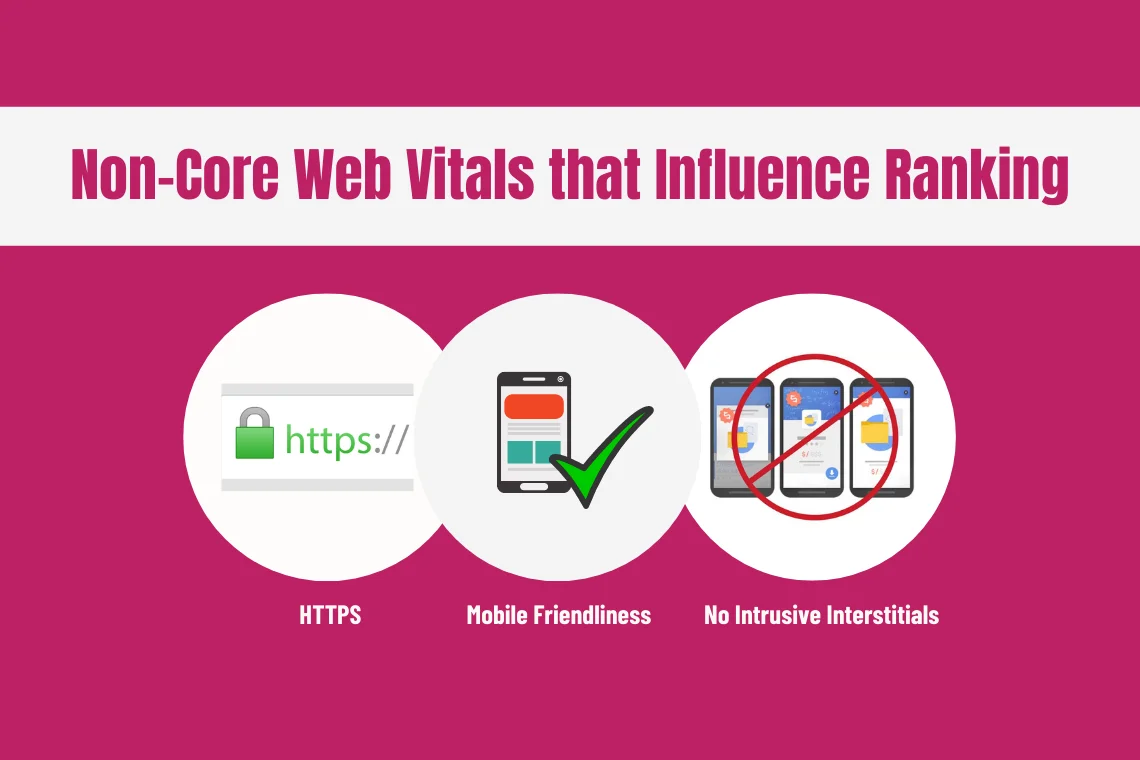
Page experience should be given a major thrust as it is integral in providing a seamless user experience. Thus, users are engaged more deeply and less likely to leave a website with a good page experience. To provide a holistic picture of page experience, core web vitals are incorporated with other existing page experience signals such as mobile-friendliness, intrusive interstitial guidelines and HTTPS security to further align with evolving user expectations. In this blog, we will discuss the basics of core web vitals and also how non-core web vitals impact SEO. Let’s dive in!

Core Web Vitals are a set of user-centred measures that help website owners evaluate key aspects of the user experience on the web. They measure elements of web usability related to speed, visual stability and responsiveness as the page loads.

According to Google page experience ranking factors are categorized into core web vitals and non-core web vitals. It recommends that webmasters and publishers should check the core web vitals and also must check whether their website meets all the non-core web vitals page experience factors to deliver a superior experience for their users.

Below are the top three non-core web vitals among the essential factors that provide users with an optimal user experience and also help in improving a site’s search traffic.


Non-Core web vitals that influences ranking


  • Mobile-friendliness

Mobile-friendliness is one of the essential factors to consider because in recent times most people are using mobile devices to surf the internet. Thus, developing a modern, responsive website design ensures that the site performs well on all devices.

Google suggests some tips to ensure a site is more compatible with mobile devices:

  • Make sure to set a minimum height and width for tappable elements like buttons, menu dropdowns, etc.
  • Ensure that the content ascends to the right size when users visit the website.
  • Optimised the site to create a smoother navigation experience for users.

Besides the Google recommendations, webmasters can also work on other parts of mobile-friendliness like removing outdated plugins such as Flash, checking if URLs meet the criteria using mobile-friendliness test tools, etc.

Along with the Google search console, while checking the entire website, it is best to use a mobile-friendly checker tool to manage how their content is displayed on the SERPs.

  • HTTPS security

A website that uses HTTPS secure protocol for sending and receiving information on the internet will have an additional authentication. Websites that collect sensitive data should always use HTTPS. HTTPS improves user’s overall security and privacy and thus it is a positive ranking factor for websites.

HTTPS security check is a direct and easy check. It checks whether a site uses HTTPS or not and a website that uses it will pass the check. In addition, it is essential to confirm thal rel=’canonical’ is set to the HTTPS version of the domain and also ensure that all non-HTTPS URLs are redirected to the HTTPS versions.

  • Absence of intrusive interstitials

This factor can also be referred to as an absence of annoying pop-ups. There is no tool to check but we can quickly assess if the website passes this check by examining whether the website has automated pop-ups or not. If the site has pop-ups then it has intrusive interstitials.

Google recommends that the website owners should avoid covering the overall content with ads or pop-ups irrelevant to the page. Also, the ads on the website should not interrupt the user from interacting and they need not dismiss an interstitial before they can interact with the webpage.

However, note that the below requirements are recognized as fine by Google and don’t apply to interstitials used for:

  • Cookies
  • Legal reasons like age verification
  • User logins
  • Subscription paywalls

Conclusion

Page experience is an important ranking factor for SEO. To reap the benefits of this ranking signal, all you need to do is simply make the web experience better for users. Google believes that the above-mentioned factors are fundamental to provide users with a superior user experience and to improve your SEO rankings.

If you are concerned about your website’s SEO or rankings, check out our SEO Strategy and Services. Our leading digital marketing agency is a one-stop solution for your multiple problems. Contact us today to get a quote on our SEO Services.

Durga

Durga

About The Author…

Durga has a master’s degree in engineering. Technological advances in digital space interest her a lot. Digital marketing is her forte and she passionately follows latest trends in the digital marketing space. She has written many trending articles on various social media platforms. Her areas of interest include SEO Optimization, structured data, SMM, Keywords research and analysis etc. She is focused, resourceful and dedicated.

We use cookies to ensure that we give you the best experience on our website. If you continue to use this site we will assume that you are happy with it.

Cookies settings
Accept
Privacy & Cookie policy
Privacy & Cookies policy
Cookie name Active

Privacy Policy

What information do we collect?

We collect information from you when you register on our site or place an order. When ordering or registering on our site, as appropriate, you may be asked to enter your: name, e-mail address or mailing address.

What do we use your information for?

Any of the information we collect from you may be used in one of the following ways: To personalize your experience (your information helps us to better respond to your individual needs) To improve our website (we continually strive to improve our website offerings based on the information and feedback we receive from you) To improve customer service (your information helps us to more effectively respond to your customer service requests and support needs) To process transactions Your information, whether public or private, will not be sold, exchanged, transferred, or given to any other company for any reason whatsoever, without your consent, other than for the express purpose of delivering the purchased product or service requested. To administer a contest, promotion, survey or other site feature To send periodic emails The email address you provide for order processing, will only be used to send you information and updates pertaining to your order.

How do we protect your information?

We implement a variety of security measures to maintain the safety of your personal information when you place an order or enter, submit, or access your personal information. We offer the use of a secure server. All supplied sensitive/credit information is transmitted via Secure Socket Layer (SSL) technology and then encrypted into our Payment gateway providers database only to be accessible by those authorized with special access rights to such systems, and are required to?keep the information confidential. After a transaction, your private information (credit cards, social security numbers, financials, etc.) will not be kept on file for more than 60 days.

Do we use cookies?

Yes (Cookies are small files that a site or its service provider transfers to your computers hard drive through your Web browser (if you allow) that enables the sites or service providers systems to recognize your browser and capture and remember certain information We use cookies to help us remember and process the items in your shopping cart, understand and save your preferences for future visits, keep track of advertisements and compile aggregate data about site traffic and site interaction so that we can offer better site experiences and tools in the future. We may contract with third-party service providers to assist us in better understanding our site visitors. These service providers are not permitted to use the information collected on our behalf except to help us conduct and improve our business. If you prefer, you can choose to have your computer warn you each time a cookie is being sent, or you can choose to turn off all cookies via your browser settings. Like most websites, if you turn your cookies off, some of our services may not function properly. However, you can still place orders by contacting customer service. Google Analytics We use Google Analytics on our sites for anonymous reporting of site usage and for advertising on the site. If you would like to opt-out of Google Analytics monitoring your behaviour on our sites please use this link (https://tools.google.com/dlpage/gaoptout/)

Do we disclose any information to outside parties?

We do not sell, trade, or otherwise transfer to outside parties your personally identifiable information. This does not include trusted third parties who assist us in operating our website, conducting our business, or servicing you, so long as those parties agree to keep this information confidential. We may also release your information when we believe release is appropriate to comply with the law, enforce our site policies, or protect ours or others rights, property, or safety. However, non-personally identifiable visitor information may be provided to other parties for marketing, advertising, or other uses.

Registration

The minimum information we need to register you is your name, email address and a password. We will ask you more questions for different services, including sales promotions. Unless we say otherwise, you have to answer all the registration questions. We may also ask some other, voluntary questions during registration for certain services (for example, professional networks) so we can gain a clearer understanding of who you are. This also allows us to personalise services for you. To assist us in our marketing, in addition to the data that you provide to us if you register, we may also obtain data from trusted third parties to help us understand what you might be interested in. This ‘profiling’ information is produced from a variety of sources, including publicly available data (such as the electoral roll) or from sources such as surveys and polls where you have given your permission for your data to be shared. You can choose not to have such data shared with the Guardian from these sources by logging into your account and changing the settings in the privacy section. After you have registered, and with your permission, we may send you emails we think may interest you. Newsletters may be personalised based on what you have been reading on theguardian.com. At any time you can decide not to receive these emails and will be able to ‘unsubscribe’. Logging in using social networking credentials If you log-in to our sites using a Facebook log-in, you are granting permission to Facebook to share your user details with us. This will include your name, email address, date of birth and location which will then be used to form a Guardian identity. You can also use your picture from Facebook as part of your profile. This will also allow us and Facebook to share your, networks, user ID and any other information you choose to share according to your Facebook account settings. If you remove the Guardian app from your Facebook settings, we will no longer have access to this information. If you log-in to our sites using a Google log-in, you grant permission to Google to share your user details with us. This will include your name, email address, date of birth, sex and location which we will then use to form a Guardian identity. You may use your picture from Google as part of your profile. This also allows us to share your networks, user ID and any other information you choose to share according to your Google account settings. If you remove the Guardian from your Google settings, we will no longer have access to this information. If you log-in to our sites using a twitter log-in, we receive your avatar (the small picture that appears next to your tweets) and twitter username.

Children’s Online Privacy Protection Act Compliance

We are in compliance with the requirements of COPPA (Childrens Online Privacy Protection Act), we do not collect any information from anyone under 13 years of age. Our website, products and services are all directed to people who are at least 13 years old or older.

Updating your personal information

We offer a ‘My details’ page (also known as Dashboard), where you can update your personal information at any time, and change your marketing preferences. You can get to this page from most pages on the site – simply click on the ‘My details’ link at the top of the screen when you are signed in.

Online Privacy Policy Only

This online privacy policy applies only to information collected through our website and not to information collected offline.

Your Consent

By using our site, you consent to our privacy policy.

Changes to our Privacy Policy

If we decide to change our privacy policy, we will post those changes on this page.
Save settings
Cookies settings