Top 5 SEO trends of 2021 that are hard to ignore

Top 5 SEO trends of 2021 that are hard to ignore

Search engine optimization (SEO) is one of the effective ways of any marketing plan to improve traffic and attract users to your business. As SEO is constantly changing, sometimes it might be difficult to keep up with the latest Google search trends that boost rankings and improve your site’s visibility on the search engines. However, it is essential to be up-to-date, and the benefits are worth the effort.

Search engine optimization is a set of metrics for optimizing your website to drive more organic traffic, improve the visibility of your website and achieve high rankings in search engine results pages (SERPs). Good SEO practices increase the quality of your website by making it faster, user-friendly, and easier to navigate.

Top 5 SEO trends in 2021

In this blog, you will discover the list of top five SEO trends for 2021 to improve your website’s rankings on the search engine results page. Let’s have a look!

1. Boot up voice search

The SEO community is buzzing about voice search, which will enhance your chances of appearing in featured snippets. Over 27% of the entire global population uses voice search, and its popularity is increasing.

One of the key reasons for its popularity is the precision of voice transcription. The introduction of Alexa, Siri, Cortana, and smart speakers such as Apple HomePod, Amazon Echo, have also contributed to the increase in the popularity of voice search. Voice searches are often specific and long-tail keywords, so make sure that your content will tailor to the pure language.

Therefore, optimizing your content for voice searches would be the best strategy to succeed in the search results, which will continue to trend in 2021.

2. Dominate with Artificial intelligence

Another trend to consider is Artificial intelligence. Similar to most industries, AI is changing SEO as well. From Alexa to Siri, Artificial intelligence spreads everywhere, and it is the future. Personalization of AI provides the users with the focused content they are searching for. Many companies like Frase, HubSpot, and MarketMuse are providing AI-based solutions which help companies with their SEO efforts. So, AI is becoming a significant trend in the content marketing industry. AI-driven content will deliver the best results for the searched queries, such as AI-powered chatbots.

3. Courting Core web vitals for UX

Google introduced Core web vitals as a ranking factor in 2021 shows that incorporating page experience into your SEO is an increasingly important metric to improve your website’s performance, maintain search rankings ahead of the algorithm updates, and improve user experience and conversions.

Core web vitals are a set of metrics used for measuring the overall user experience on a website, such as interactivity, loading, page speed, and visual stability. Many popular tools like Lighthouse and PageSpeed Insights are dedicated to give more concrete recommendations for UX improvement and help websites better rankings.

4. Video marketing dominate the digital marketing

Video marketing dominates digital marketing in 2021

People like to watch a short video rather than reading a long page of written content. After Google, YouTube is the second most popular search engine with more than a billion users. Google recognizes this, so web pages with a video supporting written content will often appear on the first page of results.

So it’s high time to get started and optimize your video content using keywords to reach the targeted audience. Make sure not to overload the description with keywords but provide a user-friendly narration of your channel.

5. Visibility through local search optimization

Local SEO took a hit in 2020 because COVID-19 has encouraged people to rely on their smartphones to get nearby results. Therefore, over the past few months, local search has become increasingly important, and people started supporting small local businesses. Google has always supported searches related to local businesses by using ‘search near me’. Hence, Add your business information to local listings across multiple search directories for all your locations to improve your local search rankings.

Conclusion

The SEO performance of a website depends on many metrics. It is essential to implement the latest SEO trends while optimizing SEO to maintain your site’s rankings well in the SERPs.

If you are concerned about your website’s SEO or rankings, check out our SEO Strategy and Services. Our leading digital marketing agency is a one-stop solution for your multiple problems. Contact us today to get a quote on our SEO Services.

7 biggest SEO keyword research mistakes that you should avoid

7 biggest SEO keyword research mistakes that you should avoid

What we cover in this blog?

Every web search begins with a keyword either by typing in the search box or using a voice search. The search engines will return the most relevant results based on the user query. Therefore, for creating a successful SEO for your website, it is essential to optimize your content with the right keywords. This helps to acquire a targeted audience for your site through search engines.

SEO Keyword research and its importance

SEO marketing campaigns kick start with the right keywords, hence keyword research in SEO is very important for boosting your rankings and search traffic. Keyword research means to discover words called ‘keywords’ that users will search in search engines to get relevant results from search queries.

A keyword is also termed as a search term and is the initial step for developing successful SEO for your business. It could be one or more words or phrases. Keyword research influences every task that you perform on your SEO, for example, on-page SEO, finding content topics, link building and content promotion etc.

For example, if you have chosen the wrong keywords that are not related to your content then this may misguide users thus lowering your overall rankings. Further, it will increase your site’s bounce rate and it may lead to losing potential users. Therefore, researching keywords helps you understand your target audience more effectively.

7 SEO keyword research mistakes to avoid

Check out these seven SEO keyword research mistakes that you should avoid for improving your SEO performance.

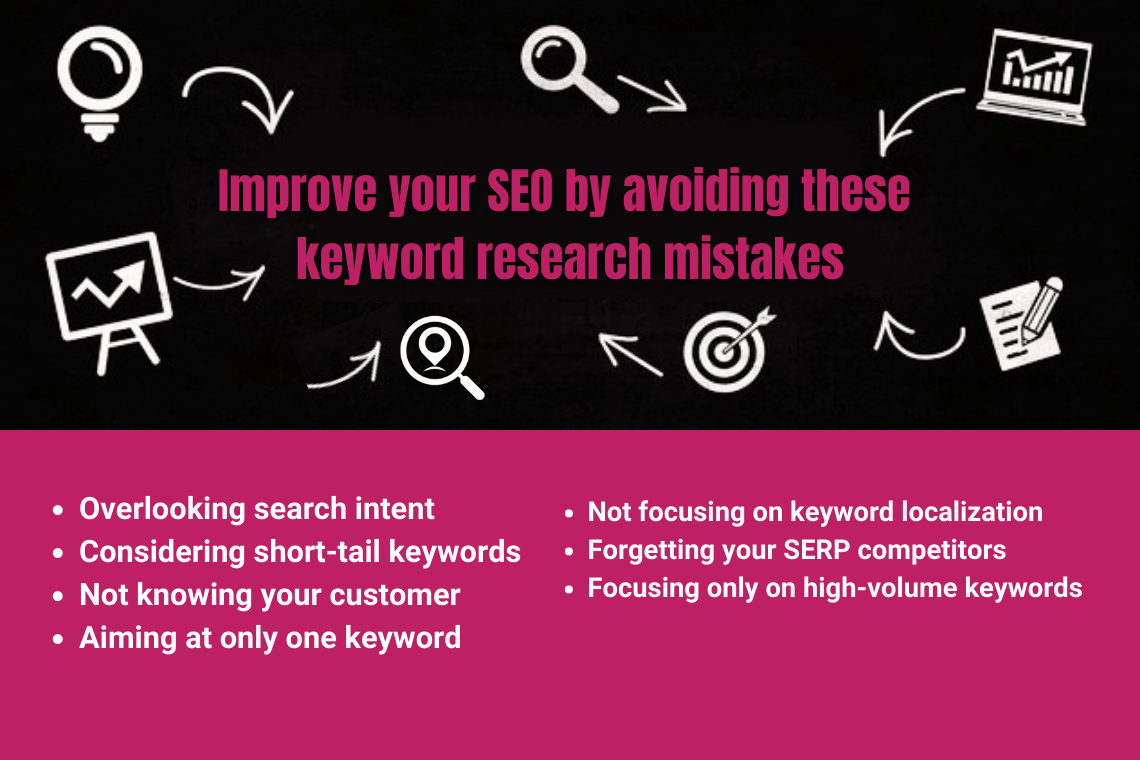
1. Overlooking search intent

User’s search intent is more important to optimize your content than focusing on how many users are searching a specific keyword. The keywords you use should be related to the intent of the people searching for that particular content. Understanding the audience will help you figure out what users are searching for to make your content the best option for them.

2. Considering short-tail keywords

Short-tail keywords are short, one-word keywords that are often initially used when discovering the content to write. However, focusing on short-tail keywords alone will result in poor results. Using more specific long-tail keywords ensures you cover a topic more widely and attract the audience with the content they will be more likely to convert.

3. Not knowing your customer

In any digital marketing strategy understanding your customer is one of the very first things you should do. Especially for keyword research, you should segment your customers by creating buyer personas. There are many other channels that users use as search engines.

Improve your SEO by avoiding these keyword research mistakes

Buyer personas help you to choose more targeted keywords and thus make your content more relevant to your customers. Pay attention to user’s different preferences.

4. Aiming at only one keyword

Working towards a single keyword could limit your reach as different users may phrase their search queries differently thus fail to rank for similar keywords. Frequently using the same keyword and optimizing for just one keyword could lower your SEO ranking. Instead of targeting one keyword, select the most searched key phrase, its synonyms and phrase them as related key phrases.

5. Not focusing on keyword localization

Keyword localization that is using keywords based on location, is necessary to improve the global success of a website. Customers in different locations do not use the same keywords when searching for a product. A strategic plan to localize your products or marketing campaigns can help you build a bridge to your targeted audiences and boost your brand in local markets.

6. Forgetting your SERP competitors

Analyzing competitor’s ranked keywords can help you determine the gaps in their current content that you could fill to boost your SEO ranking. It also gives you clues on what similar buyers are looking for and also lets you know current trends. Competitive research can also help in identifying the keywords you haven’t considered.

7. Focusing only on high-volume keywords

Targeting on high-volume keywords would often ignore user intent. These keywords are highly competitive and it’s tough to stand out using the same keywords as others. Start writing content for mid-volume keywords that match search intent and are easier to rank.

Conclusion

A lot of factors contribute to a site’s SEO success, of which the most important factor is keyword research. Successful keyword research takes effort and careful planning.

If you are concerned about your website’s SEO or rankings, check out our SEO Strategy and Services. Our leading digital marketing agency is a one-stop solution for your multiple problems. Contact us today to get a quote on our SEO Services.

An Ultimate guide to ‘Nofollow’ links

An Ultimate guide to ‘Nofollow’ links

Link building is undeniably a critical part of SEO, whether it is linking to your site or another website, it’s hard to build a successful link building strategy. High-quality backlinks pointing to your website brings in more traffic not only from the users who click on those links but also through search engines. Search engines consider the quality of these backlinks to measure the value of your website. Therefore, you should make sure you have the right kind of backlinks and understand for which links you should be using the nofollow tag on your website.

Here is the ultimate guide which will explain how nofollow links help with SEO, why it is essential to add a nofollow tag to your links and when not to use them?

What are nofollow links?

Nofollow links are hyperlinks that use the rel=’nofollow’ inside the anchored element in the HTML tag pertaining to them. Tagging a nofollow attribute to a link on your site indicates that you are specifying search engines that you don’t want to give any authority from your page to the linked site.

It is a fact that Google believes nofollow links as backlinks for websites. Therefore, linking to unreliable websites could affect the site rankings in the search results. Hence, we use the nofollow link tag to define that the link doesn’t have to be considered as a vote by the Google search engine.

In 2005, the nofollow link option was introduced to block comment spam. It is usually used for links that you didn’t want to pass PageRank. According to Google, links with nofollow tags do not pass PageRank thus they do not directly impact your rankings in search engine results pages but can be a great source of traffic and increase your brand exposure when users click through the link to visit your website.

For example, A link from Facebook will not directly increase your page rankings but could boost traffic through referral visits.

Which links should you consider as nofollow?

Here’s an example of links from the following types of content that we set to nofollow :

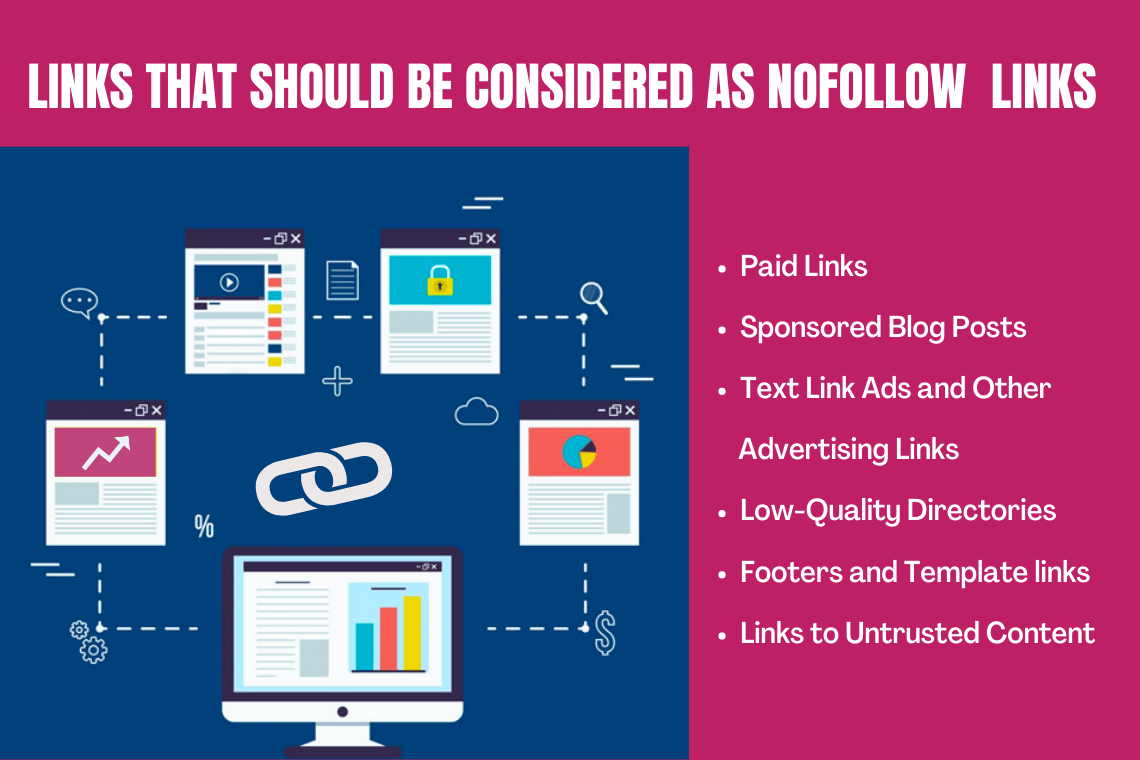
Links that should be considered as nofollow links

  • Social media
  • Press releases
  • Blog comments
  • Low-quality directories.
  • Sponsored or paid content
  • Footers and template links.
  • Auto-generated content
  • Widgets
  • Forum comments

Why should you use the nofollow link?

The nofollow attribute should be used for paid links, sponsored blog posts, text link ads, and other advertising links to make it clear to search engines like Google that they should not take any notice of that link. Also, any content that is considered untrusted should use the nofollow attribute for links.

How to use the nofollow link?

If you want to manually add a nofollow link attribute to links within the article, you need to modify the code. Go to your WordPress editor and switch to HTML post editor then click on ‘Text’ at the top right corner. Now find the link you want to make nofollow in the HTML post editor. Add a rel=’nofollow’ attribute.

You can check manually whether a link is nofollow or not by using a chrome extension that highlights nofollow links. In the Chrome browser, view the page source, search ‘a href’ and look for the links which contain the nofollow tag. To check nofollow links for a lot of pages use a plugin, the chrome extension will display all nofollow links in red.

Conclusion

Invest some time in understanding the basics of nofollow links and make sure you optimize your website’s backlinks properly. Remember that nofollow links can also boost your search traffic.

If you are concerned about your website’s SEO or rankings, check out our SEO Strategy and Services. Our leading digital marketing agency is a one-stop solution for your multiple problems. Contact us today to get a quote on our SEO Services.

1. Nofollow link option, Ahrefs
2. Nofollow attribute for links, Search Engine Journal
5 tips to use Interstitials without negatively impacting your SEO

5 tips to use Interstitials without negatively impacting your SEO

Nowadays interstitial advertisements have become the most popular advertisement format. Marketers started using them more often because of their high impression rate to increase CTR and revenue. Using the best practices while implementing interstitials, really do magnetize the customers. Let’s take a closer look.

What are interstitials?

Interstitials are pop-up content that appears before or after loading an expected content page. They usually appear at natural transition points to display advertisements or offers, age queries or information about the use of cookies and other information that are available to promote their services on the website.

Intrusive interstitials are spammy and non-responsive pop-ups that lower the page experience on your website. Therefore, Google considers pages with intrusive interstitials as not mobile-friendly and enforces penalties to websites providing a bad user experience to the users.

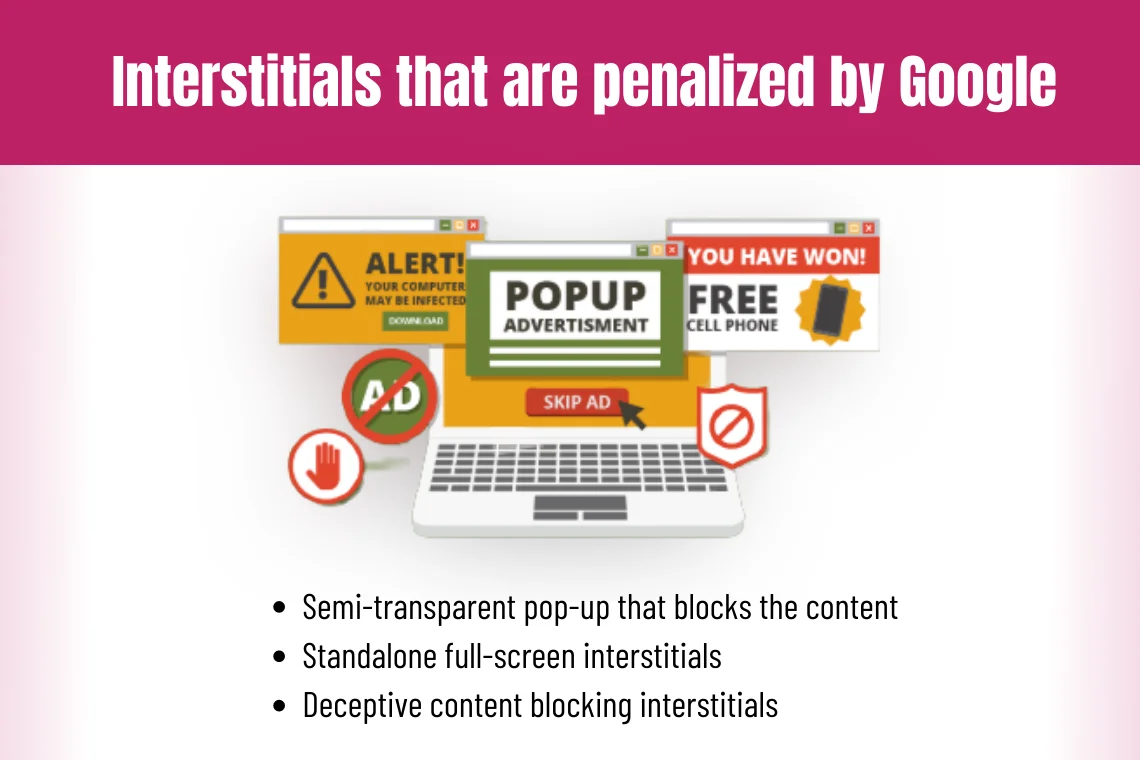
Let us check the intrusive interstitials that are penalised by Google:

Interstitials that are penalized by google

  • A semi-transparent pop-up that blocks the contents of the webpage
  • Standalone full-screen interstitials forcing the users to scroll up to see the content.
  • Deceptive content blocking interstitials that block all the content of a website.

So, if your site is riddled with intrusive interstitials that ruin the user experience then your page is liable to be penalised.

5 tips to use interstitials without affecting your rankings

Here are the five best practices that can help to make your interstitials effective without impacting your SEO rankings and boost search traffic.

1. Consider timed pop-ups

If it is necessary to continue to use interstitials then try to redesign them as less intrusive as possible. The primary thing you can change is the timing of every interstitial. Instead of displaying a pop-up every time a user accesses your site, plan it to show up at the scheduled time when the user finishes reading the content. Also, limit the display time of the pop-up such that it automatically closes after three seconds of inactivity. These timed interstitial ads are only as effective as your content.

2. Understand which interstitials are not be used

The term interstitial broadly means banners, pop-ups, modals and overlays that come up on web pages. They are usually categorized into informational and promotional ads. These interstitials can be useful, but some may cause user experience issues and affect how search engines crawl a website, but all interstitials are not intrusive. John Mueller advises that the interstitials triggered by exit intent, that don’t appear over the main content blocking the users to access the information are still allowed and these are possibly not targeted by penalty.

3. Interstitials on the desktop are still permitted

Some webmasters have come up with a solution with regards to the interstitial penalty, which is to retain intrusive pop-ups in the desktop version and hide them on all mobile platforms. There are many website plugins wherein they allow you to display intrusive pop-ups on specific platforms. However, it is better to turn away from using them since it lowers the user experience but if you cannot then look for other alternatives excluding intrusive pop-ups.

4. Use pop-ups on sources other than Google search results

Another option is to put pop-ups in web pages that can be accessed through sources other than Google search results. Note that incorporating one or two interstitials is ok, but filling the site with numerous pop-ups will eventually get your site penalized.

5. Check out for gray area interstitials

Google devalues the sites with too many intrusive advertising formats that are negatively impacting the overall experience of the users. So, you should avoid including ads such as classic interstitial ads, splash ads, new window pop-ups, and other intrusive ads that easily redirect visitors when clicking on them or difficult to close pop-ups. Avoid these grey areas to offer a positive user experience that will boost your rankings in search results.

Conclusion

Google’s objective is to make the websites more accessible and usable especially for mobile users. Therefore, if your popups serve a purpose then they will add value for the user but there are certain types of interstitials that are not tolerated by Google and might negatively impact your SEO. So, understand which interstitials are accepted.

If you are concerned about your website’s SEO or rankings, check out our SEO Strategy and Services. Our leading digital marketing agency is a one-stop solution for your multiple problems. Contact us today to get a quote on our SEO Services.

7 things that are not ranking factors for Google

7 things that are not ranking factors for Google

As we all know, Google uses more than 200 ranking factors in their algorithm to determine the position of a website on the Google search results page. In brief, some of the most important ranking factors that can help you improve your rankings are quality content, backlinks, user experience, page speed, mobile-friendliness, search intent, website security, keywords optimization, domain authority and so on.

So, you might wonder now out of these 200 ranking factors which factors are important for your website? As some are proven significant while some of the factors appear to be not so important. There are plenty of things connected with ranking factors that may not be considered ranking factors themselves. But, many website owners spend too much time or attention on them and do not get the expected results.

Therefore, in our blog, we’ve tried to explain why these non-factors are insignificant. So, here goes the list of seven things that are not ranking factors according to Google’s SEO experts.

1.Domain age and registration length

Domain age and registration length are not ranking factors

Firstly, domain age is not an SEO ranking factor. Even Google’s John Mueller has confirmed that it is not a ranking factor while responding to a Twitter user saying that ‘domain age helps nothing’. Usually, older domains are likely to get more signals that go into ranking as they build authority as the website gains backlinks from other websites and not the domain age that is important for its search ranking.

Similarly, no search engine has ever committed that they use registration length as a ranking factor in indexing.

2. Page content length

Does page content length impact your SEO? The answer is no. However, more useful, relevant content is effective but the minimum word count for improving SEO is nowhere mentioned in Google’s quality guidelines. Content is an integral part of SEO. It is not the content length but the quality of the content on-page that is important to rank better in search engines. The content length should be such that it can deliver the required message to the visitors or answer their queries.

3. AMP

AMP (Accelerated Mobile Pages) is completely different from page speed. It improves page speed, but it is not a part of the ranking algorithm. It gives mobile users a -fast, and more engaging experience. Google’s John Mueller has specifically confirmed that AMP is not a ranking signal but implementing AMP is beneficial for the mobile version of your website for greater visibility and extremely faster loading speed.

4. Social signals

Social signals are not a direct ranking factor. However, they are a powerful approach for the presence of your website in SERPs. The more users communicate, the greater is the level of awareness of your business and thus have an indirect impact on the SEO ranking.

5. LSI keywords

LSI (Latent Semantic Indexing) keywords are the keywords that are semantically linked to the main keyword. They help to add more context to the content and make it easier for both search engines and users to know what your domain is all about. It’s a myth that LSI is an important ranking factor for Google.

6. All caps in site URL

Google’s John Mueller also cleared that capital letters in URLs do not have any impact on its search ranking. Google also does not recommend using special symbols in the domain address. It considers URLs as case-sensitive and can create duplicate content issues if you don’t handle them properly and can hurt your SERP performance.

7. Pogo sticking

Pogo sticking is not a ranking factor but it acts as an indirect metric that impacts your ranking. It is an act of a user visiting your page and then clicking back to the SERPs immediately. It can be linked with factors like bounce rates, CTR and dwell time but doesn’t turn up to be a ranking factor in the Google algorithm.

Conclusion

To summarize, you can note that the factors mentioned in the blog are not directly important for Google but it does not mean that they can be completely ignored. Always optimize your site for users rather than for the search engines.

If you are concerned about your website’s SEO or rankings, check out our SEO Strategy and Services. Our leading digital marketing agency is a one-stop solution for your multiple problems. Contact us today to get a quote on our SEO Services.

1. Factors appear to be not so important., Search Engine Journal
2. Content Length, Semupdates

We use cookies to ensure that we give you the best experience on our website. If you continue to use this site we will assume that you are happy with it.

Cookies settings
Accept
Privacy & Cookie policy
Privacy & Cookies policy
Cookie name Active

Privacy Policy

What information do we collect?

We collect information from you when you register on our site or place an order. When ordering or registering on our site, as appropriate, you may be asked to enter your: name, e-mail address or mailing address.

What do we use your information for?

Any of the information we collect from you may be used in one of the following ways: To personalize your experience (your information helps us to better respond to your individual needs) To improve our website (we continually strive to improve our website offerings based on the information and feedback we receive from you) To improve customer service (your information helps us to more effectively respond to your customer service requests and support needs) To process transactions Your information, whether public or private, will not be sold, exchanged, transferred, or given to any other company for any reason whatsoever, without your consent, other than for the express purpose of delivering the purchased product or service requested. To administer a contest, promotion, survey or other site feature To send periodic emails The email address you provide for order processing, will only be used to send you information and updates pertaining to your order.

How do we protect your information?

We implement a variety of security measures to maintain the safety of your personal information when you place an order or enter, submit, or access your personal information. We offer the use of a secure server. All supplied sensitive/credit information is transmitted via Secure Socket Layer (SSL) technology and then encrypted into our Payment gateway providers database only to be accessible by those authorized with special access rights to such systems, and are required to?keep the information confidential. After a transaction, your private information (credit cards, social security numbers, financials, etc.) will not be kept on file for more than 60 days.

Do we use cookies?

Yes (Cookies are small files that a site or its service provider transfers to your computers hard drive through your Web browser (if you allow) that enables the sites or service providers systems to recognize your browser and capture and remember certain information We use cookies to help us remember and process the items in your shopping cart, understand and save your preferences for future visits, keep track of advertisements and compile aggregate data about site traffic and site interaction so that we can offer better site experiences and tools in the future. We may contract with third-party service providers to assist us in better understanding our site visitors. These service providers are not permitted to use the information collected on our behalf except to help us conduct and improve our business. If you prefer, you can choose to have your computer warn you each time a cookie is being sent, or you can choose to turn off all cookies via your browser settings. Like most websites, if you turn your cookies off, some of our services may not function properly. However, you can still place orders by contacting customer service. Google Analytics We use Google Analytics on our sites for anonymous reporting of site usage and for advertising on the site. If you would like to opt-out of Google Analytics monitoring your behaviour on our sites please use this link (https://tools.google.com/dlpage/gaoptout/)

Do we disclose any information to outside parties?

We do not sell, trade, or otherwise transfer to outside parties your personally identifiable information. This does not include trusted third parties who assist us in operating our website, conducting our business, or servicing you, so long as those parties agree to keep this information confidential. We may also release your information when we believe release is appropriate to comply with the law, enforce our site policies, or protect ours or others rights, property, or safety. However, non-personally identifiable visitor information may be provided to other parties for marketing, advertising, or other uses.

Registration

The minimum information we need to register you is your name, email address and a password. We will ask you more questions for different services, including sales promotions. Unless we say otherwise, you have to answer all the registration questions. We may also ask some other, voluntary questions during registration for certain services (for example, professional networks) so we can gain a clearer understanding of who you are. This also allows us to personalise services for you. To assist us in our marketing, in addition to the data that you provide to us if you register, we may also obtain data from trusted third parties to help us understand what you might be interested in. This ‘profiling’ information is produced from a variety of sources, including publicly available data (such as the electoral roll) or from sources such as surveys and polls where you have given your permission for your data to be shared. You can choose not to have such data shared with the Guardian from these sources by logging into your account and changing the settings in the privacy section. After you have registered, and with your permission, we may send you emails we think may interest you. Newsletters may be personalised based on what you have been reading on theguardian.com. At any time you can decide not to receive these emails and will be able to ‘unsubscribe’. Logging in using social networking credentials If you log-in to our sites using a Facebook log-in, you are granting permission to Facebook to share your user details with us. This will include your name, email address, date of birth and location which will then be used to form a Guardian identity. You can also use your picture from Facebook as part of your profile. This will also allow us and Facebook to share your, networks, user ID and any other information you choose to share according to your Facebook account settings. If you remove the Guardian app from your Facebook settings, we will no longer have access to this information. If you log-in to our sites using a Google log-in, you grant permission to Google to share your user details with us. This will include your name, email address, date of birth, sex and location which we will then use to form a Guardian identity. You may use your picture from Google as part of your profile. This also allows us to share your networks, user ID and any other information you choose to share according to your Google account settings. If you remove the Guardian from your Google settings, we will no longer have access to this information. If you log-in to our sites using a twitter log-in, we receive your avatar (the small picture that appears next to your tweets) and twitter username.

Children’s Online Privacy Protection Act Compliance

We are in compliance with the requirements of COPPA (Childrens Online Privacy Protection Act), we do not collect any information from anyone under 13 years of age. Our website, products and services are all directed to people who are at least 13 years old or older.

Updating your personal information

We offer a ‘My details’ page (also known as Dashboard), where you can update your personal information at any time, and change your marketing preferences. You can get to this page from most pages on the site – simply click on the ‘My details’ link at the top of the screen when you are signed in.

Online Privacy Policy Only

This online privacy policy applies only to information collected through our website and not to information collected offline.

Your Consent

By using our site, you consent to our privacy policy.

Changes to our Privacy Policy

If we decide to change our privacy policy, we will post those changes on this page.
Save settings
Cookies settings