
A business leader rarely walks into a technology meeting saying, “We need a new data architecture.”

They are more likely to say:

“Why does this report still take three days?”

“Why can’t our teams get a reliable view of the data?”

“We have an AI pilot. Why can’t we get it into production?”

Those questions start with business outcomes. But solving them often requires work across data, cloud, AI, applications and infrastructure. That is where the gap appears.

Business teams understand what needs to change. Engineering teams understand how technology works. When those worlds remain separated, technology investments can take longer to deliver value.

Forward Deployment Engineering brings those worlds closer together.

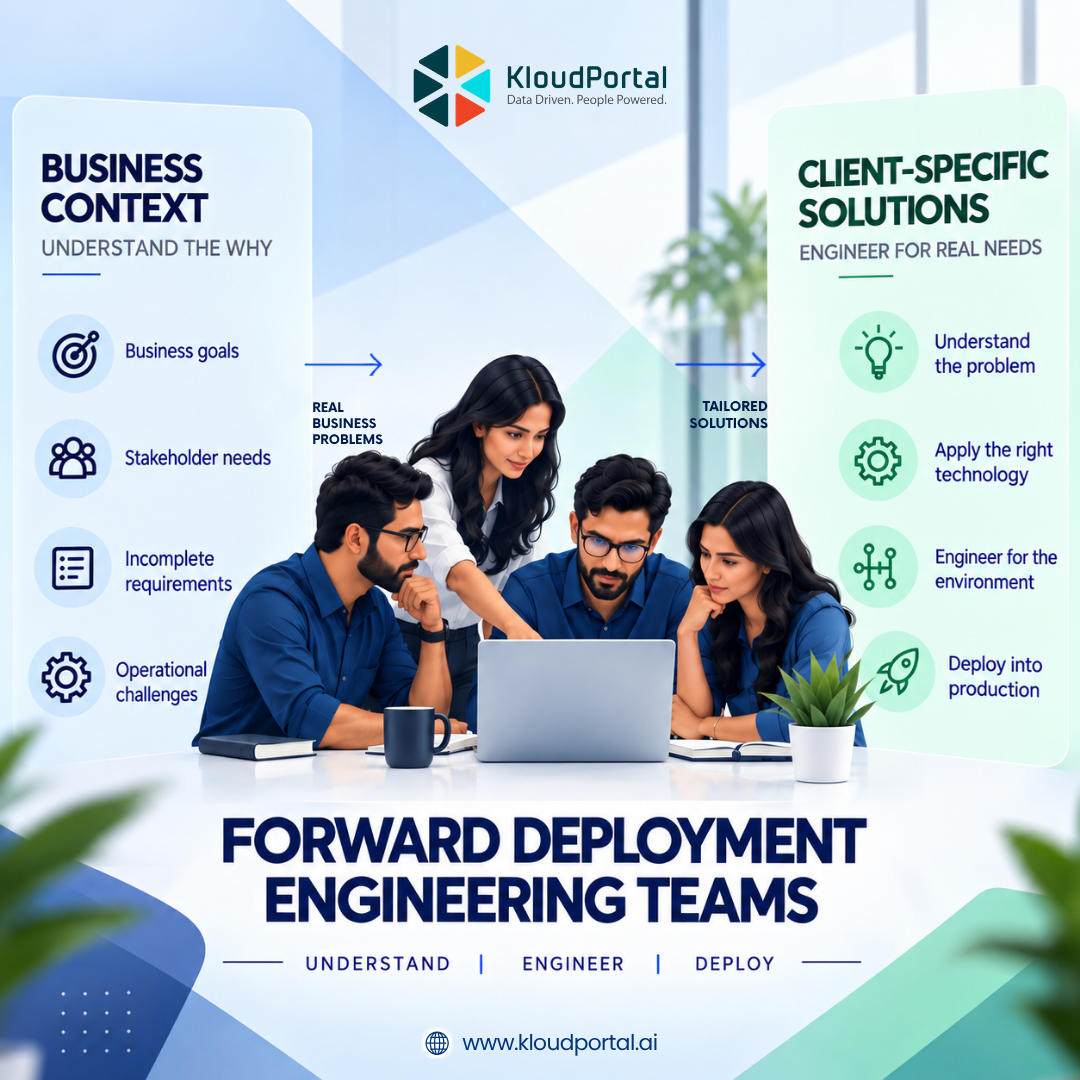
Forward deployment teams work close to the business problem, understand the environment and engineer around the organization’s reality.

The Real Problem Is Often Between the Requirements

Consider an enterprise trying to improve customer intelligence. The business wants a single, reliable view of customers. The technology team discovers customer information across CRM, ERP, operational databases and external applications.

Some data arrives in batches; other information needs to move in real time. Teams may even use different definitions for the same metric.

The original requirement—“give us better customer intelligence”—has now become a data integration, architecture, governance and engineering challenge.

This is where projects can slow down. The business understands the outcome, but the technical team must translate it into hundreds of engineering decisions.

A forward deployment team sits in that space.

Turning Business Language Into Engineering Decisions

A Forward Deployment Team moves between two conversations.

The business might say: “We need information faster.”

“We need information faster” becomes questions about ingestion, processing, architecture, latency, data quality and infrastructure.

When an approach isn’t practical, the team explains what that means for the business outcome. That translation cannot always happen through documents and handoffs. It often happens through continuous collaboration.

The team sees the workflow, examines the data, talks to users, identifies constraints and adjusts the architecture as new information emerges.

The result is a shorter loop:

Business Need → Technical Discovery → Solution Design → Engineering → Feedback → Production

Technology Should Follow the Business Problem

This approach also changes how technology decisions are made.

An enterprise may need Snowflake for a scalable data foundation, Databricks for data engineering or AI workloads, or Solace for real-time, event-driven requirements. But the starting point shouldn’t be the platform. It should be the problem.

The architecture might involve one technology or several. The important question is whether it fits the organization’s data, systems, workflows and operational requirements.

Modern data engineering therefore needs people who understand how technologies work together to produce an outcome.

The Engineering Capability Behind the Model

FDE also changes what organizations should expect from an engineering team. Technical expertise is essential. But it isn’t sufficient.

Engineers working in this model need to understand:

✓
Enterprise data architectures
✓
Cloud platforms

✓
Data pipelines and integration
✓
AI and machine learning workflows

✓
Security and governance
✓
Production operations

They also need to be comfortable with incomplete requirements, changing priorities and direct interaction with business teams.

This is why KloudPortal is building trained Forward Deployment Engineering and AI-native teams. The focus is on modern data, data pipelines, cloud, AI technologies and applying that expertise inside real enterprise environments.

The objective isn’t simply to provide engineers who know Snowflake, Databricks or cloud platforms. It is to provide trained engineering capability that can understand the problem, work within the client’s environment and take the solution towards production.

Why AI Makes This Even More Important

The business-technology gap becomes even more visible with AI. A prototype can demonstrate that an AI model or agent can perform a task. Production introduces different questions. logy industry.

u
  • What enterprise data should it access?
  • How should its outputs be evaluated?
  • What systems does it need to interact with?
  • What permissions should it have?
  • How should its actions be monitored?
  • Who owns the workflow when something goes wrong?

These are not questions a model alone can answer. They require data, application integration, cloud infrastructure, security, governance and AI engineering to work together.

AI-native teams therefore need to think beyond the model and turn AI capability into a reliable business workflow.

Why Forward Deployment Is Gaining Momentum in 2026

The industry is increasingly moving toward this model.

  • AWS launched a Forward Deployed Engineering program for partners in June 2026, describing a move toward embedded teams that put production AI systems into customer environments under real data and governance requirements.
  • Accenture has launched FDE programs with Microsoft, SAP and ServiceNow, with the stated focus on moving AI from experimentation and pilots into enterprise production.
  • OpenAI’s current FDE roles span discovery, technical scoping, system design, build and production rollout, with success tied to production adoption and measurable workflow impact.

Together, these developments point to a growing focus on engineering capability that connects technology to business execution.

From Technical Execution to Business Outcomes

A successful Forward Deployment Team should not be measured simply by headcount or how quickly code was written.

The better questions are:

  • Did the business problem get solved?
  • Did the workflow become faster or more reliable?
  • Did the data become usable and trusted?
  • Did the AI use case reach production?
  • Can the organization operate and extend the solution?
These are the measures that connect engineering work to business value.

At KloudPortal, this is the direction behind our Forward Deployment Engineering and AI-native teams: trained engineering capability deployed around real enterprise problems, with the technical depth to build and productionize the solution. The technology may be Snowflake, Databricks, Solace, cloud, AI or a combination.

Have a Business Problem to Solve?

Bring us the problem. We bring our trained engineering teams to build the solution.

Frequently Asked Questions

What is a Forward Deployment Team?

A cross-functional engineering team that works closely with a client to understand a business problem, design the solution and take it toward production.

How do Forward Deployment Teams bridge business and technology?

They translate business objectives into engineering requirements and validate the solution against real workflows with business and technical stakeholders.

How are Forward Deployment Teams different from staff augmentation?

Staff augmentation primarily adds technical capacity. Forward Deployment Teams are structured around solving a defined business problem and delivering a production outcome.

What technologies can Forward Deployment Teams work with?

Depending on the requirement, teams can work across Snowflake, Databricks, Solace, cloud platforms, data engineering, AI and platform engineering. The technology follows the business need.

Why are AI-native engineering teams important?

They combine AI expertise with data, cloud, application and production engineering capabilities, helping enterprises move AI use cases beyond prototypes into reliable business workflows.

We use cookies to ensure that we give you the best experience on our website. If you continue to use this site we will assume that you are happy with it.

Cookies settings
Accept
Privacy & Cookie policy
Privacy & Cookies policy
Cookie name Active

Privacy Policy

What information do we collect?

We collect information from you when you register on our site or place an order. When ordering or registering on our site, as appropriate, you may be asked to enter your: name, e-mail address or mailing address.

What do we use your information for?

Any of the information we collect from you may be used in one of the following ways: To personalize your experience (your information helps us to better respond to your individual needs) To improve our website (we continually strive to improve our website offerings based on the information and feedback we receive from you) To improve customer service (your information helps us to more effectively respond to your customer service requests and support needs) To process transactions Your information, whether public or private, will not be sold, exchanged, transferred, or given to any other company for any reason whatsoever, without your consent, other than for the express purpose of delivering the purchased product or service requested. To administer a contest, promotion, survey or other site feature To send periodic emails The email address you provide for order processing, will only be used to send you information and updates pertaining to your order.

How do we protect your information?

We implement a variety of security measures to maintain the safety of your personal information when you place an order or enter, submit, or access your personal information. We offer the use of a secure server. All supplied sensitive/credit information is transmitted via Secure Socket Layer (SSL) technology and then encrypted into our Payment gateway providers database only to be accessible by those authorized with special access rights to such systems, and are required to?keep the information confidential. After a transaction, your private information (credit cards, social security numbers, financials, etc.) will not be kept on file for more than 60 days.

Do we use cookies?

Yes (Cookies are small files that a site or its service provider transfers to your computers hard drive through your Web browser (if you allow) that enables the sites or service providers systems to recognize your browser and capture and remember certain information We use cookies to help us remember and process the items in your shopping cart, understand and save your preferences for future visits, keep track of advertisements and compile aggregate data about site traffic and site interaction so that we can offer better site experiences and tools in the future. We may contract with third-party service providers to assist us in better understanding our site visitors. These service providers are not permitted to use the information collected on our behalf except to help us conduct and improve our business. If you prefer, you can choose to have your computer warn you each time a cookie is being sent, or you can choose to turn off all cookies via your browser settings. Like most websites, if you turn your cookies off, some of our services may not function properly. However, you can still place orders by contacting customer service. Google Analytics We use Google Analytics on our sites for anonymous reporting of site usage and for advertising on the site. If you would like to opt-out of Google Analytics monitoring your behaviour on our sites please use this link (https://tools.google.com/dlpage/gaoptout/)

Do we disclose any information to outside parties?

We do not sell, trade, or otherwise transfer to outside parties your personally identifiable information. This does not include trusted third parties who assist us in operating our website, conducting our business, or servicing you, so long as those parties agree to keep this information confidential. We may also release your information when we believe release is appropriate to comply with the law, enforce our site policies, or protect ours or others rights, property, or safety. However, non-personally identifiable visitor information may be provided to other parties for marketing, advertising, or other uses.

Registration

The minimum information we need to register you is your name, email address and a password. We will ask you more questions for different services, including sales promotions. Unless we say otherwise, you have to answer all the registration questions. We may also ask some other, voluntary questions during registration for certain services (for example, professional networks) so we can gain a clearer understanding of who you are. This also allows us to personalise services for you. To assist us in our marketing, in addition to the data that you provide to us if you register, we may also obtain data from trusted third parties to help us understand what you might be interested in. This ‘profiling’ information is produced from a variety of sources, including publicly available data (such as the electoral roll) or from sources such as surveys and polls where you have given your permission for your data to be shared. You can choose not to have such data shared with the Guardian from these sources by logging into your account and changing the settings in the privacy section. After you have registered, and with your permission, we may send you emails we think may interest you. Newsletters may be personalised based on what you have been reading on theguardian.com. At any time you can decide not to receive these emails and will be able to ‘unsubscribe’. Logging in using social networking credentials If you log-in to our sites using a Facebook log-in, you are granting permission to Facebook to share your user details with us. This will include your name, email address, date of birth and location which will then be used to form a Guardian identity. You can also use your picture from Facebook as part of your profile. This will also allow us and Facebook to share your, networks, user ID and any other information you choose to share according to your Facebook account settings. If you remove the Guardian app from your Facebook settings, we will no longer have access to this information. If you log-in to our sites using a Google log-in, you grant permission to Google to share your user details with us. This will include your name, email address, date of birth, sex and location which we will then use to form a Guardian identity. You may use your picture from Google as part of your profile. This also allows us to share your networks, user ID and any other information you choose to share according to your Google account settings. If you remove the Guardian from your Google settings, we will no longer have access to this information. If you log-in to our sites using a twitter log-in, we receive your avatar (the small picture that appears next to your tweets) and twitter username.

Children’s Online Privacy Protection Act Compliance

We are in compliance with the requirements of COPPA (Childrens Online Privacy Protection Act), we do not collect any information from anyone under 13 years of age. Our website, products and services are all directed to people who are at least 13 years old or older.

Updating your personal information

We offer a ‘My details’ page (also known as Dashboard), where you can update your personal information at any time, and change your marketing preferences. You can get to this page from most pages on the site – simply click on the ‘My details’ link at the top of the screen when you are signed in.

Online Privacy Policy Only

This online privacy policy applies only to information collected through our website and not to information collected offline.

Your Consent

By using our site, you consent to our privacy policy.

Changes to our Privacy Policy

If we decide to change our privacy policy, we will post those changes on this page.
Save settings
Cookies settings