Webflow CMS vs. Ghost CMS vs. WordPress CMS

Webflow CMS vs. Ghost CMS vs. WordPress CMS

By Durga

Today, having a website is essential for both businesses and individuals in the digital landscape. Creating and maintaining a website can feel overwhelming, especially without coding knowledge. This is where a Content Management System (CMS) comes in as a lifesaver!

CMS has revolutionized how we build and manage websites. From personal blogs to complex e-commerce sites, a good CMS can make a significant difference in efficiency, functionality, and user experience. Among the myriad options available, Webflow, Ghost, and WordPress stand out as popular choices, each with its unique features and benefits.

Ready to pick the right CMS for your website? This blog will deep dive into Webflow, Ghost, and WordPress, which will equip you to make an informed decision. Let’s start!

Key Takeaways

  • Your choice of a CMS should align with your specific needs. Webflow is best suited for design-focused websites, Ghost is an excellent option for content-heavy sites, and WordPress provides extensive customization options for various website types.
  • All CMS options offer several advantages, including ease of use, scalability, cost-effectiveness, SEO-friendliness, and customization.
  • Each popular CMS has unique strengths. Webflow provides visual design tools, Ghost focuses on speed and performance, and WordPress offers a vast plugin library and extensive themes.

What Is A Content Management System?

Content Management Systems (CMS) have become game-changers. These software applications empower users to create, edit, and publish website content, all without needing to write a single line of code. With user-friendly interfaces that break down technical barriers, CMS platforms make website management accessible to everyone – from established businesses to passionate bloggers. This ease of use is why A CMS has become the go-to solution for anyone looking to build and maintain a strong online presence.

Why Do Companies Use CMS?

A Content Management System is essential for creating, managing, and modifying digital content without needing specialized technical knowledge. Here are a few reasons why companies opt for a CMS:

  • Ease of Use: A CMS offers non-technical users user-friendly interfaces to create and manage content efficiently.
  • Scalability: As businesses grow, their websites need to scale up. A CMS facilitates easy content updates and additions, ensuring the website evolves with the business.
  • Cost-Effective: Reducing the need for extensive technical support saves costs on development and maintenance.
  • SEO-Friendly: Most CMS platforms come with built-in SEO tools to help optimize content and improve search engine rankings.
  • Customization: With a variety of plugins and themes, a CMS can be customized to meet specific business requirements.
Why Do Companies Use CMS?

Why You Should Consider Webflow as a CMS?

Webflow is known for its robust design capabilities and versatile content management features. Here are some reasons to choose Webflow:

Visual Design Flexibility

  • Webflow offers a visual development platform that enables designers to create responsive and stunning websites without needing to write code.
  • Its intuitive drag-and-drop interface and pre-built components allow users to craft custom designs that are both aesthetically pleasing and highly functional.

CMS Collections

  • Webflow’s CMS Collections feature allows users to set up custom content structures, making it especially beneficial for websites that require dynamic content like blogs, portfolios, or product listings.
  • This functionality lets users manage and update content seamlessly without altering the design.

Hosting and Security

  • Webflow includes built-in hosting on a global network of servers, ensuring fast load times and high security.
  • This integrated approach simplifies site management and reduces the need for third-party hosting services.

Why Should Ghost Be Your Content Creation Ally?

Ghost is a streamlined CMS primarily focused on professional publishing. Here’s why it might be the right choice for you:

Performance and Speed

  • Ghost is built with modern technologies like Node.js, which ensures high performance and speed.
  • It’s optimized for delivering content quickly, making it ideal for content-heavy sites.

Markdown Support

  • Ghost supports Markdown, which simplifies content creation for writers.
  • Markdown presents a straightforward syntax for text formatting, enhancing the ease of composing and structuring text content.

SEO and Social Sharing

  • Ghost comes with strong built-in SEO features, such as automatic XML sitemaps, metadata management, and canonical tags.
  • It also supports social sharing cards, facilitating easy content sharing on social media platforms.

Why WordPress Fits Any Website

WordPress is globally the most popular CMS, powering many websites. Here’s why it’s a go-to choice for many:

Extensive Plugin Ecosystem

  • WordPress provides a vast collection of plugins that enhance its functionality.
  • Whether you need SEO tools or e-commerce solutions, there’s a plugin available for almost any feature you could require.

Themes and Customization

  • With thousands of themes to choose from, WordPress makes it easy for users to customize their site’s appearance.
  • Whether you need a simple blog or a sophisticated e-commerce site, there’s a theme that can be tailored to suit your requirements.

Community and Support

  • WordPress has a large and active community. This means extensive documentation, tutorials, forums, and professional support options are available, making it easier to troubleshoot and enhance your site.

Selecting the Right CMS for Growth

Choosing the right CMS depends on your specific needs and technical expertise:

  • Choose Webflow if you prioritize design flexibility and a visual development interface. It’s ideal for designers who want to create custom, responsive websites without coding.
  • Choose Ghost if you need a fast, performance-oriented platform focused on publishing. It’s perfect for bloggers, writers, and content-driven sites.
  • Choose WordPress if you require extensive customization options and a wide range of plugins. It’s suitable for almost any type of website, from blogs to e-commerce sites, especially if you prefer a more traditional CMS with robust community support.

Conclusion

Each of these CMS platforms – Webflow, Ghost, and WordPress – has its distinct advantages. Webflow excels in design capabilities, Ghost is notable for its performance and publishing focus, and WordPress is unique for its extensive customization options and supportive community.

To choose the best platform for your website, evaluate your requirements, technical skills, and the specific features you need.

Frequently Asked Questions (FAQs)

Which CMS is best for non-technical users?

Webflow and WordPress are great for non-technical users due to their user-friendly interfaces. Webflow offers a visual drag-and-drop interface, while WordPress boasts a huge variety of themes and plugins that simplify customization.

Can I use these CMS platforms for e-commerce sites?

Yes, all three CMS platforms can support e-commerce sites. WordPress has numerous e-commerce plugins like WooCommerce, Webflow provides e-commerce features within its platform, and Ghost, while primarily focused on publishing, can be extended for e-commerce with integrations.

Which CMS is the most cost-effective for small businesses?

WordPress is often considered the most cost-effective due to its open-source nature and the availability of free plugins and themes. However, the choice depends on specific business needs, as Webflow and Ghost offer different pricing models and unique features that might suit different requirements.

Driving Business Growth Through Effective Data Operations

Driving Business Growth Through Effective Data Operations

By Rasmita Patro

In the digital age, data is the new currency that drives market growth. Effective data operations are pivotal in harnessing the power of consumer data, analytics, and AI to make strategic decision-making that propel businesses forward. This comprehensive guide explores how integrating data into every facet of business processes can lead to increased customer happiness, optimized performance, and sustained competitive advantage.

This guide explores the components of effective data operations and their impact on market growth.

Key Takeaways

  • Effective data operations are not just a necessity, but a gateway to driving significant business growth.
  • Data is not just a collection of numbers, but a powerful tool that can be harnessed to improve customer satisfaction, optimize operations, and gain a competitive edge.
  • Data analytics drives better business decisions by optimizing performance, processes, risk, and resources.
  • The challenges associated with data operations can be effectively addressed, paving the way for a smoother and more efficient data operation.

Key Components of Effective Data Operations

Data has become the cornerstone of modern business operations. Businesses that efficiently handle and analyze data can obtain crucial insights, make calculated decisions, and stimulate growth.

  • Customer data: Collecting and managing client information helps businesses understand customer interactions, preferences, and behavior. This data is essential for tailoring products and services to meet customer needs and enhance satisfaction.
  • Data analytics: Data analytics involves examining datasets to uncover patterns, trends, and insights. It supports data-driven decision-making and strategic planning.
  • Data-driven decision making: Basing decisions on data analysis results in more precise and effective business outcomes, reducing risks and maximizing growth opportunities.
  • Key performance indicators (KPIs): Identifying and tracking KPIs allows businesses to measure performance against objectives, ensuring alignment with strategic goals.
  • Data quality: Ensuring high data quality is essential for accurate analysis and decision-making. Data must be complete, accurate, and reliable.
  • Data governance: Implementing data governance policies ensures data is managed and used responsibly, maintaining compliance with regulations and safeguarding data security.
  • Data visualization: Interactive dashboards and visualizations help key stakeholders understand complex data insights quickly, facilitating strategic decisions.
  • Data hub: Storing vast amounts of structured and unstructured data in a data hub enables flexible and scalable data analysis.

Finding the ideal best Digital Marketing Agency may seem daunting. However, our guide simplifies the process by tailoring recommendations to your unique requirements and objectives.

How Can We Use Data To Drive Business Expansion?

Data enables businesses to comprehend customer needs, streamline operations, and make educated decisions that drive growth.

  • Customer insights: Analyze data collection to identify preferences, buying patterns, and pain points. It allows for targeted marketing campaigns, personalized experiences, and the development of services that resonate with your audience.
  • Improved operations: Utilize data to streamline processes, identify inefficiencies, and optimize resource allocation. It leads to cost reduction, faster turnaround times, and more efficient new business models.
  • Data-driven decisions: Base strategic choices on data insights, not intuition. Data reveals business trends, competitor activity, and potential opportunities, leading to decisions that drive growth.
  • Predictive analysis: Statistical models to anticipate forthcoming consumer behavior and business trends. It enables proactive strategies for product development, marketing initiatives, and resource allocation.

Unleashing the power of data for business expansion? Look no further than partnering with the Best digital transformation company in Hyderabad to leverage data insights and optimize your online presence for local success.

Leveraging Data Analytics To Enhance Business Processes

Data analytics enables business professionals to enhance decision-making by optimizing performance, processes, risk, and resources. Utilizing data analytics allows businesses to proactively improve overall efficiency. The key areas include

  • Performance Measurement
  • Process Optimization
  • Risk Management
  • Resource Allocation
Strategies for Growth-Focused Data Operations

How Does Data Drive Business?

Data is the fuel that propels modern business. Data analytics unlocks valuable insights that drive company performance.

  • Customer Focus: Data allows for a deeper understanding of customer preferences and behavior. It enables businesses to become more customer-centric, leading to increased customer satisfaction and loyalty.
  • Competitive Advantage: Data-driven insights reveal industry trends, competitor strategies, and emerging markets. It enables businesses to stand out by providing inventive solutions and seizing emerging opportunities.
  • Informed Decision Making: Data removes guesswork from decision-making. Informed decisions are more likely to be successful, leading to improved business performance and achievement of strategic objectives.
  • Innovation: Data analytics helps identify customer needs and market gaps, fostering innovation in product development and service offerings, leading to increased business value.
  • Increased Efficiency: Data analytics streamlines processes, identifies inefficiencies, and enables data-driven resource allocation, leading to improved operational efficiency and cost reduction.
  • Enhanced User Satisfaction: Data analytics helps to personalize customer experiences, address pain points proactively, and develop products/services that meet their needs, leading to increased customer happiness and loyalty.
  • Improved Decision-Making: Data-driven decisions are more informed and strategic, leading to better outcomes and improved corporate performance across all areas.
  • Risk Mitigation: Predictive analytics helps identify and mitigate potential risks before they impact business processes, ensuring business continuity and financial stability.

Future Trends And Practical Applications In Data Operations

  • Artificial Intelligence (AI): AI and ML are set to have a substantial impact on automating data analysis, delivering deeper insights and strengthening predictive capabilities.
  • Data Integration: Integrating data from various sources will become increasingly important for comprehensive analysis and decision-making.
  • Advanced Data Visualization: Enhanced visualization tools will enable more interactive and intuitive exploration of data insights.
  • Increased Focus on Data Governance: As data privacy regulations evolve, businesses will need to strengthen data governance practices to ensure compliance and build trust.
  • Consumer Data Management: By maintaining comprehensive reference data, businesses can track customer feedback, preferences, and interactions to improve service delivery and satisfaction.
  • Data Analytics in Marketing: Utilizing data analytics for marketing strategies helps businesses understand consumer campaigns and their behavior to maximize marketing ROI.
  • Data-Driven Product Development: Using data to inform product development ensures that new products meet customer needs and preferences, enhancing market success.

Challenges

While effective data operations can drive business growth, several challenges may arise.

  • Data accuracy issues: Ensuring data accuracy and completeness can be challenging. Implementing robust data accuracy management processes can mitigate this issue.
  • Data protection concerns: Protecting sensitive data from breaches and unauthorized access is critical. Investing in advanced security measures and regular audits can enhance data protection.
  • Data integration complexities: Integrating data from disparate sources can be complex. Utilizing data lakes and advanced integration tools can streamline this process.
  • Skill gaps: The demand for skilled data analysts is high. Allocating resources to training and development initiatives can aid in bridging skill disparities.

Conclusion

Effective data operations are essential for driving business scaling in today’s competitive landscape. By harnessing the power of consumer data, data analytics, predictive analytics, and other key components, businesses can make strategic decisions, optimize operations, and stay ahead of market trends. As data continues to play a pivotal role in business strategy, investing in robust data management and analysis capabilities will be crucial for achieving long-term success.

FAQs

Q. How can I safeguard the security of my business data?

A: Cybersecurity is paramount. Implement robust security measures like access controls, encryption, and regular security audits. Partner with a reputable cyber security provider for additional expertise.

Q. How can businesses ensure data quality?

A: Businesses can ensure the quality of data by implementing robust data management frameworks, employing data scientists, and using advanced technology to manage and validate data sources.

Q. What role does AI play in data operations?

A: AI’s critical function lies in analyzing extensive data sets, delivering predictive insights, and automating tasks, thus boosting efficiency and underpinning novel business frameworks.

The Future Of Web Development: Trends And Innovations

The Future Of Web Development: Trends And Innovations

By Almaas Saleem

Websites may seem like a static collection of text and images; still, in reality web development is a constantly evolving field that is driven by innovation and the changing needs of users. New trends emerge all the time, influencing everything from user experience to security and shaping how we interact with the web.

Staying informed about web development trends is essential.

Today, we will explore the future of the web development domain in 2024, including the key advancements, technologies, and approaches that are shaping the digital world.

From emerging technologies to enhancing user engagement, we will cover everything to ensure you have a complete picture of what’s on the horizon.

Key Takeaways

  • Web development is evolving rapidly, responding to innovation and user demands.
  • AI and ML transform user experiences, predict behaviors, and automate tasks for efficient development.
  • Low-code/no-code tools empower non-coders, enhancing engagement and accessibility.
  • VR, AR, and the “metaverse” pose exciting possibilities but also challenges for future development.

The Evolution of Web Development

Imagine a world without instant access to information, where sharing ideas took weeks or months.

That was the reality before the invention of web browsers!

In the 1980s, Tim Berners-Lee saw a need for a better way for researchers to share information.

His revolutionary idea: ‘The World Wide Web.’

The early web was a simple place, mostly text and basic images. But it was the start of the revolution! People could finally access information quickly and easily from anywhere in the world.

This was a monumental shift, helping students to research without a library and businesses to connect with customers across borders.

Of course, it wasn’t all smooth sailing. People were unsure of this new technology. Was it safe? Could they trust the information they found online?

Learning to navigate web browsers felt like deciphering a new language. But slowly, people embraced the web. Businesses saw the potential to reach new markets, and individuals discovered a world of knowledge and connection at their fingertips. This journey of acceptance and adaptation is a testament to the web’s enduring impact.

The web continued to evolve, becoming more interactive and user-friendly. New tools like CSS and JavaScript started the era of responsive web design.

Remember those fancy blinking text greetings from the early 2000s?

Today, the web is an essential part of our lives. We use it for everything from shopping and banking to staying connected with loved ones and learning new skills.

But the story doesn’t end there! The web application is constantly changing, with predictive analytics and trends emerging all the time. The future of web development looks more exciting and promising!

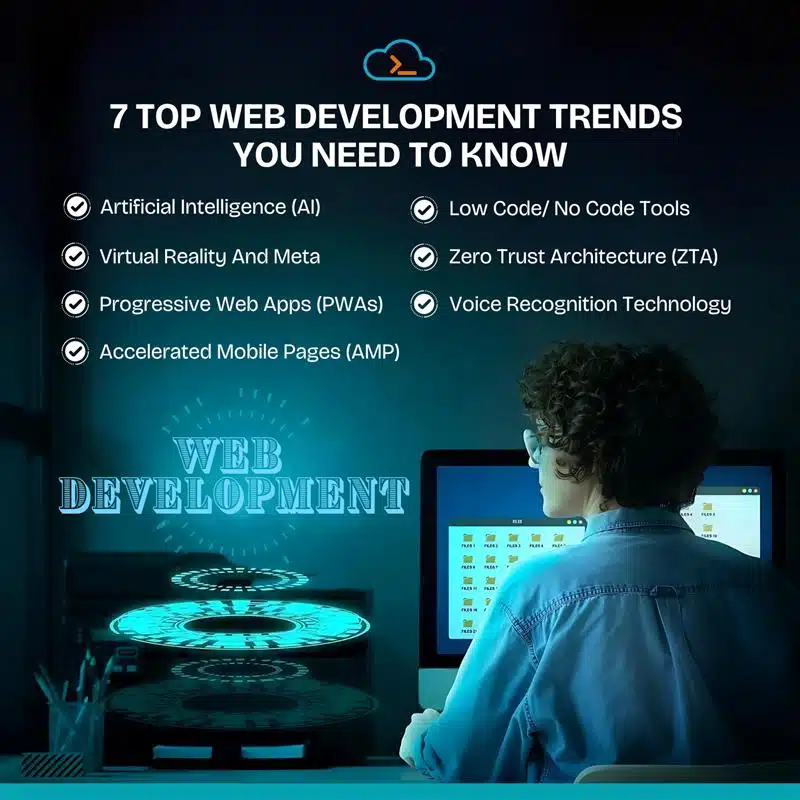
7 Top Web Development Trends You Need To Know

Artificial Intelligence (AI)

AI holds the power to transform web development by personalizing user experiences. But how did AI get so popular, and what does it really mean to create web applications?

The rise of AI is fueled by advancements in machine learning (ML), a subset of AI that allows computers to learn from data with minimal intervention. Imagine a website that learns your browsing habits and recommends products you’ll actually love or a bot program that can answer your questions in a natural, conversational way. That’s the power of machine learning in action.

We can expect to see even more sophisticated web and mobile applications that can personalize content, automate tasks, and create truly immersive web experiences.

Low code/ no code tools

Traditionally, building web applications requires complex coding knowledge. But what if there was a way to create powerful web app(s) and mobile apps without writing a single line of code? That’s the promise of low-code/no-code tools.

These web platforms use drag-and-drop interfaces and pre-built components, allowing anyone with a basic understanding of design and logic to build functional web development domains with great user interface(s).

Low-code/no-code tools have proven their versatility, being used not just for simple landing pages but also for server management. Their user-friendly nature makes them a boon for entrepreneurs, small businesses, and even citizen developers within larger corporations. This flexibility empowers businesses to have better web experiences.

Reach, engage, and convert your potential leads with our effective digital marketing services.

Virtual reality and meta

Virtual reality (VR) has long captured our imaginations, promising immersive experiences that transport us to fantastical worlds or recreate real-world scenarios.

Recent advancements in VR are changing the narrative. Meta (formerly Facebook) has stepped into the picture.

Meta has made VR and Augmented Reality (AR) a central focus, pouring resources into developing powerful VR headsets and software. Their vision is for VR to play a major role in the “metaverse,” a proposed future iteration of the internet helping to enhance user interaction and web accessibility.

Is VR an example of future web development? It’s too early to say for certain. VR offers exciting possibilities, but it’s important to remain aware of the challenges.

7 Top Web Development Trends You Need To Know

Zero trust architecture (ZTA)

Picture a website where security isn’t based on blind trust but on constant verification. That’s the core principle behind Zero Trust Architecture (ZTA), a rapidly growing trend in web development. Let’s break down what ZTA is and why it’s becoming increasingly important.

Traditionally, web security has relied on a perimeter-based approach. Think of it like a castle – once inside the walls (the network), users were generally trusted. However, this approach has vulnerabilities. If an attacker breaches the perimeter, they have free rein to access sensitive data.

ZTA flips this concept on its head. It assumes no user or device is inherently trustworthy, regardless of location. Every access attempt from any device is continuously verified before granting access to resources. This “never trust, always verify” approach significantly reduces the attack surface and provides enhanced security.

Progressive web apps (PWAs)

In today’s mobile-driven world, users expect a seamless and app-like experience when browsing websites on their phones. This is where Progressive Web Apps (PWAs) become superheroes.

PWAs are websites built with web technologies that offer easy controls and user experience of native apps without the need to download from app stores.

If a website loads instantly, even with a slow internet connection, a shopping site lets you add items to your cart even when offline. These are just some of the benefits PWAs offer users.

But why are they so important for web developers in 2024?

  • Limited reach: Not everyone downloads apps, especially for niche businesses or one-time use cases. Relying solely on a native app might restrict your potential user base.
  • Engagement hurdles: App download processes can be clunky, discouraging users from trying out your offering.
  • Installation friction: Updates for native apps require users to go through the app store, introducing a delay and potential user frustration.

Therefore, PWAs bridge the gap between websites and native apps, offering several advantages such as better user experience, high engagement”, “low development costs.

Voice recognition technology

As smart speakers and voice assistants like Google Home and Amazon Echo become more popular, users are increasingly comfortable using voice commands to interact with technology. This shift in user behavior presents a tremendous opportunity for web developers.

By incorporating VUI and voice search capabilities into websites, developers can create a more natural and intuitive user experience, especially for hands-free situations like cooking or driving.

Additionally, voice search optimization allows websites to be more discoverable through spoken queries, reaching a wider audience and boosting user engagement.

Craft compelling stories that drive results and grow your brand’s presence with our powerful content marketing services.

Accelerated mobile pages (AMP)

Forget waiting! Today, users have an attention span of just 3 seconds, and a slow mobile website is the kiss of death for engagement. This is where Accelerated Mobile Pages (AMP) come in as a knight in shining armor for web developers.

AMP optimizes website code and utilizes cached content to ensure blazing-fast loading times, even on unreliable connections. Consider your website on a mobile fitness program – it sheds unnecessary code and gets lean for peak performance. This translates to a happy user experience, keeping visitors engaged and exploring your content. With mobile browsing dominating the web landscape, AMP is a crucial trend for developers in 2024, ensuring your website remains optimized and keeps users happily clicking.

Looking Ahead With KloudPortal

With AI integration accelerating and innovative tools emerging, the future of web development promises a web experience unlike ever before. Get ready for a brighter digital landscape in 2024 with KloudPortal.

We build the future of your web presence. We craft websites using cutting-edge UI design and integrate the latest search engine optimization (SEO) strategies to ensure you shine online.

Frequently Asked Questions (FAQs)

What is innovation in web development?

Marketers need to be data-driven, creative storytellers, social media savvy, and adaptable to constant change.

What is the changing landscape in marketing?

Innovation includes things like using artificial intelligence to personalize user experiences or virtual reality to create immersive web applications.

Which web technology will be best for the future?

There’s no single “best” technology, as it depends on your project’s needs. However, some promising areas include:

  • AI & Machine Learning: Tailoring web browser content and enhancing user experiences using natural language processing.
  • Progressive Web Apps (PWAs): Web applications that feel like native apps, even without downloading.
  • Voice User Interfaces (VUIs): Controlling websites and searching with your voice.

What is the future of web development?

The future of web development will likely be:

  • More Intelligent: AI enables developers to automate tasks and build interactive websites.
  • More Immersive: VR and AR could create new ways to interact with web applications.
  • More Secure: New security protocols will help with cyber threats on social media platforms.

What is the trend of web development?

The latest web development trends include:

  • Low-code/No-code Tools: Making user-friendly websites and single-page websites, improving the mobile user experience.
  • Serverless Architecture: Ditch server headaches! Focus on your application’s logic while the cloud handles server setup, scaling, and content delivery networks. Think pay-per-use for website development.
  • Interactive Design: Move beyond static site generators! Engage users with animations, push notifications, and real-time data. Think quizzes, polls, and dynamic content management system(s) according to the evolving user expectations.
Product Led Growth: The SaaS Success Mantra

Product Led Growth: The SaaS Success Mantra

By Aparna Sushumna

Product-led growth strategy (PLG) is becoming a popular go-to-market (GTM) strategy for businesses that want to use their product as a primary growth driver. By prioritizing product and customer needs, SaaS companies can build a sustainable organic business mechanism that leads to a quick increase in their annual recurring revenue (ARR).

Product-led growth (PLG) strategy gives top priority to the product experience as the primary driver of business growth. In simpler terms, unlike sales-led, the PLG model relies on the product to be the main sales and marketing tool, which increases user adoption, engagement, and expansion.

As compared to traditional sales-led or marketing-led models, product-led companies achieve higher revenue growth rates and lower costs. Therefore, they have a better customer acquisition costs (CAC) payback.

Benefits of Product-Led Growth Strategy

Product-led only growth strategy is an incredibly powerful strategy as it allows you to transform your product into a marketing flywheel. This approach can help you drive product growth through word of mouth, which is one of the most reliable and scalable growth engines.

Additionally, it positively impacts all metrics without requiring you to implement a strategy for each one.

By reducing your customer acquisition costs (CAC), improving your annual contract value (ACV), and lowering costs for sales, customer support, and customer success, product-led growth can significantly benefit your business.

Importance of Product-Led Growth Strategy

A strong product experience is essential in the B2B customer journey as it can shorten sales cycles and improve customer retention. However, becoming product-led goes beyond just offering a free trial or a freemium trial of a product.

A business strategy, that is not only marketing-led growth, or strategy-led growth is called product marketing-led growth (PLG). This strategy can be highly effective for businesses with simple and affordable products that are easy to adopt.

In a PLG model, the focus is on designing a seamless user experience that helps users easily discover, adopt, and expand product usage. When users have a positive experience with a product, they become customers, resulting in faster decision-making and higher conversion rates.

A personalized onboarding process that presents all of the product’s capabilities is crucial to keep users loyal to the brand.

The PLG (product-led growth) method is a self-service onboarding approach, while the sales-led approach is an assisted product presentation.

PLG prioritizes customer experience, whereas sales-led prioritizes customer acquisition. This approach focuses on organic user growth, while sales-led approaches are proactive.

PLG is mainly suitable for larger markets, whereas sales-led is more suitable for enterprise businesses. Additionally, customer-led growth entirely relies on customer feedback.

Product-Led Growth for Saas

Product SaaS growth strategies–led growth is a strategy that allows SaaS companies to maximize product offerings by making it easier for users to discover product features and their use cases. This strategy leads to increased usage and revenue per user. However, it doesn’t mean that sales and marketing efforts are not necessary.

Product-led growth works in tandem with sales and marketing efforts, making it easier for new users to discover and get value from the product. With product-led growth, the product is the main driver of growth, and user onboarding serves as a product adoption flywheel that constantly pushes customers to discover more value from the product.

Benefits of Product-led growth strategies

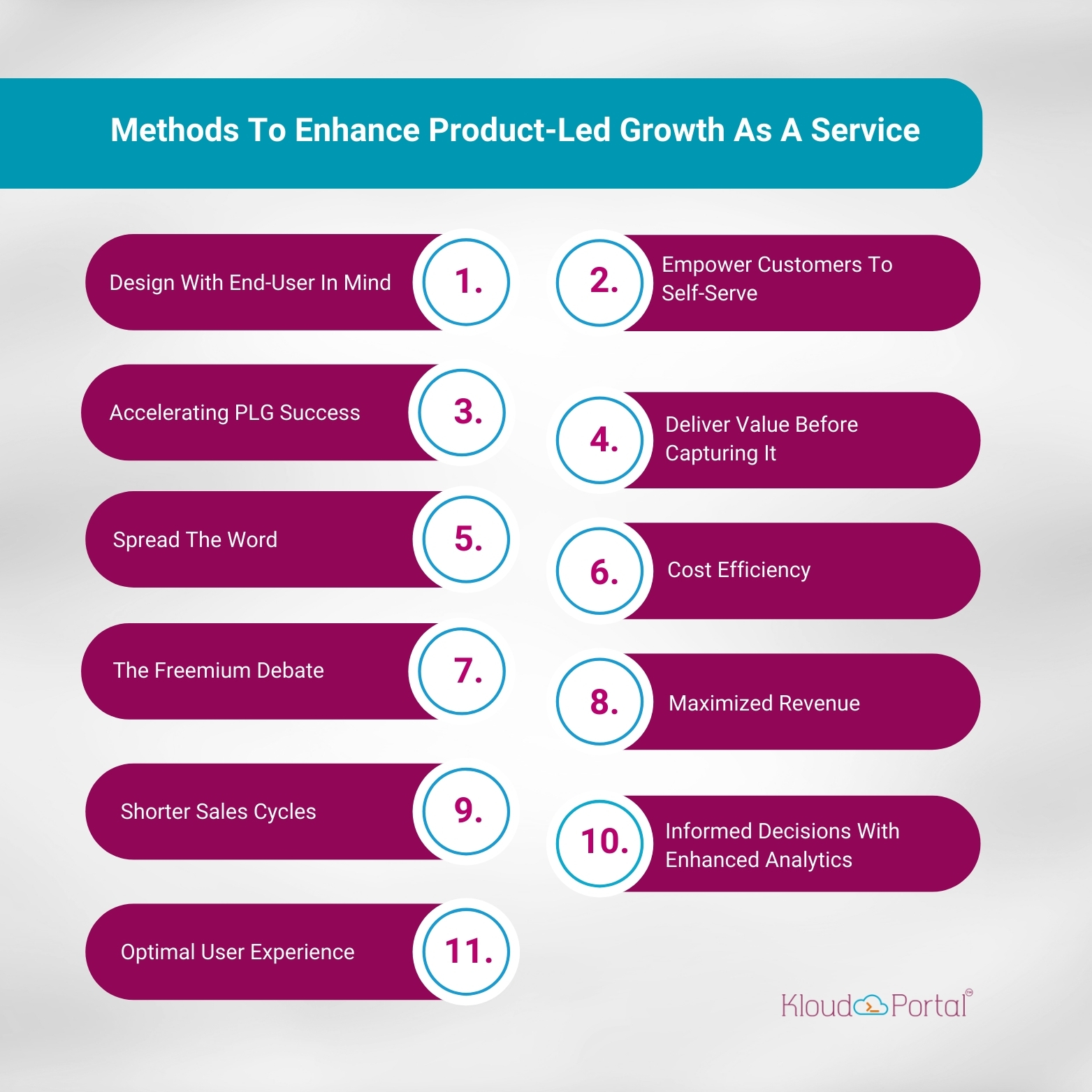
Methods To Enhance Product-Led Growth as a Service

Mentioned below are some key metrics and tactics that can enhance your PLG strategy.

Design with end-user in mind

Truly exceptional software products make companies connect with their users on a deep level. Software companies need to understand the desires of the users and create an intuitive product that meets their needs.

Additionally, a great product should empower its users, making them passionate advocates within their communities.

Empower customers to self-serve

Businesses can improve their user engagement, satisfaction, and adoption by using user relationships and simplifying every user engagement touch point from registration to product usage.

Accelerating PLG success

The PLG strategies increase product visibility, drive organic growth further, address the ongoing debate between freemium trials and free, and strengthen the self-service approach.

Attain all essential components of a successful PLG strategy under the assistance of the best SaaS product development agency

Deliver value before capturing it

A product-led strategy requires users to understand the value proposition of a product before making a purchase. This moment of realization is crucial in converting free users to paying customers.

Companies like SurveyMonkey and Grammarly excel in providing a great user experience and effectively drive growth using user feedback by highlighting the value proposition of their products in real-time.

Spread The Word

The power of virality can supercharge PLG results. While tools like Zoom are inherently viral, platforms like Dropbox harness virality through customer relationships and strategic features.

Providing exceptional customer experience can often transform satisfied customers into brand evangelists.

Cost efficiency

PLG prioritizes product over heavy marketing, resulting in exponential growth and lower customer costs. The approach highlights the important roles of sales representatives and marketing teams and maintains the sales team with agility.

The freemium debate

Freemium models have been a popular topic of discussion. According to OpenView’s data, the freemium model approaches are great for attracting new users with significant revenue growth. Still, they are not as effective as free trials when it comes to converting them to paid users.

However, when you consider the overall value delivery costs and efficiency, the freemium model often comes out on top.

Maximized revenue

By putting the product in the sales and marketing teams in the driver’s seat, the sales team members can optimize revenue per employee by focusing sales teams on specific roles.

Shorter sales cycles

By making the onboarding process self-serve and widening the funnel between product-qualified leads, sales reps, and marketing teams, PLG accelerates sales timelines, leading to product-qualified leads and faster conversions and scaling.

Informed decisions with enhanced analytics

PLG companies that collaborate with SaaS product development agency can use user feedback, engagement, and key metrics to improve their offerings continually, providing better end-user experiences and customer lifetime value and driving innovation.

PLG’s self-service option is one of the best ways to track user behavior and collect feedback.

Optimal user experience

Product-led companies cannot afford to neglect the user journey and experience. A superior user experience leads to loyalty, user satisfaction, positive referral sales, more sales, and a more streamlined monetization process.

Conclusion

When exploring the concept of Product-Led Growth (PLG), it becomes clear that placing the product at the center of customer acquisition, activation, and retention is an effective way to transform businesses.

The world of Product-Led Growth (PLG) is full of exciting innovations such as hyper-personalization, purpose-driven initiatives, and even augmented reality experiences that can be integrated into the PLG strategy. As businesses adapt and evolve, these trends can propel them to new heights in an ever-changing digital landscape.

The Benefits of Backlink Building for SEO and How to Do It Right

The Benefits of Backlink Building for SEO and How to Do It Right

By Almaas Saleem

Backlinks, inbound links, external links, and link building—they all revolve around the concept of having other websites link to yours. It might sound straightforward, but the reality is that link building is an intricate process with various considerations.

Imagine you run a SaaS company, utilizing your blog to share useful content about industry trends and software solutions. In this week’s blog post, you’re diving into the details of efficient project management within the SaaS Industry. To bolster your insights, you decide to include a backlink to a reputable project management resource from a renowned industry association. Your approach could be as simple as saying, “Explore more about project management efficiency here,” with a hyperlink to the phrase “project management efficiency.”

One crucial detail in crafting your internal links is ensuring they open in a new tab or window, providing a seamless user experience without diverting visitors away from your site.

Now that we grasp the essence of backlinks and their practical application, the question arises—why are backlinks important for our content strategy?

Great question! This article dives deep and answers all your queries regarding link building;

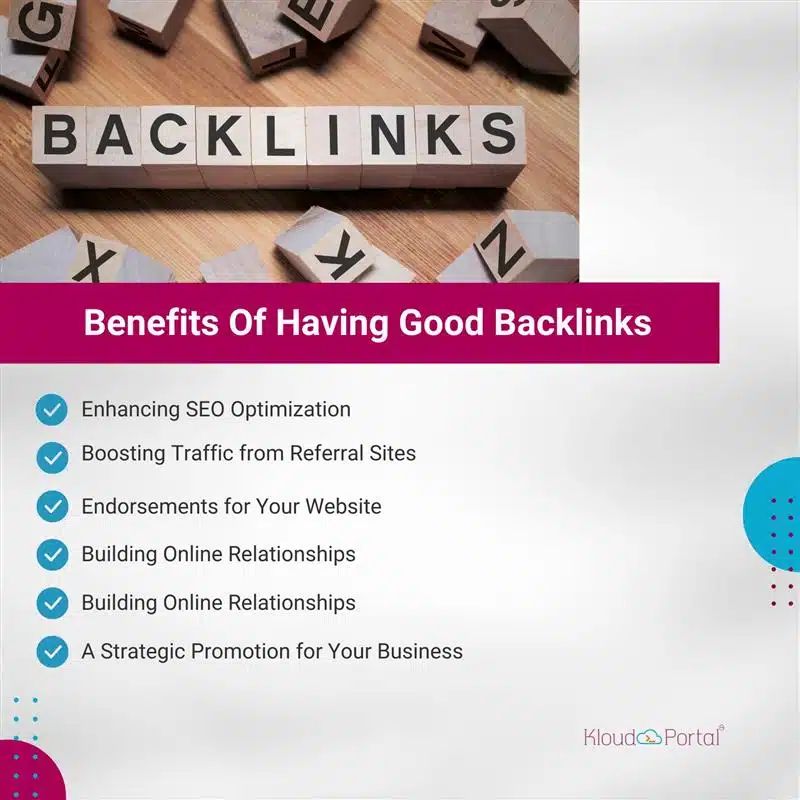
Benefits of Having Good Backlinks

Enhancing SEO Optimization

Backlinks act as strong indicators of quality for search engine optimization. When other websites are linked to yours, search engines consider it eligible for domain authority. This endorsement plays a pivotal role in elevating your website’s ranking, as search engines recognize the value of content that others deem worthy of sharing.

This two-way street of link building, whether to complement your quality content or direct users to more comprehensive information, is a key aspect that search engines consider when assessing website rankings.

Boosting traffic from referral sites

The more diverse and abundant your backlinks, the greater the opportunity for increased traffic from referral sites. It’s a straightforward equation: more quality backlinks equate to more referral traffic to your web page.

It not only enhances your online visibility but also reinforces the interconnectedness of content across search engines.

Endorsements for your website

Backlinks aren’t arbitrary; they act as endorsements for your website. Placing a high-quality link on your website is a strategic decision similar to vouching for the reliability and quality of the linked source.

This mutual endorsement between website pages builds a network of trust, indicating that the content on both ends is reputable and valuable.

Fostering trust and authority

The accumulation of endorsements from authoritative websites contributes significantly to building trust and authority for your business or brand.

As more reputable websites endorse yours and it climbs the Google search rankings, users are likely to trust your business, recognizing your brand as a credible authority in the industry.

Unleash unparalleled visibility with our expert strategies as the best enterprise SEO agency in India

Building online relationships

Backlinks go beyond being simple hyperlinks; they represent digital relationships between other website owners. By linking to or endorsing other websites, a transparent connection is forged, nurturing trust among users.

However, it’s crucial to avoid the misconception that a simple link exchange is beneficial; such practices can lead to penalties in the long run.

A strategic promotion for your business

High-quality links serve as a promotion for your business, offering consistent visibility across various online platforms.

Benefits of having good backlinks

Characteristics of Quality Backlinks

Before diving into the process of link building, it’s essential to recognize the characteristics of a high-quality backlink:

  1. Authoritative: Backlinks should originate from sites with high domain authority, like well-established brands and leading industry platforms. Links from low-quality or spammy sources can potentially harm your site’s reputation and overall SEO strategy.
  2. Relevant: Google prioritizes website links from websites within the same niche. For instance, if you run a web development site, a backlink from a tech site holds more value than one from a travel blog. Additionally, using relevant anchor texts enhances readers’ understanding of the link’s context.
  3. Dofollow: Dofollow backlinks are essential for effective link-building campaigns as they transfer link equity between web pages. In contrast, nofollow links don’t convey the authority of the referring domain, providing fewer SEO benefits for the site owner(s).
  4. Diversified Sources: Google values a variety of sources over sheer link quantity. It’s more beneficial to earn ten links from 10 different websites than to accumulate 100 links from the same source. This approach ensures a more robust and effective backlink profile for your website.

Transform your narrative with compelling Content Marketing Services – your key to organic traffic and audience engagement.

Seven Important Link Building Strategies

  1. Adopting competitors’ backlinks: Identify your competitors’ top-performing backlinks using SEO tools like Ahrefs or SEMrush. Reach out to the same high-authority websites, demonstrating why your content deserves a link too.
  2. Competitor Mentions: Track Their Buzz: Monitor where your competitors are mentioned but not linked. Politely approach those resource pages, proposing the addition of a link for more traffic. For instance, if a competitor is mentioned in a blog post, seek a link to your related content.
  3. Boosting link building with infographics: Create visually appealing infographics with target keywords related to your exceptional content. Share them on platforms like Pinterest or infographic directories, encouraging others to embed them in their articles and providing valuable link-building activity.
  4. Offer guest posting: Identify reputable blogs in your niche with the target audience in mind and offer to write guest posts. In your bio, include a guest blogging link back to your site. It not only provides quality site linking but also introduces your expertise to a new audience.
  5. Build a strong internal linking structure: Strategically link relevant pages within your website. For example, if you have a blog post about SEO tips, link to it from other web pages with relevant keywords like your homepage or service pages to enhance the overall site structure.
  6. Reach and promote your content across platforms:  Actively share your top-performing content on social media, industry forums, and relevant communities. These can attract attention, leading to organic link building as others discover and appreciate your valuable content.
  7. Broken link building for reputable websites: Utilize the search engine crawlers and on-page SEO to identify broken links on reputable websites in your niche using tools like Check My Links. Reach out to the site owners, suggesting your relevant content as a replacement, providing a win-win solution and earning a valuable backlink.

Conclusion

Backlink building remains one of the most powerful strategies in SEO, significantly influencing your website’s authority, visibility, and organic traffic. By securing high-quality, relevant, and diverse backlinks, you signal trust and credibility to search engines and users alike. Whether through guest posting, infographics, or broken link outreach, effective link building requires a strategic, ethical, and value-driven approach.

Remember, successful backlink building isn’t about quantity alone—it’s about quality, relevance, and long-term relationships. With the right tactics in place, you can elevate your website’s performance, drive sustainable growth, and build a trusted digital presence in your niche.

SEO Tips: How To Create Meta Descriptions That Attract Clicks

SEO Tips: How To Create Meta Descriptions That Attract Clicks

By Almaas Saleem

Meta description play a crucial role in the success of your web content. These concise snippets serve as your website’s virtual storefront, inviting users to click through and explore your page content. While meta descriptions may no longer be a direct ranking factor, they remain a critical element for enhancing your site’s performance on the web page.

In Google’s eyes, they are a vital link connecting your content with its intended audience using organic search. With a focus on user-centric principles, a compelling meta description has the power to increase your click-through rate, enhance your position on the search engine results page (SERP), and provide visitors with clear expectations.

In this article, we will delve into the art and science of creating compelling meta descriptions that attract clicks and drive SEO success.

Understanding Meta Descriptions

  • Meta descriptions are concise HTML code elements that offer a sneak peek under the page title.
  • They serve as a quick reference point for both search engines and users, providing a clear overview of your website or content.

The Role of Meta Descriptions in Search Engine Optimization (SEO):

  • While the direct impact of meta description and meta keywords on SEO rankings has waned since 2009, they are far from obsolete.
  • These snippets still play a vital role in driving click-throughs, as the user’s query relies on relevant information.
  • Consider meta description as a form of cost-free advertising, enabling you to engage, gain more traffic, and appear in search engine results pages.
  • The prominent position they hold in search results underscores the importance of crafting compelling meta descriptions to boost your website’s traffic.

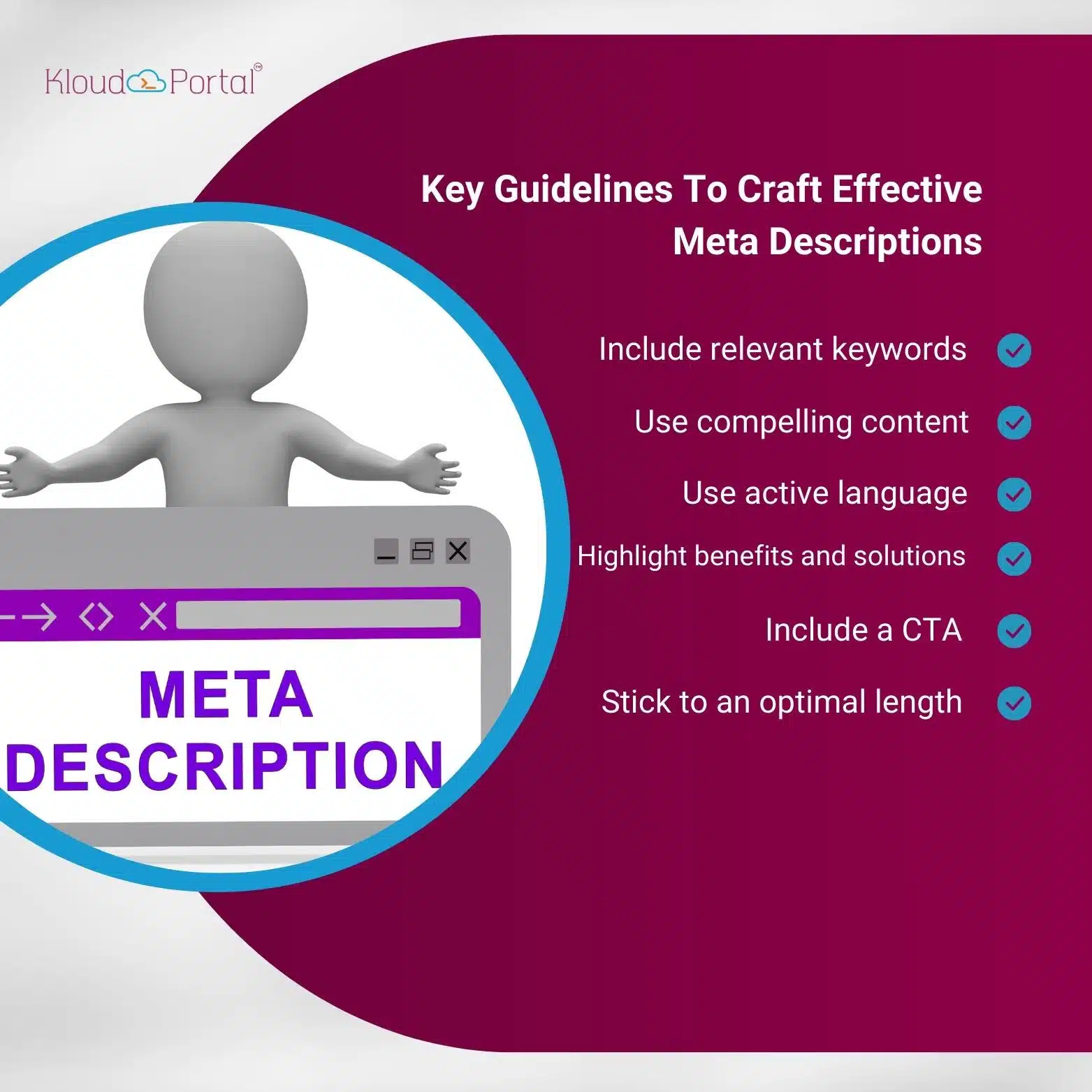
Crafting an Effective Meta Descriptions: Key Guidelines

When crafting your meta description, it’s essential to keep several key points in mind for better

Crafting Effective Meta Description

Five Amazing SEO Tips to Write Click Worthy Meta Description

1. Boost clicks with CTA and offering value proposition(s)

Crafting effective meta description for optimal click-through rates, you should consider this two-fold strategy:

  • Incorporate a compelling CTA (Call to Action): Boost user engagement by adding a persuasive call to action in your meta description. Phrases like “Click here,” “Learn more,” or “Shop Now” can motivate searchers to take that crucial step and click through to your site.
  • Highlight the value: Mere words won’t make users click; you need to make the users understand the value they’ll gain by visiting your site. Start by providing a clear description of what you offer so searchers can quickly determine if it’s worth exploring your content.
  • Strategy for higher CTR: For informative content, use words like “Learn,” “See,” or “Watch.” For products or services, emphasize words like “Best,” “Deal/Deals,” “New,” “Popular,” or “Packages.” This strategy ensures that the potential benefits entice users and are more likely to click through to your site, enhancing your click-through rates.

Elevate your content strategy with the best content marketing services.

2. A/B testing your meta description for impact

Enhance your meta description effectiveness through A/B testing. Create two variations for each page description, each with relevant meta descriptions. Analyze the Google Analytics data after a few weeks to identify which version garners more clicks. Use this data to craft page meta-descriptions that resonate with your target audience.

3. Creating a compelling meta description tag

Writing meta descriptions that are compelling and unique is a surefire way to capture the attention, entice readers, and drive action. You can achieve this by incorporating clickbait titles, thought-provoking questions, and different keywords that resonate with users. Additionally, using relevant keywords that accurately mirror your content, highlighting the unique attributes of your products or services, and addressing your audience directly with active language and engaging questions will further enhance the effectiveness of your meta descriptions.

Experience the impact of effective content marketing through our Digital Marketing Services.

4. Enhancing seo and user relevance through keywords

Incorporating one or two relevant keywords per phrase into your meta descriptions is essential for two key reasons:

  1. Improved search engine recognition: Including keywords aids search engines in comprehending the page’s content, leading to enhanced ranking opportunities.
  2. User reassurance: It reassures users that the page aligns with their specific interests and the information they seek.

It’s noteworthy that while Google doesn’t directly factor keyword meta tags into its rankings, this practice remains valuable for enhancing the user experience by aligning your content with their expectations. Remember to vary the keywords used in meta descriptions across different pages to ensure your content appears in a broader range of relevant searches.

5. Avoid duplicate meta descriptions

Ensure each page on your website has its unique meta description. It helps search engines, and audiences understand what each page is about and how it’s different from the others. Duplicate content not only hinders meta description crawlers but also confuses internet users. For instance, if users encounter the same meta descriptions across every page of your website, they won’t have a clear idea of the webpage’s content.

This practice becomes especially vital for e-commerce sites with multiple pages featuring similar content. Even if the products are similar, having exceptional meta descriptions is essential to provide users with distinct information on different pages.

Conclusion

So far, we have learned how meta descriptions play a crucial role in your onsite SEO efforts. They should be not only concise but also captivating, descriptive, and tailored to each page for better Google search ranking.

To make the most of this, remember to include unique meta descriptions on every page content of your website, whether it’s a blog post or a product page. By doing so, you enhance your website’s visibility and make a compelling case for users to engage with your content.

SEO can be demanding, but we’ve got you covered. Concentrate on your core business while we tackle the hard work as your enterprise SEO experts.

We use cookies to ensure that we give you the best experience on our website. If you continue to use this site we will assume that you are happy with it.

Cookies settings
Accept
Privacy & Cookie policy
Privacy & Cookies policy
Cookie name Active

Privacy Policy

What information do we collect?

We collect information from you when you register on our site or place an order. When ordering or registering on our site, as appropriate, you may be asked to enter your: name, e-mail address or mailing address.

What do we use your information for?

Any of the information we collect from you may be used in one of the following ways: To personalize your experience (your information helps us to better respond to your individual needs) To improve our website (we continually strive to improve our website offerings based on the information and feedback we receive from you) To improve customer service (your information helps us to more effectively respond to your customer service requests and support needs) To process transactions Your information, whether public or private, will not be sold, exchanged, transferred, or given to any other company for any reason whatsoever, without your consent, other than for the express purpose of delivering the purchased product or service requested. To administer a contest, promotion, survey or other site feature To send periodic emails The email address you provide for order processing, will only be used to send you information and updates pertaining to your order.

How do we protect your information?

We implement a variety of security measures to maintain the safety of your personal information when you place an order or enter, submit, or access your personal information. We offer the use of a secure server. All supplied sensitive/credit information is transmitted via Secure Socket Layer (SSL) technology and then encrypted into our Payment gateway providers database only to be accessible by those authorized with special access rights to such systems, and are required to?keep the information confidential. After a transaction, your private information (credit cards, social security numbers, financials, etc.) will not be kept on file for more than 60 days.

Do we use cookies?

Yes (Cookies are small files that a site or its service provider transfers to your computers hard drive through your Web browser (if you allow) that enables the sites or service providers systems to recognize your browser and capture and remember certain information We use cookies to help us remember and process the items in your shopping cart, understand and save your preferences for future visits, keep track of advertisements and compile aggregate data about site traffic and site interaction so that we can offer better site experiences and tools in the future. We may contract with third-party service providers to assist us in better understanding our site visitors. These service providers are not permitted to use the information collected on our behalf except to help us conduct and improve our business. If you prefer, you can choose to have your computer warn you each time a cookie is being sent, or you can choose to turn off all cookies via your browser settings. Like most websites, if you turn your cookies off, some of our services may not function properly. However, you can still place orders by contacting customer service. Google Analytics We use Google Analytics on our sites for anonymous reporting of site usage and for advertising on the site. If you would like to opt-out of Google Analytics monitoring your behaviour on our sites please use this link (https://tools.google.com/dlpage/gaoptout/)

Do we disclose any information to outside parties?

We do not sell, trade, or otherwise transfer to outside parties your personally identifiable information. This does not include trusted third parties who assist us in operating our website, conducting our business, or servicing you, so long as those parties agree to keep this information confidential. We may also release your information when we believe release is appropriate to comply with the law, enforce our site policies, or protect ours or others rights, property, or safety. However, non-personally identifiable visitor information may be provided to other parties for marketing, advertising, or other uses.

Registration

The minimum information we need to register you is your name, email address and a password. We will ask you more questions for different services, including sales promotions. Unless we say otherwise, you have to answer all the registration questions. We may also ask some other, voluntary questions during registration for certain services (for example, professional networks) so we can gain a clearer understanding of who you are. This also allows us to personalise services for you. To assist us in our marketing, in addition to the data that you provide to us if you register, we may also obtain data from trusted third parties to help us understand what you might be interested in. This ‘profiling’ information is produced from a variety of sources, including publicly available data (such as the electoral roll) or from sources such as surveys and polls where you have given your permission for your data to be shared. You can choose not to have such data shared with the Guardian from these sources by logging into your account and changing the settings in the privacy section. After you have registered, and with your permission, we may send you emails we think may interest you. Newsletters may be personalised based on what you have been reading on theguardian.com. At any time you can decide not to receive these emails and will be able to ‘unsubscribe’. Logging in using social networking credentials If you log-in to our sites using a Facebook log-in, you are granting permission to Facebook to share your user details with us. This will include your name, email address, date of birth and location which will then be used to form a Guardian identity. You can also use your picture from Facebook as part of your profile. This will also allow us and Facebook to share your, networks, user ID and any other information you choose to share according to your Facebook account settings. If you remove the Guardian app from your Facebook settings, we will no longer have access to this information. If you log-in to our sites using a Google log-in, you grant permission to Google to share your user details with us. This will include your name, email address, date of birth, sex and location which we will then use to form a Guardian identity. You may use your picture from Google as part of your profile. This also allows us to share your networks, user ID and any other information you choose to share according to your Google account settings. If you remove the Guardian from your Google settings, we will no longer have access to this information. If you log-in to our sites using a twitter log-in, we receive your avatar (the small picture that appears next to your tweets) and twitter username.

Children’s Online Privacy Protection Act Compliance

We are in compliance with the requirements of COPPA (Childrens Online Privacy Protection Act), we do not collect any information from anyone under 13 years of age. Our website, products and services are all directed to people who are at least 13 years old or older.

Updating your personal information

We offer a ‘My details’ page (also known as Dashboard), where you can update your personal information at any time, and change your marketing preferences. You can get to this page from most pages on the site – simply click on the ‘My details’ link at the top of the screen when you are signed in.

Online Privacy Policy Only

This online privacy policy applies only to information collected through our website and not to information collected offline.

Your Consent

By using our site, you consent to our privacy policy.

Changes to our Privacy Policy

If we decide to change our privacy policy, we will post those changes on this page.
Save settings
Cookies settings