How Much Is Too Much Content? Best Content Strategies For Your Business

How Much Is Too Much Content? Best Content Strategies For Your Business

By Amulya Sukrutha

Content writing is an important aspect of creating high-quality content to engage your target audience. Many strategists believe in the quality of the content rather than how much content you produce.

Let’s look at a few marketing efforts, such as social media strategy, SEO utilization, and other marketing tactics, including email marketing, to meet your business goals and provide your users with relevant and timely information.

What Are the Challenges for Content Creation?

Many businesses find it challenging to know where to start content marketing and how much content should be created to attract potential customers. Content strategy is a comparatively new niche discipline in the digital era. Content marketing strategies share common grounds with interface design, SEO, UX, web development, etc.

The type of content to be posted, such as videos, blog posts, infographics, etc., is one of the major challenges for content creation. The topics to be covered, the distribution of content among the target audience, and what’s working and what’s not are a few other common marketing challenges.

We’ll cover various content marketing strategies in this blog post. Stay tuned, and keep scrolling for more information, friends!

Keeping It to the Point and Precise

Keeping an eye on the word count and quality apart from the frequency of the posts could make a huge difference. Chapman said the miniskirt approach covers the essentials with enough content to keep the audience curious. Learn more!

In other words, the content should have on-point and timely, precise information. Stop humming! People are busy and have fewer attention spans. Make them skim through your content with relevant subtitles. Instead of trying to put everything forward in one place, incorporate links to information that would elaborate your point. Linking to the information from your archives will hold your audience to the marketing platform and boost your credibility at the same time.

Chapman believes in timing and holding your audience with fascination without ever boring them. Producing content constantly without going silent wouldn’t let the audience divert, and keeping them engaged is easy, says C.C Chapman. Also, cautions that creating content and sharing it once a week isn’t enough.

Knowing What Works

A marketer’s job is not just to produce content but to utilize analytics to identify the ideal frequency and volume. Balancing the appropriate amount of testing against the overall objectives defines the content quality and holds true for the content volume.

Testing is an important component of content marketing strategies. Through marketing tools, it is easier to finetune the output of your content to engage your audience based on the metrics displayed after posting. Like all marketing activities, investing in content can show diminishing returns.

Doubling the investment would only fetch 40% greater results. But be practical. Jon Miller says that many companies are at the lower end of the content curve, so compact investments in addition to content would fetch large returns. He also advises you to continue to invest more while moving up the curve till the marginal return of your investment reaches the same level.

Matching the Literacy Level of Audience With Your Writing

A series of tests were done to check the varying literacy levels of people by Angela Colter. The research showed that people with low literacy levels found it difficult to finish the basic tasks of the website containing content available for folks with high literacy levels.

While using websites that don’t require high literacy levels, lower literacy users finish their tasks quicker and with the least irritation. That sounds obvious, doesn’t it? An incidental discovery from this research is users with high literacy levels scored more on the website, which was written for lower literacy users.

Some important aspects are keeping your language simple and putting the information on the point. The low and high literacy users will appreciate you for it.

Important W’s and H’s of Content Marketing Strategy

Anyone majoring in journalism would be aware of the five w’s and h, i.e., who, where, why, what, when, and how. Purists defend that a story is incomplete if all six questions are unanswered. It is valid up to a certain level in the journalism sense, although omitting any one of these questions would carve a hole in the story.

So how does this ally to the content strategy? Rick Yagodich has shuffled the order of the five w’s and h to serve a checklist that online content strategists can utilize to make sure their content strategy is watertight.

  • What?: “What” refers to the message to be conveyed.
  • Why?: “Why” refers to business objectives and cases.
  • Who?: “Who” refers to the audience.
  • When?: “When” refers to the time to create content and publish.
  • Where?: “Where” refers to the place of message reading.
  • How?: “How” refers to the structuring of the program.

It is one of the most efficient content marketing strategies that serve as a checklist to ensure your content strategy covers everything.

Important 5W's for Content marketing strategies

SEO Efforts

With the latest algorithm updates, such as Penguin and Panda, folks from different genres claimed that search engine is not dead. The common problem is that it is getting challenging to pave your path to the top page.

Jonathan Colman claims that search engines are the core part of content marketing efforts. The strategists are also positioned to strategize and create content that establishes brands instead of keywords and governs content marketing. It also follows the webmaster guidelines search engines provide for putting forward valuable information in depth.

It is super important to stick to Google’s quality guidelines for successful search results and avoid known SEO tricks. Google also provides a checklist containing SEO tactics that must be avoided.

In order to generate quality content, it is necessary to associate with the SEO best practices. Every SEO must adopt SEO content marketing to remain on Google’s better list.

Importance of Social Media Platforms

The humbling and modest aspect of any content strategy is the awareness that your content might not be important content on the website. The most important content must be the user’s content.

Luke Wroblewski states that the most visited websites exist only due to their read/write nature. Social channels such as Facebook, Google, YouTube, and Twitter are great resource and allows the users to create and deliver content in addition to interacting with user’s content. Wroblewski explains the importance of embracing the read/write concept for a meaningful content strategy.

Social media strategy is also a successful content marketing strategy that allow users to create, engage, and express their content on a particular topic. We must establish platforms that permit users to create their content.

Conclusion

In today’s digitally-driven landscape, content marketing must evolve beyond volume and focus on strategic impact. Leveraging technology—whether through AI-powered analytics, SEO automation tools, or advanced social media platforms—empowers businesses to craft smarter, data-backed content strategies. By aligning with user literacy levels, integrating the essential 5Ws and 1H framework, and embracing search engine algorithms and user-generated content ecosystems, brands can amplify reach and relevance. The future of content lies in precision, personalization, and platform intelligence—where technology is not just a tool, but the backbone of effective content strategy.

Digital Marketing Terminologies And Abbreviations For Aspiring Digital Marketers

Digital Marketing Terminologies And Abbreviations For Aspiring Digital Marketers

By Almaas Saleem

We all need digital marketing to grow in many aspects of our lives, whether you own a business or are a six-figure solopreneur. Because it enables organizations to reach a larger audience, engage with customers in a personalized manner, and drive measurable results. At the same time, individuals can leverage it to build their brand, expand their reach, and create new opportunities in the digital domain.

Here is a compilation of essential digital marketing terms across various domains, including SEO, social media marketing, email marketing, video, paid advertising, influencer marketing, and other digital marketing campaigns.

Understanding these terms will help you better understand the industry and position yourself higher in search engine results. Optimize your sales funnel by partnering with the award-winning digital marketing agency.

Important Digital Marketing Acronyms Everybody Should Know

Understanding digital marketing terminologies and glossary is essential because it allows individuals to effectively communicate and collaborate with professionals in the field, ensuring clarity and accuracy in discussions and strategies.

Staying updated with digital marketing, including utilizing tools like Google Search Console, empowers individuals to make the right decisions and optimize their marketing efforts.

Search engine optimization (SEO)

SEO improves a website’s or page’s ranking in search engine results pages (SERPs).

It can be utilized through various methods, including keyword research, on-page optimization, and off-page optimization.

Search engine marketing (SEM)

SEM is a part of online advertising that uses search engines to deliver ads to potential customers. SEM campaigns can be used to promote various products and services, and they can be targeted to particular audiences based on their demographics, interests, and search history.

Suppose you are an automobile company that sells cars and might want to run an SEM campaign to promote its new model. They could do this by creating a Google AdWords campaign and targeting their ads to people searching for terms related to cars, such as “new cars” and “used cars.”

Content marketing (CM)

CM is about creating and sharing useful content to attract and retain a target audience.

These marketing techniques help generate leads, build strong customer relationships, and drive sales.

Content management system (CMS)

A content management system is a web analytics tool that facilitates digital content creation, organization, and management. It provides inbound links for editing and publishing content on websites or other digital platforms.

Customer relationship management (CRM)

CRM is a software system that helps organizations manage their interactions with customers. CRM systems are capable of tracking customer interactions, storing customer data, and automating marketing and sales operations.

Get the best digital marketing services tailored to your business needs with KloudPortal.

Cost per acquisition

The financial metric measures the customer acquisition cost. It helps marketers know how much a business can pay for leads and drive new customer growth.

CPC (cost per click)

A digital marketing strategy that analyzes the cost of each ad click to drive traffic to a website. This critical marketing metric shows how much a company pays for someone to click on their digital advertisement.

Conversion rate (CR)

The conversion rate means the number or percentage of visitors who visit your website or ad viewers who take a particular action, such as purchasing or filling out a form.

For instance, if a website receives 1,000 visitors and 75 purchase something, the conversion rate would be 7.5%.

Landing page

These digital marketing tools are designed to capture visitor information or drive specific actions. For example, a landing page for webinar signup may have a form where visitors can enter their name and email address to register.

A/B testing

A/B testing involves comparing two versions (A and B) of a web page, social media campaign, mobile advertising, and paid search campaign to determine which performs better. For instance, you could test different headline variations to see which results in search engine ranking.

Understanding digital marketing terms

Key performance indicator(s)

KPIs are quantifiable metrics that measure the performance and progress of digital advertising toward achieving specific goals.

These indicators should be SMART which stands for Specific, Measurable, Achievable, Relevant, and Time-Bound.

KPIs are vital in tracking marketing campaign effectiveness, identifying improvement areas, and making data-driven decisions to optimize performance across various social media platforms.

Google analytics

Google Analytics, also known as GA, is a software platform created by Google. Through the Google Marketing Automation platform, the Google-created software allows marketers to analyze nearly all aspects of website users.

The Google marketing analytics tools can manage website traffic, customer lifetime value, conversions, historical data comparisons, and the effectiveness of each marketing channel in Google search results.

Long tail keywords

These are lengthy and specific phrases matching a user search query. Short-tail keywords are less frequently searched than short-keyword phrases, but they have a higher search intent when they are. Long tail keywords are advantageous for digital marketing professionals because they typically have less competition.

On-page SEO

On-page SEO is optimizing each web page to rank better in search engines. Most of the time, ranking higher equates to generating more traffic. For more relevant traffic, use a keyword and phrase base.

Keyword stuffing

Keyword stuffing refers to excessively using keywords in the content to improve visibility on search engines. However, search engines now penalize this tactic, as it results in low-quality and spammy content that doesn’t provide value to users.

Instead, a good marketing strategy focuses on proper keyword research and incorporating relevant keywords naturally within the content. This approach helps optimize web advertising and website search engine placement to match high-traffic keywords while ensuring a positive user experience.

Lead generation

Lead generation involves capturing potential customers’ interest and contact information, commonly called as leads. This process typically involves offering valuable content, such as e-books, webinars, or gated resources, in exchange for the visitor’s information.

Experience unparalleled results with our enterprise SEO agency and dominate the search rankings.

Conclusion

In summary, learning digital marketing terminologies provides a solid foundation for effective communication, staying updated on industry trends, and expanding your career prospects in the dynamic world of online marketing.

KloudPortal, being the best digital marketing agency, can elevate a business’s brand management by leveraging its expertise in various digital marketing strategies, such as SEO, conversion rate optimization, content strategy, marketing, and Google Ads, to enhance brand visibility, engage the target audience, and drive growth. Contact us to know more!

SaaS Security: Best Practices For Keeping Your Data Safe

SaaS Security: Best Practices For Keeping Your Data Safe

By Rasmita Patro

Due to the global pandemic that started in early 2020, there was a significant transition towards remote work. Because of this, companies became more reliant on the cloud and, consequently, on providing SaaS Endpoint Security. Ensuring SaaS data security is crucial for any SaaS company, as it involves implementing robust security measures that regulate data access, protect the data stored on SaaS resources, and minimize the risk of security breaches.

SaaS developers must proactively track and protect data assets within their organization and across third-party services and implement appropriate SaaS security models to achieve this. KloudPortal, the best SaaS Product Development Agency, offers a range of benefits, including cost savings, flexibility, and scalability. However, along with these benefits, potential security risks must be addressed to ensure the safety of the data.

What Is SaaS Security?

SaaS (Software as a Service) is a software distribution model where users subscribe to a service on a cloud infrastructure. One of the most important aspects of a SaaS service is the security service implemented to guarantee the privacy and safety of user data. With vast amounts of customer data being accessed, manipulated, and analyzed by SaaS companies daily, failure to implement security can directly impact the user experience.

A crucial responsibility for SaaS security professionals is to ensure the discovery, classification, tagging, mapping, and monitoring of all data, whether in transit, in use, or at rest. It includes identifying and safeguarding intellectual property and sensitive information collected in unmanaged data and cloud shadow IT and protecting them from unauthorized access, disclosure, or misuse.

Cloud Access Security Brokers (CASBs) are security solutions that mediate between an organization’s on-premise or cloud-based systems and public cloud service providers to enhance the security of data and applications accessed in the cloud.

A Cloud Access Security Broker must provide the safety measures implemented to safeguard SaaS applications and their users from cyber threats. While cloud providers bear responsibility for ensuring the security of their systems, it is also crucial for businesses using these services to take proactive measures to protect their data.

Best Practices for Keeping Your Data Safe In SaaS Applications

1. Choose a reputable SaaS provider

Choosing a reputable SaaS provider is the first step in ensuring the security of your data. Look for SaaS vendors with a proven track record of providing secure services and certifications such as ISO 27001, SOC 2, or PCI DSS.

It’s also important to carefully read the service provider’s privacy policy and terms to understand how they handle your data. Ensure they have clear policies on data encryption, privacy, retention, and access.

2. Implement strong passwords and multi-factor authentication

KloudPortal, the best B2B SaaS Product Development Agency follows best practices for keeping your data safe. Researching and vetting potential providers thoroughly is important to ensure they have a strong track record of precautions and compliance with industry standards. Opting for well-established and highly-rated providers can minimize the risk of data leaks or security lapses.

Weak passwords are one of the biggest security risks for any online account, even in SaaS applications. Implementing strong passwords and multi-factor authentication (MFA) can significantly reduce the risk of unauthorized access to your account.

3. Regularly update software and applications

Software updates often contain important network security patches that address vulnerabilities and protect against cyber threats. It’s important to regularly update your web applications and any other software you use.

Many SaaS product marketing companies automatically update their applications, but you should still check that the updates have been installed and are functioning correctly. Keep any other software you use up to date, including your operating system and web browser.

4. Use encryption for data online

Encryption is a technique used to transform data into an encoded form, which can be decoded only by individuals possessing the appropriate decryption key.

The majority of trustworthy vendors implement data encryption to safeguard data online. However, you can use external encryption tools to protect your data.

5. Conduct regular security assessments

Regular security assessments are crucial for identifying vulnerabilities in your cloud applications or other systems like access management. Such assessments can comprise penetration testing, vulnerability scanning, and risk assessments.

6. Monitor your systems for suspicious activity

Monitoring your systems for suspicious activity can help you detect and respond to cyber threats before they cause damage. The best SaaS Product Development Company offers built-in monitoring tools to help you identify unusual activity on your account.

You can also use third-party tools to monitor your systems, including intrusion detection systems (IDS) and security information and event management (SIEM) systems. These tools can help you detect and respond to potential security breaches in real-time.

Best practices for SaaS security

Key Data Security Challenges that SaaS Applications Face

1. SaaS apps face security challenges from data breaches and unauthorized access. SaaS providers need strong security tools, like encryption and access controls, to prevent breaches and educate users on safe practices.

2. SaaS apps face data security challenges due to the need for control over stored customer data. Providers must ensure proper data governance and compliance measures to prevent data loss and unauthorized access.

3. Insufficient backup and recovery processes are a top data security challenge for cloud computing. Without proper backups, data loss can occur in a breach, system failure, or human error, resulting in irreparable damage to businesses.

4. Browser-based applications face compliance and regulatory challenges due to varying data protection laws across regions. Ensuring compliance requires a comprehensive understanding and adherence to local regulations, which can be complex and time-consuming.

5. Integrating the SaaS security model with other systems and applications can pose security best practices, such as vulnerabilities in third-party software or issues with data syncing. Proper testing and monitoring can help mitigate these risks.

6. Cloud software’s top data security challenge is weak password management and access control. Vendors must implement strong password policies, two-factor authentication, and access controls to prevent unauthorized access to sensitive user data.

7. Difficulty in tracking and monitoring data usage and access can lead to potential data exposure and unauthorized access. Cloud vendors should implement transparency and visibility measures, such as audit logs and access reports, to ensure users’ data is protected and compliant with regulations.

Customers must also take responsibility for their data security by carefully selecting reputable SaaS vendors and implementing strong security best practices, such as using strong passwords and limiting access to sensitive data.

Conclusion

SaaS security is a critical aspect that should be taken seriously by businesses of all sizes. With the increasing use of cloud-based software, it is essential to implement best practices to keep data safe from potential threats such as hackers, malware, and data breaches.

By following the best practices outlined in this article, including using strong passwords, encrypting data, monitoring activity logs, and regularly updating software, organizations can minimize the risk of a security breach and safeguard their sensitive data.

Ultimately, take action to prioritize SaaS security and proactively communicate them to customers. KloudPortal is the best SaaS Product Development company that provides ultimate security with its distinguished list of products and services. Try us and secure your business with us.

The Pros And Cons Of SaaS Adoption For Small Businesses 

The Pros And Cons Of SaaS Adoption For Small Businesses 

By Rasmita Patro

SaaS is a modern software deployment model that allows third-party providers to create cloud-based computing accessible to customers via the Internet connection. Unlike traditional software applications installed on a local machine, SaaS business applications can be accessed from any device with an internet connection and a web browser.

The focus of this article is to explore the definition of SaaS, its advantages for organizations, the obstacles it poses, as well as popular use cases and up-and-coming technologies.

To analyze, evaluate, and design cloud computing solutions, it is crucial to understand the different types of cloud computing services, such as Infrastructure as a service (IaaS), Platform as a service (PaaS), and SaaS. SaaS offers organizations numerous advantages, including flexibility and cost savings. Let SaaS market vendors handle tasks such as software licensing, software maintenance, project management, and employees can concentrate on other priorities.

Product marketing is critical in ensuring that the SaaS product is successful. Since SaaS applications/products are delivered over the Internet, they require a different marketing approach than traditional software products. Software as a service (SaaS) essentially extends the idea of the Application Service Providers model.

SaaS Deployment Models

SaaS can be deployed in three models:

Private Cloud: A single organization comprising multiple consumers uses cloud software running on infrastructure that is provisioned for their exclusive use. The physical location of the infrastructure may be on or off the premises. The ownership, management, and operation of the infrastructure can be carried out by either the organization, a third party, or both.

Public Cloud: The cloud software is built on IT infrastructure that is provisioned for open use by the public. The infrastructure may be under the ownership, management, and operation of a business, academic or government organization, or a combination of them, and is located on the cloud providers’ premises.

Hybrid Cloud: The cloud software delivery model is primarily built on one type of infrastructure, but can switch to another in times of high demand. Standardized or proprietary technology enables data centers and application portability.

What Are the Pros and Cons of Businesses Adopting Saas?

In today’s cloud market, businesses prefer SaaS applications due to ease of use, higher convenience, flexibility, and accessibility. These factors have made SaaS applications increasingly popular among organizations seeking to streamline their activities and enhance their workflow efficiency. All we need is an internet browser and an internet connection.

SaaS providers handle all the technical issues, eliminating the need for in-house IT expertise. As companies continue to embrace cloud computing, SaaS solutions are gaining traction. Although certain users are capable of independently provisioning SaaS technology, others necessitate third-party aid for integrating, customizing, and ensuring security.

Let’s explore some advantages and disadvantages of adopting SaaS in businesses.

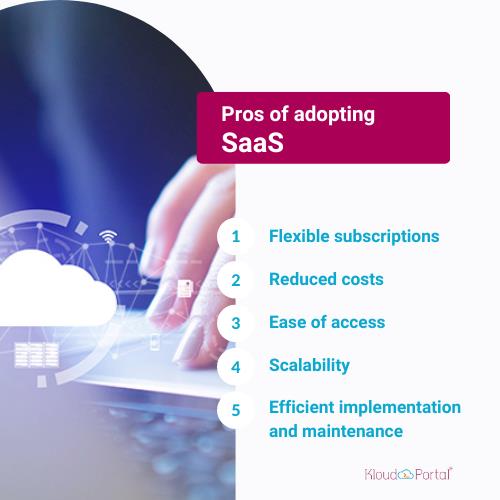
Pros of adopting SaaS:

1. Flexible subscriptions: Software as a Service replaces the traditional software method of purchasing on-premises software with a subscription model that can meet customers’ individual needs. Most commonly, subscriptions are paid monthly, quarterly, or annually, providing a recurring operating expense that can be modified based on evolving operating costs.

2. Reduced costs: Customers can enjoy lower initial costs by replacing the licensing costs associated with purchasing software with more flexible subscription fees. Allows companies to focus their investments on operating systems expenses rather than capital expenditures. Additionally, since SaaS providers manage the IT infrastructure that administers the software, customers have reduced reliance on hardware and software updates, resulting in lower costs.

3. Ease of access: SaaS business apps, being cloud-based, only require an internet connection, browser, mobile access, and user authentication, making them easily accessible from anywhere at any time. This convenience saves time and effort, decreasing significant workload, reducing costs, and increasing productivity.

4. Scalability: The modifiable nature of SaaS subscription-based models allows companies to optimize their budgets and gain access to the latest technology and professional services. Subscriptions can be adjusted to match a company’s changing volume, enabling optimized performance and enhanced expansion opportunities.

5. Efficient implementation and maintenance: Traditional on-premise software resources typically require extensive deployment periods for software installation across an organization. With SaaS solutions, a functional system and access initiation during an active subscription period are all that’s required, saving effort and boosting productivity. Maintenance, including regular software updates to mitigate bugs and errors, is also handled by SaaS, reducing labor and costs.

Pros Of SaaS marketing

Cons of adopting SaaS:

While there are numerous advantages to using SaaS browser-based applications, organizations need to consider the potential drawbacks before adopting a SaaS provider. These disadvantages include the following:

1. Reduced control: Outsourcing implementation and management to a third party, organizations may lose control over certain aspects of the software solution. Customization options may be limited, and the organization may have to rely on the software versions provided by the SaaS provider.

2. Connectivity challenges: Software as a Service applications rely on access to the internet and cloud sources, so internet outages or cloud failures can impact performance and productivity.

3. Security concerns: Storing confidential information in a cloud-based environment outside of the organization’s server raises concerns about data security, privacy protection, and access management, making industries that work with sensitive data cautious about SaaS services.

4. Service agreements: With various SaaS providers offering different service level agreements, organizations must navigate the details of each agreement, including issues like data breaches and service failures, resulting in time expenditure and potential confusion about their impact on the business processes.

The Future of Software as a Service (SaaS)

The popularity of Software-as-a-Service (SaaS) is undeniable, with estimates indicating that nearly 90% of businesses are currently utilizing some form of SaaS application. This trend is expected to continue as more companies develop and implement new technologies to meet growing demand.

Predictions suggest that SaaS technology will experience a resurgence with a heavy focus on mobile devices. In contrast, others believe that artificial intelligence (AI) will dominate the logistics, transport, and retail market.

As technology continues evolving, so will the SaaS application and implementation models. Out-of-the-box and ready-made tools will always have a business place, and SaaS offers a wide range of benefits for suppliers and users.

Conclusion

In today’s digital age, cloud computing is widely regarded as the future of technology. For SaaS software implementation, KloudPortal represents an exceptional opportunity for businesses as a leading SaaS product development company. By leveraging SaaS, organizations can effectively scale their operations, achieve higher, and sustainable revenues.

To keep up with the demand for cloud computing solutions, KloudPortal helps companies with qualified IT professionals to analyze, evaluate, and design suitable solutions for their current and future needs.

The Future Of SaaS: Trends To Watch In 2023

The Future Of SaaS: Trends To Watch In 2023

By Deepa Kesavan

Software-as-a-Service (SaaS) has revolutionized the software industry by transforming how software is developed, delivered, and consumed. This model has rapidly gained popularity among businesses of all sizes thanks to its flexibility, scalability, and cost-effectiveness. SaaS has become a popular model for companies to manage their business processes and customer relationship management (CRM) and provides greater integration capabilities in computer systems.

So, let us explore some of the most recent SaaS trends and the service model’s prospects.

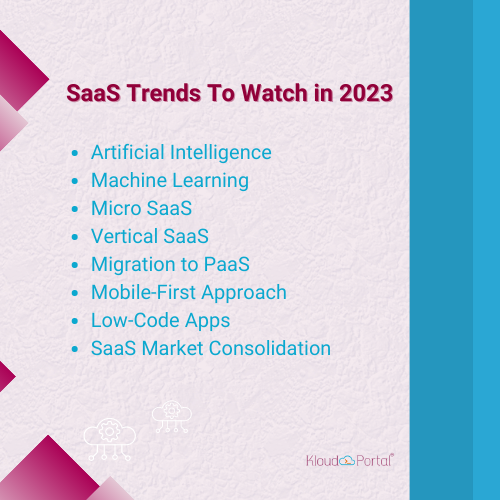
Top SaaS trends to watch in 2023

1. AI-powered SaaS solutions

Artificial intelligence (AI) has become an integral part of the SaaS industry trends, with businesses using AI-powered solutions to automate their workflows and gain valuable insights from their data. In 2023, we expect more SaaS solutions incorporating AI capabilities, such as predictive analytics and natural language processing.

However, some other SaaS use cases for AI include:

  • Superior customer service tools like chatbots, analytics software, etc.
  • Simpler code review and upkeep
  • Detection of SaaS security breach
  • Advanced SaaS onboarding and user guidance
  • Adaptive pricing

2. Machine learning

Machine learning (ML) is a branch of artificial intelligence focusing on data processing and learning capabilities. It is one of the fastest-growing software segments, making it a popular SaaS topic for 2023.

The following are just a few of the most significant use cases for ML in SaaS:

  • Letting platforms learn about consumer preferences and habits
  • Help SaaS product marketing agencies create more intuitive and accessible products
  • Processing a lot of contextual data and insights to assist businesses in improving their product and market positioning
  • Improving internal communication and operational efficiency
  • Boosting consumer involvement
  • Advanced pattern recognition to ensure greater data protection

3. Micro SaaS

Micro SaaS has gained much attention for business owners seeking solutions for a specific target market. Because in this growing competitive business environment, there is a demand to create smaller, flexible products. And micro SaaS can create advanced software capabilities that can be run by small teams or even a single person.

Some of the perks that come with a micro SaaS are:

  • It takes less time to develop because it requires less work and resources.
  • Effortlessly upgrades inside the browser.
  • The company is entirely managed by you, with no external ownership holdings.
  • The resources are all online and cloud-based.
  • The software has a low chance of security breaches and is generally affordable for customers.

4. Vertical SaaS

Another SaaS trend for 2023 that will likely be quite profitable is vertical SaaS solutions. It is a product that attempts to serve a more specific market, usually one specific niche. And that’s why IT professionals consider vertical SaaS the current generation’s equivalent of horizontal SaaS.

The following are some of the benefits it provides:

  • SaaS products can be modified to meet customer demands or specific industry requirements.
  • Capable of adjusting to market trends and meeting the industry’s changing needs.
  • It offers specialized answers to industry-specific difficulties.
SaaS trends to watch in 2023

5. Migration to PaaS

Vendors of SaaS are increasingly implementing platform-as-a-service (PaaS) to retain customers. PaaS enables customers or enterprises to create custom applications to enhance their distinctive offerings. Some other underlying factors that make PaaS unique are-

  • Clients may easily scale their operations thanks to its flexible, accessible, and reliable delivery strategy.
  • It gives businesses the security to carry out numerous automatic upgrades more frequently.
  • Greater customer acquisition has led to an increase in demand.

6. Mobile-first approach

Mobile optimization has become critical for SaaS companies as more businesses rely on mobile devices to manage their operations. Additionally, a 2019 CNBC survey found that the typical individual spent more than 120 hours per month staring at their smartphone and that by 2025, nearly three-quarters of the world’s population will only use their smartphones to access the internet.

Hence, SaaS providers must ensure that their applications are optimized for mobile devices to provide a seamless user experience with-

  • Features that are more accessible
  • Improved mobile personalization
  • Experiences on mobile platforms powered by AR and VR
  • Improved responsiveness, gesture design, and intuitive filtering capabilities powered by ML.

7. Low-code applications

Low-code development allows businesses to create SaaS applications quickly and easily without requiring specialized coding skills or code tools. That means these tools can operate with no infrastructure. However, several other advantages that come together with these low-code platforms are-

  • It drives innovation and digital transformation.
  • It decreases the need for or dependency on difficult-to-hire technical talents
  • It increases responsiveness by shielding the company from aggressive technological churn
  • It minimizes present IT or technical backlog
  • It makes internal processes better

8. SaaS market consolidation

Large industry leaders are buying smaller businesses quickly to provide their clients with a more comprehensive product package and keep ahead of rivals. Similarly, smaller businesses are resorting to consolidation as a safe strategy to expand their markets and produce a profit.

Hence, the SaaS market will likely experience numerous mergers and acquisitions in 2023. And these mergers will likely occur between businesses that can complement one another rather than necessarily between smaller and larger players.

SaaS platforms

In 2023, we expect to see a growing focus on cloud platforms, allowing businesses to access their software applications from anywhere. The SaaS platforms also increase the compound annual growth rate of businesses. Some of the top SaaS companies to watch in 2023 include:

Google Cloud Platform: Google Cloud, a SaaS provider, will continue to help various cloud services, including cloud storage, computing, and cloud networking, that help businesses manage their data and applications.

Amazon Web Services (AWS): AWS is a rapidly expanding platform for cloud computing that offers a variety of SaaS innovations, such as cloud computing, networking, and storage, that assist organizations in managing their data and applications.

How can SaaS trends drive business growth?

Centralized analytics allow businesses to gather and analyze data from different sources in one place, enabling them to make data-driven decisions quickly. Customer segmentation enables businesses to target their marketing efforts to specific customer groups, increasing the effectiveness of their marketing spending.

The SaaS model enables businesses to connect with new software applications seamlessly. And that’s why more SaaS vendors provide greater integration capabilities, enhancing competitive edge and business value. It has become a key driver of revenue growth for businesses of all sizes.

Your search ends at KloudPortal

KloudPortal is a dynamic SaaS product development company specializing in cutting-edge cloud engineering services. Our offerings cater to a wide spectrum of enterprise needs, from scalable infrastructure solutions to seamless cloud integration. With a strong focus on innovation and agility, KloudPortal empowers businesses to optimize operations and drive digital transformation. Their expertise ensures reliable, secure, and future-ready cloud environments for sustained growth.

We use cookies to ensure that we give you the best experience on our website. If you continue to use this site we will assume that you are happy with it.

Cookies settings
Accept
Privacy & Cookie policy
Privacy & Cookies policy
Cookie name Active

Privacy Policy

What information do we collect?

We collect information from you when you register on our site or place an order. When ordering or registering on our site, as appropriate, you may be asked to enter your: name, e-mail address or mailing address.

What do we use your information for?

Any of the information we collect from you may be used in one of the following ways: To personalize your experience (your information helps us to better respond to your individual needs) To improve our website (we continually strive to improve our website offerings based on the information and feedback we receive from you) To improve customer service (your information helps us to more effectively respond to your customer service requests and support needs) To process transactions Your information, whether public or private, will not be sold, exchanged, transferred, or given to any other company for any reason whatsoever, without your consent, other than for the express purpose of delivering the purchased product or service requested. To administer a contest, promotion, survey or other site feature To send periodic emails The email address you provide for order processing, will only be used to send you information and updates pertaining to your order.

How do we protect your information?

We implement a variety of security measures to maintain the safety of your personal information when you place an order or enter, submit, or access your personal information. We offer the use of a secure server. All supplied sensitive/credit information is transmitted via Secure Socket Layer (SSL) technology and then encrypted into our Payment gateway providers database only to be accessible by those authorized with special access rights to such systems, and are required to?keep the information confidential. After a transaction, your private information (credit cards, social security numbers, financials, etc.) will not be kept on file for more than 60 days.

Do we use cookies?

Yes (Cookies are small files that a site or its service provider transfers to your computers hard drive through your Web browser (if you allow) that enables the sites or service providers systems to recognize your browser and capture and remember certain information We use cookies to help us remember and process the items in your shopping cart, understand and save your preferences for future visits, keep track of advertisements and compile aggregate data about site traffic and site interaction so that we can offer better site experiences and tools in the future. We may contract with third-party service providers to assist us in better understanding our site visitors. These service providers are not permitted to use the information collected on our behalf except to help us conduct and improve our business. If you prefer, you can choose to have your computer warn you each time a cookie is being sent, or you can choose to turn off all cookies via your browser settings. Like most websites, if you turn your cookies off, some of our services may not function properly. However, you can still place orders by contacting customer service. Google Analytics We use Google Analytics on our sites for anonymous reporting of site usage and for advertising on the site. If you would like to opt-out of Google Analytics monitoring your behaviour on our sites please use this link (https://tools.google.com/dlpage/gaoptout/)

Do we disclose any information to outside parties?

We do not sell, trade, or otherwise transfer to outside parties your personally identifiable information. This does not include trusted third parties who assist us in operating our website, conducting our business, or servicing you, so long as those parties agree to keep this information confidential. We may also release your information when we believe release is appropriate to comply with the law, enforce our site policies, or protect ours or others rights, property, or safety. However, non-personally identifiable visitor information may be provided to other parties for marketing, advertising, or other uses.

Registration

The minimum information we need to register you is your name, email address and a password. We will ask you more questions for different services, including sales promotions. Unless we say otherwise, you have to answer all the registration questions. We may also ask some other, voluntary questions during registration for certain services (for example, professional networks) so we can gain a clearer understanding of who you are. This also allows us to personalise services for you. To assist us in our marketing, in addition to the data that you provide to us if you register, we may also obtain data from trusted third parties to help us understand what you might be interested in. This ‘profiling’ information is produced from a variety of sources, including publicly available data (such as the electoral roll) or from sources such as surveys and polls where you have given your permission for your data to be shared. You can choose not to have such data shared with the Guardian from these sources by logging into your account and changing the settings in the privacy section. After you have registered, and with your permission, we may send you emails we think may interest you. Newsletters may be personalised based on what you have been reading on theguardian.com. At any time you can decide not to receive these emails and will be able to ‘unsubscribe’. Logging in using social networking credentials If you log-in to our sites using a Facebook log-in, you are granting permission to Facebook to share your user details with us. This will include your name, email address, date of birth and location which will then be used to form a Guardian identity. You can also use your picture from Facebook as part of your profile. This will also allow us and Facebook to share your, networks, user ID and any other information you choose to share according to your Facebook account settings. If you remove the Guardian app from your Facebook settings, we will no longer have access to this information. If you log-in to our sites using a Google log-in, you grant permission to Google to share your user details with us. This will include your name, email address, date of birth, sex and location which we will then use to form a Guardian identity. You may use your picture from Google as part of your profile. This also allows us to share your networks, user ID and any other information you choose to share according to your Google account settings. If you remove the Guardian from your Google settings, we will no longer have access to this information. If you log-in to our sites using a twitter log-in, we receive your avatar (the small picture that appears next to your tweets) and twitter username.

Children’s Online Privacy Protection Act Compliance

We are in compliance with the requirements of COPPA (Childrens Online Privacy Protection Act), we do not collect any information from anyone under 13 years of age. Our website, products and services are all directed to people who are at least 13 years old or older.

Updating your personal information

We offer a ‘My details’ page (also known as Dashboard), where you can update your personal information at any time, and change your marketing preferences. You can get to this page from most pages on the site – simply click on the ‘My details’ link at the top of the screen when you are signed in.

Online Privacy Policy Only

This online privacy policy applies only to information collected through our website and not to information collected offline.

Your Consent

By using our site, you consent to our privacy policy.

Changes to our Privacy Policy

If we decide to change our privacy policy, we will post those changes on this page.
Save settings
Cookies settings