Why Is A Privacy Policy Page Important On A Website? 

Why Is A Privacy Policy Page Important On A Website? 

By Rasmita Patro

In today’s digital age, the collection and processing of personal data have become integral to online businesses and websites. However, with the rise of data protection laws, such as the General Data Protection Regulation in the European Union and many third-party services in different regions, it has become crucial for websites to have a well-defined privacy policy. This legal document ensures compliance with these laws and helps build trust. This article will explore why a privacy policy is important, the consequences of not having one, its purpose, and what your privacy policy should include.

The significance of a website privacy policy

A website’s privacy policy is a critical legal contract that outlines how the site gathers, utilizes, secures, and manages users’ or visitors’ data. Its presence on your website is paramount for several compelling reasons:

  • Compliance with data protection laws: A primary purpose of the privacy policy is to ensure strict adherence to data privacy legislation and regulations, such as GDPR and CCPA. Violation of regulations can result in significant fines and legal actions.
  • Building trust with website visitors: A transparent and well-crafted privacy policy fosters trust. When users understand how their information collected is protected, they are likelier to share it, bolstering their online reputation.
  • Informed Consent: The policy informs users about data acquisition practices, enabling them to make informed decisions. Many laws require active consent from users before information gathering.
  • Meeting legal requirements: Beyond privacy regulations, it demonstrates a commitment to legal obligations, serving as a foundation for legal data retrieval, contract compliance, and app store requirements.
  • Addressing state and international laws: Privacy laws vary by region; your policy should adapt accordingly. For example, GDPR compliance is crucial for EU country users.
  • Protection against legal action: Legal actions may ensue without a privacy policy or non-compliance. A privacy notice acts as a binding agreement, protecting against potential disputes.

Consequences of operating a website without privacy policies

Operating a website without a privacy law can lead to significant repercussions. It can legally violate regulations, inviting penalties and fines in their jurisdictions. Users may lose trust, causing reduced engagement and damage to their reputation. Data breaches become more likely due to inadequate security measures, leading to legal and financial consequences. You might miss out on valuable business opportunities that necessitate a privacy policy.

Regulatory scrutiny and potential legal actions can disrupt operations. A clear and comprehensive privacy policy aligning with data practices and legal requirements is crucial to mitigate these risks and showcase commitment to user privacy. India’s Best Enterprise SEO companies companies excel in crafting comprehensive strategies and leveraging their expertise to optimize the website’s growth.

Best Enterprise SEO companies

The purpose of website privacy policy

The privacy policies of most websites serve several critical functions and are primarily designed to provide transparency and clarity on the collection, utilization, storage, and protection of users’ private information. The objective is:

  • Transparency: Privacy policies promote transparency by disclosing how an organization handles personal data. This transparency helps build trust between the organization and individuals.
  • Legal compliance: Privacy laws and regulations in various jurisdictions often require policies. Compliance with these laws is essential to avoid legal penalties. With this, websites demonstrate their commitment to upholding these legal requirements.
  • Data protection and accountability: The policies outline the security measures and safeguards to protect personal data from breaches and unauthorized access. Having them in place demonstrates accountability for its data processing practices.
  • Data usage: The policy helps individuals understand why and how their data is processed. If an organization shares personal data with any third parties, the policy should disclose this and explain the circumstances under which sharing occurs.
  • Retention periods: It typically specifies how long personal data will be retained. This information is essential for individuals to understand how long their data will be stored.
  • Updates and changes: Organizations may update their data processing practices or policies. A privacy policy will inform individuals of these changes and how they will be notified.

Usually, an online business employs a data protection officer to oversee the collection of personal information through third-party apps such as Google Analytics and mobile apps, ensuring strict compliance. This commitment to customer trust lets users know their privacy is paramount when providing information through Google AdWords or other means. Websites offering India’s Best Enterprise SEO services also boast well-defined privacy policies.

Content guidelines for your website’s privacy policy

Your company’s privacy policy should be a comprehensive and transparent document that addresses the specific data practices of your site. While the content may vary depending on your business and website, here are the key elements that should be included:

  • Introduction: Start with an introductory section explaining the privacy policy’s purpose and scope. Let users know that by using your website, they are agreeing to the terms outlined in the policy.
  • Data collection: Collect personally identifiable information, such as names, email addresses, payment information, IP addresses, or any other relevant information. Explain how and why this data is collected.
  • Data use: Specify the purposes for using the data collected. It may include processing orders, personalizing user experiences, sending marketing communications, or improving site performance.
  • Privacy regulations: Explain the security measures to protect user data from unauthorized access, breaches, or misuse. Assure users that you take their data privacy seriously.
  • Third-party services: Disclose many third-party services or ad service integrations used on your website and provide links to their data privacy policies. Explain how these services collect personal data and process it.
  • User rights: Inform users of their rights, such as access to their data, request deletion or opt-out of certain data processor activities. Explain how they can exercise these rights.
  • Cookie policy: If your website uses cookies or similar tracking technologies, provide notice about their purpose, types, and how users can manage or disable them.
  • Contact information: Include contact information for users to contact with questions, concerns, or data-related requests. Designate a data privacy and protection officer if required by a law firm.
  • Specific regional compliance: If your website operates in multiple regions, include sections addressing compliance with regional data protection laws, such as GDPR for European users or CCPA for California residents.
  • Children’s data: If your website is directed at or knowingly collecting data from children under the age of 13 (or a different age, depending on applicable laws), explain how you handle children’s data in compliance with the Children’s Online Privacy Protection Act (COPPA) or other laws.

Conclusion

A privacy policy is an indispensable component of any website, serving multiple essential purposes. It ensures regulatory compliance with data security legislation, builds trust with website visitors, and provides data collection and processing practices transparency. Failing to have a privacy policy or neglecting its contents can lead to legal consequences, loss of user trust, and missed business opportunities.

At KloudPortal, we design Privacy Policy pages that are easy to understand, visually consistent with your website, and aligned with current privacy regulations. Our website design services include creating legally sound and professionally styled Privacy Policy pages tailored to your business needs.

Importance of User Experience Design in SaaS Application Development

Importance of User Experience Design in SaaS Application Development

By Rashmita Patro

In the dynamic realm of software development, User Experience (UX) design has risen to prominence as a pivotal factor, wielding the power to profoundly shape the trajectory of Software as a Service (SaaS) applications. This exploration delves into the intrinsic significance of UX design in the evolution of SaaS products and applications, underscoring its profound influence on client satisfaction, user retention, and the holistic expansion of businesses. This journey also explores key practices, unraveling the techniques to elevate a good SaaS UX design.

It explores practical instances, uncovering the essence of the user experience, the artistry of UI/UX design, and the skillful integration of essential functionalities. These components together choreograph a triumphant narrative in the domain of SaaS products, reshaping the trajectory of customers’ experiences and propelling the SaaS company toward exceptional expansion.

Effective UX design in SaaS minimizes attrition rates, enhances customer acquisition and loyalty, elevates user engagement, empowers individuals, and sets the product apart in a competitive market. Optimal approaches for SaaS UX design encompass fostering customer trust, ensuring intuitive interaction, preemptively addressing user requirements, delivering delight, and crafting designs centered around user interests.

Significance of UX design in application development

  • User-Centered Design: SaaS applications must address users’ needs and pain points. A well-executed SaaS UX design process ensures the application is user-centric, making it easier for SaaS users to achieve their goals efficiently.
  • Customer Satisfaction and Retention: A seamless and intuitive user experience fosters client happiness, encouraging users to stick with the SaaS product. Increasing customer engagement, in turn, boosts customer retention rates, a vital metric for companies.
  • User Journey Mapping: Understanding the user path is essential for crafting a design that aligns with user expectations. A simplified user journey map helps identify pain points and opportunities for improvement.
  • Reduces Churn Rates: One of the most significant benefits of a good SaaS UX design is reducing customer churn rates.

Role of design in enhancing user experience

  • Simplified User experience pathway: Designing a customer journey ensures users navigate the application effortlessly. Minimize the number of steps required for users to achieve their goals.
  • Onboarding Experience: A smooth onboarding registration process sets the tone for the user’s interaction with the application. Provide clear guidance and interactive tutorials to help users get started.
  • Mobile-First Design: As more new users access SaaS apps through their mobile devices, it is imperative to prioritize mobile-friendly design to accommodate different screen sizes and interactions.
  • UI/UX Design Consistency: Maintain a consistent design language throughout the application to create a cohesive and familiar user experience across different features and functionalities.

Best practices for SaaS UI/UX design

  • Responsive Design: Given the diverse range of devices and screen sizes users might use to access SaaS applications, ensure the UI/UX design is responsive and optimized for different SaaS platforms.
  • Consistency in Design: Maintain consistency in design elements such as color schemes, typography, and icons across the SaaS application. Consistency creates a cohesive and familiar onboarding experience for users.
  • Effective Information Architecture: Organize the application’s content and features logically. Use clear labeling and categorization to help users easily find what they want.
  • Intuitive Navigation: Design a navigation system that is intuitive and easy to understand. Users should be able to move through the application without confusion or frustration.
SaaS UX Design Best Practices

Enhancing SaaS UX design: practical examples and best practices

  • Understand Your Users: Conduct user research to understand your target audience’s needs, goals, and pain points. Create user personas to develop empathy and design with specific user profiles in mind.
  • Intuitive Navigation: Design a clear, intuitive navigation system that helps users navigate the SaaS apps effortlessly. Use well-organized menus, breadcrumbs, and clear labels for navigation.
  • Visual Hierarchy: Implement a clear visual hierarchy to guide users’ attention to important elements, such as call-to-action buttons and essential information architecture. Use color, size, and placement to differentiate between different levels of importance.
  • Minimize Cognitive Load: Avoid overwhelming users with too much information on a single screen. Break down complex tasks into smaller, manageable steps to reduce cognitive load.
  • Feedback and Micro-interactions: Provide immediate feedback for user actions, such as button clicks or form submissions. Implement micro-interactions like animations to make the user experience more engaging and responsive.
  • Usability Testing: Regularly conduct user testing to identify pain points and areas for improvement. User feedback can guide design refinements and enhancements.
  • Iterate and Improve: Continuously gather user feedback and iterate on the design based on real-world usage. Be open to making changes and improvements as user needs and preferences evolve.

Real-life examples of successful SaaS UI/UX design

  • Asana: This project management tool offers a clean and organized user interface focusing on task management. Its simple design and intuitive layouts make it easy for teams to collaborate and manage projects efficiently.
  • Dropbox: Dropbox provides a straightforward file-sharing experience with drag-and-drop functionality. Its minimalist design allows users to upload, organize, and share files without confusion.
  • Shopify: Shopify’s e-commerce platform boasts an intuitive SaaS interface design that empowers users to create online stores without technical expertise. Its user-friendly design allows merchants to manage SaaS products, orders, and customers effortlessly.
  • Zendesk: The customer support system, Zendesk, offers an intuitive and clean interface. Its design focuses on simplicity, making it easy for users to navigate and manage customer interactions efficiently.
  • HubSpot: This all-in-one marketing, sales, and SaaS service platform boasts a user-friendly interface that seamlessly guides users through various features. The design encourages users to explore and utilize the platform’s capabilities.
  • Salesforce: This renowned CRM platform offers a user-friendly interface focusing on simplicity and functionality. Its clean design and intuitive navigation contribute to a positive user experience.
  • Slack: The collaboration platform Slack strongly emphasizes effective communication and collaboration. Its user-focused design enables seamless interaction and efficient information exchange.

Improving SaaS UX designs requires a deep understanding of user needs and a commitment to refining the interface based on real-world usage. By implementing these best practices and drawing inspiration from successful examples, SaaS companies can create user experiences that increase customer satisfaction, engagement, and loyalty. As a SaaS application development company, KloudPortal believes in the power of UI/UX design and the skillful integration of essential functionalities to build intuitive, high-performing applications. Our solutions seamlessly blend aesthetics with usability to deliver exceptional user experiences.

Conclusion

In the ever-evolving world of SaaS software, the significance of SaaS UX design cannot be overstated. A well-crafted UX design enhances customer experience, increases user retention, and contributes to overall SaaS business success. Companies can create applications that resonate with modern users and build long-lasting customer loyalty by adopting best practices, mapping user journeys, and focusing on user-centric design. As the digital landscape continues to evolve, companies must prioritize UX design as a critical driver of customer acquisition and brand loyalty, ultimately leading to sustainable growth in the competitive market.

Salient Features Of India’s Digital Personal Data Protection Bill, 2023

Salient Features Of India’s Digital Personal Data Protection Bill, 2023

By Rashmita Patro

Since the Supreme Court recognized privacy as a fundamental right in 2017, the Indian legislature has been committed to establishing a robust data protection framework. This need became even more pronounced after the controversy surrounding WhatsApp’s revised policy raised concerns about sharing users’ personal information with third parties. The Digital Personal Data Protection Bill (DPDP) was introduced to address these issues on August 3, 2023. This bill, which focuses on safeguarding personal data, was presented by the Minister of Railways, Communications, and Electronics and Information Technology before the Lok Sabha. When both Houses approve the DPDP Bill in its current form, it will be elevated to the status of law, becoming the “Digital Personal Data Protection Act, 2023,” after being published in the Official Gazette.

India’s Data Protection Bill

The DPDP Bill marks the Indian government’s second endeavor to establish comprehensive data protection law and privacy legislation. It builds upon India’s data protection regime, particularly Section 43A of the Electronics and Information Technology Act 2000. It is supplemented by the 2011 Electronics and Information Technology Rules.

The proposed Bill in India aims to establish a robust framework for safeguarding personal data, addressing issues like granting rights to the affected data principal, regulating data fiduciaries that process personal data, and implementing measures to prevent personal data breaches while addressing concerns related to targeted advertising and behavioral monitoring.

It also has innovative key features such as storage limitation, delineates the responsibilities of data processors in handling financial assets, and ensures that both the rights of individuals are upheld by mandating that data processing is conducted by seeking consent or under a legally valid contract.

Being a martech company, KloudPortal ensures data protection through secure, compliant handling of client and user data, adhering to global privacy standards and digital personal data protection policies laid down by the Indian government. All marketing data is managed with encryption, restricted access, and confidentiality protocols.

A Key Functions, Stakeholders, and Definitions

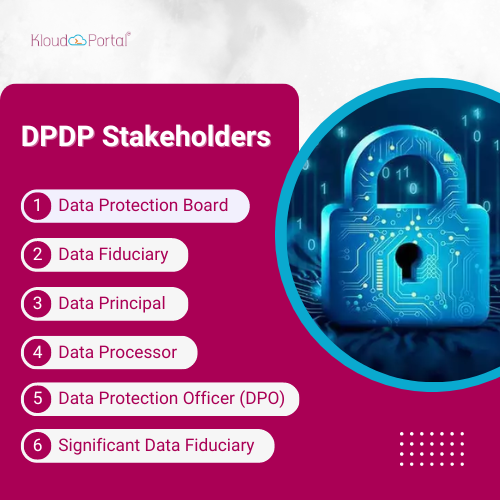
The DPDP Bill outlines key stakeholders who will play essential roles in ensuring the protection of personal data publicly:

  • Data protection board: This central governing body, to be established by the Central Government, will oversee the implementation of the Act.
  • Data fiduciary: Any individual or entity, alone or in collaboration with others, that determines the statistical purposes and means of processing personal data.
  • Data principal: An individual to whom the personal data relates, which includes minors and individuals with disabilities.
  • Data processor: An entity responsible for processing personal data on behalf of data controllers, ensuring compliance with data protection laws, and maintaining the security and confidentiality of the information.
  • Data protection officer (DPO): Data fiduciaries must designate a DPO to enforce legal rights. Furthermore, an autonomous independent Data Auditor could be enlisted to appraise and review data procedures, guaranteeing alignment with statutory provisions. An individual nominated by a Significant Data Fiduciary to oversee and ensure compliance with data protection regulations.
  • Significant data fiduciary: Certain Data Fiduciaries have characteristics of Central Government based notifications, such as the volume of data minimization processed and the potential impact on security and public order.
Digital Personal Data Protection Stake Holders

Scope and Application

The DPDP Bill’s scope encompasses innovative features like digitally processing India’s data, collected online or digitized from offline sources. It also extends to the permit processing of digital personal data outside India if related to offering goods, services, or profiling of Data Principals within the country. However, personal data processed for personal or domestic purposes and data made publicly available by the Data Principal or under legal obligations fall outside the bill’s purview.

Data fiduciaries can process data for lawful purposes by seeking the consent of managers of the Data Principal or for ‘certain legitimate uses.’ Before obtaining consent, a Data Fiduciary must provide detailed notices specifying the process data, the purpose, and the Data Principals’ rights.

Conditions for Data Processing by Data Fiduciaries

A Data Fiduciary must ensure ethical and lawful management of personal information. These conditions encompass securing explicit consent from data subjects, articulating the purpose behind data collection, upholding data accuracy, enacting suitable security measures, and adhering to pertinent data protection legislation. Additionally, Data Fiduciaries, notified as Significant Data Fiduciaries, may be obliged to furnish individuals access to their data and establish mechanisms for rectification and erasure. These conditions protect individuals’ privacy while facilitating transparent and legitimate information processing practices.

A Data Fiduciary enforces sensible security measures ensures precise data handling, and implements protocols for notifying breaches. Their responsibilities also extend to erasing personal data once its purpose has been fulfilled.

Rights of Data Principals

The salient features of the bill recognize the rights of the affected data principals and the fiduciary’s obligations. Affected data principal can access their data, correct inaccuracies, erase personal data and restrict or object to processing for specified purposes. Data fiduciaries are responsible for fulfilling these rights while ensuring the security and data accuracy of the data.

Data of Children and Persons With Disabilities

Data of children and persons with disabilities hold special significance in data protection. Given their vulnerability, specific safeguards and considerations are often applied to their personal information. Organizations must prioritize their privacy and well-being by obtaining parental or legal guardian consent for processing children’s data, ensuring that the data collected is age-appropriate and serves the child’s best interests. Similarly, data fiduciaries must adopt measures to accommodate the unique needs and rights of persons with disabilities, ensuring equal access, clear communication, and tailored support mechanisms.

Data Protection Board’s Role

The Data Protection Board is pivotal in supervising and upholding data protection regulations within a specific jurisdiction. Its responsibilities encompass interpreting and implementing data protection laws, issuing guidelines and recommendations for organizations to adhere to, and resolving telecom dispute settlements on data privacy matters. Furthermore, the board wields the power to impose financial penalties on entities found contravening data protection regulations, thereby ensuring the responsible management of individuals’ personal information by legal prerequisites.

This board possesses the authority to address and prevent personal data breaches and instances of non-compliance. It holds the capacity to levy substantial penalties for violations. Overseeing the board’s functioning, the Central Government can issue directives as deemed necessary.

It needs to impose financial penalties on non-compliance, including mitigating data breaches of security safeguards and failure to notify breaches. The Central Government can grant exemptions for certain purposes, government entities, and specified purposes.

Cross-Border Personal Data Transfer

Cross-border personal data transfer pertains to relocating individuals’ personal information from one nation or legal jurisdiction to another. This intricate procedure entails managing diverse legal, judicial, or regulatory functions and security factors, all aimed at preserving the data’s security and adherence to pertinent data protection regulations as it traverses international boundaries.

The Central Government can impose storage limitations on cross-border personal data transfers via notifications. This provision ensures that existing laws offering heightened storing data protection will persistently apply and govern these transfers.

Conclusion

The Digital Personal Data Protection Bill 2023 establishes a comprehensive framework for safeguarding personal data in India’s digital landscape. By defining key stakeholders, outlining data manipulation conditions, specifying obligations, and providing for penalties and exemptions, the bill addresses the challenges posed by data privacy and protection in the modern era. If passed into law, it will significantly enhance individuals’ control over their data while holding organizations accountable for responsible data-handling practices.

Mastering Color Selection for Your Business: Decoding the Power of Black and White in Leading Apps

Mastering Color Selection for Your Business: Decoding the Power of Black and White in Leading Apps

By Rashmita Patro

Color combinations hold immense power in determining the success of any business design or branding. The visual hierarchy significantly impacts people’s emotions, perceptions, and behavior, influencing how they interact with a brand or business and enhancing the overall user experience. While a wide spectrum of mixed colors exists, choosing the best color scheme for an app is crucial as it can significantly impact user experience and overall aesthetics. Here are some guidelines to help you with your neutral colors choice:

Use the 3 Color Strategy

The 3-color theory refers to choosing three main colors for your app’s design. These colors will be the foundation for your app’s overall theme and branding. Here’s how it works:

  • Primary color: This is the dominant color that will represent your brand and set the overall tone for your app. Primary colors align with your app’s personality and values.
  • Secondary color: The primary and secondary colors can be used for buttons, icons, and other user interface elements to create visual contrast.
  • Accent color: The accent color is meant to emphasize and highlight important elements in the app. Color Usage sparingly draws attention to buttons, links, or specific information.

The 3-color strategy allows designers to maintain a consistent and visually appealing design while providing flexibility and room for creativity. Limiting the color choices to three allows the design to remain focused and avoid overwhelming the audience with too many colors. It also helps in establishing recognizable and memorable branding. Unlock the power of the Best Online reputation management Services in Hyderabad, safeguarding your brand image and fostering trust among your audience. Apart from the above, we can also consider the following strategies:

  • Consider color combinations: Once you’ve selected your three colors, test how they look together. Ensure color harmony and avoid a negative connotation. Various color scheme tools online can help you find complementary colors palette.
  • Create contrast: Make sure that there are various shades between text and background colors to ensure readability. Avoid using colors that may cause eye strain or make it challenging for users to distinguish between different elements.
  • Keep it simple: Avoid overwhelming your users with too many colors. Stick to a limited color palette to maintain visual consistency and a clean design. Use the same palette to maintain consistency.
  • Test with users: Conduct thorough testing or get feedback from your target market to see how they respond to your color choices. It helps identify issues and presents opportunities for improvement.
  • Adapt for dark mode: If your app supports dark mode, ensure your color choices work well in light and dark themes. Consider using softer, less vibrant colors for dark mode to reduce eye strain.

Color Psychology and Associations

Color psychology and associations are vital in choosing the right bright color for your applications. Luxury brands often utilize black to exude authority and sophistication, creating a premium image. High contrast makes white symbolize purity, making it ideal for health and wellness apps. Combining black and white in a balanced manner evokes elegance and professionalism, resonating with modern users who appreciate simplicity.

The minimalist design approach has gained popularity recently, with a black-and-white color scheme essential in achieving this aesthetic. By embracing simplicity and eliminating distractions, apps can create a clean and uncluttered user interface, fostering a seamless user experience. Furthermore, the timeless black-and-white combination guarantees the app’s enduring relevance and visual appeal.

Effective Brand Color Selection

Colors and Brand Identity

Color selection for brands transcends mere aesthetics; it becomes a powerful tool in defining their identity and conveying their message. Consistency in brand colors fosters a strong brand message and leaves a lasting impression on users. However, it is essential to consider color associations and potential connotations across diverse cultures and target audiences to ensure your app resonates with positivity.

Inclusive design should be a top priority when designing mobile apps. Ensuring color scheme accessibility for users with visual impairments, including color blindness, is paramount. By incorporating sufficient contrast between body text and background colors, avoiding low contrast combinations, and thoughtfully integrating cool colors and warm colors, you can significantly enhance app accessibility and cater to a broader audience.

Partner with a top SaaS marketing agency to elevate your brand strategy by leveraging the expertise of the top product marketing agency. With targeted strategies to maximize growth and market penetration, propel your business to new heights.

Best Practices In UI Designer

  • Use a thoughtful execution of black and white elements, avoiding excessive use of either color.
  • Aim for balance by employing black for headers, icons, bold typography, and white for backgrounds and negative spaces.
  • Strive for an elegant and simple user experience.
  • Mix colors, use darker shades, consider tertiary colors, and split complementary schemes for better user engagement.
  • Ensure there is enough contrast between colors for improved readability and visual appeal.
  • Incorporate subtle shades and tones to add depth and richness to the UI.
  • Implement a complementary color scheme to create a visually captivating harmonious interface.
  • Learn from leading apps that effectively use opposite colors for engaging interfaces.
  • Consider the importance of online reputation management services to safeguard your brand image and build trust among your audience.

Understand The App’s Purpose and Target Audience

Consider the app’s primary purpose and the emotions or feelings you want to evoke in your users. Different colors can have varying psychological effects on people, so understanding your user base is essential.

For instance, for a mobile app design, choosing the best color palette requires:

  • Understanding the app’s purpose and consumer group.
  • Using the 3-color strategy to establish a theme.
  • Testing color combinations.
  • Ensuring readability and simplicity.
  • Considering dark mode compatibility and more.

Always keep user feedback and color preferences in mind throughout the design process.

Choose colors for your app to wield substantial influence over your target audience’s perception and behavior. Consider your app’s purpose and user preferences when deciding between black-and-white color schemes. For creative or fashion-forward apps, a black-dominant color theme can evoke a sense of creativity and exclusivity, while a predominantly white design can convey simplicity and user-friendliness. Thorough market research and understanding user preferences are vital for making informed color choices that resonate with your customer base.

Conclusion

The power of black-and-white UI design for apps is undeniable, especially in a mobile application, with their simplicity and versatility making them popular choices for leading apps. By understanding color psychology, associations, and their impact on the target audience, app designers can harness the potential of black and white to create engaging and effective user interfaces.

Striking the right balance is essential in mastering the art of color selection, ensuring your app stands out in a competitive digital landscape.

Google Analytics 4: Know How To Set Up

Google Analytics 4: Know How To Set Up

By Almaas saleem

Get ready for the arrival of a brand new era in the realm of web analytics! A revolutionary update from Google is on the horizon, set to replace the familiar Universal Analytics as we know it.

Starting July 1st, 2023, this cutting-edge system known as Google Analytics 4 will take center stage, rendering Universal Analytics a thing of the past. If you haven’t ventured into Google Analytics 4 yet, it’s time to do so immediately.

The impending shift means that Universal Analytics will stop collecting data, and the new analytics framework to ensure a seamless flow of information.

In this article, we will delve into the remarkable features of Google Analytics 4 and guide you through setting it up, guaranteeing that you continue to gather valuable insights from your data streams. Brace yourself for an exhilarating journey into the future of analytics!

Google Analytics 4 Explained

Google Analytics 4 represents the latest iteration of the renowned Google Analytics platform. It heralds a new era of web analytics, empowering marketers to delve beyond mere traffic tracking and gain profound insights into crucial customer usage metrics. Unlike its predecessors, Google Analytics 4 offers a comprehensive view of the customer journey across various platforms, enabling businesses to understand and optimize user interactions with their websites and applications.

Google Analytics 4 is known for its strong dedication to safeguarding customer privacy. As privacy regulations such as GDPR (General Data Protection Regulation) and CCPA (California Consumer Privacy Act) have become increasingly stringent, GA4 prioritizes customer privacy with a privacy-first approach. It employs advanced techniques for tracking while prioritizing user anonymity and data protection. With its cross-channel data measurement capabilities and the integration of artificial intelligence and machine learning, GA4 equips marketers with a robust and sophisticated toolset for extracting unparalleled insights.

By leveraging AI-driven predictive analytics, GA4 empowers businesses to anticipate user behavior and optimize their marketing strategies accordingly. This forward-looking approach enables marketers to make data-informed decisions and stay one step ahead in an ever-evolving digital landscape. Google Analytics 4 is an invaluable asset for organizations seeking to navigate the complexities of modern analytics while safeguarding user privacy and maximizing their understanding of user interaction.

How Is Google Analytics (GA4) Different From Universal Analytics Property (UA)

Google Analytics 4 (GA4) is being hailed as the “next generation” of analytics by Google. In comparison to an existing Universal Analytics Property, it offers several advantages that cater to the evolving needs of businesses:

1. Future-Proof and Privacy-Focused

GA4 is designed to be resilient in the face of future technological advancements and changing privacy regulations.

2. Insights Across Platforms and Devices

Utilizing machine learning capabilities, GA4 provides valuable insights into customer journeys across various platforms and devices.

3. Enhanced Integrations with Google’s Advertising Platform

GA4 offers improved integrations with Google’s ads platform, enabling businesses to optimize campaign performance.

However, GA4 has been developed, focusing on data analysts. While Universal Analytics properties were marketer-friendly, this new generation may present a steeper learning curve for average users.

Rest assured, by adapting to GA4 and leveraging its advanced features. Organizations gain deeper insights into customer behavior and enhance their marketing strategies. You can learn more about it Learn More .

Benefits of Google Analytics 4

How to Set Up a New Google Analytics Account the Easy Way

Here are the steps to get your new GA4 setup assistant up and running.

Note: If you wish to establish a new Google Analytics 4 property, follow these steps.

The information is also accessed on the GA4 help center!

1. Go to the Admin panel of your Google Analytics interface and select Create Property from the drop-down menu.

2. Add the basic business and property data; a new GA4 property is created by default.

3. Select Web Stream from the drop-down menu, then enter the website URL and stream name.

Kindly note the name of the data stream cannot be changed further, so choose wisely!

In this blog post, we only generate website data streams. You also can add an iOS or Android app data stream to understand the customer experience across platforms, which is one of the great perks of GA4.

4. In your GA4 Property, turn on Enhanced Measurement.

When establishing a web data stream in Google Analytics 4, you can choose whether or not to activate Enhanced Measurement.

Enhanced measurement is turned on by default through the setup assistant, but you may turn it off if you don’t want to track anything other than page visits.

If this is enabled, the following enhanced measurement events will be tracked and will continue to collect data:

  • scrolling (event name: scroll)
  • outbound clicks (event name: click with the parameter outbound: true)
  • page views (event name: page_view)
  • site search (event name: view_search_results)
  • video interaction (events: video_start, video_progress, video_complete)
  • file downloads (event name: file_download)

It does, however, need either a basic GA4 tag in Google Tag Manager or a Global Site Tag (gtag.js) on the site before data collection. Further, for detailed page views, go to the advanced options.

Note: Copy the entire Google tag and paste it into the platform’s custom HTML field if you are employing a content management system (C.M.S.)/website builder that doesn’t yet support the Google tag.

Ensure “Page changes based on browser history events” is enabled, especially for single-page apps, and update the Site search depending on the query parameters of your site.

5. Select “Create Stream” from the Drop-Down Menu.

6. To see Data in your GA4 Property, Add Tags.

We’ll show you how to generate tags using Google Tag Manager (GTM), but you can utilize a Global Site Tag for this step (gtag.js).

Inside Google Tag Manager account:

Open the Google Tag Manager container you’ve added to your page.

Select Tags > New from the drop-down menu.

Select GA4 Configuration from Tag Configuration.

Enter the Measurement ID in format G-XXXXXXXX

Select “All Pages” to display the tag on all pages (or the subset of pages you want to measure).

Save and deploy your tag settings.

Within 24 hours of publishing your tags, you should start seeing analytics data in your GA4 Property column.

Congratulations! You’ve just finished creating a new GA4 property. To view your historical data, use the reporting interface in your UA.

Steps for upgrading a Universal Analytics Property to GA4

The GA4 property setup is easier if you already have an existing Universal Analytics account that you want to upgrade to.

Select GA4 Setup Assistant under Admin>>Tracking info>> Tracking code and click on the “connected site tags” option by navigating there. The assistant will help you through creating your new GA4 Property.

The same GTM procedures described before must still be followed while updating a Universal Analytics property.

Transform your business with the help of Search Engine Optimization Services, leveraging the potential of Google Analytics.

Harness the Full Power of Google Analytics 4 With These Five Life-Changing Tips

The five point checklist mentioned below to harness Google Analytics 4 to its full potential covers everything you need to grow any business. These help you learn the most useful features, measures, and approaches for using google analytics:

1. Train your team to harness data and drive growth

Analytics should be tailored to your company to maximize its benefits and allow you to adopt a data-driven strategy to evaluate and enhance your digital marketing activity. Goals, funnels, events, and custom dimensions must be configured through customization for the business to review and enhance its online marketing regularly.

2. Customized conversions for maximum business potential

To sum up, the procedure for evaluating how your conversion events are set up is as follows:

  • Recognize common GA4 Events
  • Create your unique events, such as those for leads.
  • Select the custom events that should be converted in agreement.
  • In the Admin section, mark relevant standard and custom events as conversions.

3. Measure and leverage your most valuable audiences

The percentage of visitors who interact with the content and go on to make a purchase determines the quality of the audience. Conversion rates vary naturally for different traffic sources and landing pages on the website, and it’s crucial to compare this variation in digital marketing to increase conversion.

4. Create dynamic performance review dashboards

GA4 is a fantastic, free service that has recently made it easier to customize detail reports by, for instance, adding conversion rates to the standard reports. Despite these improvements, it still has a ton of metrics and reports.

5. Visualizing your marketing funnel for strategic insights

The funnel was formerly component of goal setup in UA. The fact that it is now an Exploration in GA4 is an improvement because it makes it easier for other non-e-commerce businesses to access and customize.

Even though funnels are visually appealing due to their simplicity, they don’t vary much between reviews, so improved Path exploration reports in GA4 are available for a more thorough understanding of paths.

Key Takeaways

  • With the sunset of Universal Analytics in July 2023, the shift to Google Analytics 4 is not just timely—it’s essential. GA4 opens the door to smarter, more flexible insights that help you understand user behavior across platforms.
  • Now is the moment to embrace this evolution. By adopting GA4, you equip your business with advanced tools that drive better decision-making and sharpen your digital marketing performance.
  • More than just a technical upgrade, GA4 marks a transformation in how data empowers growth. Dive in, explore the possibilities, and let data lead your next big move.
Staff Augmentation: How Do We Drive Success For IT Businesses? 

Staff Augmentation: How Do We Drive Success For IT Businesses? 

By Priyamvada Bulusu

An organization is complete with the right workforce. It is the power of human workmanship that determines the success and progress of an organization. Companies may often need more people to perform a certain task, and hiring full-time employees based on a consistent monthly payment is only sometimes cost-effective for occasional errands. The right strategy to implement in such instances is staff augmentation. If you are excited to avail of the most efficient staff augmentation services to meet your business needs, you must partner with the best staff augmentation company, such as KloudPortal.

Staff Augmentation Process – Steps

The strategy in which additional skilled professionals are brought into the organization temporarily to add to an existing team to assist in performing certain tasks on a project basis is called staff augmentation. The ideal way to proceed is by following the steps below.

1. Identify the business requirements and talent gaps

The first step is to check the IT requirements to meet your business goals. Project managers should do a skillset mapping of the existing skills to note down the required skill set to fill skill gaps in the in-house team.

2. Define the job description

Specify the required qualifications to acquire the right resource for the job.

3. Team up with a reliable staff augmentation firm

Many industries, like finance, healthcare, retail, manufacturing, and more, require IT staff augmentation services today to expand their manpower. Like most businesses, your organization requires a knowledgeable staff augmentation provider with a proven track record to accomplish your task. Before picking your staff augmentation partners, check the following:

  • Their experience in servicing past clients
  • If they have a good local and international market reach to procure talent
  • If they have the right tools to perform business functions
  • Their terms and conditions of service
  • Cost affordability
  • Feedback from past clients

Choosing a trusted software development partner as your staff augmentation provider is also beneficial so that you get acquainted with skilled IT people who have worked on successful projects earlier.

4. Assess the applicants’ candidature

By reviewing the profile, assessing their performance, and conducting interviews, your staff augmentation partner should be able to procure the right resource for your organization.

5. Hire the new staff

Once you finalized the resources, hire them to proceed with your software development projects.

6. Establish a foolproof work culture through best practices

Some best practices include the following:

  • Ensure that the appropriate hardware and project management tools, including laptops, wi-fi connectivity, and other devices and accesses, are provided to proceed with their job.
  • Open and transparent communication among staff and within remote teams drives an efficient work culture within your organization. You may arrange social gatherings online to allow the additional staff and the in-house team to socialize to bring down any barriers in communication.
  • The employees need to work with a team spirit to meet the software development project goals, for which you can establish a well-defined code of conduct.

7. Evaluate the results

Monitoring the performance of the external team lets you suggest changes in how they work as necessary. Reward the staff who perform well as a means of encouragement.

Benefits of IT Staff Augmentation for Business Processes

The IT staff augmentation market in the US, valued at $32.5 billion in 2021, is projected to flare up to $43.68 in 2027, indicating a surge in demand for the services.

The staff augmentation model has several advantages over the traditional method of hiring full-time employees, which business analysts explain as follows.

1. Access to skilled staff with top technical expertise

At times, the necessary skillset may be absent within an organization, so an external workforce is hired for a short time to outsource the task. Availing of staff augmentation solutions can bring forth the cream of the top technical experts, who solely work on the specialized skill, to participate in project management.

Some roles in demand nowadays are front-end and back-end developers, quality assurance engineers, data engineers who deal with large chunks of sensitive data, certified UX and UI designers, and certified experts in robotic process automation and artificial intelligence.

2. Reduction in operational costs and recruitment efforts

Staff augmentation efforts reduce operational costs by building a new infrastructure for the required skills. The time and effort spent in recruiting new talent is minimized due to outsourcing the task.

3. Better control over projects

Team augmentation services offer great flexibility and scalability to adjust the demand in output to market fluctuations while maintaining a competitive edge and improved innovation.

4. Better efficiency

Staff augmentation services help boost productivity by dividing the workload among new members to deliver quicker and higher quality output within the project timelines.

Benefits of IT staff augmentation

Future Trends in Staff Augmentation

  • Today’s globalized economy leads to increased remote staff augmentation by leveraging the latest technology that allows teams to collaborate and share work remotely. Therefore, expanding the staff augmentation model from a specific location to global outreach is possible.
  • The rise of niche staffing agencies is another possible future trend. It is beneficial as it improvises the approach of generic staff augmentation by narrowing it to recruiting a niche talent to yield higher quality output.
  • Cross-training of staff is a possible trend in the fact that the existing employee base in a company is exposed to new skills through staff augmentation.
  • The boosting popularity of artificial intelligence (AI) in all fields predicts the foray of this technology into the staff augmentation strategy as an upcoming trend. Most steps, like resume screening and skill assessment, may become automated using AI.
  • Despite the advantages mentioned above and projected trends, staff augmentation carries the risk of the lack of institutional knowledge in the augmented staff, as they need time to understand and adapt their work style to the company’s existing policies. Also, a repeated requirement for staff augmentation may lead to greater operational costs in the long run when compared to hiring permanent employees.

The Best Staff Augmentation Services for Your IT Requirements

KloudPortal is the best staff augmentation company that brings the most knowledgeable and skilled engineers to your service. The award-winning company specializes in its timely delivery of services in the most trustworthy and reliable manner, and with its versatile pool of talent, it also functions as a digital marketing agency specializing in services like SEO, content marketing, keyword analysis, and social media advertising.

We use cookies to ensure that we give you the best experience on our website. If you continue to use this site we will assume that you are happy with it.

Cookies settings
Accept
Privacy & Cookie policy
Privacy & Cookies policy
Cookie name Active

Privacy Policy

What information do we collect?

We collect information from you when you register on our site or place an order. When ordering or registering on our site, as appropriate, you may be asked to enter your: name, e-mail address or mailing address.

What do we use your information for?

Any of the information we collect from you may be used in one of the following ways: To personalize your experience (your information helps us to better respond to your individual needs) To improve our website (we continually strive to improve our website offerings based on the information and feedback we receive from you) To improve customer service (your information helps us to more effectively respond to your customer service requests and support needs) To process transactions Your information, whether public or private, will not be sold, exchanged, transferred, or given to any other company for any reason whatsoever, without your consent, other than for the express purpose of delivering the purchased product or service requested. To administer a contest, promotion, survey or other site feature To send periodic emails The email address you provide for order processing, will only be used to send you information and updates pertaining to your order.

How do we protect your information?

We implement a variety of security measures to maintain the safety of your personal information when you place an order or enter, submit, or access your personal information. We offer the use of a secure server. All supplied sensitive/credit information is transmitted via Secure Socket Layer (SSL) technology and then encrypted into our Payment gateway providers database only to be accessible by those authorized with special access rights to such systems, and are required to?keep the information confidential. After a transaction, your private information (credit cards, social security numbers, financials, etc.) will not be kept on file for more than 60 days.

Do we use cookies?

Yes (Cookies are small files that a site or its service provider transfers to your computers hard drive through your Web browser (if you allow) that enables the sites or service providers systems to recognize your browser and capture and remember certain information We use cookies to help us remember and process the items in your shopping cart, understand and save your preferences for future visits, keep track of advertisements and compile aggregate data about site traffic and site interaction so that we can offer better site experiences and tools in the future. We may contract with third-party service providers to assist us in better understanding our site visitors. These service providers are not permitted to use the information collected on our behalf except to help us conduct and improve our business. If you prefer, you can choose to have your computer warn you each time a cookie is being sent, or you can choose to turn off all cookies via your browser settings. Like most websites, if you turn your cookies off, some of our services may not function properly. However, you can still place orders by contacting customer service. Google Analytics We use Google Analytics on our sites for anonymous reporting of site usage and for advertising on the site. If you would like to opt-out of Google Analytics monitoring your behaviour on our sites please use this link (https://tools.google.com/dlpage/gaoptout/)

Do we disclose any information to outside parties?

We do not sell, trade, or otherwise transfer to outside parties your personally identifiable information. This does not include trusted third parties who assist us in operating our website, conducting our business, or servicing you, so long as those parties agree to keep this information confidential. We may also release your information when we believe release is appropriate to comply with the law, enforce our site policies, or protect ours or others rights, property, or safety. However, non-personally identifiable visitor information may be provided to other parties for marketing, advertising, or other uses.

Registration

The minimum information we need to register you is your name, email address and a password. We will ask you more questions for different services, including sales promotions. Unless we say otherwise, you have to answer all the registration questions. We may also ask some other, voluntary questions during registration for certain services (for example, professional networks) so we can gain a clearer understanding of who you are. This also allows us to personalise services for you. To assist us in our marketing, in addition to the data that you provide to us if you register, we may also obtain data from trusted third parties to help us understand what you might be interested in. This ‘profiling’ information is produced from a variety of sources, including publicly available data (such as the electoral roll) or from sources such as surveys and polls where you have given your permission for your data to be shared. You can choose not to have such data shared with the Guardian from these sources by logging into your account and changing the settings in the privacy section. After you have registered, and with your permission, we may send you emails we think may interest you. Newsletters may be personalised based on what you have been reading on theguardian.com. At any time you can decide not to receive these emails and will be able to ‘unsubscribe’. Logging in using social networking credentials If you log-in to our sites using a Facebook log-in, you are granting permission to Facebook to share your user details with us. This will include your name, email address, date of birth and location which will then be used to form a Guardian identity. You can also use your picture from Facebook as part of your profile. This will also allow us and Facebook to share your, networks, user ID and any other information you choose to share according to your Facebook account settings. If you remove the Guardian app from your Facebook settings, we will no longer have access to this information. If you log-in to our sites using a Google log-in, you grant permission to Google to share your user details with us. This will include your name, email address, date of birth, sex and location which we will then use to form a Guardian identity. You may use your picture from Google as part of your profile. This also allows us to share your networks, user ID and any other information you choose to share according to your Google account settings. If you remove the Guardian from your Google settings, we will no longer have access to this information. If you log-in to our sites using a twitter log-in, we receive your avatar (the small picture that appears next to your tweets) and twitter username.

Children’s Online Privacy Protection Act Compliance

We are in compliance with the requirements of COPPA (Childrens Online Privacy Protection Act), we do not collect any information from anyone under 13 years of age. Our website, products and services are all directed to people who are at least 13 years old or older.

Updating your personal information

We offer a ‘My details’ page (also known as Dashboard), where you can update your personal information at any time, and change your marketing preferences. You can get to this page from most pages on the site – simply click on the ‘My details’ link at the top of the screen when you are signed in.

Online Privacy Policy Only

This online privacy policy applies only to information collected through our website and not to information collected offline.

Your Consent

By using our site, you consent to our privacy policy.

Changes to our Privacy Policy

If we decide to change our privacy policy, we will post those changes on this page.
Save settings
Cookies settings