
List Of Top Manufacturing Industry Awards To Apply For

List Of Top Manufacturing Industry Awards To Apply For

Remember that awards might benefit you more if you own a business and employ innovative strategies and social media platforms to promote it. Awards boost your confidence in your achievements and are always requisite when your work is ideal and future-proof. Awards can also aid in the economic boom of your business by attracting more stakeholders.

When competing for an award, you can evaluate your manufacturing effectiveness and benchmark yourself against competitors. Not just manufacturing excellence, it can also enable you to benchmark your operational excellence, increasing your competitiveness. Recognition is important in every field, among various awards in various disciplines. Manufacturing sector awards are crucial for a country’s overall progress. Specifically, a country’s economic growth depends on its manufacturing competence as the manufacturing industry involves a strong material transition.

Several awards are presented by different entities for the innovative products and techniques that have fueled revolutionary growth in manufacturing. We have garnered a list of the top manufacturing industry awards you can apply for.

  • Society of manufacturing engineers (SME) awards
  • Manufacturing leadership council awards
  • Industrial products finder (IPF) industrial excellence awards
  • Frost & Sullivan’s manufacturing excellence awards (IMEA),
  • World manufacturing congress & awards,
  • World corporate review corporation (WBR Corp) awards
  • Spirit of manufacturing awards

Society of manufacturing engineers (SME) awards

We can begin with the Society of Manufacturing Engineers (SME) awards. The Society of Manufacturing Engineers (SME) is a non-profit organization established in 1932. It consists of professionals, trainers, and students devoted to enhancing the manufacturing industry’s performance. In this context, it has created an International Awards & Recognition Committee. This committee observes one’s contribution as a person, team, or company for exceptional achievements in the manufacturing industry.

Manufacturing leadership council awards

Next to explore is an award from the Manufacturing Leadership Council, which was established by the National Association of Manufacturers. It consists of skilled executives from all manufacturing disciplines. This Manufacturing Leadership Council provides two top Manufacturer of the Year Awards each year based on assessments by a panel of professional judges. One for a big organization and the other for a small to medium-sized organization, with the prize for nearly $1 million annually revenues.

Industrial products finder (IPF) industrial excellence awards

Following that, you should check awards from Industrial Products Finder (IPF). IPF is a 50-year-old Indian industrial publication that has served as a destination for the strategic procurement demands of the industry. Presently, this journal offers IPF Industrial Excellence Awards. These awards intend to recognize manufacturers that comply with performance excellence and carry the industry ahead. There are different categories in which awards are presented. Such as ‘Emerging Start-up,’ ‘Innovative Products,’ ‘Fastest Growing Manufacturing Companies,’ and ‘Male and Female Entrepreneurs of the year.’

Frost & sullivan’s manufacturing excellence awards (IMEA)

The next manufacturing award is Frost & Sullivan’s Manufacturing Excellence Awards (IMEA), the oldest and most prestigious manufacturing award in India. IMEA has evaluated over 1,200 future-ready manufacturing facilities for almost two decades across 18 key industries.

Manufacturing industry awards are crucial for a country's overall progress.
The industries that employ digital manufacturing technologies, effectively streamlining their supply chain and boosting their production capabilities.It has close to 35Manufacturing Excellence Awards being presented to companies in key categories. Categories include Indian Manufacturer of the year, smart factories, future-ready factories of the year, MSME awards, and Gold awards. These are awarded to multiple large, medium, and small-scale companies.

World manufacturing congress & awards

Another organization that awards annually is the World Manufacturing Congress & Awards. Disciplines include manufacturing excellence for automotive, constructions, chemicals & pharma, electronics, steel, textile products, and more. It has been a global platform for manufacturers and operators to connect stakeholders and link supply chains effectively. It has also been a great platform to discuss critical industry challenges.

World corporate review corporation (WBR Corp) awards

The next award is from one of the top Brand Management Consulting & Research firms, World Corporate Review Corporation (WBR Corp). This corporation assists in designing brands, and business analysis, including long-term business growth plans. It offers awards for manufacturing sectors after examining all quality attributes, expertise and identity with the help of professional jury members.

Spirit of manufacturing awards

If you are a new manufacturer with less than ten years of experience, you can apply for the Spirit of Manufacturing Awards. This firm encourages young manufacturing innovators to improve their abilities with the necessary tools and leadership. This award helps as a hub to spotlight the most outstanding manufacturing startups.

To Conclude

As we all know, manufacturing is critical for economic growth and development. With the fastest growing economies worldwide, the manufacturing sector is emerging as one of the fastest expanding industries. Due to this exponential growth in the number of manufacturing facilities, varying from massive factories to little ones, competition is rising daily. Given the size of the competition, even if you are driving digital marketing with a great website and consistently keep in mind the variables that influence your market, the awards might bring significant value to your promotional campaign. As you compete with your competitors, you will discover the highest benchmark in your industry and how to stay up with the latest innovations. Most significantly, you need to be recognized if you have the best in you.

At KloudPortal, we are focused on helping our customers with result-oriented marketing strategies. We also write curated articles to help our clients and industry experts acquire knowledge on latest Marketing trends across all the industry segments.

Now that you are here, why not check out our other articles [How To Make An Effective Content Marketing Strategy In 2022?] & [Product Marketing Strategy For SaaS Startups] as well. If you would like to work with us for your marketing needs, please reach us here


1. Society of Manufacturing Engineers (SME)
2. Frost & Sullivan’s Manufacturing Excellence Awards (IMEA)
7 Simple Strategies That Work For SaaS Startups 

7 Simple Strategies That Work For SaaS Startups 

Growth in SaaS startups is a game of numbers, plain and simple.

If five customers bid farewell to your startup, but ten have been acquired for the day, you win. If it’s the opposite, competitors devouring you is a matter of time.

It might sound hard, but growth is the holy grail for a new venture.

Yet unfortunately, traditional marketing tactics simply won’t help sell your products anymore.

With that said, here are seven SaaS startup strategies that are industry relevant and proven to work, regardless of the current phase of your startup.

Let’s check them out one by one.

1. Leverage content marketing and SEO

Content marketing is the cornerstone of every SaaS startup’s marketing SEO strategy. One doesn’t work without the other. Both have to work unanimously well to rank higher in the SERPs.

In fact, the average SaaS business in the first 3 years spends 80% of its revenue on content marketing.

While SEO acts like a fuel that boosts your content all the way up to your target audience, the quality and relevance factors are what attracts and retain your customers.

Here are a few ways to implement SEO for Content Marketing –

On-page SEO

On-Page SEO refers to the practice of optimizing website content and webpages along with other aspects of your website that are under your control.

A few of the most popular On-Page SEO tactics include optimizing Title tags, Meta Description, and images along with structuring headings and subheadings and Keywords.

Off-page SEO

While on-page SEO focuses on optimizing the content for better visibility in Search Engines, off-page SEO commits its focus to increase the site’s authority and popularity.

Few of the most popular Off-Page SEO tactics include repurposing through Guest content, local listings or creating backlinks.

2. Listen to your paying customers.

Your paying customers are essentially the bread and butter of your business.

They’re shelling out their hard-earned money to use your product, meaning they have a pretty good idea about what works and doesn’t.

This is why it’s always a good idea to listen to your paying customers and take their feedback seriously. After all, they’re the ones who are using your product daily and know it inside out.

Leveraging this feedback to improve your product will make your customers happy, increase retention, and reduce churn rates.

3. Offer free trials

When it comes to SaaS businesses, people are always a little wary about trying out new products.

And why wouldn’t they be?

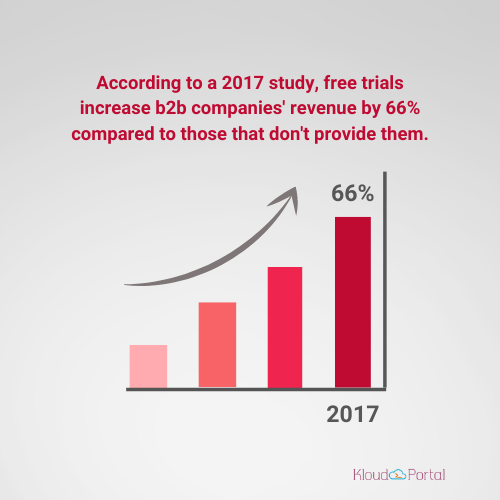
b2b businesses that offer free trials generate 66% more revenue than those that don't
With the internet asserting such a huge influence on our lives, chances are we’ve all been scammed at least once.

This is where free trials come into play.

Free trials are such an excellent way for your potential customers a taste of what your product offers without asking for any commitment from their end.

A study conducted in 2017 found that b2b businesses that offer free trials generate 66% more revenue than those that don’t.

Upon availing of a trial run for the product, customers can decide whether your product is worth their time and money. Moreover, free trials also help you weed out the tire-kickers from your customer base, which is always a good thing.

4. Easy-to-scale pricing model

With an increasing userbase, it’s evident that you’ll need to scale up your operations to accommodate the increasing demand for services.

Because no matter how great the idea, if it lacks a proper business model to bring in the bucks, the startup’s sustainability becomes questionable.

This is where a scalable pricing model comes into play.

pricing model
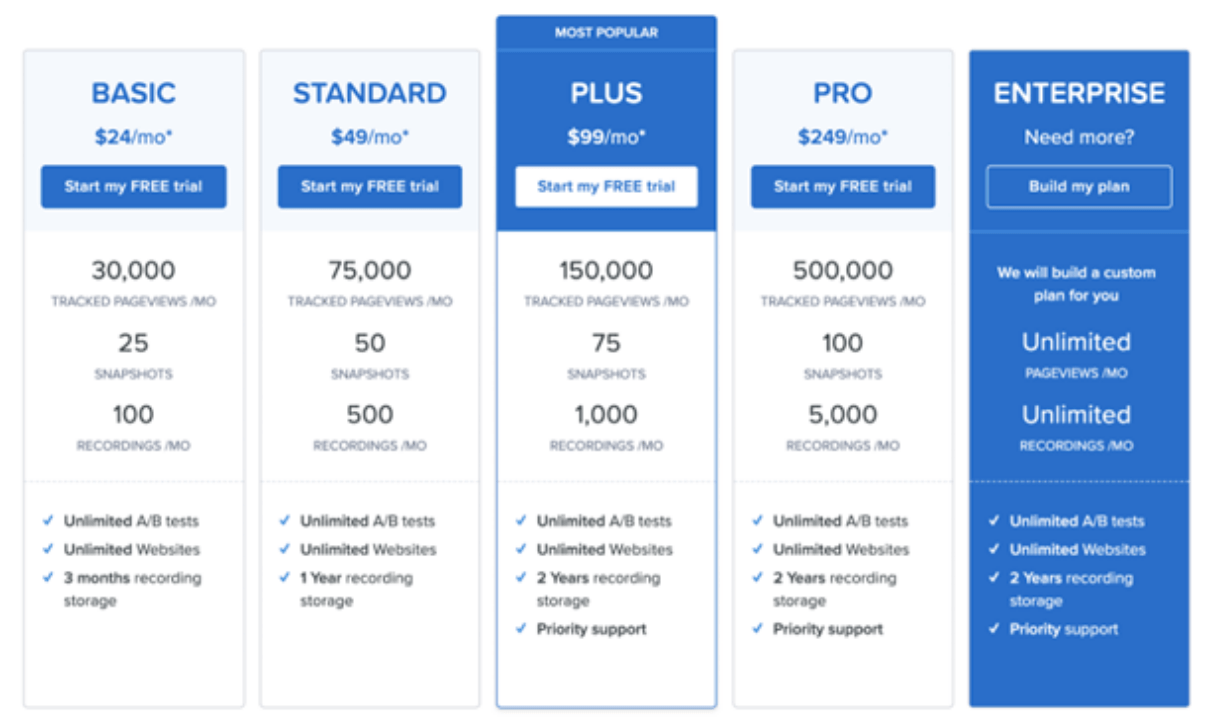
A scalable pricing model is one that can be easily adjusted to accommodate the changing needs of your business.

The best part about a scalable pricing model is that it allows you to generate more revenue as your business grows without altering the existing pricing structure.

This helps you stay competitive and ensures that your customers get the best possible value for their money.

5. Referral programs

Referral programs are an excellent way to organically grow your customer base while increasing brand awareness and loyalty among your existing customers.

Take the case of Cloud-services giant Dropbox. Currently valued at over $12 Billion, Dropbox gained its initial traction through a stellar referral strategy by offering 500 MB Bonus space for each user that signed up with their referral link.

This tactic took their user base from 100,000 to 4 Million in a matter of 15 months.

Unbelievable, right?

Well, People love free stuff.
Referral programs are always a win-win situation for you and your customers.

Your customers enjoy rewards for referring your product to others, and you get more customers without spending extra money on marketing or advertising.

6. Focus on customer storytelling

What unites customers?

Fancy ads? Random features? Cool UI?

Stories.

Stories can evoke an emotional response in people, which is often more effective than a logical or rational one.

Customer storytelling can be leveraged in multiple ways to help you achieve your business goals.

For instance, a creative story-driven marketing campaign can be used to show how your product or service has helped customers achieve their desired results.

You could also feature customer feedback experiences and post them on your marketing channels.

This helps build trust and credibility but also serves as a great way to showcase the features and benefits of your product or service.

7. Sell the problem, not the product

This is a rather counter-intuitive approach, but it works like a charm.

Often, customers aren’t aware that they have a problem until they come across something that emphasizes the same.

This is, in fact, the essence of every successful marketing campaign ever.

Instead of selling the features and benefits of your product, focus on the problem your potential customers might be facing.

If you’re selling a calorie-tracking tool, don’t just talk about how your product can help people lose weight. Instead, please focus on the emotional and physical pain that people go through when they’re overweight.

This helps you connect with your customers deeper and makes them more likely to invest in your product or service.

Conclusion

There you go. Seven stellar strategies to uplift your SaaS startup from that nascent phase of uncertainty.

One crucial aspect to be remembered here is that even the slightest improvement in your growth can profoundly impact your startup.

The opposite makes sense with the churn rates too.

But do you really need to monitor the entirety of your marketing funnel?

Sounds more like a hassle, doesn’t it?

Why not let the experts take over the marketing aspect of your business while you could focus on the daily bustle with your SaaS startup?

From starting up your marketing foundation to scaling it to the top, we offer a variety of specialized SaaS growth marketing services for software companies that reap results faster and in good numbers.

At KloudPortal, we are focused on helping our customers with result-oriented marketing strategies. We also write curated articles to help our clients and industry experts acquire knowledge on latest Marketing trends across all the industry segments.

Now that you are here, why not check out our other articles [ SEO Is vital for Digital Marketing. Here are the Top 5 reasons] & [7 Tips to Choose the Best Domain Name for Your Business] as well. If you would like to work with us for your marketing needs, please reach us here.


1. 66% more revenue

How Motivational Marketing Helps To Convert Your Leads To Clients

How Motivational Marketing Helps To Convert Your Leads To Clients

What we cover in this blog?

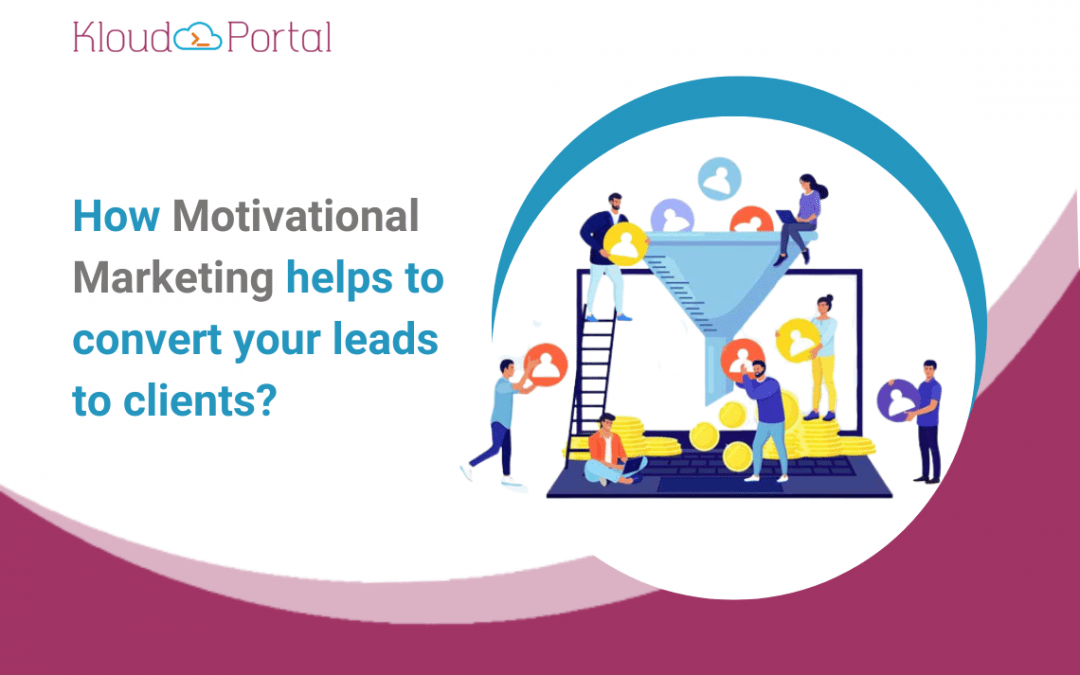
Marketing to customers who are already interested in your products can be a little simpler. However, building trust with someone who has never heard of your product or does not immediately require it may be challenging. Isn’t that right? Each of us uses different strategies to promote our goods using numerous digital channels. Eventually, there is a strong possibility that numerous new leads may be interested in your products, but converting these leads into customers will be challenging.

How do you convert these leads to clients?

Generally, we all go with the following flowchart as marketing strategies for converting leads.

Build pyramid with motivational marketing to convert leads to clients

This conversion strategies flow chart becomes more efficacious when motivational marketing is used. Motivational marketing is a new and powerful way to convince people to get attracted to your product. As we all know, it’s important to understand the inner desires of your clients to fulfill their demands. This is because their instincts are the driving forces behind any purchase or brand preference. When you apply motivating tactics, it can cleverly raise interest in your target audience, eventually establishing brand loyalty.

Here are a few powerful tactics that assist you in effectively converting inquiries into a client base using this motivational marketing

  • Market research
    When researching your market and intending to generate leads, you must also conduct in-depth research on product demand and consumer behavioral patterns. This aids in identifying the appropriate lead who could be your prospect.
  • Know the customer profile
    Furthermore, for your motivational marketing, it is critical to understand your lead in detail, such as their gender, age, profession, income, and even their hobbies and interests. So that we can analyze how well your leads match the prospect of a positive customer profile and even have targeted marketing and quickly connect with your lead.
  • Get on sales strategy
    When we have the analysis to determine the target audience, you need to implement a sales strategy, such as


    • Promote the product.
    • Connect with the lead either face-to-face or use the power of social media marketing.
    • Send free samples or offer discounts and coupons.
    • Use blogs and articles to provide useful, informative content to assist them so that you can guide them.
    • You can even create content with graphics or animations to attract more visitors.
    • These days, you can even collaborate with influencers that the leads follow, and their promotion may encourage them to be more attracted to your product.
  • Service always on top
    When leads become prospects, you must provide the best service possible. It is always important to address client needs and maintain the customer portal to answer customer queries and provide effective solutions. Doing so will increase consumer confidence in the product and help them become a committed client.
  • Focused marketing
    Go with the focused marketing with your leads with regular follow-up via phone calls and email, informing them about new products, offers, and coupons. This will help your leads become more interested in your product. Moreover, the lead feels important when you follow up with them.
  • Build trust
    Aside from interacting with your target audience, another important goal of your promotional material should be to build trust. This is possible from customer feedback from your potential customers. When someone likes your product and leaves a good review or testimonial, these customer testimonials can instantly connect with your target audience and help you transform leads into clients. A survey suggests that 92% of clientsread reviews of potential purchases before making a decision.
  • How CRM helps
    CRM (customer relationship management) tools are frequently a key component of motivational marketing for any business, no matter how big or small. Your CRM tool can not only generate leads from various social networks, surveys, referrals, and so on. But with your CRM, you can get all lead-relevant data of yourleads, their actions, and purchase patterns and allow you to track and analyze lead profiles, such as the number of calls needed for conversion, types of leads most likely to convert, etc. It can also aid in implementing the automation of calls, and email communications can help streamline the entire conversion process.
  • Easy access
    Above all, Things, when simple, can motivate a higher conversion rate of leads into customers, such as simplifying your web experience, payment methods, and signing up new royal customers.

To summarize

We experiment with various marketing activities to generate new leads or with platforms and technologies to expand our business. Your best marketing strategies will ultimately directly impact the size of your client base and market expansion. When you use motivational marketing, you can create a strategy that uses a conventional viewpoint that encourages customers to buy your product. Your motivational marketing, a smart and effective technique, may not only help in successful lead conversion and get closer to your customers but also can develop a deeper understanding of their wants and needs, ultimately generating brand loyalty.

At KloudPortal, we are focused on helping our customers with result-oriented marketing strategies. We also write curated articles to help our clients and industry experts acquire knowledge on latest Marketing trends across all the industry segments.

Now that you are here, why not check out our other articles [ What do you need to know about Digital Marketing for your business? ] & [ How to choose the CRM for your Business and what pricing model matches your Business?] as well. If you would like to work with us for your marketing needs, please reach us here.

5 Major Benefits of Cloud Computing

5 Major Benefits of Cloud Computing

What we cover in this blog?

Cloud Computing is simply the technology that uses remote servers hosted over the internet called ‘Cloud’ to manage, process and store data instead of using the local servers.

Cloud computing has become growingly popular and widespread in recent years though it has been in the market for two decades. It is speedily becoming a necessity for organizations as it seems to save time and money, data security, and increase customer delight. Therefore, large portions of organizations are now turning to the cloud, weighing its benefits over traditional IT data centers and infrastructure.

Organizations need large storage to store data in databases. So, in the past, companies managed their servers, networks, and databases in a physical data center. But now, industries of all geographies are turning to cloud services. Cloud technology allows customers to access all features of the applications over the internet without having to keep the applications on their systems.

So, suppose an organization is planning or already using cloud services; in that case, it is vital to understand the basics and the benefits of cloud computing to make exclusive use of cloud-powered solutions. Cloud computing is of mainly four types – private, public, hybrid cloud, and community cloud. These cloud environments are deployed and defined according to the infrastructure and services needed.

Cloud computing services are broadly classified into four categories: platform as a service (PaaS), infrastructure as a service (IaaS), software as a service (SaaS), and serverless computing.

In this blog, you will discover the major advantages of Cloud Computing which will help reduce the maintenance cost
ofyour IT systems. So let’s explore!!

Major 5 benefits

Here are some of the benefits of Cloud computing we would like to share for you to consider.

Data security and quality control:

While adopting a cloud-computing solution, many organizations might have security concerns about how their data is being protected because all the data is kept onsite. Cloud offers data security more efficiently than a conventional system and has significantly advanced security features that ensure the data is securely handled and stored.The cloud environment is protected based on the category of cloud computing used in data centers.
Managing information is what the organization looks for, and the cloud’s ability to provide excellent data management is its most useful attribute. In a cloud-based system, data consistency is maintained and will have a clear record of any updates or updates.

Cloud computing is a necessity for organizations as it seems to save time and money, data security, and increase customer delight.

Cost reduction and efficiency:

Cloud Computing benefits are Cost savings. As it does not need any time and money on physical installations thus helps to reduce substantial costs. Cloud offers access to the latest services giving it a competitive edge over its competitors. Cloud applications allow faster deployment and quick service within a short time.

Reliability and increased collaboration:

Reliability is crucial for any business. Cloud uses its five design principles in the reliability pillar to create workloads that can consistently and optimally monitor the apps and software throughout their entire lifecycle.

Employee collaboration is a top priority in organizations. Cloud computing makes this point a simple process as team members can easily view and share information securely in the cloud platform. Some services connect employees across the organization by providing collaborative social media space, which increases interest and improves effective collaboration.

Storage and loss prevention:

Authentic cloud storage is more beneficial than traditional storage as it provides accessibility, easy sharing, and collaboration via the internet. The stored data is also easier to restore and back up when needed.

Loss of valuable data is a crucial part of the organization. Various reasons like viral infections, malfunction, or hardware deterioration lead to data loss if it is saved locally permanently. However, with a cloud-based server, all the uploaded information remains safe and easily accessible from anywhere with a broadband connection.

Mobility, agility, and flexibility:

Cloud allows easy and quick access to data for storing and retrieving information anytime or anywhere in the world over broadband. It ensures flexibility, easy accessibility, and scalability to businesses.
In cloud computing, the applications are rapidly developed, tested, and constantly launched in the changing environment. A cloud-based infrastructure is more flexible and increases the organization’s productivity by ensuring that data is always accessible using web-enabled devices such as laptops, smartphones, and notebooks.

Apart from the above major benefits, Cloud Computing has also some other advantages over traditional IT infrastructure, which include-

  • Web-based interfaces and control
  • On-Demand self-service
  • Always available
  • Provide you with low-cost software
  • Offers advanced online security
  • Allows pay-per-use
  • Fast and effective virtualization
  • API access available
  • Scales automatically adjust to the increase in demand
  • Multi-Tenancy
  • Location and device independence
  • Offers resilient computing

Takeaway

  • Cloud computing is a rapidly growing technology that almost every organization is switching to for growth and improving services.
  • Cloud services like Amazon Web Services (AWS), Microsoft Office 365, and Dropbox provide resources over the internet, including databases, servers, storage, networking, analytics, and software.
  • Clouds save businesses money, time, and other resources to maintain their IT infrastructure.
  • Cloud computing offers modern businesses advantages, including efficiency, flexibility, security, scalability, reduced costs, and increased collaboration.

At KloudPortal, we are focused on helping our customers with result-oriented marketing strategies. We also write curated articles to help our clients and industry experts acquire knowledge on the latest Marketing trends across all the industry segments.

Now that you are here, why not check out our other articles [ Content Marketing vs. Influencer Marketing: How to use both to achieve your marketing goals ] & [ Online Reputation Management (ORM) Services: What It Is & Why You Need] as well? If you would like to work with us for your marketing needs, please reach us here.
Contact us for more info.


1. Cloud Computing

Virtual Influencers Who Are They & How Do They Work

Virtual Influencers Who Are They & How Do They Work

While many of us use social media for a breather or colonial ties, others use it for promotional causes to reach a global audience. Indeed, at some point, we all might have been influenced by posts on social media platforms such as Twitter, Facebook, and Instagram. Isn’t it? Let us brace for the next phase, the era of virtual influencers. The virtual influencer is a piece of fiction, yet it will be the next major technological advance in the future years.

Who is a virtual influencer?

A virtual influencer is a kind of computer-generated imagery (CGI). To put it simply, they are digitally created characters that are aimed to be human-like in appearance, traits, and reactions. They can sway public perception through social media posts, blogs, and tweets. In fact, behind each virtual influencer, there will be a creative team working for brands or individuals with fair technical advances. They have complete control over their style and reactions and keep updated on online communities to fit the inclinations of their targeted audience.

When did virtual influencers begin to sway?

Today while virtual influencers may appear to be a new trend, did you know they’ve actually been around for quite some time? In reality, Virtual influencers appear to be developed from the concept of virtual idols, which was first developed in the 1980s Japanese animations. Since then, different virtual influencers have developed as entertainers, vocalists, and hosts, as well as in commercial marketing, and the era has begun.

Who among them has the most public recognition?

After the age began, several virtual influencers gained notoriety and were able to sway audiences. Check out the process of development.

First here is Ludo Magalu. If you’ve heard of virtual influencers, you’ve probably heard about Ludo Magalu, the world’s top virtual influencer from Brazil with the most social media followers. Ludo Magalu is a virtual influencer created to promote and market Magalu, Brazil’s largest retail brand. Later she started by promoting iBlogTV on behalf of Magazine Luiza and afterward started sharing product reviews, unboxing videos, and software tips on her social media account from the year 2009.

With over 3 million followers, the next most popular influencer is Lil Miquela, a well-known American virtual influencer who endorses streetwear and luxury brands such as Prada, Calvin Klein, Nike, and Samsung. When she made her debut during Milan Design Week in 2018, she puzzled the audience as to whether she was a real personality or a virtual one. She quickly took over the fashion house’s social media profile.

Virtual influencers provide companies with an innovative and fresh approach to communicating with their audience.
Later on, it was luxury fashion firms that welcomed virtual influencers as a trend. In 2018, the French luxury fashion label Balmain unveiled virtual models Margot, Shudu, and Zhi as fashion models. There was no stopping after that as if the doors had been unlocked. Other businesses and brands quickly adopted the same concept. Today, we have over 200 virtual influencers working for different brands, and here are a few to list.

  • Imma is a renowned influencer who works with popular brands such as Puma, IKEA, KFC, Porsche, Magnum, Nike, Dior, Calvin Klein, Valentino, Lenovo, Amazon, Lenovo… and she has also made an appearance at the Tokyo 2020 Paralympic Games closing ceremony.
  • Noonoouri, a virtual influencer from Germany, has not only taken the fashion business by storm by collaborating with the majority of top luxury fashion labels, like Versace, Lacoste, and Bulgari. She educates her audiences on various social problems in addition to fashion.
  • Shudu Gram is a well-known South African virtual Instagram influencer who is generally recognized as the World’s First Digital Supermodel and even walked the first red carpet at the 2019 BAFTA film awards. She has been associated with brands such as Balmain, Cosmopolitan, Samsung, Vogue, The Dubai Mall, Chanel, Bulgari, and WWD.
  • Maya Gram, a virtual influencer, has been appointed as a Puma brand ambassador for influencer marketing.
  • To promote the new season of Upload, Amazon worked with four different virtual influencers: Aliza Rex, Binxie, FNMeka, and Ruby 9100M.
  • The World Health Organization collaborated with Knox Frost, a 21-year-old AI, to raise COVID awareness.
  • KFC has released a CGI model of Colonel Sanders to meet the next generation of marketing products and services.

While the list continues to grow, Today India has also gone on board, launching its first virtual influencer, Kyra, in December 2021. While Kyra’s journey with collaborators has just begun, it is AI-controlled computer graphics software that will empower her to monitor social media trends online and create material autonomously. Although there are a slew of influencers and brands operating behind the scenes. Let’s see

How do virtual influencers work?

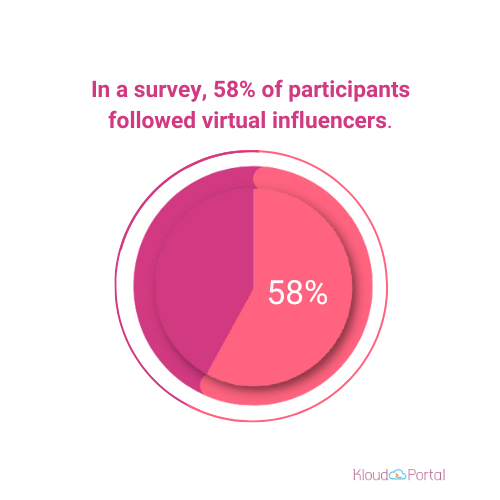
According to a survey report, 58 percent of people among the surveyors followed at least one virtual influencer. This explains how quickly these virtual Influencer trends are taking traction. Just like real influencers, virtual influencers can also influence the audience’s mind. Today, everyone is keen on the latest trends and brands to follow to keep ahead of the pack. Virtual influencers with an AI-controlled system can help to create a new trend and influence people by catching the pulse of the audience curve easily. Moreover, it can reach out to an entire audience in one stretch.

In contrast to real influencers, virtual influencers provide companies with an innovative and fresh approach to communicating with their audience. Moreover, companies can have full control over virtual influencers, as they are extremely versatile and can cut down marketing costs. Not only are purchasing impulses virtual influencers, but they can also cause social responses and behavioral change.
Virtual influencer marketing may be an alternate choice for firms looking to add a distinctive twist to their marketing strategy other than the digital marketing flywheel. Because virtual influencers have few practical limitations and with an alluring continuous relationship, virtual influencers can be one of the smartest prospects to connect with audiences. However, before you pick a virtual influencer for your brand, remember to assess your target audience and design the perfect influencer- a personality as rich and relevant to your market. Of course, there is no one-tier model for successful marketing, but practically every firm may benefit from engaging virtual influencers with proper execution. So, Let’s see how a virtual influencer leads in the coming years.


1. 58 percent

5 Step Guide To Build A Product Using AI and ML

5 Step Guide To Build A Product Using AI and ML

Artificial intelligence is the new passion of the technology world (AI). This technology is used in all company areas, from sophisticated data science to automated customer support. Product managers may scale data analytics, advance research, automate tasks, and notify users, thanks to machine learning (ML). Let us understand what AI/ML is and how this new technology works.

What is Artificial Intelligence?

Artificial intelligence (AI) refers to a machine’s or robot’s capacity to do actions normally performed by intelligent beings. Some examples of specific AI applications are frameworks, natural language processing, voice control, and machine vision. Conversational chatbots, self-driving cars, email spam filters, Siri, and Alexa, are a few applications of AI.

What is Machine Learning?

Machine learning (ML) is often incorporated into bigger systems in production settings. ML is used in production systems to train models to make recommendations that are used by the system. These forecasts may serve as the system’s essential foundation in some systems while serving as merely an ancillary component in others. At the same time, many conventional software systems incorporate ML for various “add-on” features.

AI is different from the traditional software development methodology.

Technology can establish the AI-enhanced User Experience (UX) for any product, organize the team’s efforts to construct the product’s features, and deploy the solution. In contrast, the user’s pain issue is still present. But when an AI product is involved, the problem is to do all that while still working within the limitations of rapidly advancing technology,which is expensive and requires in-demand skills to build it out, and the necessity to be able to provide the features in time for launch. In an expensive AI, a project avoids pitfalls that could result in delays of several months or, worse, the failure of the entire project. Too frequently, mistakes like incorrectly defining the ML problem, using insufficient data to train the models, and slowly iterating occur. Let us look at how to build an AI/ML product.

5 steps to build an AI/ML product:

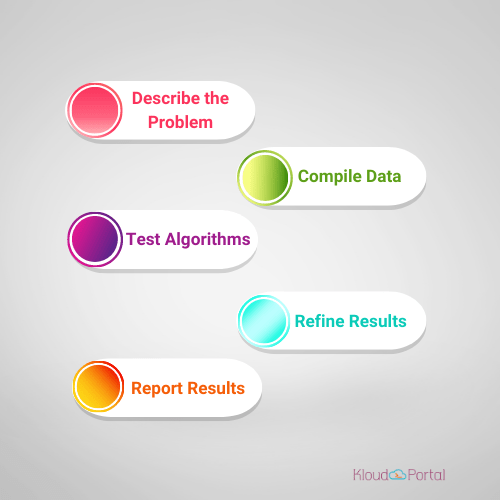
Create a process to solve problems swiftly with solid, reliable results. This method can be applied repeatedly to different projects. Faster access to reliable results is possible with more developed and sturdy processes. The steps involved in developing a process are:

  • Describe the problem
  • Compile data
  • Test algorithms
  • Refine results
  • Report results

1. Describe the problem

List assumptions and similar issues while providing a formal and informal description of the issue. Understanding the business needs is the first step in every machine learning project. Recognize the goals and needs of the project. The objective is to use this knowledge to create an appropriate problem statement for the machine learning project and to create a rough plan for carrying out the project’s goals. Setting precise, measurable objectives will enable the machine learning project to produce a meaningful return on investment.

2. Compile data

Focus on the data that is present, the missing data, and the data that can be deleted. A machine learning model is created by taking the knowledge gained from training data, generalizing it, and then using it to make predictions and achieve its goal. Determine the data’s requirements and whether it suits the machine learning project. The main points of attention should be the identification of data, initial data gathering, requirements, quality identification, insights, and possibly intriguing features that merit additional examination.

3. Test algorithms

After the problem has been discovered and the data has been transformed into a usable state, it is time to train the model to draw lessons from the high-quality data that have been prepared by utilizing various techniques and algorithms. This stage calls for the choice and use of a model technique, model training, model validation, model development, and testing, algorithm choice, and model optimization.

4. Refine results

In AI, evaluation entails analyzing model metrics, calculating confusion matrices and model performance metrics, assessing model quality, and ultimately deciding whether the model can achieve the business objectives. Model version control and iteration, model deployment, model monitoring, and model staging are among operationalization considerations in development and production contexts.

5. Report results

The results are useless if a complex machine learning problem is not applied. Usually, this refers to a presentation to stakeholders. Model operationalization might involve generating a report or a multi-endpoint deployment, depending on the requirements. Always go through the process and tweak things to improve the next iteration. Changes in business requirements. Changes in technology’s capabilities. Actual data is subject to unforeseen changes. All of these can result in the model’s deployment specifications changing for various endpoints or brand-new systems.

Few easy steps in building an AI and ML product

Let us look into the aforementioned in detail.

AI is a highly specialized field that is challenging to comprehend. A lot of expertise and a specific set of talents are required to develop algorithms that can enable machines to think, develop, and optimize business activities.

It’s important to determine the user experience (UX) metrics and the business’ Key Performance Indicators (KPIs). The inputs for the ML model should be accessible at the time of inference, and the outputs should be able to be annotated by humans with only the inputs as context. Select the machine learning (ML) approach that is most appropriate to develop the model for the AI solution.

Establish accuracy and forecast time goals based on the UX and user benefits’ objectives to define the success criteria for AI solutions. Prioritizing use cases aids in selecting the ideal ML algorithm, the model architecture, and the formation of a data science team with the necessary skill set and experience to achieve the solution.

Any model needs data to function, and there is no good substitute for using training data collected under the same circumstances as the in-production environment. On the output side, obtaining clear, high-quality data is more crucial than devoting effort to model improvement. To create a good user experience, use an internal or cloud architecture with flexibility for constructing the AI solution. Engineering features employing scaling, attribute deconstruction, and attribute aggregation will transform preprocessed data to be ready for machine learning.

It is possible to successfully integrate the ML model with the services supporting it by developing end-to-end model training procedures, having Human-in-the-Loop failure preventions, employing effective strategies, and using a combination of synchronous and asynchronous messaging services.

A collaborative review process with a “guild” of industry professionals can help ensure that the chosen strategy is strong, optimized, and keeps up with rapidly evolving technology.

Systematically enhance model performance using a model, hyperparameter, and data versioning. Establishing the model and data increases the frequency and reliability of model deployment into production. Give benefits to users and value to stakeholders by iterating quickly on AI/ML products.

Benefits of incorporating AI/ML:

  • Authenticity
    Artificial intelligence in operations will assist in eliminating human mistakes and assure reliable output.
  • Predictions
    Accurate estimation and predictions made by processing large amounts of data can help with future planning and corporate objectives.
  • Quality assurance
    Machine learning can improve business processes by spotting anomalies in them.
  • Analysis Artificial intelligence (AI) and machine learning (ML) speed up data processing and programming, which helps us make better judgments.

Conclusion:

Using AI or ML alone is only a good beginning. Nearly everyone in businesses will soon be utilizing AI or ML in some capacity. Finding the correct data and figuring out how to use it to develop an innovative product that thrills users are key components of successful AI product management. Think about the aspects of your model that have worked, need improvement, and are still under development. The only definite method to succeed when developing machine learning models is always seeking new approaches to suit changing business needs.

Get in touch with us.

We use cookies to ensure that we give you the best experience on our website. If you continue to use this site we will assume that you are happy with it.

Cookies settings
Accept
Privacy & Cookie policy
Privacy & Cookies policy
Cookie name Active

Privacy Policy

What information do we collect?

We collect information from you when you register on our site or place an order. When ordering or registering on our site, as appropriate, you may be asked to enter your: name, e-mail address or mailing address.

What do we use your information for?

Any of the information we collect from you may be used in one of the following ways: To personalize your experience (your information helps us to better respond to your individual needs) To improve our website (we continually strive to improve our website offerings based on the information and feedback we receive from you) To improve customer service (your information helps us to more effectively respond to your customer service requests and support needs) To process transactions Your information, whether public or private, will not be sold, exchanged, transferred, or given to any other company for any reason whatsoever, without your consent, other than for the express purpose of delivering the purchased product or service requested. To administer a contest, promotion, survey or other site feature To send periodic emails The email address you provide for order processing, will only be used to send you information and updates pertaining to your order.

How do we protect your information?

We implement a variety of security measures to maintain the safety of your personal information when you place an order or enter, submit, or access your personal information. We offer the use of a secure server. All supplied sensitive/credit information is transmitted via Secure Socket Layer (SSL) technology and then encrypted into our Payment gateway providers database only to be accessible by those authorized with special access rights to such systems, and are required to?keep the information confidential. After a transaction, your private information (credit cards, social security numbers, financials, etc.) will not be kept on file for more than 60 days.

Do we use cookies?

Yes (Cookies are small files that a site or its service provider transfers to your computers hard drive through your Web browser (if you allow) that enables the sites or service providers systems to recognize your browser and capture and remember certain information We use cookies to help us remember and process the items in your shopping cart, understand and save your preferences for future visits, keep track of advertisements and compile aggregate data about site traffic and site interaction so that we can offer better site experiences and tools in the future. We may contract with third-party service providers to assist us in better understanding our site visitors. These service providers are not permitted to use the information collected on our behalf except to help us conduct and improve our business. If you prefer, you can choose to have your computer warn you each time a cookie is being sent, or you can choose to turn off all cookies via your browser settings. Like most websites, if you turn your cookies off, some of our services may not function properly. However, you can still place orders by contacting customer service. Google Analytics We use Google Analytics on our sites for anonymous reporting of site usage and for advertising on the site. If you would like to opt-out of Google Analytics monitoring your behaviour on our sites please use this link (https://tools.google.com/dlpage/gaoptout/)

Do we disclose any information to outside parties?

We do not sell, trade, or otherwise transfer to outside parties your personally identifiable information. This does not include trusted third parties who assist us in operating our website, conducting our business, or servicing you, so long as those parties agree to keep this information confidential. We may also release your information when we believe release is appropriate to comply with the law, enforce our site policies, or protect ours or others rights, property, or safety. However, non-personally identifiable visitor information may be provided to other parties for marketing, advertising, or other uses.

Registration

The minimum information we need to register you is your name, email address and a password. We will ask you more questions for different services, including sales promotions. Unless we say otherwise, you have to answer all the registration questions. We may also ask some other, voluntary questions during registration for certain services (for example, professional networks) so we can gain a clearer understanding of who you are. This also allows us to personalise services for you. To assist us in our marketing, in addition to the data that you provide to us if you register, we may also obtain data from trusted third parties to help us understand what you might be interested in. This ‘profiling’ information is produced from a variety of sources, including publicly available data (such as the electoral roll) or from sources such as surveys and polls where you have given your permission for your data to be shared. You can choose not to have such data shared with the Guardian from these sources by logging into your account and changing the settings in the privacy section. After you have registered, and with your permission, we may send you emails we think may interest you. Newsletters may be personalised based on what you have been reading on theguardian.com. At any time you can decide not to receive these emails and will be able to ‘unsubscribe’. Logging in using social networking credentials If you log-in to our sites using a Facebook log-in, you are granting permission to Facebook to share your user details with us. This will include your name, email address, date of birth and location which will then be used to form a Guardian identity. You can also use your picture from Facebook as part of your profile. This will also allow us and Facebook to share your, networks, user ID and any other information you choose to share according to your Facebook account settings. If you remove the Guardian app from your Facebook settings, we will no longer have access to this information. If you log-in to our sites using a Google log-in, you grant permission to Google to share your user details with us. This will include your name, email address, date of birth, sex and location which we will then use to form a Guardian identity. You may use your picture from Google as part of your profile. This also allows us to share your networks, user ID and any other information you choose to share according to your Google account settings. If you remove the Guardian from your Google settings, we will no longer have access to this information. If you log-in to our sites using a twitter log-in, we receive your avatar (the small picture that appears next to your tweets) and twitter username.

Children’s Online Privacy Protection Act Compliance

We are in compliance with the requirements of COPPA (Childrens Online Privacy Protection Act), we do not collect any information from anyone under 13 years of age. Our website, products and services are all directed to people who are at least 13 years old or older.

Updating your personal information

We offer a ‘My details’ page (also known as Dashboard), where you can update your personal information at any time, and change your marketing preferences. You can get to this page from most pages on the site – simply click on the ‘My details’ link at the top of the screen when you are signed in.

Online Privacy Policy Only

This online privacy policy applies only to information collected through our website and not to information collected offline.

Your Consent

By using our site, you consent to our privacy policy.

Changes to our Privacy Policy

If we decide to change our privacy policy, we will post those changes on this page.
Save settings
Cookies settings