What is SaaS Product Marketing | SaaS Product Roadmap

What is SaaS Product Marketing | SaaS Product Roadmap

I am always fascinated by SaaS products. Every product that is designed, developed and released solves a market problem. Closely monitored and carefully designed, most of the SaaS products, I feel, add a lot of value to its users. But I always wondered why we only see less than 1% of the SaaS products succeeding? Why do the SaaS products lose their shine? One key aspect that we found was the gap in marketing and sales. In this article, we highlight the core marketing steps for every SaaS product to succeed

Many entrepreneurs dream of building their SaaS products and in helping the market with their solutions. The beauty of every SaaS product is there is a passion to solve a problem that can affect millions of lives. Facebook, Twitter, Salesforce, Zoho, all are SaaS products that have identified certain gaps in the market and have developed appropriate solutions to fill the gaps or solve a problem.

Then you may be wondering, when so many SaaS product companies exist, why only a handful of them reach the market potential? What do they do differently, than other SaaS product companies that reach a success criterion and capture a large market share?

What is SaaS Product Marketing?

SaaS Product Marketing is the process of creating market awareness about a problem and how your product can solve it. The objective of SaaS product marketing is not always focused on increasing the number of subscriptions alone but also creating awareness in the market about a possible problem this product can solve.

Marketing Vs Sales.

Many Product owners are often confused between Marketing material and Sales Material. While marketing material is more focused on “What” of a problem statement, Sales collateral focuses on “How” of a problem statement.

Most of the SaaS marketing collateral focusses on helping customers understand the features of a product. While we advise you to focus on “What” of the problem statement in your marketing collateral. What problem you saw in the market and a high level picture of how your product solves that problem.

A detailed walkthrough of your solution should be the part of your Sales pitch and your product demos.

Identify Target Market

Identifying your marketing channels plays a major role in strategizing your marketing plan. Geographics, Demographics and Psychographics of your Target audience segment plays a significant role in successful execution.

Identify your Market.

TAM – Target achievable Market,
SAM – Serviceable Available Market and
SOM – Serviceable Obtainable Market.
The goal of SaaS Product Marketing is to effectively reach your SOM.

Eg., Say you have developed a SaaS product that is a Management Software. Typically, your feature list includes Admin Panel, Workflow Management, Calendar, Task Management, Integration plugins (Eg., Shopify & Magento), E-commerce Modules etc.,

TAM – All the organizations/companies across the World who use Software in their organizations.
SAM – All the organizations/companies that sell their products online are your SAM
SOM – All organizations/companies/small businesses that are using Shopify or Magento as their e-commerce platform.
Typically your SOM is 6 percent of your SAM market.
The above metrics is not only important for a marketing plan, but is also the most demanded one to be included in your business plans, if you are going for investments.

How is SaaS Product Marketing different from Traditional Services marketing?

Marketing efforts vary based on the type of product, service and market segments we try to reach. For example a Consumer based SaaS product like Uber App has a different set of audience, different demographics and Psychographics, where as a SaaS product like Salesforce has a different objective focussed on the B2B segment.

The difference between SaaS Product Marketing and Traditional services marketing is huge and they are two different segments which have to be looked up independently. There are several factors based on which a strategy is designed. For Eg., Target Market, Demographics, Culture, Psychographics etc., play a significant role.

When should SaaS Product Marketing Start?

Many SaaS product owners are quite confused on when their marketing campaign should start. Often most of the SaaS Product owners engage the marketing team at a much later stage, and often don’t see the results quickly.

The best time to start your SaaS Product marketing is when you are half way through your MVP 0. When the marketing team starts working with you, you have to have few things already in place – Your Competitors list, Your Target Market/audience defined and most importantly your digital presence which includes a basic website, Social media channels etc.,
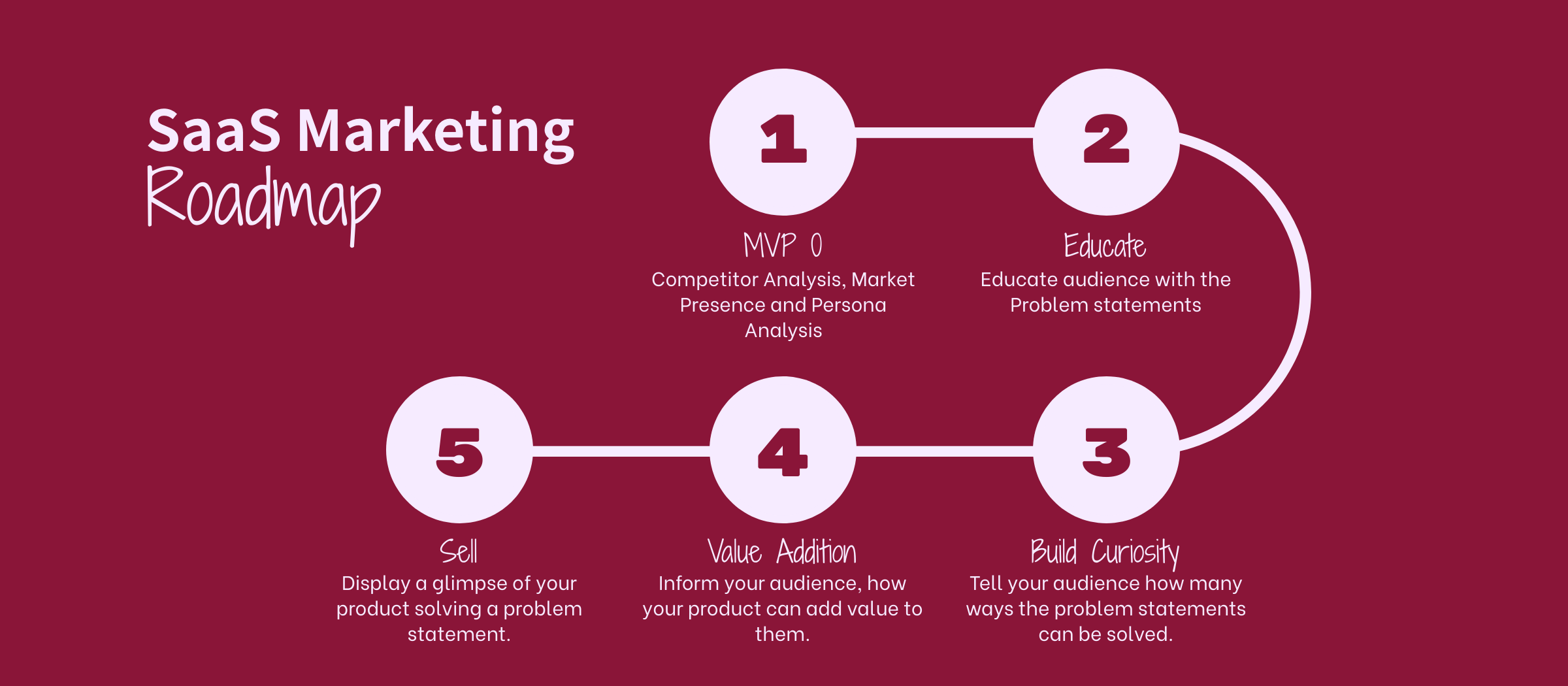
SaaS Marketing RoadmapThough SaaS product development itself is less than two decades old, our fascination to study the SaaS Product roadmap has never ended. We keep updating ourselves with latest techniques, market shifts and marketing tools to take SaaS products in to the market. Stay tuned to this space, as we will be coming up with more articles on SaaS Product Marketing. If you want to explore more about SEO techniques please checkout our recent blogs around it. Want to know about Instagram hacks, we have an article for you too.

The Digital Marketing Flywheel

The Digital Marketing Flywheel

We have heard about many business models that define a company’s revenue and growth vision. Coming to marketing, funneling the leads and engaging the leads was always a point of discussion. However, identifying your flywheel in your business is the key to move up the ladder from being a startup to enterprise. And it is essential to remember that it does take time to identify the flywheel and the key players who turn the wheel.

Being a Digital Marketing agency with over seven years of experience, here we present you the Digital Marketing Flywheel.

As we always advocate, Digital Marketing is not a one person’s job. And true to that, we have experienced this flywheel in KloudPortal, where the wheel is turned by each of the stakeholders.

Digital Marketing Flywheel for Kloudportal.

Every member in the team turns the wheel effectively, to give enough momentum to our marketing efforts. An SEO expert extensively works on Search Engine Optimization techniques which are both On-page and Off-Page. Keeping in tune with the Google’s search engine optimization updates, Bing and Yahoo search engine updates, understanding the key ranking factors, our SEO expert is constantly evaluating our website’s performance as per search engine’s guidelines.

Off Page SEO experts – guided by the latest guidelines, Off-page SEO experts work continuously with an objective to drive traffic to the website. On an average, making 30-40 submissions in a day, fine tuning their submissions to drive more and more quality referrals to the website.

Search Engine Marketing Experts – This team focusses on bringing in search engine traffic to the website. Optimizing our display advertisements, search ads on Google, Yahoo and Bing they consistently work on improving the search appearance, managing the ad budgets and improving the ad performance.

Social Media Marketing – Social Media has become an inevitable part of life. Keeping a track of social media behaviors of our prospects, identifying the right social media channels suitable for our business, strategically presenting KloudPortal on social media channels, driving engagement and traffic to the company pages. Users triggering call to actions on social media posts, has been driving considerable quality traffic to our website.

Digital Marketing Flywheel for KloudPortal.

Content Writing – This team focuses on developing value added content for our prospects. Consistently writing about latest google updates, changes and suggestions as proposed in Google, keeping an eye on the search engine ranking parameters, this team adds value to the visitors coming to our website.

Content Marketing – Creating content and just leaving it there on the website, doesn’t help much. The value added content should reach the audience on different channels. Hence our content marketing team focuses on sharing the KloudPortal blogs on various channels, websites and social media handles. They focus on taking KloudPortal content to the eyes of our prospects and customers.

PR Marketing – This team focusses on taking the KloudPortal’s work to larger audience through Press Releases. Working exclusively with Medium.com and EIN presswire, this team analyzes the audience reach and optimizes the Press Releases accordingly.

SMS Marketing – A 121 channel to reach our prospects, SMS Marketing has played a key role to bringing great prospects to KloudPortal. The team focuses on driving attention of the prospects by keeping the message crisp and clear with an intentional Call to Action.

E-mail Marketing – Reaching prospects on their personal e-mails, delivering value added content to their inboxes, have attracted valuable prospects for KloudPortal. Many B2B customers have reached us for their marketing needs.

How we measure the flywheel performance?

We define KPIs for each stakeholder in the flywheel. While they enjoy doing their work, each stakeholder is excited to share their results and observations. They consistently plan to improve their performance, thereby adding momentum to the flywheel.

Typical KPIs that we use to measure our stakeholder’s performance include:

  • Website Performance
  • Traffic Analysis
  • Goals and Conversions
  • Submission Rates
  • Engagement Rates
  • Measuring our SEO RoI

While we build the flywheel model and execute it successfully for ourselves, we help our customers identify their Digital Marketing flywheel and execute it for them too.

Our experience has shown that, every organization’s Digital Marketing flywheel varies. A service based company sees a different digital marketing flywheel, and the same does not work for a product based company.

Want to know which digital marketing flywheel model is correct for your business? Book a strategy call with us. Fill the Contact us form today with your details, and our team will be with you as soon as possible.

Facebook Announces New Name: Meta

Facebook Announces New Name: Meta

“Today, we’re seen as a social media company, but in our DNA we are a company that builds technology to connect people,” Zuckerberg said at the company’s Connect meeting on Thursday, where he unveiled a chain of new products and goals around the metaverse. “It is time for us to adopt a new company brand to incorporate everything that we do, to reflect who we are, and what we hope to build.” Then he announced a new name for the company: not Facebook, but Meta.

FB is one of the best iconic brands in the world, and that used to suit Zuckerberg just fine. In 2019, he slapped the FB name on his company’s other products—Instagram, WhatsApp, Messenger, and Oculus—to recap people that Facebook is not just Facebook, but “a family of apps.” But now, Mark Zuckerberg said on Thursday, “our brand is so tightly linked to one product that it can’t possibly represent everything we’re doing today, let alone in the future.” The new name is intended to signal that future: one beyond social media, and beyond all the bad news.

Facebook’s rechristening as Meta has some elements of all three. The company wants to describe themself as a “metaverse” company, not just a creator of social media products. And Zuckerberg wants more of a hand in those new pursuits, rather than overseeing the Facebook app. The company also seeks a way out of the past few years of everyone dunking on Facebook, a name that’s become synonymous with mistrust and skepticism (not to mention conspiracy theories and genocide).

The crucial 6P’s for building a brand

The crucial 6P’s for building a brand

A brand is a name, symbol, term, or any other specific attribute given to a product or service by the seller. It becomes an identity in itself and is used to distinguish these products from similar ones in the market.

What is the importance of a brand name?

A brand name is often memorable, and it resonates with the target customers. It sticks in their minds and helps to build and maintain trust with your consumers. Branding is an asset that can create sales and bring in revenue for the company. Customers find comfort, happiness, loyalty, and positivity in your brand. A good brand can make an ever-lasting impression on the customers and hence you will have loyal customers through various generations. So, now that we understand how crucial branding is, let’s find out how to build or grow your brand?

The six crucial elements to create a strong brand image

What makes a brand stand out, and what makes another one fail? What makes one brand capture the market faster than its competitors? How can a brand make a memorable impression on the target audience? Let’s dig deep to get answers to these.

There are six essential elements which when paid attention to, can help you build your brand or make it successful. These are:

The six crucial elements to create a strong brand image

1. Positioning: Before you position your brand in the market, it is important to do your research. It would help if you understand your target audience and why they should buy products from you and also understand the difference between you and your biggest competitor.

Positioning can be done by using positioning maps which are easy to use and very powerful. Positioning tells how you are useful to the customer. You can fill the positioning map in a way such that your brand fills a gap in the market, or you can compete with your competitors by placing it in the same place as theirs. After positioning, make sure you give a positioning statement that is nothing but a Unique Value Proposition(UVP).

2. Promise: A brand promise is the expectations that a company puts in to customer’s head. A brand promise is good only when it is kept, or else it can lead to loss of trust and hence decline in sales revenue. So always promise the customers what you can deliver, and if you promise something, try to make it true.

3. Personas: These are ideal customers for your brand. There are different ways to get data of your buyer personas, like checking Google Analytics or social media profiles, observing them at hanging out places, or talking to them on the streets. Knowing more about them will help to build a better brand strategy for the target audience.

4. Personality: It is essential to create a brand personality. A brand personality will help your customers to get connected with your brand emotionally and will also give a ‘human’ touch to your brand. Developing awareness or defining your brand personality will help you face your customers and talk to them better.

5. Product: A product doesn’t refer to features around it, but it also refers to the customers’ complete experience when they interact with it. So make sure you bring about the best experience for the customer in all phases, like before purchase, during purchase, and after purchase. These kinds of services can differentiate you from your other competitors in the market.

6. Pricing: This is an important element that will help you generate revenue and run your company effectively. Pricing reflects the actual value of your service or product and its perceived value in the customer’s mind. If the price is too low or too high, it may lead to losses and failure of your brand. The three commonly used pricing models are cost-based pricing,value-based pricing, and competition-based pricing.

Takeaway

There is no doubt that branding is a very important part of marketing as it influences the decision-making of not only the customers but also employees and investors. This influence is significant if you want your company to be commercially successful. So use the 6P’s listed by us and grow your brand and your revenue.

If you are concerned about your website’s SEO or rankings, check out our SEO Strategy and Services. Our leading digital marketing agency is a one-stop solution for your multiple problems. Contact us today to get a quote on our SEO Services.

Top 5 SEO trends of 2021 that are hard to ignore

Top 5 SEO trends of 2021 that are hard to ignore

Search engine optimization (SEO) is one of the effective ways of any marketing plan to improve traffic and attract users to your business. As SEO is constantly changing, sometimes it might be difficult to keep up with the latest Google search trends that boost rankings and improve your site’s visibility on the search engines. However, it is essential to be up-to-date, and the benefits are worth the effort.

Search engine optimization is a set of metrics for optimizing your website to drive more organic traffic, improve the visibility of your website and achieve high rankings in search engine results pages (SERPs). Good SEO practices increase the quality of your website by making it faster, user-friendly, and easier to navigate.

Top 5 SEO trends in 2021

In this blog, you will discover the list of top five SEO trends for 2021 to improve your website’s rankings on the search engine results page. Let’s have a look!

1. Boot up voice search

The SEO community is buzzing about voice search, which will enhance your chances of appearing in featured snippets. Over 27% of the entire global population uses voice search, and its popularity is increasing.

One of the key reasons for its popularity is the precision of voice transcription. The introduction of Alexa, Siri, Cortana, and smart speakers such as Apple HomePod, Amazon Echo, have also contributed to the increase in the popularity of voice search. Voice searches are often specific and long-tail keywords, so make sure that your content will tailor to the pure language.

Therefore, optimizing your content for voice searches would be the best strategy to succeed in the search results, which will continue to trend in 2021.

2. Dominate with Artificial intelligence

Another trend to consider is Artificial intelligence. Similar to most industries, AI is changing SEO as well. From Alexa to Siri, Artificial intelligence spreads everywhere, and it is the future. Personalization of AI provides the users with the focused content they are searching for. Many companies like Frase, HubSpot, and MarketMuse are providing AI-based solutions which help companies with their SEO efforts. So, AI is becoming a significant trend in the content marketing industry. AI-driven content will deliver the best results for the searched queries, such as AI-powered chatbots.

3. Courting Core web vitals for UX

Google introduced Core web vitals as a ranking factor in 2021 shows that incorporating page experience into your SEO is an increasingly important metric to improve your website’s performance, maintain search rankings ahead of the algorithm updates, and improve user experience and conversions.

Core web vitals are a set of metrics used for measuring the overall user experience on a website, such as interactivity, loading, page speed, and visual stability. Many popular tools like Lighthouse and PageSpeed Insights are dedicated to give more concrete recommendations for UX improvement and help websites better rankings.

4. Video marketing dominate the digital marketing

Video marketing dominates digital marketing in 2021

People like to watch a short video rather than reading a long page of written content. After Google, YouTube is the second most popular search engine with more than a billion users. Google recognizes this, so web pages with a video supporting written content will often appear on the first page of results.

So it’s high time to get started and optimize your video content using keywords to reach the targeted audience. Make sure not to overload the description with keywords but provide a user-friendly narration of your channel.

5. Visibility through local search optimization

Local SEO took a hit in 2020 because COVID-19 has encouraged people to rely on their smartphones to get nearby results. Therefore, over the past few months, local search has become increasingly important, and people started supporting small local businesses. Google has always supported searches related to local businesses by using ‘search near me’. Hence, Add your business information to local listings across multiple search directories for all your locations to improve your local search rankings.

Conclusion

The SEO performance of a website depends on many metrics. It is essential to implement the latest SEO trends while optimizing SEO to maintain your site’s rankings well in the SERPs.

If you are concerned about your website’s SEO or rankings, check out our SEO Strategy and Services. Our leading digital marketing agency is a one-stop solution for your multiple problems. Contact us today to get a quote on our SEO Services.

7 biggest SEO keyword research mistakes that you should avoid

7 biggest SEO keyword research mistakes that you should avoid

What we cover in this blog?

Every web search begins with a keyword either by typing in the search box or using a voice search. The search engines will return the most relevant results based on the user query. Therefore, for creating a successful SEO for your website, it is essential to optimize your content with the right keywords. This helps to acquire a targeted audience for your site through search engines.

SEO Keyword research and its importance

SEO marketing campaigns kick start with the right keywords, hence keyword research in SEO is very important for boosting your rankings and search traffic. Keyword research means to discover words called ‘keywords’ that users will search in search engines to get relevant results from search queries.

A keyword is also termed as a search term and is the initial step for developing successful SEO for your business. It could be one or more words or phrases. Keyword research influences every task that you perform on your SEO, for example, on-page SEO, finding content topics, link building and content promotion etc.

For example, if you have chosen the wrong keywords that are not related to your content then this may misguide users thus lowering your overall rankings. Further, it will increase your site’s bounce rate and it may lead to losing potential users. Therefore, researching keywords helps you understand your target audience more effectively.

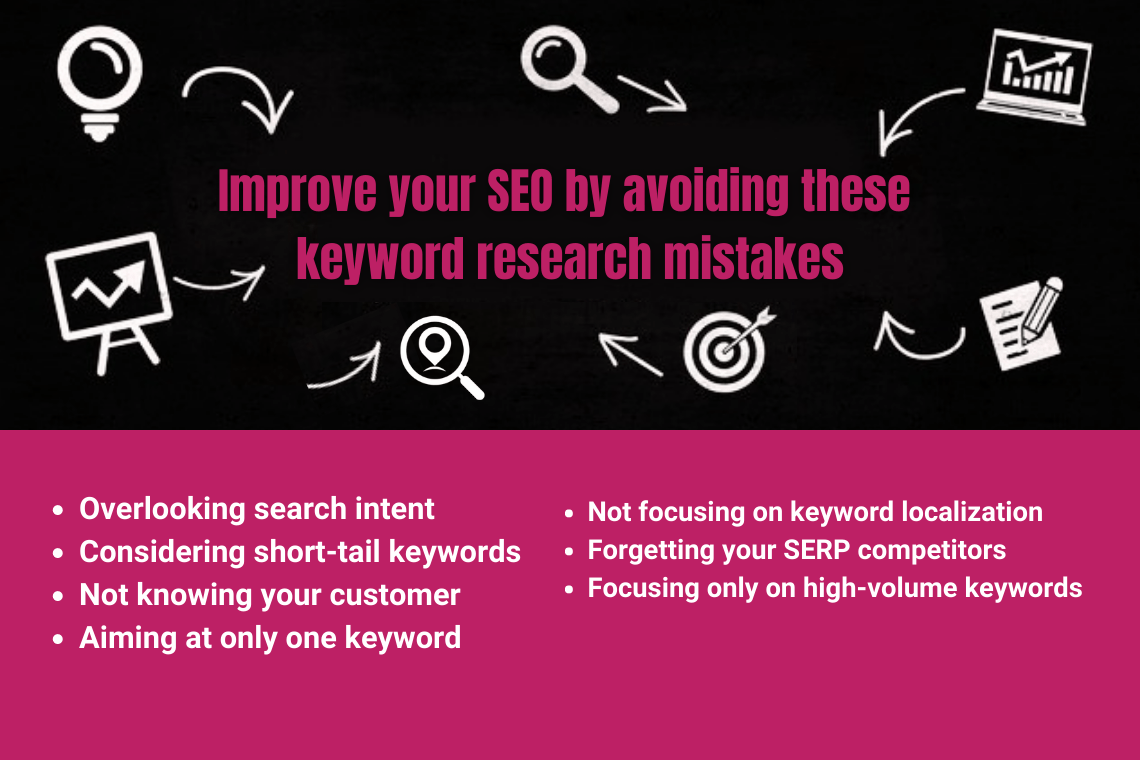
7 SEO keyword research mistakes to avoid

Check out these seven SEO keyword research mistakes that you should avoid for improving your SEO performance.

1. Overlooking search intent

User’s search intent is more important to optimize your content than focusing on how many users are searching a specific keyword. The keywords you use should be related to the intent of the people searching for that particular content. Understanding the audience will help you figure out what users are searching for to make your content the best option for them.

2. Considering short-tail keywords

Short-tail keywords are short, one-word keywords that are often initially used when discovering the content to write. However, focusing on short-tail keywords alone will result in poor results. Using more specific long-tail keywords ensures you cover a topic more widely and attract the audience with the content they will be more likely to convert.

3. Not knowing your customer

In any digital marketing strategy understanding your customer is one of the very first things you should do. Especially for keyword research, you should segment your customers by creating buyer personas. There are many other channels that users use as search engines.

Improve your SEO by avoiding these keyword research mistakes

Buyer personas help you to choose more targeted keywords and thus make your content more relevant to your customers. Pay attention to user’s different preferences.

4. Aiming at only one keyword

Working towards a single keyword could limit your reach as different users may phrase their search queries differently thus fail to rank for similar keywords. Frequently using the same keyword and optimizing for just one keyword could lower your SEO ranking. Instead of targeting one keyword, select the most searched key phrase, its synonyms and phrase them as related key phrases.

5. Not focusing on keyword localization

Keyword localization that is using keywords based on location, is necessary to improve the global success of a website. Customers in different locations do not use the same keywords when searching for a product. A strategic plan to localize your products or marketing campaigns can help you build a bridge to your targeted audiences and boost your brand in local markets.

6. Forgetting your SERP competitors

Analyzing competitor’s ranked keywords can help you determine the gaps in their current content that you could fill to boost your SEO ranking. It also gives you clues on what similar buyers are looking for and also lets you know current trends. Competitive research can also help in identifying the keywords you haven’t considered.

7. Focusing only on high-volume keywords

Targeting on high-volume keywords would often ignore user intent. These keywords are highly competitive and it’s tough to stand out using the same keywords as others. Start writing content for mid-volume keywords that match search intent and are easier to rank.

Conclusion

A lot of factors contribute to a site’s SEO success, of which the most important factor is keyword research. Successful keyword research takes effort and careful planning.

If you are concerned about your website’s SEO or rankings, check out our SEO Strategy and Services. Our leading digital marketing agency is a one-stop solution for your multiple problems. Contact us today to get a quote on our SEO Services.

We use cookies to ensure that we give you the best experience on our website. If you continue to use this site we will assume that you are happy with it.

Cookies settings
Accept
Privacy & Cookie policy
Privacy & Cookies policy
Cookie name Active

Privacy Policy

What information do we collect?

We collect information from you when you register on our site or place an order. When ordering or registering on our site, as appropriate, you may be asked to enter your: name, e-mail address or mailing address.

What do we use your information for?

Any of the information we collect from you may be used in one of the following ways: To personalize your experience (your information helps us to better respond to your individual needs) To improve our website (we continually strive to improve our website offerings based on the information and feedback we receive from you) To improve customer service (your information helps us to more effectively respond to your customer service requests and support needs) To process transactions Your information, whether public or private, will not be sold, exchanged, transferred, or given to any other company for any reason whatsoever, without your consent, other than for the express purpose of delivering the purchased product or service requested. To administer a contest, promotion, survey or other site feature To send periodic emails The email address you provide for order processing, will only be used to send you information and updates pertaining to your order.

How do we protect your information?

We implement a variety of security measures to maintain the safety of your personal information when you place an order or enter, submit, or access your personal information. We offer the use of a secure server. All supplied sensitive/credit information is transmitted via Secure Socket Layer (SSL) technology and then encrypted into our Payment gateway providers database only to be accessible by those authorized with special access rights to such systems, and are required to?keep the information confidential. After a transaction, your private information (credit cards, social security numbers, financials, etc.) will not be kept on file for more than 60 days.

Do we use cookies?

Yes (Cookies are small files that a site or its service provider transfers to your computers hard drive through your Web browser (if you allow) that enables the sites or service providers systems to recognize your browser and capture and remember certain information We use cookies to help us remember and process the items in your shopping cart, understand and save your preferences for future visits, keep track of advertisements and compile aggregate data about site traffic and site interaction so that we can offer better site experiences and tools in the future. We may contract with third-party service providers to assist us in better understanding our site visitors. These service providers are not permitted to use the information collected on our behalf except to help us conduct and improve our business. If you prefer, you can choose to have your computer warn you each time a cookie is being sent, or you can choose to turn off all cookies via your browser settings. Like most websites, if you turn your cookies off, some of our services may not function properly. However, you can still place orders by contacting customer service. Google Analytics We use Google Analytics on our sites for anonymous reporting of site usage and for advertising on the site. If you would like to opt-out of Google Analytics monitoring your behaviour on our sites please use this link (https://tools.google.com/dlpage/gaoptout/)

Do we disclose any information to outside parties?

We do not sell, trade, or otherwise transfer to outside parties your personally identifiable information. This does not include trusted third parties who assist us in operating our website, conducting our business, or servicing you, so long as those parties agree to keep this information confidential. We may also release your information when we believe release is appropriate to comply with the law, enforce our site policies, or protect ours or others rights, property, or safety. However, non-personally identifiable visitor information may be provided to other parties for marketing, advertising, or other uses.

Registration

The minimum information we need to register you is your name, email address and a password. We will ask you more questions for different services, including sales promotions. Unless we say otherwise, you have to answer all the registration questions. We may also ask some other, voluntary questions during registration for certain services (for example, professional networks) so we can gain a clearer understanding of who you are. This also allows us to personalise services for you. To assist us in our marketing, in addition to the data that you provide to us if you register, we may also obtain data from trusted third parties to help us understand what you might be interested in. This ‘profiling’ information is produced from a variety of sources, including publicly available data (such as the electoral roll) or from sources such as surveys and polls where you have given your permission for your data to be shared. You can choose not to have such data shared with the Guardian from these sources by logging into your account and changing the settings in the privacy section. After you have registered, and with your permission, we may send you emails we think may interest you. Newsletters may be personalised based on what you have been reading on theguardian.com. At any time you can decide not to receive these emails and will be able to ‘unsubscribe’. Logging in using social networking credentials If you log-in to our sites using a Facebook log-in, you are granting permission to Facebook to share your user details with us. This will include your name, email address, date of birth and location which will then be used to form a Guardian identity. You can also use your picture from Facebook as part of your profile. This will also allow us and Facebook to share your, networks, user ID and any other information you choose to share according to your Facebook account settings. If you remove the Guardian app from your Facebook settings, we will no longer have access to this information. If you log-in to our sites using a Google log-in, you grant permission to Google to share your user details with us. This will include your name, email address, date of birth, sex and location which we will then use to form a Guardian identity. You may use your picture from Google as part of your profile. This also allows us to share your networks, user ID and any other information you choose to share according to your Google account settings. If you remove the Guardian from your Google settings, we will no longer have access to this information. If you log-in to our sites using a twitter log-in, we receive your avatar (the small picture that appears next to your tweets) and twitter username.

Children’s Online Privacy Protection Act Compliance

We are in compliance with the requirements of COPPA (Childrens Online Privacy Protection Act), we do not collect any information from anyone under 13 years of age. Our website, products and services are all directed to people who are at least 13 years old or older.

Updating your personal information

We offer a ‘My details’ page (also known as Dashboard), where you can update your personal information at any time, and change your marketing preferences. You can get to this page from most pages on the site – simply click on the ‘My details’ link at the top of the screen when you are signed in.

Online Privacy Policy Only

This online privacy policy applies only to information collected through our website and not to information collected offline.

Your Consent

By using our site, you consent to our privacy policy.

Changes to our Privacy Policy

If we decide to change our privacy policy, we will post those changes on this page.
Save settings
Cookies settings