Curious Case Study – Marketing Strategy of Cred

Curious Case Study – Marketing Strategy of Cred

By Arun

Cred is a phenomenal success story on the Indian startup horizon. Founded in 2018, it became a unicorn at a valuation of $2.2 billion in April 2021, in less than 2 years. That makes it the fastest billion-dollar startup in India.

Although Cred is a Fintech company and doesn’t quite fit into the definition of a SaaS product, its cloud-based app that provides the credit card payment system works much like a SaaS product.

Before we take a deep dive into Cred’s marketing strategies, new start-ups can learn from its success. They should avoid making some common mistakes and choose their marketing agency carefully.

Cred’s marketing strategy involves B2B Marketing and SaaS product marketing.

Cred’s marketing case study

As per the latest reports, the credit card payment processing company is again scouting for a fresh round of investment at a valuation of $5.5 billion. Cred has a staggering 7.5 million users on its platform and apart from facilitating credit card payments, it offers a bouquet of financial services that include instant personal loans, a D2C payment system, and more.

The lightning speed at which Cred has grown as a Fintech enterprise is largely due to its marketing blitzkrieg. The company reported a loss of Rs 360.31 crore in 2019-2020, high due to high expenditure on marketing and advertising.

In this post, we will discuss some of the key marketing strategies campaigns that launched Cred into the big league of most successful startups globally.

Event Marketing

Cred signed up as a sponsor of IPL for 2020 to 2022 for a hefty Rs 120 crore. Event marketing is Cred’s calling card as it relies on this strategy to influence massive audiences. There is no better strategy than to promote brands using the vibrancy of events. Event sponsorship is coveted and cherished.

That being said, there are two modes—align brand campaigns with many events, or put all your eggs in one big basket! Cred’s vote has always been for and with the Indian Premier League (IPL). If the Cred App exists, it’s because you saw it on IPL ads and promotions.

Cred square drive

During IPL 2020, Cred launched the 100% cashback offer to those making payments using the Cred app. The 100% cashback was for one lucky user. And there was no minimum payment limit to avail of the offer. Social media jousts, ads, and marketing drives during the IPL gave the Cred brand saturation exposure.

For Cred content is king

Cred gets its heft from knowing finance. As it is, finance is not everyone’s cup of tea. But Cred does a great job in educating Indians on finance. Financial blogs and youtube videos on financial topics on credit cards are very much part of Cred’s marketing content. There is also a Cred YouTube channel called ‘On the Money’ which is dedicated to how IPL earns money. In short, Cred serves customers with content.

When Cred went viral

Cred does its marketing such that it gets viral. Cred is known worldwide for its viral content. Trending is in Cred’s blood!

That ‘Dravid the Gunda’ ad

Now whoever thought Rahul Dravid is a ‘Gunda’? But for IPL 2021, Cred launched ‘The Great for the Good’ marketing campaign featuring a bunch of ads. One of them had Rahul Dravid doing the impossible. Mr. Cool, the Wall, loses his cool in a traffic jam! He yells, and he rages—he is not the man he is, he is the quintessential bad dude! The ad expresses incredulity at somebody getting rewarded for paying his credit bills using the Cred app. It is like saying Everest is a hillock. It is like insisting Rahul Dravid lost his temper! Impossible! Comic Tanmay Bhat thought it up.

Cake from Cred

Another time, Cred struck upon the cake idea! In a first worldwide, in 2019, Cred dispatched cakes for customer acquisition. Existing users were surprised with a cake apiece at their workplaces. “Who sent you this cake?” asked colleagues and the answer made droves of people install the cred app for making credit card payments—it was a bloodless coup!

Jousts and Jackpots

Cred attracts users to its platform with contests and giveaways—exciting gifts plus rewards. A reward warms the heart. Cred lays out a spread of rewards and asks for only two things in return—install the Cred App, and don’t miss paying credit card bills.

How many of you remember Cred’s ‘Mega Jackpot Week’ during IPL 2021? The Mega Jackpot, a total of seven rewards! Harley Davidson—Fat Boys—iPhones for a decade—Free flights for five years—Gold—Tata Safari—Bitcoin—and a complete homemaker! Beat that if you can.

Seen on TV

Cred’s target audience is Gen Y. Generation Y loves TV, they watch the idiot box like they are geniuses, the thing to do and how! Want to advertise to them, make a TV commercial. Way to go!

In 2019, the Cred app was a TV ad launched with Jim Sarbh doing the honors of explaining the benefits of Cred.

In 2020 Cred made 6 TV commercials featuring Madhuri Dixit, Govinda, Alka Yagnik, Udit Narayan, Bappi Lahiri, and Anil Kapoor. Outcome: 700% hike in Cred App users.

Summing up

Cred’s backroom marketing experts leveraged many of the strategies typically used in SaaS marketing. It may not have hired a  SaaS product marketing agency per se, but it did engage a few reputed digital marketing agencies to plan and run its campaigns.

New startups both in Fintech and  SaaS Product marketing  can benefit from  lead generation and marketing automation software OPAL CRM. Cred may soon be tapping public funds by listing itself on the stock exchanges. For new startups, ideation to IPO is a lot of distance.

However, it’s not impossible to cover in a short duration. Here are  some tips from Kloudportal, a leading  B2B marketing, and SaaS Product Marketing Agency. Cred’s curious marketing case study should inspire you to stay on the course and aim for big success.
How To Calculate Your SaaS Product Marketing Budgets and The RoI?

How To Calculate Your SaaS Product Marketing Budgets and The RoI?

By Arun

The budget for SaaS product marketing can be a difficult issue in the first few years of the business. You need to spend vigorously on different channels to drive sales and recurring revenue. At the same time, you can’t lose sight of the ROI that gives you a hint about the areas that need more investments than others.

To know about winning marketing digital strategies for SaaS companies, you should visit Kloudportal, a leading SaaS Product Marketing Agency. In SaaS B2B marketing, retaining the customers is as important as making new customers. You can take the help of Customer Relationship Management (CRM) Software  to engage, delight, and retain your customers.

In this post, we are going to discuss how you can plan your SaaS marketing budget by working out ROI for different channels.

SaaS Marketing Budget and ROI

Assessment of ROI and preparing a marketing budget for your SaaS product is an essential aspect of SaaS marketing. SaaS companies need to constantly work on increasing their recurring revenue so it can offset the cost of customer acquisition, if not fully then to some extent. How much a SaaS company may have to spend on sales and marketing? For an established brand, it may vary from 10 to 40 of the annual recurring revenue (ARR). The SaaS product marketing of a new product may cost up to 90% of the ARR in the first year of its launch.

How to calculate your SaaS Product Marketing Budgets

A SaaS product’s business model is based on monthly or annual recurring revenue. So, how much budget should you set aside for SaaS marketing? The answer depends on how much return you want and how many customers you need to achieve that target. For example, if your SaaS product is priced at $100 a year and you want an ARR of $100,000, you need 1,000 customers.

Next is the number of leads you need to convert into 1,000 customers. If your SaaS product marketing agency works out that you will get 1 conversion from 200 leads, then you need 200,000 leads to achieve your target of 1000 customers.

Your SaaS product marketing budget depends on how much you need to spend to generate one lead. For example, if it takes $1 to generate 4 leads, you will have to spend $50 to generate 200 leads that will convert into 1 customer who pays $100 for a year. This is how you work out your SaaS marketing budget.

How to work out your return on investment (RoI)?

The return on investment is the rate of profitability and it is worked out as the ratio of return against investment. In the example that we are working with, the total investment needed to acquire 1 customer is $50. For 1000 customers, the investment would be $50,000 while the ARR or the return is $100,000. So, the ROI will be $100,000: $50,000, which is equivalent to 2: 1. In other words, for every dollar spent, the return is $2. More simply, we can say the RoI is double the investment.

Why is ROI important?

The marketing campaign for a SaaS product may involve  B2B marketing where many different channels are used. For every channel, a marketing budget can be allocated based on the return on investment it offers. Working out RoI for different channels may give an idea as to which of them is more effective and cost-efficient. There can be a whole range of metrics that can provide insight into your investments and returns.

Different marketing channels

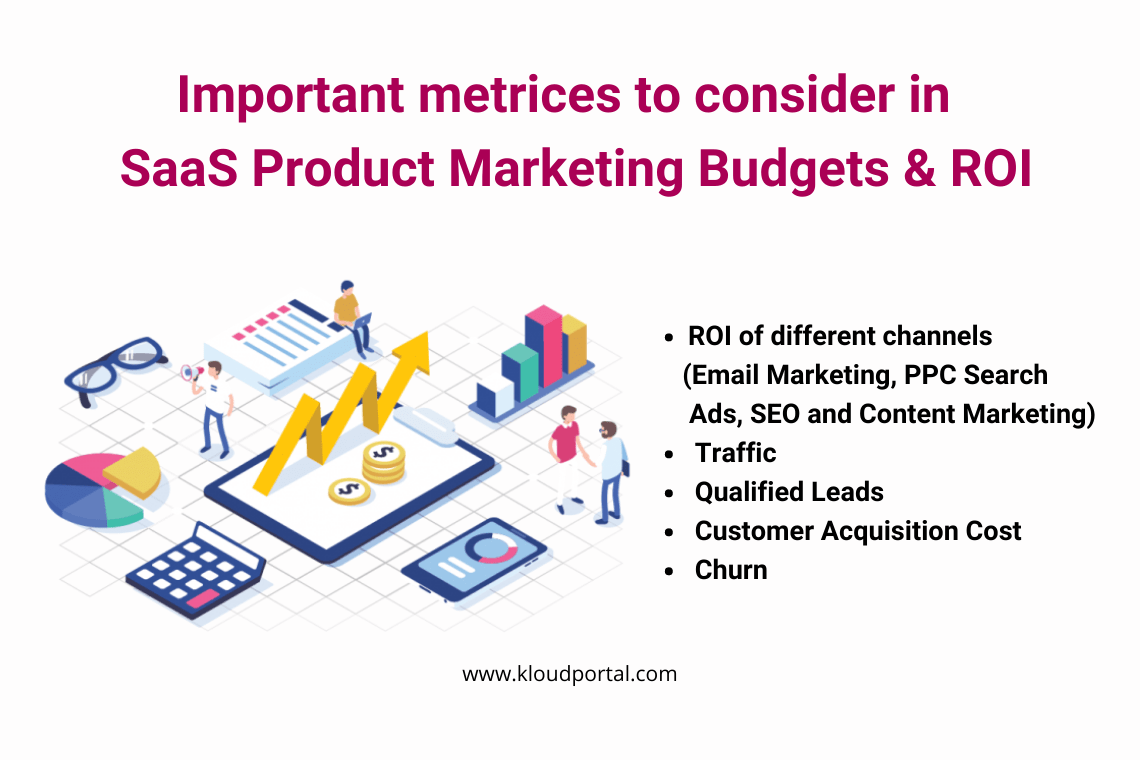
A SaaS product marketing agency will most likely use Email Marketing, PPC Search Ads, SEO and Content Marketing. These marketing campaigns can help the company reach new customers within the budget and quickly.

Of the 3 marketing channels we have just mentioned, email marketing and Google search ads are the first and the second most cost-effective. They deliver an average ROI of $45 and $8 respectively for every $1 spent.

To effectively monitor the leads particularly where it’s coming from you will need CRM software such as the one from Salesforce or Hubspot.

ROI of different channels

You can use the same formula as we have used earlier in this post to calculate ROI. You can work out how much money it needs to be spent on email marketing to generate enough leads to acquiring 1 customer. Finally, you will compare the returns with the investment for a clear picture of the RoI status.

An important thing to remember is that you should compare the RoI with the previous month of the year to see if the direction of your campaign and the allocation of budget are right.

Dig deeper into the data

Once you have all the ROI data of the period under review as well as that of the previous month of the year, you can do some data analysis and see which channel is more profitable to work with. You may get some actionable insights such as reducing or increasing the budget on a particular channel.

However, RoI alone may not be a matter of concern all the time. There are some SaaS marketing metrics that you might be interested in. They all go into making your RoI better from one review period to the next.

Traffic:

Whether it’s has gone up or down; geography-wise mapping and tracking of visitors.

Qualified leads:

it gives you an idea of which channel is more effective in bringing qualified marketing leads and qualified sales leads.

Customer Acquisition Cost (CAC):

It helps you know where you should spend your marketing budget and in what proportion.

Churn:

Customer retention is the key in SaaS marketing. If your business is witnessing a higher churn rate, you need a course correction.

Summing up

Accurate and timely assessment of SaaS product marketing ROI and provisioning of SaaS product marketing budgets holds the key to success in this highly competitive business segment.

For SaaS marketing, you need to plan, develop, and implement   a sound digital marketing campaign. To this end, you need to hire a good SEO company  that can make your digital marketing journey less painful and more productive.

Ideation To Investors to IPO: How Should You Plan Your SaaS Product?

Ideation To Investors to IPO: How Should You Plan Your SaaS Product?

By Arun

A very important thing in SaaS marketing is retaining the customers and ensuring that they continue to subscribe your product and services. This alone can guarantee that the company’s annual recurring revenue (ARA) continues to grow. Retaining the SaaS customers in today’s fiercely competitive business environment is not easy and you must outsource customer service for great results. To know more about this and other issues, you should read 10 Great Customer Service Tips to Improve your Customer Satisfaction on KloudPortal, a leading digital agency that provides sales and marketing outsourcing services to SaaS companies.

Need for capital

Capital is a basic need for any business whether a startup or a big enterprise. It applies to SaaS products as well.
There are at least 2 counts on which money needs to be spent in ample measure: HR and SaaS Marketing. Software development is a labor- and skill-intensive business where qualified and experienced hands are needed and it cost top dollar to the company. Marketing is something that you can’t do without, more so for SaaS product marketing that faces some exceptional challenges.

Why you need a SaaS Product Marketing Agency?

When it comes to SaaS B2B marketing, it is not possible to work without a SaaS Product Marketing Agency. It is so because a SaaS company needs to grow rapidly and at a high rate to remain in the reckoning. As per a report, a SaaS company that grows at 20% per annum will most likely cease to exist in 5 years – such is the pace of innovation that the tough competition that follows. The average growth rate of successful SaaS companies in the first 5 years should be above 65%, says another report.
To achieve and sustain such a high rate of growth, companies need to spend vigorously on SaaS product marketing.
This brings us to our topic of the discussion – Ideation to Investors to IPO: How Should You Plan Your SaaS Product?

Need for SaaS product planning

A SaaS product must be comprehensively planned from budgeting to market research, product development, and introduction to the market.
We will explore different aspects of funding and SaaS product planning in some detail here:

Funding

The need for a strong funding support is paramount in SaaS marketing. Access to capital is a competitive area and not easy to come by. However, there is a proven roadmap that can help any enterprise in accessing capital.
Here is how a SaaS startup can raise funds to support its marketing, growth, and expansion plans:

Angel Investors:

This is also called seed funding and is the  earliest stage of funding for a startup. Here, a High Net-worth Individual (HNI) invests in a business idea more because he is convinced of the abilities of the entrepreneur rather than the SaaS business idea. However, given the high risk in such businesses, an angel investor may not exceed his exposure to startups beyond 10% of his investment portfolio.

More often than not, an angel investor may come from close family and friends. For a startup, it makes sense to work within its budget and this concept is called bootstrapping. It intends to stay clear of capital at high rates or on coercive terms.

Venture capital:

Once a SaaS startup finds its groove and is poised for steady long-term growth, it needs a fresh round of capital. At this stage, both HNIs and institutional investors such as investment banks may be interested in funding your business.

Series A, B, C…

After the business has been fairly successful, you need to work on the growth and expansion fronts. And at this stage, investors are interested in becoming part of your SaaS success story by bringing their capital and taking equities in your business. Series A, Series B, and Series C represent the stage of the business and why the funds are needed.

Series A investments are linked to the basic capital requirement in the initial stages of a startup and may still come from angel investors or capital firms.

Series B funding is likely to be used for expansion and improving the portfolio of products and services. Usually, venture capitalists bring in investments for this round.

Series C investment shows investors have confidence in the business and want to invest in its further growth and expansion.

Planning an IPO

When a SaaS startup has become successful and well-known in its niche and industry, it has capital requirements for various new projects including some strategic acquisitions. To fund these activities, the founders decide to go public and sell a percentage of the equity in the company to the public. The company needs to engage an underwriter or investment bank to take your IPO plan forward as it’s an exclusive area of domain experts.

SaaS product planning

Once the funding roadmap is clear, you can get back to your SaaS product and take a serious look if it needs any tweaking and adjustments as you ready to go to the market with it. Here is a checklist for SaaS product planning and development:

Faith and conviction in your SaaS business idea

Are you convinced and committed to your business idea? Most businesses fail for the lack of these two factors. Read about prominent SaaS products such as Salesforce, Oracle, Amazon, Google, and IBM for inspiration and course correction.

Product planning

Analyze the market in terms of customers, competitors, business model, and advantages your product enjoys on these counts. Develop a business plan about the pain point your product is going to solve, target audience, brand building, advertising, and funding.

Create your team

A SaaS company needs a team of expert IT and marketing professionals. In particular, you will need business analysts, software developers; designers; quality assurance engineers, and project managers.

Build an MVP

Coming up with a minimum viable product (MVP) and introducing it to the market is an important step. It not only gives you an early bird advantage but also helps you with feedback and course correction advantages.

Summing up

SaaS product planning and funding management are two key components that determine the success of  SaaS B2B marketing products. However, taking on board a  SaaS Product Marketing Agency  can help the company overcome many of the hurdles on the way to success. If you are into the SaaS product business, you should read some of the blogs on Start-up Marketing Mistakes You Should Avoid  and  Things You Need To Know In Digital Marketing. You will find these blogs on KloudPortal, which is a top-ranking sales and marketing outsourcing service provider to SaaS companies.

What is a Roadmap for SaaS Product Marketing?

What is a Roadmap for SaaS Product Marketing?

By Arun

The launch of a SaaS product and the chaos that may follow may derail a marketing plan if it is not laid down in a document that holds priority. An important question here is when you should start SaaS product marketing. A well-strategized SaaS marketing roadmap will tell you that you should not delay it – a mistake that many SaaS companies make. SaaS marketing experts suggest that a SaaS product should be introduced in the market as early as it attains a Minimum Viable Product (MVA) status. Also, the latest SEO trends such as voice search, AI, UX, Video Marketing, and Local Search Optimization should not be ignored as you embark on an exciting journey of making a little-known SaaS product today to make it tomorrow’s market leader.

The story of all successful SaaS products sounds similar on this count! And they come from all possible business segments — marketing communication, payments systems, project management, and marketing automation to name a few.

A roadmap helps resource planning and budgeting in alignment with the business and marketing goals of an organization. SaaS products are intangible, consistently being updated, and pitched in a fiercely competitive marketing environment. Given this, a SaaS Product Marketing roadmap is an absolute need for SaaS companies and marketers to stay on the course.

Before we discuss a roadmap for SaaS product marketing, a clear understanding that much of , a clear understanding that much of  SaaS marketing takes place in the B2B marketing space will help us. Here are a few quick facts:

  • In 2020, the SaaS market was pegged at $157 billion and 80% of businesses were using at least one SaaS product
  • SaaS market is expected to grow at a CAGR of 9.22% between 2019 and 2023, adding $60 billion during the period
  • 73% of organizations report that all their apps and software requirements will be met by SaaS by 2021
  • 93% of CIOs report that their organizations are actively adopting cloud-based SaaS, with adoption varying from complete to under-consideration
  • From being standalone software, SaaS has grown to offer integrated platforms for mission-critical applications

SaaS Product Marketing Roadmap

Although as important as for any tech company, product marketing for SaaS is a little different concept. For other products, the marketing roadmap is pretty straight beginning with product launch and culminating with product positioning. A SaaS product marketing agency has a slightly different order of priority. Here, the product is at the heart of the marketing and it always remains there, thanks to the constant update that it goes through in its product life cycle.

Except for this, the basics don’t change much for SaaS product marketing. Some of the routine features include:

  • Defining Industry
  • Defining Target market
  • Creating Marketing model
  • Planning Proper Messaging
  • Market Positioning
  • Content and Channels

Business Model

Complexity and price play an important role in SaaS marketing. For example, a low price and high complexity product will not survive in the market. The right strategy would be:

  • Enterprise model for high complexity and high price products
  • Transactional Model for low complexity and high price products
  • Self-service model for low complexity and low price products

SaaS Product Marketing Strategy

A marketing roadmap should have a well-formulated strategy along the proven success path. For SaaS product, it goes something like this:

Creating Buyer Persona:

You can 2-3 target audiences as well as many buyer personas

Marketing Funnels:

From discovery to delight, the roadmap of the customer journey should be identified

Inbound Marketing Funnel:

Marketing automation tools can inform you where your leads are in their buying journey

Awareness and education

Specific to SaaS B2B marketing, creating awareness about the product and the pain point it aims to solve is very important. In this context, accurate and exhaustive information about the product and prioritizing data are necessary. This leads us to the most important part of the SaaS marketing roadmap: Content Marketing.

Content Marketing:

There can be many forms of content marketing:
Blogs, newsletters, ebooks, sales emails, videos and they can work much like sales funnels. The twist in the tale is: your content is the lead form rather than the impersonal lead form that you see on the sites.

Many SaaS brands have junked the idea of traditional lead forms for lead generation. Rather, they rely on their content to create leads through likes, shares, and referrals.

Why Content Marketing?

For SaaS product marketing, the use of meaningful and personalized content is also necessary for customer retention – an area of critical importance. Customer acquisition is a lengthy and expensive process while customer retention depends on the emotions and experiences created.

As SaaS has a subscription-based revenue model, its topline or ARR (Average Recurring Revenue) depends on the retention of subscribers. To this end, SaaS companies update their software pretty regularly in their bid to outsmart competitors and retain their subscribers.

Marketing automation

SaaS Product marketing involves the same set of marketing tools and techniques that any other online marketing plan might involve: SEO, PPC, SEM, Marketing Automation, and Content Marketing. All of these are geared up to Growth Hacking. The quick and high growth rate is critical to the survival of a new SaaS product on the market.

Scaling up marketing efforts calls for the use of marketing automation tools such as Customer Relationship Management (CRM) and automated email marketing. For a SaaS product, these become all the more critical, making it an essential tool for a SaaS product Marketing Agency.

Summing up

When it comes to using marketing automation tools for SaaS marketing, you can’t overlook OPAL CRM from Kloudportal, a digital marketing company providing marketing and sales outsourcing services to SaaS companies.In SaaS B2B Marketing, you can’t hire just any agency. The stakes are high as your product needs to capture the market quickly and decisively.

Failing to do so can mean the end of the road for a SaaS product. To know more about SaaS marketing, you should get in touch with Kloudportal and go through some of the blogs on its site.

1. SaaS marketing, Jeffbullas
What Should You Consider When Hiring A SaaS Marketing Agency?

What Should You Consider When Hiring A SaaS Marketing Agency?

By Arun

Most articles and blogs on SaaS marketing begin saying it’s difficult. There could be some substance as the statistics that they quote to buttress their claim is scary to say the least. Nine out of 10 SaaS products fail in the market. So, what are the chances of your product not only staying afloat but also making rapid strides on the market?

Much of the processes remain the same for SaaS marketing as it is for product marketing. For example, leads need to be generated, nurtured, and converted into sales. Various online advertising methods such as SEM and PPC need to be used. Constant content marketing through educational and informative blogs need to be utilized for organic leads and brand enhancement.

Perhaps, the difference lies in taking on board a marketing agency that has all the processes and systems in place to ensure a successful implementation of SaaS product marketing plan.

There are 3 things that make a SaaS marketing agency better than others:

  • Clear roadmap to success
  • System to repeat success
  • Consistency of success

How can a marketing agency ensure success on these 3 fronts? A SaaS marketing strategy can be a long-drawn-out process where the SaaS product marketing agency needs to go about systematically. Here are the steps that constitute a good SaaS marketing plan:

  • Defining and setting the goals
  • Preparing a marketing strategy
  • Setting KPIs and marketing metrics
  • SaaS Web designing and development
  • Reporting and analysis
  • Setting up internal marketing processes
  • Content marketing
  • Inbound vs. Outbound Focus
  • Marketing Personas

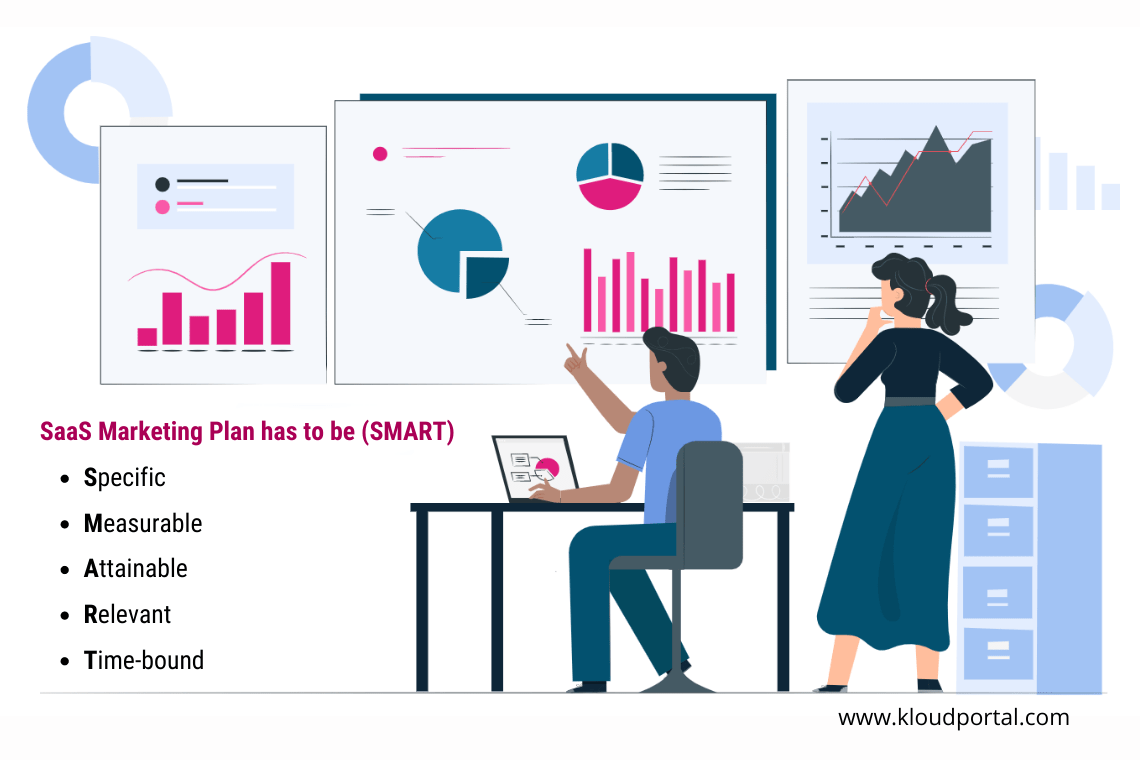
Like any other marketing plan, a SaaS marketing plan has to be specific, measurable, attainable, relevant, and time-bound (SMART).

Here are the top SaaS marketing agencies that can help you in your SaaS product marketing on a sure and confident footing.

Kloudportal

Kloudportal is a SaaS digital marketing agency that provides cutting-edge tools and solutions to startups and established brands. It provides both Sales Services and Customer Services. Whether you want to drive sales or take better care of customer engagement, Kloudportal has you covered.

Its services include planning, implementation, monitoring, and tracking of marketing solutions. The company has also developed a string of marketing software such as OPAL CRM that provides a whole host of automated services from lead capturing to automated emails, lead tracking and lead nurturing.

Services:

SEO Services, ORM Services, Content Writing Services, Social Media Services, and Staff Augmentation Services.

Some of its clients include:

  • Winfo Solutions
  • CoMakeIT
  • 5dataInc
  • OPAL CRM

Why choose Kloudportal?

  • Provides proper and accurate strategies
  • Ensures steady flow of qualified leads
  • Helps marketing teams achieve more sales

Intruact

Even if you have an overly technical product, taking the help of Intruact is a good idea. It offers both sales and consultancy services for SaaS product marketing. Whether you want to retain customers or increase revenue, Intruact has a track record of implementing complex SaaS marketing plans successfully. Intruact can help with whatever it takes to make your SaaS marketing journey an unstoppable force. Whether it’s B2B marketing or B2B consultancy, you can rely on Intruact for planning and executing an efficient SaaS marketing plan.

Services:

Inbound Marketing, Content Marketing, Growth Hacking, Web Design & Development.

Some of its clients include:

  • Hellopeter
  • Inner Trends
  • Keen Embedded Analytics
  • Hubspot

Why Choose Intruact?

  • B2B SaaS Marketing
  • B2B SaaS Consultancy

Single Grain

As a SaaS product marketing agency, Single Grain has been associated with marketing campaigns of some of the SaaS products that later became market leaders in their niche. It has been particularly more successful in B2B marketing because of the innovative ideas it brings to the table. Single Grain helps you achieve more from your marketing efforts. It is well clued in with the marketing trends making your SaaS marketing campaign to benefit from what’s going on in the market. Its approach is to provide you value-added services rather than hard selling.

Services:

SaaS Marketing, Content Marketing, E-commerce Marketing, Technology Marketing.

Some of its clients include:

  • Airbnb
  • Amazon
  • Intuit
  • SEMrush

Why Choose Single Grain?

  • Digital Ad Agency
  • Marketing software
  • Marketing Training

Voxturr

Voxturr is a full-service SaaS product marketing agency that brings proven growth marketing capabilities to the table. It promises quick and sustained growth for your SaaS products. Voxturr provides tailor-made solutions for whatever challenge you are facing.

The company’s approach is distinctly data-driven and agile marketing. So, you are neither in the dark nor in hibernation.

Voxturr’s content marketing campaigns are innovative and creative.

All these strengths lead to unbeatable growth marketing capabilities. It has a strong team of domain experts and the work environment is as spirited as you would expect in a startup that has tasted success is raring to go.

Services:

Webinar Marketing, Pre Launch Marketing, Marketing Automation, B2B Marketing.

Some of its clients include:

  • AskMe
  • Workly
  • Sodexo
  • Tata

Why choose Voxturr?

  • Growth Hacking
  • Agile Approach
  • Organic Results

Kalungi

A B2B marketing company, Kalungi has a proven track record of helping SaaS products break into the next stage of growth and revenue generation. It has helped many SaaS marketing campaigns with T2D3 campaigns. Kalungi offers a complete recipe for success from defining your brand to bringing the product to the market. Its marketing resources are impressive in terms of size and expertise. Kalunggi’s marketing strategies include building a strong foundation from where subsequent campaigns can be launched.

The company also offers learning opportunities in the realm of SaaS marketing through Growth Series, Webinars, Podcast, and Videos. Its services are themed around coach, start, scale, and profit strategies.

Services:

Growth Marketing, Content Marketing, Web Design and Development.

Some of its clients include:

  • Acumatica
  • Beezy
  • Atera
  • BPLogix

Why choose Kalungi?

  • Audit of SaaS marketing plans
  • SaaS marketing playbook
  • Atlas HubSpot Theme

Summing up

Software as a service (SaaS) brings immense benefits to the users. But before they become successful and known, studies reveal that there are more chances of failure than success. And, it’s all because of the success or failure of SaaS marketing campaigns.

Given this, a SaaS company must hire a capable SaaS product marketing agency. For example, Kloudportal is a digital marketing company that offers unbeatable SaaS marketing and sales outsourcing services. It has been immensely successful in some markets including India.

Why SaaS Marketing should be Different from other Types of Marketing?

Why SaaS Marketing should be Different from other Types of Marketing?

By Arun

It’s often said that SaaS product marketing is difficult. Is it?

There is no doubt that it’s different from any other type of marketing. It is because in the case of SaaS, you may have a great product but you can’t show it to the customers. Why it is so?+ They don’t get an idea of all the features of a SaaS product just by looking at a few advertisements on the internet.

A visit to the site of any successful SaaS product such as Hubspot and Zoho would confirm that the company has taken a great deal of effort to explain the product on the site itself. The only way to do so is through online content.

To know how to market SaaS products with great results, we need to understand SaaS and the difficulties in its marketing.

What is SaaS?

In the course of a normal day at work, we use many software products that are available online. For example, we use Grammarly to check the correctness of the language in a copy, Copyscape to identify copied or plagiarized text, and Bitly to shorten unwieldy long URLs.

We never have these platforms on our computers as we have MS Office or CorelDraw. And, to use these platforms you pay a subscription fee rather than a one-time cost of the product.

Businesses use many software applications on the internet whenever they need to use them. For example, Freshbooks is popular accounting software while Zoho offers similar features with options to customize it to Indian GST requirements. In the marketing automation space, Salesforce and Hubspot are among the most popular SaaS products.

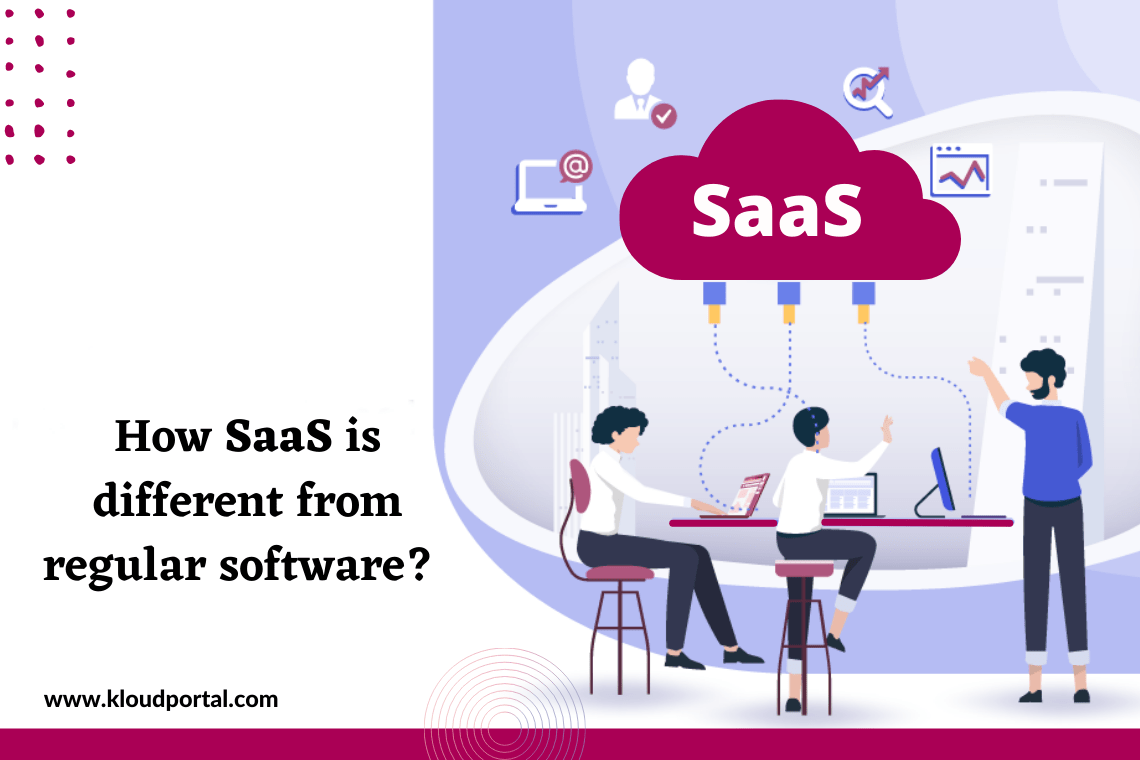
How SaaS is different from regular software?


Why SaaS Marketing should be Different from other Types of Marketing?

SaaS products are different from regular software because of their ability to implement instant upgrades and customization, which is a growing need of businesses in today’s high-paced and intensely competitive business environment. These software products are hosted on the service providers’ servers on the cloud. It spares the customers all the hassles involved in buying and installing the software on their systems. Typically, SaaS products are available for a subscription rather than a one-off sale. These factors make them more robust and versatile.

Trends in SaaS Product Marketing

As per a survey, 38% of small and medium business (SMB) organizations are running entirely on SaaS, the market is still witnessing new and more promising products.

For example, Kloudportal provides SaaS marketing services and offers a suite of SaaS products that cover many functional areas of a business:

EazeKart: Reads barcodes and QR codes and can be integrated into both offline and online stores.

OpalCRM: Offers marketing automation solutions such as lead capturing.

Simple Exam: Provides educators and education businesses customizable software to organize exams online.

Mobilearn: Provides a complete ecosystem for a coaching business.

MobiQuiz: This allows you to engage your customers and audiences quizzes.

Why SaaS marketing is different and difficult?

We have discussed in brief how SaaS marketing is difficult. It is because we have a product to sell that we can’t show physically. Whether it’s B2B marketing or B2C marketing, SaaS is a different ball game altogether. But is it difficult, too? We at Kloudportal, a SaaS Product Marketing Agency, don’t subscribe to the idea that SaaS Product Marketing is difficult.

Yes, it’s different from product marketing, for instance.

That said, any type of marketing requires calibrated strategies and consistent efforts. If we use the same approach to SaaS marketing with necessary changes in content and delivery, SaaS marketing can also be successful.

Difficulties with SaaS Marketing


Why SaaS Marketing should be Different from other Types of Marketing?

Lack of physical features

We have talked about this earlier in the post. Now, we would explore how the lack of physical features can be overcome.

One of the most effective ways of making SaaS products known and popular among the target audience is by talking about its features and use cases through content – blogs, guest posts, articles, social media posts, and videos.

When you visit a successful SaaS product site, one thing that strikes you most and leaves you impressed, if not awe-inspired, is the quality and quantity of the content — the explainer type.

That’s the way forward!

A case for compelling and engaging content

Explain your SaaS products in the context of the overall industry and level of awareness about them. A SaaS product may be ahead of its time. Its story and future need to be told amply for the people to grasp its use cases and potentials.

Talk in detail and in an engaging manner how your SaaS product offers effective solutions to a major problem such as scalability constraints faced by businesses. Educating the customers is vital to make them take an informed and confident decision.

Retaining the customer rather than the acquisition of a new customer is always less expensive and more rewarding, more so in B2B marketing. Ensuring that your SaaS customers don’t migrate to your competition’s platform, you should keep them engaged and informed to stay ahead of the curve that your competition might be trying to scare them with.

So, content is the most potent weapon in the armory of a SaaS Product Marketing Agency.

Difficulty with free trials

A key marketing strategy is to let the customers have some real ideas about your product – how it feels, how it works, and how it solves the problems. You can use this strategy and give your customers an opportunity to try out your SaaS product before they subscribe to it.

Different companies offer different plans. Some may offer a free-of-cost basic version such as Grammarly’s basic plan in contrast to paid Premium and Business plans.

Many SaaS companies offer their services free for a limited period of time ranging from a week to a month. But, none would give access to their premium services as part of the free trial.

That’s where the difficulty with SaaS marketing surfaces. There is practically no way a SaaS Product Marketing Agency can let the customers have complete knowledge and feel about the product until they subscribe to it.

Well, this challenge once again highlights the importance of content that is compelling in terms of information and engaging in terms of delivery.

So, more content, please!

Long sales cycle

B2B marketing is a long-drawn process that can easily stretch up to a year for a single deal to come through. In a SaaS product’s life cycle, it’s a considerably long time for the product to remain as it was at the beginning of the sales cycle. Typically, a SaaS product would witness frequent upgrades to meet new challenges and competition. A SaaS product marketing strategy has to aim at swift results and to that end, it has to be different. This is the ultimate challenge in SaaS marketing.

However, a SaaS Product Marketing Agency such as Kloudportal is cut out for this type of challenge. It has a precise and proven roadmap that can deal with all possible hurdles in SaaS product marketing effectively.

Summing Up

Software as a Service is a rapidly growing technology that helps businesses with cutting-edge solutions without making them deal with logistical issues. SaaS products are available for subscription, meaning customers don’t need to commit for life by paying a hefty price to buy them. However, SaaS marketing may not appear as easy as other types of marketing. It has to focus more on educating the customers than selling the products.

But as sales are important, SaaS marketers have to work on multiple fronts and aim for quick results. Given this, a SaaS company must enlist the help of a SaaS Product Marketing Agency that has the capability to meet the challenge and deliver on the promises.

You must choose your SaaS agency with due care and planning!

We use cookies to ensure that we give you the best experience on our website. If you continue to use this site we will assume that you are happy with it.

Cookies settings
Accept
Privacy & Cookie policy
Privacy & Cookies policy
Cookie name Active

Privacy Policy

What information do we collect?

We collect information from you when you register on our site or place an order. When ordering or registering on our site, as appropriate, you may be asked to enter your: name, e-mail address or mailing address.

What do we use your information for?

Any of the information we collect from you may be used in one of the following ways: To personalize your experience (your information helps us to better respond to your individual needs) To improve our website (we continually strive to improve our website offerings based on the information and feedback we receive from you) To improve customer service (your information helps us to more effectively respond to your customer service requests and support needs) To process transactions Your information, whether public or private, will not be sold, exchanged, transferred, or given to any other company for any reason whatsoever, without your consent, other than for the express purpose of delivering the purchased product or service requested. To administer a contest, promotion, survey or other site feature To send periodic emails The email address you provide for order processing, will only be used to send you information and updates pertaining to your order.

How do we protect your information?

We implement a variety of security measures to maintain the safety of your personal information when you place an order or enter, submit, or access your personal information. We offer the use of a secure server. All supplied sensitive/credit information is transmitted via Secure Socket Layer (SSL) technology and then encrypted into our Payment gateway providers database only to be accessible by those authorized with special access rights to such systems, and are required to?keep the information confidential. After a transaction, your private information (credit cards, social security numbers, financials, etc.) will not be kept on file for more than 60 days.

Do we use cookies?

Yes (Cookies are small files that a site or its service provider transfers to your computers hard drive through your Web browser (if you allow) that enables the sites or service providers systems to recognize your browser and capture and remember certain information We use cookies to help us remember and process the items in your shopping cart, understand and save your preferences for future visits, keep track of advertisements and compile aggregate data about site traffic and site interaction so that we can offer better site experiences and tools in the future. We may contract with third-party service providers to assist us in better understanding our site visitors. These service providers are not permitted to use the information collected on our behalf except to help us conduct and improve our business. If you prefer, you can choose to have your computer warn you each time a cookie is being sent, or you can choose to turn off all cookies via your browser settings. Like most websites, if you turn your cookies off, some of our services may not function properly. However, you can still place orders by contacting customer service. Google Analytics We use Google Analytics on our sites for anonymous reporting of site usage and for advertising on the site. If you would like to opt-out of Google Analytics monitoring your behaviour on our sites please use this link (https://tools.google.com/dlpage/gaoptout/)

Do we disclose any information to outside parties?

We do not sell, trade, or otherwise transfer to outside parties your personally identifiable information. This does not include trusted third parties who assist us in operating our website, conducting our business, or servicing you, so long as those parties agree to keep this information confidential. We may also release your information when we believe release is appropriate to comply with the law, enforce our site policies, or protect ours or others rights, property, or safety. However, non-personally identifiable visitor information may be provided to other parties for marketing, advertising, or other uses.

Registration

The minimum information we need to register you is your name, email address and a password. We will ask you more questions for different services, including sales promotions. Unless we say otherwise, you have to answer all the registration questions. We may also ask some other, voluntary questions during registration for certain services (for example, professional networks) so we can gain a clearer understanding of who you are. This also allows us to personalise services for you. To assist us in our marketing, in addition to the data that you provide to us if you register, we may also obtain data from trusted third parties to help us understand what you might be interested in. This ‘profiling’ information is produced from a variety of sources, including publicly available data (such as the electoral roll) or from sources such as surveys and polls where you have given your permission for your data to be shared. You can choose not to have such data shared with the Guardian from these sources by logging into your account and changing the settings in the privacy section. After you have registered, and with your permission, we may send you emails we think may interest you. Newsletters may be personalised based on what you have been reading on theguardian.com. At any time you can decide not to receive these emails and will be able to ‘unsubscribe’. Logging in using social networking credentials If you log-in to our sites using a Facebook log-in, you are granting permission to Facebook to share your user details with us. This will include your name, email address, date of birth and location which will then be used to form a Guardian identity. You can also use your picture from Facebook as part of your profile. This will also allow us and Facebook to share your, networks, user ID and any other information you choose to share according to your Facebook account settings. If you remove the Guardian app from your Facebook settings, we will no longer have access to this information. If you log-in to our sites using a Google log-in, you grant permission to Google to share your user details with us. This will include your name, email address, date of birth, sex and location which we will then use to form a Guardian identity. You may use your picture from Google as part of your profile. This also allows us to share your networks, user ID and any other information you choose to share according to your Google account settings. If you remove the Guardian from your Google settings, we will no longer have access to this information. If you log-in to our sites using a twitter log-in, we receive your avatar (the small picture that appears next to your tweets) and twitter username.

Children’s Online Privacy Protection Act Compliance

We are in compliance with the requirements of COPPA (Childrens Online Privacy Protection Act), we do not collect any information from anyone under 13 years of age. Our website, products and services are all directed to people who are at least 13 years old or older.

Updating your personal information

We offer a ‘My details’ page (also known as Dashboard), where you can update your personal information at any time, and change your marketing preferences. You can get to this page from most pages on the site – simply click on the ‘My details’ link at the top of the screen when you are signed in.

Online Privacy Policy Only

This online privacy policy applies only to information collected through our website and not to information collected offline.

Your Consent

By using our site, you consent to our privacy policy.

Changes to our Privacy Policy

If we decide to change our privacy policy, we will post those changes on this page.
Save settings
Cookies settings