While many organizations have adopted cloud data platforms, simply moving data to the cloud isn’t enough. A successful Snowflake enterprise data platform requires a well-designed architecture that delivers scalability, governance, performance, and cost efficiency all while supporting future AI initiatives.
At KloudPortal, we believe architecture should enable business outcomes, not just technology adoption — an approach reflected across our Data & AI services. Here’s the blueprint we recommend for building an enterprise-ready Snowflake data platform.
Why Enterprises Are Standardizing on Snowflake
Snowflake has evolved far beyond a cloud data warehouse. Today, it serves as a unified platform for data engineering, analytics, data sharing, machine learning, and AI applications.
Its separation of storage and compute allows organizations to scale workloads independently, ensuring consistent performance without infrastructure complexity.
11,000+ customers worldwide, including hundreds of the Global 2000
Source: Snowflake FY2026 financial results (investors.snowflake.com)
Architecture Blueprint for a Modern Snowflake Enterprise Data Platform
Instead of viewing Snowflake as a standalone warehouse, enterprises should treat it as the foundation of a complete data ecosystem.
1. Unified Data Ingestion Layer
Every enterprise has data coming from multiple sources: ERP and CRM systems, business applications, APIs, streaming platforms, IoT devices, and third-party data providers.
A scalable architecture begins with standardized ingestion pipelines. Recommended practices include:
- Automated batch and real-time ingestion
- Metadata-driven pipelines
- Schema evolution handling
- Data quality validation before loading
This creates a reliable foundation for downstream analytics.
2. Layered Data Architecture
Rather than loading everything into a single database, KloudPortal recommends a layered architecture that improves governance and maintainability.
| Layer | Purpose |
|---|---|
| Raw | Stores source data without transformation |
| Curated | Cleansed, validated, and standardized data |
| Business | Domain-specific models for reporting |
| Consumption | Dashboards, AI models, APIs, and applications |
3. Compute Isolation for Performance
One of Snowflake’s biggest strengths is independent virtual warehouses. Instead of running every workload on the same compute cluster, enterprises should isolate workloads such as ELT pipelines, business intelligence, data science, AI workloads, and ad-hoc analytics.
Benefits include:
- Better performance
- Reduced resource contention
- Easier workload management
- Improved cost visibility
This architecture allows each team to scale independently without affecting others.
4. Enterprise Data Governance
As organizations expand their data ecosystem, governance becomes essential. A strong governance framework should include role-based access control, data masking policies, row-level and column-level security, data classification, lineage tracking, and audit monitoring.
Snowflake’s governance capabilities, combined with proper architectural planning — including the compliance frameworks we implement through GRC Solutions — help enterprises maintain compliance while enabling secure self-service analytics.
5. AI-Ready Data Foundation
Many organizations are investing in AI but struggle because their data isn’t ready. An enterprise architecture should prepare data for predictive analytics, Retrieval-Augmented Generation (RAG), AI assistants, recommendation engines, and machine learning pipelines.
High-quality, governed, and discoverable data significantly improves AI outcomes while reducing project risk. Building an AI-ready foundation today ensures organizations can adopt emerging capabilities without re-architecting tomorrow.
Common Architecture Mistakes to Avoid
Even successful Snowflake implementations can face long-term challenges when architectural fundamentals are overlooked.
- Treating Snowflake as only a reporting database
- Mixing production, development, and testing workloads
- Poor warehouse sizing
- Lack of metadata management
- Weak governance policies
- Manual pipeline management
- No cost monitoring strategy
Addressing these issues early helps organizations avoid technical debt and unnecessary cloud spending.
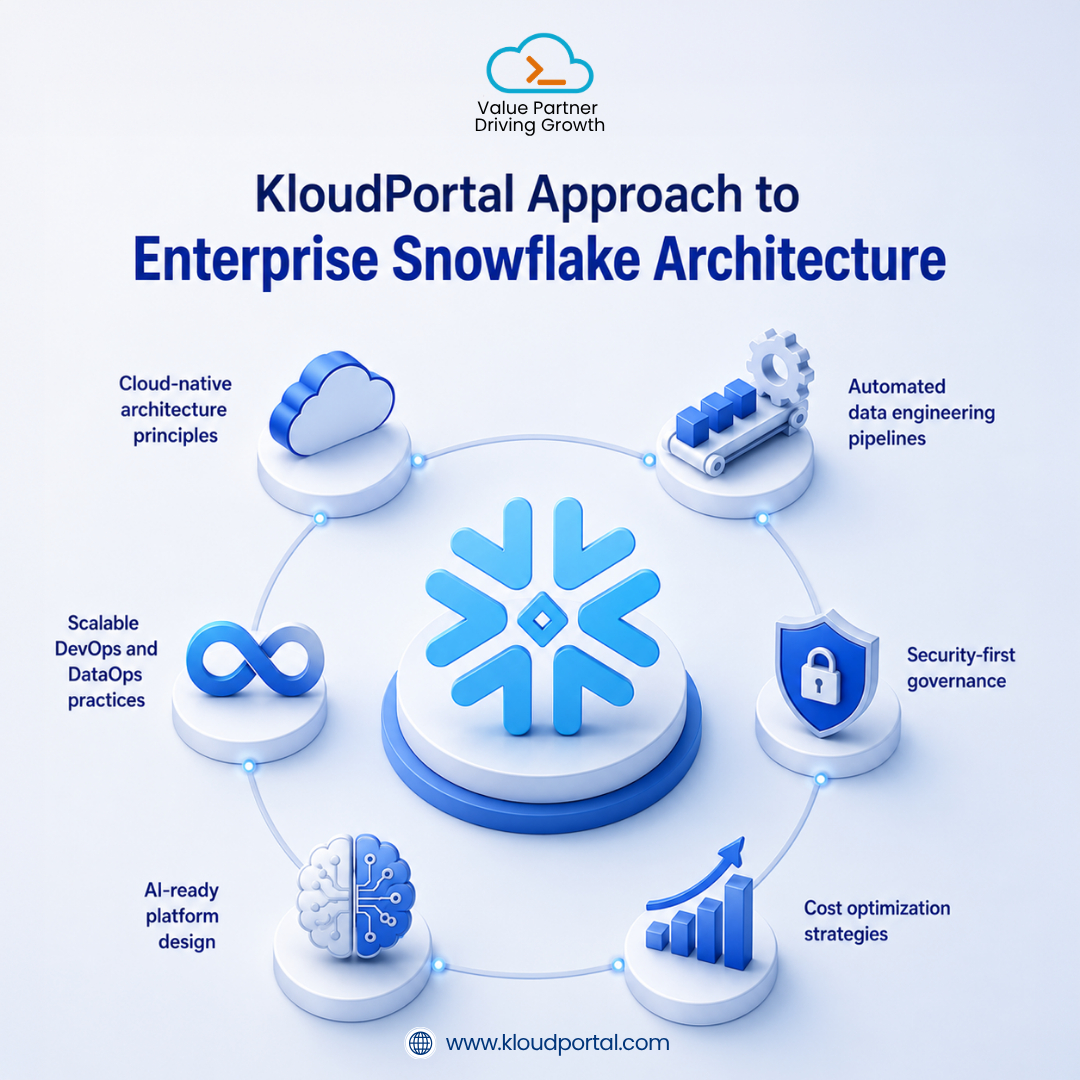
KloudPortal Approach to Enterprise Snowflake Architecture
At KloudPortal, we design Snowflake architectures that are secure, scalable, and built to support long-term business growth. Our approach combines modern cloud engineering practices with automation, governance, and AI readiness to help organizations maximize the value of their data platform.
- Cloud-Native Architecture Principles – Design resilient, scalable, and high-performance data platforms using cloud-native best practices.
- Automated Data Engineering Pipelines – Build metadata-driven, automated ELT/ETL pipelines for reliable and faster data delivery.
- Security-First Governance – Implement robust access controls, data governance, compliance, and monitoring from the ground up.
- Cost Optimization Strategies – Optimize Snowflake warehouse sizing, auto-suspend policies, storage, and query performance to reduce operational costs.
- AI-Ready Platform Design – Create architectures that seamlessly support AI, machine learning, analytics, and generative AI workloads.
- Scalable DevOps and DataOps Practices – Enable faster deployments, version control, CI/CD, infrastructure as code, and continuous monitoring for enterprise-scale operations.
Rather than delivering isolated implementations, we help organizations establish a long-term data foundation that can support analytics, operational reporting, and future AI initiatives — as reflected in our case studies with enterprise clients across banking, manufacturing, and supply chain.
What a Future-Ready Snowflake Platform Looks Like
An enterprise-ready Snowflake platform should enable:
- ✓ Trusted data across business domains
- ✓ Faster analytics without infrastructure bottlenecks
- ✓ Secure collaboration between teams
- ✓ Simplified governance and compliance
- ✓ Efficient compute utilization
- ✓ Seamless integration with AI and machine learning workloads
When these architectural components work together, organizations can accelerate decision-making while maintaining control over performance, security, and costs.
Conclusion
A successful Snowflake enterprise data platform is not defined by the number of datasets migrated or dashboards created. It is defined by the architecture that supports long-term scalability, governance, operational efficiency, and AI innovation.
By adopting a structured architecture blueprint, enterprises can reduce complexity, improve data reliability, and maximize the value of their Snowflake investment.
At KloudPortal, we work with organizations to design and implement scalable Snowflake architectures that align with business goals while preparing data platforms for the next generation of analytics and AI.
Investing in the right architecture today creates a stronger foundation for tomorrow.
Talk to our data engineering team — kloudportal.com/contact-us