The Top 10 Software Sales Blogs You Should Follow in 2023

The Top 10 Software Sales Blogs You Should Follow in 2023

By Amulya Sukrutha

Software sales blogs are valuable and important resources for staying updated, developing and honing skills, and connecting with a community of professionals. Software sales blog posts allow sales experts to thrive in fast-moving industry trends, adapt to new technologies, and achieve sales growth. In short, sales blog posts help expand your professional network and build community boost professional growth, enhance the knowledge of tools and technologies, and evaluate and select the tools according to the requirements.

We will delve deep into a few software sales blogs for sales tips, sales techniques, and sales methodologies. Keep reading to explore more.

Why to Follow Software Sales Blogs?

Let us understand the primary purposes for using software sales blogs before exploring them.

1. Provides market insights

Sales blogs give you insights into industry trends, changes in customer behavior, and market dynamics. Staying aware of the broader market can play a crucial role in sales professionals’ decision-making.

2. Better product knowledge

Following software sales blogs can expand your knowledge about various software products and their features. This knowledge could be invaluable, particularly if you’re trying to sell these products.

3. Understand sales techniques

Sales is a dynamic subject; new approaches and techniques emerge often. Following sales blogs can expose you to a variety of sales methodologies, strategies, and tactics that could be effective in your industry.

4. Enhance skills

Constant learning is an essential component in today’s fast-paced software industry. Software sales blogs are valuable resources for skill development to improve marketing and sales abilities.

5. Motivation

Successful stories and valuable learning experiences of other individuals in blogs could highly inspire you to set higher sales goals and work towards them.

A well-planned Content Marketing Service incorporates the plan, research, creation, distribution, and analysis of content with the target of attracting and attaining customer engagement.

Why Follow Software Sales Blogs

Top 10 Sales Blogs you Should Follow in 2023

Here are the ten best sales blogs that you must instantly follow to update with efficient sales management strategies, tips, and trends.

1. Sales hacker

Sales Hacker is a B2B sales network. From podcasts to forums, everything is developed by sales professionals for sales professionals to share sustainable models, sales conversations, sales enablement, sales strategies, and sales tips.

Best articles from sales hacker

  1. How To Structure Your Sales Organization For Maximum Efficiency
  2. How to Create Viral Content on LinkedIn
  3. Customer Insights to Transform Sales Conversations

2. KloudPortal

KloudPortal is a popular digital marketing and SaaS product marketing agency providing services to a diverse range of fields like software companies, NGOs, the manufacturing sector, educational institutions, and many others, helping their clients meet target markets. They adopt scientific market analysis techniques and understand the demographic and psychographics of the target audience.

Best software sales blogs by KloudPortal

  1. Top SaaS Tools For Streamlining For Business Operation
  2. Why Is Blogging Important For Digital Marketing
  3. How Does SaaS Marketing Help The Sales Team
  4. Maximizing ROI With SaaS: Strategies For Success

3. LinkedIn sales solutions

LinkedIn sales solutions blog post is another resource that a sales professional cannot disregard. This sales blog allows you to utilize LinkedIn as a potential sales platform. Sales teams must prioritize social sales through networks such as LinkedIn that provide insights into social selling, sales strategies, and sales leadership for sales professionals.

Best Software Sales blogs of LinkedIn sales solutions

  1. The Best Sales Navigator Feature Is… 10 Sellers Share Their Favorites
  2. How Does LinkedIn’s COO Sells: The Future is All About Going Deep
  3. How Companies Approached Sales Training During The Pandemic

4. Sales gravy

Sales Gravy is oriented towards sales training, providing immense valuable advice. Sales Gravy is perfect for people who enjoy multiple. This sales training blog associates with sales trainers and additional professionals producing content for podcasts, videos, and articles. Free training material is available on this website.

Best Software Sales Blogs By Sales Gravy

  1. 4 Key Traits Of The Most Successful People
  2. Build An Affordable Sales Training Program In 8 Steps
  3. 17 Best Practices Of Top Performing Salespeople

5. A sales guy

A sales guy blog offers innumerable sales tips, but the emphasis on attracting and hiring talent makes it unique from others. This blog is an efficient and informative resource for sales leaders looking forward to expanding their sales community, hiring top sales talent, and gaining efficient sales advice.

Best Software Sales Blogs By A Sales Guy

  1. The Sales Success Formula
  2. Preparing For A Discover Call: What You Need To Know
  3. Overcoming Objection: Stop Discounting!

6. Outreach.io.blog

For reviewing each subprocess of the sales process, this sales blog serves as a great resource for improving sales productivity. They particularly focus on outbound sales processes. There is a separate section dedicated to demonstrating the experiences of top sales leaders who applied some profound life lessons to their sales careers.

Best Software Sales Blogs By Outreach.io.Blog

  1. How Generative AI Shapes The Sales Team
  2. What Is Sales Enablement? Definition, Benefits, and Strategies
  3. How I Create An Effective Sales Strategy As An Outreach Sales Leaders

7. Openview labs

OpenView Labs is a growth-stage funding group that is an expert in supporting initial-stage tech companies in development and investment. They share actionable insights and advice for the sales managers on their blog by using the metrics required to scale up the sales team, product-led growth, selling to corporate customers, and many more.

Best Software Sales Blogs By OpenView Labs

  1. The Can’t-Miss SaaS Events We’re Attending (And Hosting) This Fall
  2. OpenView’s Next Chapter: Announcing Fund VII Dedicated To Expansion-Stage Growth
  3. Price Smart, Hire The Best and Prove Your Product-Market Fit: OpenView’s Predictions For 2023

8. Unbound b2b sales blog

Unbound B2B Sales blog covers a wide range of sales and marketing-related content such as content marketing or account-based marketing. The Unbound B2B sales blog is an informative resource for acquiring technical knowledge for improving sales performance.

Best Software Sales Blogs By Unbound B2B Sales Blog

  1. The Role Of A Lead Generation Specialist In Modern Business
  2. Reaching The Right Target Audience With Programmatic Ad Targeting Types
  3. Ultimate Guide For Data-Driven B2B Demand Generation

9. LeadIQ sales blog

LeadIQ delivers crucial B2B sales information and also a handy Chrome extension. LeadIQ is a good guide for developing a sales pipeline.

Best Software sales blogs by LeadIQ Sales blog

  1. Sales Development Experts Share 5 Proven SDR workflows that deliver a pipeline
  2. The ultimate B2B SaaS sales glossary and acronym cheat sheets: 76 terms reps need to know
  3. Sales trends in 2023: What I learned from B2B experts

10. CloserIQ blog

CloserIQ Blog is a renowned sales recruiting platform offering guidance towards hot and trending skills you job candidates must acquire, identifying top talent, and managing successful sales teams.

Best software sales blogs by CloserIQ

  1. 4 Stress-Relieving Activities To Improve Sales Team Morale
  2. The Essential Guide to Improving Your Sales Conversion Rate
  3. 6 Sales Pitch Ideas To Better Connect With Prospects

Good Digital Marketing Services include branding your business, planning and designing your website to optimize for higher ranking in search engines, and achieving customer success.

Conclusion

Software sales blogs are online platforms or websites that specifically focus on topics related to selling software products and services. These blogs cater to a niche audience interested in software sales, including software sales professionals, software developers, marketers, business owners, and anyone involved in the software industry. They provide insights, strategies, and information about selling software, navigating the software market, and staying updated on industry trends.

The Best SEO Agency in Hyderabad uses proven SEO strategies to improve search rankings to improve the search ranking of a web page.
How To Write A Great Meta Description For SEO 

How To Write A Great Meta Description For SEO 

By Aparna Sushumna

A meta description is a brief HTML tag or snippet of text that provides a concise summary or most accurate description of the content of a web page. These descriptions typically appear under the page title and URL of search engine results pages (SERPs). Their primary purpose is to provide users with a quick understanding of what the page is about, helping them decide whether to click on the link.

Here, we’ll guide you in crafting a compelling and more accurate description. These descriptions not only assist search engines in comprehending your webpage’s content but also entice searchers to click and explore your site.

Why are Meta Descriptions Important for SEO?

Google, back in September 2009, stated that the language contained in meta descriptions and meta keywords did not affect its search engine ranking algorithms.

However, there are still two reasons why meta descriptions matter:

  1. They aid in persuading users to click on your organic listing result.
  2. Because Google evaluates CTR rates, they may increase your results indirectly by increasing your site’s organic CTR.

Besides, meta descriptions are also important for SEO for several reasons, such as:

1. Click-through rate (CTR)

A well-crafted meta description can attract users to click on a search result, improving CTR.

2. User expectations

A clear meta description sets expectations for web content, reducing bounce rates and improving SEO.

3. Keywords and relevance

When writing meta descriptions, include relevant keywords. A search engine results page must understand the content and match it to users’ search queries.

4. Differentiation

Having a unique and compelling meta description is crucial for standing out in search results, especially when competing with similar content from other search engines and websites.

5. Seo ranking

Meta descriptions indirectly impact SEO by improving user engagement and reducing bounce rates.

6. Social sharing

Meta-description examples and descriptions are used to generate snippets when pages are shared on social media. With an optimized meta description in Google, you can enhance the content appearance and increase engagement.

An enterprise SEO agency assists firms with the ongoing process of improving online visibility through SEO.

Tips to Write Effective Meta Description for SEO

Creating an impressive meta description for SEO involves crafting a concise and compelling summary of a web page’s content. Here are some steps to help you create and write a good meta name description content:

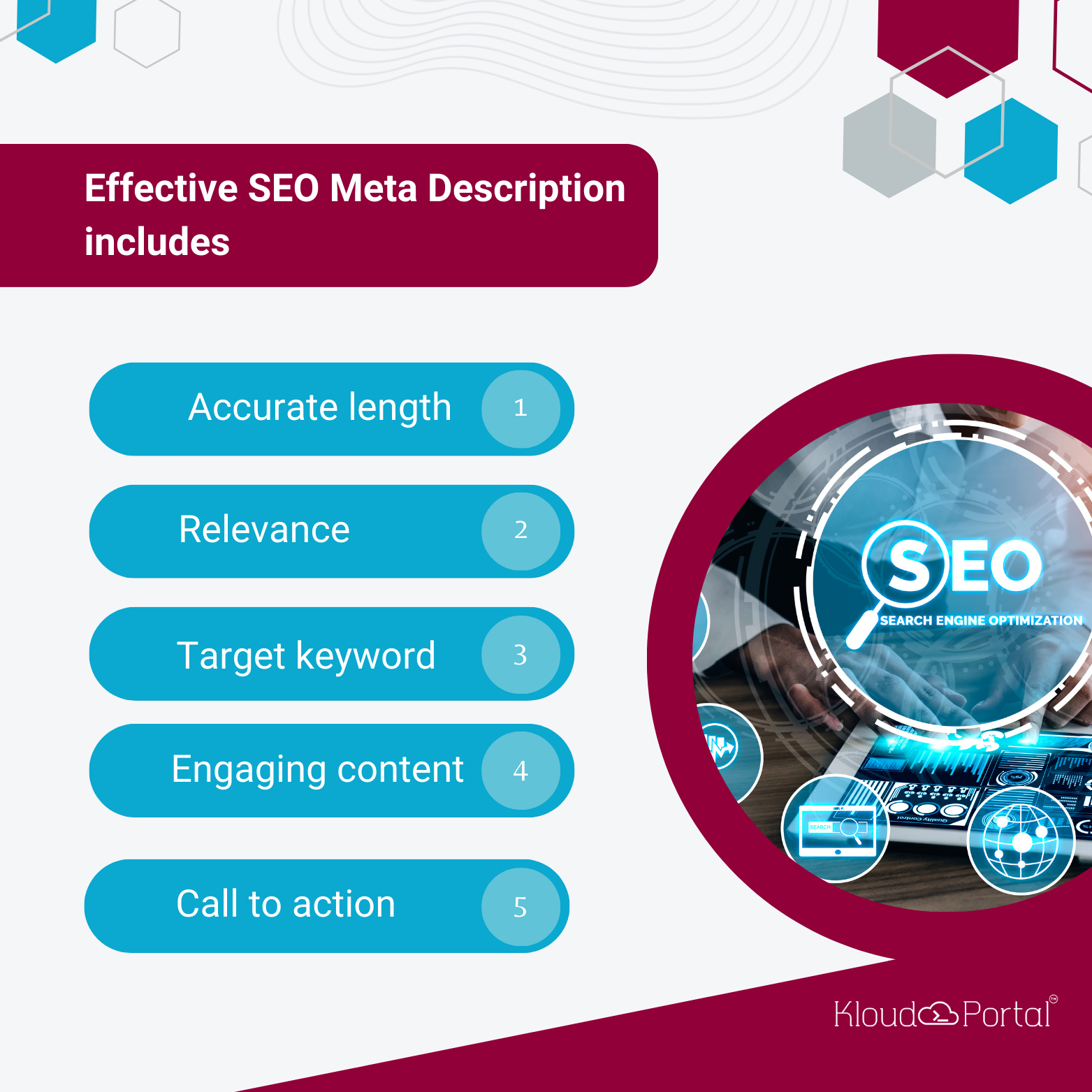
1. Accurate length

Keep a more accurate meta description length of between 150 and 160 characters, as Google engines often truncate longer descriptions.

2. Relevance

An engaging meta description must accurately reflect the page’s content and include relevant keywords to improve click-through rates. So, ensure that the meta description accurately reflects the content of the search on the page, as Google rewrites meta descriptions if it’s not relevant.

3. Include target keywords

Include the primary keyword, first target keyword, or search keyword for the HTML element of the page in the meta description, ideally near the beginning. And avoid keyword stuffing.

4. Engaging content

Write a front page description that entices users to click. Highlight unique selling points or benefits.

5. Call to action

It’s common to include a CTA or an enticing phrase to encourage users to click on the link. So, use CTAs like “Learn More,” “Read Now,” or “Shop Today.”

Effective meta description for SEO

6. Make it Unique

Each page on a website must have a unique meta description to avoid duplication and improve Google search.

7. HTML Tagging

Meta descriptions are part of a web page’s HTML and are specified using the tag within the section. Effective and engaging meta descriptions are an essential element of on-page SEO.

8. Avoid duplicate descriptions

Each page’s code should have a unique meta description tag.

9. Frontload important info

Place the most crucial and relevant information at the beginning to ensure it’s visible in search results.

10. Use power words

Incorporate compelling adjectives and power words to capture attention.

11. Mobile Optimization

Ensure your title tag meta description looks good on mobile devices.

The best digital marketing agency guides you in writing the necessary meta description content for SEO.

Here Are A Few More Helpful Tips To Follow

1. Unique selling points

Highlight what sets your page apart from other competitors.

2. Emotional appeal

Use powerful words or evoke emotions that resonate with your target audience. Meta Description examples like “Discover the secret to success” or “Experience the thrill of adventure” can enhance.

3. No deception

Avoid clickbait or misleading information, as this can harm your site owners or blog post website’s credibility.

4. Use active voice

Write in an active voice to create a sense of urgency and directness.

5. Audience consideration

Tailor the title tags description of on-page content to your specific audience and their needs. Content marketing services provide the necessary inputs to achieve a description tag.

Conclusion

Your chance to attract readers is through your meta description. Make sure to develop a compelling meta description for your website that encourages visitors to select your content first. After all, if your webpages are intended to be beneficial and valuable to browsers, then the information that describes them should be as well.

Meta descriptions are essential for attracting organic search traffic back, improving user experience, and indirectly influencing SEO by impacting user behavior and engagement with search results. A good meta description can increase clicks from search results, but it’s only one part of SEO. Optimizing webpage content for search engines and continuously monitoring and adjusting SEO performance is crucial for writing effective meta descriptions.

How To Use Social Selling To Generate More Leads And Sales For Your Software Business?

How To Use Social Selling To Generate More Leads And Sales For Your Software Business?

By Rasmita Patro

Social media platforms have advanced from mere communication tools to powerful business resources. For software companies, harnessing the potential of social selling has become paramount in staying competitive. It involves the use of social media to increase qualified leads and, subsequently, sales. It is about promoting your product and building genuine connections, understanding customer pain points, and tailoring your approach for potential buyers.

In this comprehensive guide, we will dig into the various aspects of social selling, from sales leads generation strategy and social media advertising to the importance of relevant content and tracking customer engagement. We will also explore how businesses can implement a successful social sales strategy and how sales professionals can leverage social media to boost their sales efforts.

Leveraging social media platforms for lead generation efforts

Social networking sites like LinkedIn, Instagram, Twitter, and Facebook offer a vast and diverse user base, making them ideal for customer acquisition efforts. To use social sharing effectively for lead generation, one needs to:

  • Establish a presence on social media channels: Create professional profiles for your software business on various social networking sites. Ensure your LinkedIn profile is complete, up-to-date, and aligned with your brand image.
  • Identify potential customers: Define your buyer persona and target audiences. Determine the key decision-makers and influential individuals within your targeted organizations. Understanding your potential customers is essential for tailoring your social selling efforts effectively.
  • Use different social media networks: Depending on your target audience and industry, identify social media networks that are more effective than others. For instance, LinkedIn is often a social platform for B2B software businesses, while Facebook and Instagram can effectively reach a broader consumer audience.

Social Media Marketing is an ever-evolving strategy that leverages social media platforms to facilitate businesses in engaging with their desired audience and cultivating brand recognition. It includes content creation, advertising, and engagement to effectively reach and engage potential customers.

Implementing a social selling strategy

A well-structured social selling strategy is essential for success. Here’s how to implement one:

  • Create valuable content: At the core of social selling lies content marketing, where crafting an enthralling strategy involves creating blog posts, infographics, videos, webinars, and whitepapers that directly tackle the issues and obstacles your software is designed to resolve.
  • Engage and build relationships: Social selling isn’t centered on direct sales pitches; rather, it revolves around fostering reliable connections. Engage proactively with your audience by addressing comments, joining conversations, and distributing industry news content.
  • Social media promotions: Use social media promotion to create targeted ads that lead potential customers to a compelling landing page on your website. These ads can increase your visibility and reach a wider audience.
  • Social listening: Invest in social listening tools to monitor business trends and customer sentiment. It enables you to stay informed about discussions within your industry and engage in relevant conversations.
  • Tailoring your approach: A one-size-fits-all approach has no place in social selling. Personalize your outreach and content to cater to individual prospects.

Digital Marketing Services incorporate a diverse array of online strategies and tactics designed to assist businesses in reaching their marketing objectives within the digital landscape. These services typically comprise search engine optimization (SEO), email marketing, pay-per-click advertising (PPC), social media marketing, and personalized lead generation strategies, all customized to meet the specific needs of each company. An effective sales pitch, underpinned by a compelling value proposition and supported by lead tracking and high-quality content on social platforms, ultimately directs potential customers toward conversion.

Social selling strategy

Using industry trends to your advantage

Keeping a close eye on commercial trends is crucial for a software business. Here’s how you can leverage them for social selling:

  • Stay informed: Consistently keep abreast of industry developments, emerging technologies, and trends in the software sector. Use your knowledge to share insights and viewpoints on these trends, positioning yourself as a thought leader in the field.
  • Tailor content: Align your content with current market trends and pain areas. Addressing these issues in your content shows that your software solution is relevant and timely.
  • Engage in conversations: Participate in discussions related to economic trends on social platforms. Share your expertise and provide valuable perceptions to position your business as a knowledgeable and reliable source.

The Best Social Media Marketing Agency in Hyderabad is a game-changer for businesses looking to enhance their online presence and reach their target audience effectively. With a reliable agency’s expertise, you can expect measurable results in increased brand visibility and engagement across various social platforms.

Creating valuable and personalized content

Content development plays a central role in social selling. This way to craft content that deeply connects with your target audience:

  • Understand buyer personas: Develop a deep understanding of your ideal customers and their buyer’s journey. Tailor the content to address their specific challenges at each stage of the journey.
  • Personalize content: Use personalized content to engage future clients. It can include personalized emails, LinkedIn messages, or content tailored to a specific company’s challenges.
  • Tracking leads and engagement: Leverage the right tools, for example, social media analytics and Google Analytics, to track engagement. Evaluating the impact of your social selling initiatives on website traffic and lead conversion rates facilitates strategy refinement.
  • Mapping to the sales funnel: The sales funnel, often called the purchase funnel, is a visual representation of a customer’s journey from initial awareness of a service to making a purchase decision. It is a model that helps businesses understand and manage potential customers’ stages before converting into paying customers.

By seeking Digital Marketing Partner Agencies in India, businesses can benefit from strategic and experienced collaborators who understand the nuances of the Indian market. Such agencies can provide tailored solutions to help companies navigate the complexities of online marketing and achieve their goals effectively.

How sales professionals use social selling index

Sales professionals use the Social Selling Index (SSI) as a valuable tool to enhance their social selling efforts on platforms like LinkedIn. The SSI is a metric provided by LinkedIn that quantifies an individual’s or team’s effectiveness in social selling. It consists of four key components: Establishing a Professional Brand, Finding Correct People, Engaging with Insights, and Building Relationships.

Sales professionals benefit from using the SSI in several ways:

  • Performance benchmarking: The SSI provides a benchmark for sales professionals to measure their social selling effectiveness against industry standards and their peers.
  • Goal setting: Sales professionals can use the SSI to set specific goals for their social selling efforts. For example, they may aim to increase their engagement score or grow their network by a certain percentage over time.
  • Identifying strengths and weaknesses: Sales professionals can identify their strengths and weaknesses by analyzing their SSI scores in the four components.
  • Continuous improvement: Sales professionals can use the SSI as a tool for continuous improvement by monitoring their scores and adjusting their social selling strategies.

Conclusion

Social selling is a powerful tool for software businesses to increase leads and sales. By leveraging social media platforms, implementing a well-defined social selling strategy, staying informed about industry trends, creating valuable and customized content, and adopting the practices of the sales team, software businesses can effectively use social selling to connect with potential clients, build relationships, and ultimately drive engagement and sales. Social media is no longer just a platform for communication; it’s a valuable channel for lead generation and sales growth.

Mindshare, Purpose Or Cultural – Broad Approaches To Branding. How They Work?

Mindshare, Purpose Or Cultural – Broad Approaches To Branding. How They Work?

By Rasmita Patro

A robust brand presence is crucial for success in the fiercely competitive business world. Branding goes beyond logos; it’s about forging a profound connection with consumers. Companies adopt diverse branding approaches, each with its principles and strategies. This article will explore three major branding approaches: Mindshare, Purpose, and Cultural Branding. We’ll dissect their fundamental principles, analyze their influence on consumer perceptions and behavior, and identify the situations that call for their application. Furthermore, we will investigate metrics and case studies showcasing the efficacy of these brand strategies.

Mindshare branding

Mindshare branding focuses on capturing consumers’ attention and occupying a prominent place in their minds. It revolves around marketing tactics that aim to achieve top-of-mind awareness. Key principles of Mindshare branding include:

  • Brand recognition: Creating a brand identity that stands out and is easily recognizable in the market.
  • Consistent advertising campaigns: Maintaining a consistent presence in various media channels to reinforce brand awareness.
  • Consumer engagement: Actively engaging with consumers through advertising, promotions, and online interactions.
  • Emotional connection: Using emotional appeals in advertising to form a deeper connection with consumers.

Impact on consumer perceptions and behavior:

Mindshare branding has a significant impact on consumer perceptions and behavior:

  • Consumers are more likely to consider and choose a brand they recognize and recall easily.
  • Effective mindshare branding can create a sense of trust and familiarity, encouraging repeat purchases.
  • It can also influence impulse buying decisions when consumers encounter the brand in-store or online.

When and why to choose mindshare branding:

Mindshare branding suits companies operating in highly competitive markets where brand recognition is a significant differentiator. It should be chosen when:

  • A company wants to establish itself as a market leader.
  • There’s a need to maintain a strong online presence.
  • Emotional appeals influence the target audience.

Digital Marketing Services encompass online strategies and tactics to promote products or services through various digital channels, such as social media, search engines, and email marketing.

Purpose branding

Purpose branding revolves around a brand’s commitment to a higher mission or cause beyond profit. It emphasizes the company’s values and contribution to social or environmental issues. Key principles of Purpose branding include:

  • Social Consciousness: Demonstrating a genuine concern for societal or environmental issues.
  • Authenticity: Ensuring the brand’s purpose aligns with its actions and values.
  • Consumer values: Connecting with consumers who share similar values and concerns.
  • Brand perception: Shaping how the brand is perceived by highlighting its purpose-driven initiatives.

Brand Building is a strategic process that involves creating a strong and recognizable identity for a company or product in the market.

Impact on consumer perceptions and behavior:

Purpose branding has a profound impact on consumer perceptions and their behaviors:

  • It can create a loyal customer base among those who resonate with the brand’s Purpose.
  • Consumers may be willing to pay a premium for products or services from purpose-driven brands.
  • Purpose branding can foster a sense of trust and authenticity, leading to increased brand loyalty.

When and why to choose purpose branding:

Purpose branding suits companies that want to impact society or the environment positively. It should be chosen when:

  • The brand has a genuine commitment to a social or environmental cause.
  • The target audience values corporate social responsibility and ethics.
  • The brand wants to differentiate itself in a crowded market through its purpose.
Choosing Right Branding Approach

Cultural branding

Cultural branding involves embedding a brand within the cultural context of its target audience. It aims to become a part of consumers’ lifestyles and values. Key principles of Cultural branding include:

  • Storytelling: Crafting narratives that resonate with the cultural narratives and aspirations of the audience.
  • Market positioning: Positioning the brand as an integral part of the target culture.
  • Consumer psychology: Understanding the cultural nuances that impact consumer behavior.
  • Emotional connection: Building emotional ties through cultural symbolism and references.

Impact on consumer perceptions and behavior:

Cultural branding has a substantial impact on consumers:

  • It can lead to strong brand loyalty among consumers who identify with the brand culturally.
  • Consumers are likelier to choose brands that align with their cultural identity and values.
  • Cultural branding can result in long-term brand recognition and resonance within a specific community or culture.

When and why to choose cultural branding:

Cultural branding suits companies that want to immerse themselves in specific cultural contexts. It should be chosen when:

  • The brand aims to connect deeply with a particular cultural segment of the market.
  • The target audience’s cultural identity is a significant factor in purchasing decisions.
  • The brand seeks to become a cultural icon within a particular community.

Choosing the right branding approach

The choice of branding approach depends on various factors, including the company’s mission, target audience, and competitive landscape. Here are some considerations:

  • Mindshare branding is suitable when a company wants to establish strong brand recognition, especially in highly competitive markets.
  • Purpose branding is ideal for companies with genuine commitments to social or environmental causes and when targeting consumers who prioritize ethical and purpose-driven brands.
  • Cultural branding is a good choice when a brand seeks to deeply embed itself within a specific cultural context and build strong connections with culturally identified audiences.

Metrics and case studies

1. Mindshare branding:

  • Brand recall rates.
  • Website traffic and online visibility.
  • Social media engagement and mentions.

Case study: Coca-Cola’s consistent advertising and emotionally resonant campaigns have maintained its position as a globally recognized brand.

2. Purpose branding:

  • Customer loyalty and repeat purchases.
  • Social media sentiment and engagement.
  • Sustainability impact and corporate social responsibility (CSR) metrics.

Case study: Patagonia’s commitment to environmental sustainability and its “Don’t Buy This Jacket” campaign showcases the effectiveness of purpose branding.

3. Cultural branding:

  • Market share within specific cultural segments.
  • Cultural relevance and resonance.
  • Engagement within culturally connected communities.

Case study: Nike’s “Just Do It” campaign has become a cultural phenomenon among athletes and fitness enthusiasts, illustrating the power of cultural branding.

Conclusion

Mindshare, Purpose, and Cultural branding each offer unique strategies to achieve brand recognition, resonate with consumer values, or become deeply ingrained in a specific culture. The branding approach should align with a company’s mission, values, and target audience and be supported by appropriate metrics to measure its effectiveness. By understanding these branding approaches and their principles, companies can make informed decisions to create lasting emotional connections with consumers, foster brand loyalty, and achieve success in the marketplace.

In today’s dynamic branding landscape, businesses must adopt thoughtful strategies to connect effectively with their audiences. With KloudPortal’s best-in-class digital marketing services, companies can strengthen and sustain a positive brand image across online platforms.

Why Should Brands Prioritize Bottom Of Funnel Content for SEO Success?

Why Should Brands Prioritize Bottom Of Funnel Content for SEO Success?

By Rashmita Patro

In the ever-evolving digital marketing landscape, Search Engine Optimization (SEO) remains a cornerstone of online success. SEO strategies are dynamic, and brands must continuously adapt to changes in search algorithms and user behavior. One strategic approach that has gained significant prominence recently is prioritizing ‘Bottom of Funnel’ (BoFu) content. This approach involves targeting transactional keywords and creating content that addresses stages of purchasing decisions. This blog explains why brands should prioritize why brands should emphasize Bottom of Funnel keywords in their SEO strategy, emphasizing their importance in driving natural traffic, increasing conversion rate, and ultimately achieving success in SEO.

Understanding The SEO Funnel

The SEO funnel is a conceptual model that divides the user’s journey into different stages, each with a distinct search intent. These stages typically include:

  • Awareness Stage: At the top of the funnel, the target audience is in the initial stages of their research and has a vague idea of their problem or need.
  • Consideration Stage: In the middle of the funnel, users have narrowed their options and are looking for more information to make an informed decision.
  • Decision Stage: The bottom of the funnel is where users are ready to decide on purchase. They are seeking specific details about products, services, and pricing.

SEO Funnel can be implemented using two distinct strategies: Top of Funnel (ToFu) and Bottom of Funnel (BoFu). The primary goal of ToFu SEO is to attract and engage users, providing them with valuable information that piques their interest and encourages them to move further down the funnel. The core objective of BoFu SEO is to facilitate user conversions by simplifying their journey to access the information necessary for completing their purchase.

Significance Of Bottom Of Funnel Keywords In SEO

BoFu keywords, also known as transactional keywords, are search terms that signify a user’s intent to take action. These potential keywords are highly specific and are often associated with the decision stage of the customer journey. Here are a few factors why brands should prioritize Bottom of Funnel keywords in their SEO efforts:

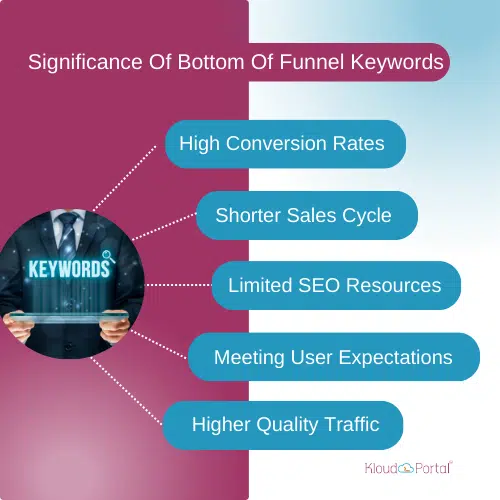
  • High Conversion Rates: Bottom of Funnel keywords are associated with higher conversion rates because users searching for them are closer to making a purchasing decision. Prioritizing these keywords will lead to more conversions and sales.
  • Shorter Sales Cycle: By addressing users’ specific needs and questions at the Top of Funnel (ToFu) stage, you can help expedite purchasing decisions, resulting in a shorter sales cycle.
  • Limited SEO Resources: Brands often have finite SEO resources, including time, budget, and workforce. By focusing on BoFu keywords, you can allocate your resources more efficiently, targeting the keywords that are most likely to deliver tangible results.
  • Meeting User Expectations: Prioritize keywords that align with user expectations. Searching for transactional keywords, expect to find information about products, prices, and where to purchase. By providing this information, you enhance the user experience and build trust.
  • Higher Quality Traffic: When you prioritize BoFu keywords, you attract users who are genuinely interested in making a purchase.

It results in higher-quality traffic that is more likely to engage with your content and customer conversions. An SEO agency strategically incorporates BoFu keywords into its SEO efforts, substantially improving website search engine rankings and more traffic.

Significance Of Bottom Of Funnel Keywords

Bottom Of Funnel Content Marketing

It refers to a specific type of content strategy that targets potential clients near the end of their buying journey and is close to making a purchase decision. This stage is often called the “decision” or “conversion” stage in the marketing funnel. BoFu content is designed to address these potential clients’ needs, questions, and concerns and provide them with the information and confidence they need to purchase.

Key characteristics of BoFu marketing include:

  1. Product-Specific Information: BoFu content often focuses on detailed information about products or services a company offers. It includes product comparisons, specifications, and pricing details.
  2. Testimonials and Case Studies: Customer testimonials and case studies play a significant role in BoFu content, providing social proof and demonstrating how others have benefited from the product or service.
  3. Free Trials and Demos: Offering free trials or product demos is a common BoFu strategy, allowing potential clients to experience the product firsthand before committing to a purchase.
  4. Discounts and Promotions: BoFu content includes special offers, discounts, or promotions to incentivize potential clients to convert.
  5. Closing the Sale: The primary goal of BoFu content is to encourage the potential customer to take a final step and make a purchase, whether online, in-store, or through other channels.
  6. Clear Calls to Action (CTAs): BoFu content should feature clear and compelling CTAs that guide users toward purchasing.

To achieve SEO success, brands must collaborate with seasoned SEO Companies. Advanced SEO tools and know-how to prioritize keywords, perform thorough keyword research on Google, generate high-quality content, and execute a well-planned SEO strategy emphasizing Bottom of Funnel (BoFu) keywords.

SEO Success And Bottom Of Funnel Keywords

Prioritizing keywords is a strategic approach that can significantly contribute to SEO keywords’ success. Here’s how it impacts various aspects of your SEO strategies:

  1. First Page Ranking: The Bottom of Funnel keywords are often less competitive, making it easier for brands to achieve rankings on the page. Being on the search results page increases visibility and the likelihood of attracting potential clients.
  2. More qualified traffic with better conversion potential: Bottom of Funnel keywords may have lower search volume than broad keywords, but the traffic they generate falls into high-converting categories. It’s about quality over quantity.
  3. Optimizing Finite SEO Resources: Brands often have limited SEO resources, including time, budget, and workforce. Prioritizing Bottom of Funnel keywords ensures that these resources are allocated to areas with the most significant potential for ROI.
  4. Catering to Conversion Process: SEO is not just about driving congestion; it’s about using relevant keywords. BoFu content quality plays a pivotal role by providing the information and assurance needed to purchase.

Meeting The Needs Of Potential Customers

In the digital marketing age, potential buyers actively search Google for information to help them make informed decisions. Brands prioritizing Bottom of Funnel content are better equipped to meet these needs and guide users toward the final stages of conversions. By providing valuable information and addressing user queries, brands can establish themselves as authorities in their respective industries.

When expanding your global online presence, turn to the Best Enterprise SEO Services in India to optimize your websites for international markets. By conducting thorough customer research and analyzing comparison keywords, you can optimize content creation strategy for specific pages targeting high-value search terms on Google, resulting in significantly improved conversion rates.

Conclusion

In the world of SEO, prioritizing Bottom of Funnel content and keywords is a strategic approach that can lead to significant success. Brands that understand the importance of Bottom of Funnel keywords and create high-quality content to cater to users in the decision stage of their journey are more likely to achieve higher conversion rates, better ROI, optimize their finite SEO resources, and ultimately outperform competitors.

By aligning their SEO efforts with search intent and customer journey, brands can enhance their online visibility, attract possible buyers, and drive growth in the digital landscape. The rapid online growth of an SEO company can be credited to the consistently exceptional results delivered by Top Enterprise SEO Services in India, allowing them to stay ahead of the competition.

Case Study: Chipotle’s Cultural Branding Strategies

Case Study: Chipotle’s Cultural Branding Strategies

By Rashmita Patro

Chipotle Mexican Grill, commonly known as Chipotle, is a fast-casual restaurant chain that has successfully employed cultural branding strategies to establish a strong brand identity and connect with consumers. This case study explores how Chipotle has leveraged cultural elements in its brand-building of a loyal customer base and achieved remarkable growth in the competitive fast-food industry. The brand is known for creative marketing and a distinct identity. Chipotle’s strategy includes social media, themed events, and active engagement with its audience.

Social Media Interaction

Chipotle has mastered the art of using social media to connect with its audience. Its witty and engaging posts on Instagram, Twitter, and TikTok have helped the brand build a strong online presence. Chipotle has turned its customers into brand advocates by incorporating user-generated content and word of mouth, amplifying its message.

Chipotle’s cultural branding strategies encompass its marketing strategy, celebration of National Burrito Day, active engagement with a specific target audience, and strong social media presence.

National Burrito Day is an annual celebration of the beloved burrito, typically held on the first Thursday of April. This day is an opportunity for restaurants, especially Mexican and Tex-Mex establishments like Chipotle, to engage with customers and celebrate this popular food item.

  • Promotions and Discounts: Chipotle offers special discounts on this day to attract customers. It includes offers like “Buy One, Get One Free” burritos or discounted burrito bowls.
  • Digital Marketing Campaigns: Chipotle uses its media accounts and website to create daily buzz. They may share engaging content, create hashtags, and run contests or giveaways to involve their online community.
  • Engaging with Customers: Chipotle invites customers to share their experiences on social media by utilizing certain hashtags. They ask customers to vote on their favorite combinations or share their customization tips.
  • In-Store Experience: Inside Chipotle locations, staff may dress in festive attire, play Mexican music, and decorate the restaurant to create a festive atmosphere for customers celebrating Burrito Day in-store.
  • App and Online Ordering: Chipotle’s mobile app and online ordering platform can be optimized for Burrito Day promotions, making it convenient for customers to order their favorite food for takeout or delivery.

Chipotle strengthens its brand presence, attracts new customers, and rewards loyal patrons, ultimately driving sales and reinforcing its position as a leading fast-casual restaurant chain known for its delicious burritos. It represents a commitment to quality, sustainability, and innovation. Using words like “Food with Integrity” and “Cultivate a Better World” in its branding reinforces this message. Chipotle’s branding efforts have created a loyal customer base that identifies with its values.

Here are a few strategies that Chipotle applies to putting itself in the elite league:

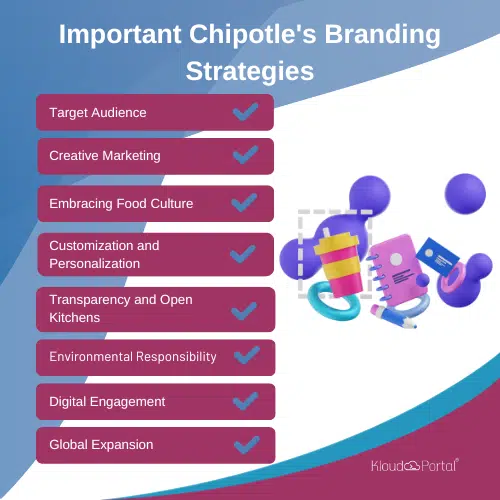
Target Audience

Chipotle’s marketing efforts are carefully tailored to resonate with its audience. Primarily health-conscious millennials and Gen Z. By emphasizing fresh ingredients, customizable options like the burrito bowl, and sustainability initiatives, Chipotle appeals to a demographic that values quality and social responsibility.

Creative Marketing

Chipotle’s marketing campaigns are known for their creativity. The brand uses humor, storytelling, and visually appealing content to engage its audience. The “Friend or Faux” campaign, where customers can get a free burrito if they bring their “best friend,” is a prime example of Chipotle’s inventive approach.

Embracing Food Culture

Chipotle’s core strategy revolves around serving “Food with Integrity.” They prioritize sourcing high-quality, sustainable ingredients and supporting local farmers. This commitment to ethical sourcing aligns with the growing cultural trend of conscious consumerism, where people seek products and brands that reflect their values.

Important Chipotles Branding Strategies

Authentic Mexican Inspiration

Chipotle draws inspiration from traditional Mexican cuisine, which resonates with consumers looking for authentic and flavorful options. Mexican culinary techniques and flavors are crucial to Chipotle’s cultural branding strategy, allowing them to stand out in the fast-food market.

Customization and Personalization

Chipotle’s “Build Your Own” model encourages customers to customize their meals, tapping into the cultural shift towards individualized choices. This method offers customers a sense of control over their meals, which improves the whole dining experience.

Transparency and Open Kitchens

Chipotle’s open kitchen concept aligns with the cultural shift toward transparency in food preparation. Customers can watch their meals being made, reinforcing the brand’s commitment to freshness and quality.

Cultural Engagement through Marketing

Chipotle has consistently engaged with popular culture through marketing campaigns. They have partnered with musicians, artists, and influencers, creating a buzz around their brand and appealing to a younger, socially conscious demographic.

Environmental Responsibility

Chipotle’s sustainability initiatives resonate with the cultural movement toward environmental responsibility. Initiatives like reducing waste, using compostable packaging, and responsibly sourcing ingredients showcase their commitment to a healthier planet.

Digital Engagement

Chipotle has adapted to the digital age by embracing technology and engaging customers through mobile apps and online ordering. This approach aligns with the cultural shift towards convenience and technology-driven experiences.

Supporting Local Communities

Chipotle actively supports local communities through initiatives like the Chipotle Cultivate Foundation, which promotes education and sustainable farming practices. This involvement connects with consumers who prioritize businesses with a social conscience.

Crisis Management and Recovery

Chipotle faced food safety issues in the past, which threatened its brand. However, the company responded by enhancing its safety protocols, demonstrating its commitment to consumer well-being, and gradually rebuilding trust.

Global Expansion

While rooted in Mexican culture, Chipotle’s branding allows it to adapt and expand into international markets. They can tweak their menu to accommodate local tastes while maintaining their core values.

Summary

Chipotle’s digital marketing strategy is characterized by its active social media presence, content marketing, mobile app and online ordering capabilities, loyalty program, influencer partnerships, personalized email marketing, content accessibility, and commitment to social responsibility. These features combine to form a unified and compelling web presence, strengthening Chipotle’s status as a fast-casual dining market leader.

We use cookies to ensure that we give you the best experience on our website. If you continue to use this site we will assume that you are happy with it.

Cookies settings
Accept
Privacy & Cookie policy
Privacy & Cookies policy
Cookie name Active

Privacy Policy

What information do we collect?

We collect information from you when you register on our site or place an order. When ordering or registering on our site, as appropriate, you may be asked to enter your: name, e-mail address or mailing address.

What do we use your information for?

Any of the information we collect from you may be used in one of the following ways: To personalize your experience (your information helps us to better respond to your individual needs) To improve our website (we continually strive to improve our website offerings based on the information and feedback we receive from you) To improve customer service (your information helps us to more effectively respond to your customer service requests and support needs) To process transactions Your information, whether public or private, will not be sold, exchanged, transferred, or given to any other company for any reason whatsoever, without your consent, other than for the express purpose of delivering the purchased product or service requested. To administer a contest, promotion, survey or other site feature To send periodic emails The email address you provide for order processing, will only be used to send you information and updates pertaining to your order.

How do we protect your information?

We implement a variety of security measures to maintain the safety of your personal information when you place an order or enter, submit, or access your personal information. We offer the use of a secure server. All supplied sensitive/credit information is transmitted via Secure Socket Layer (SSL) technology and then encrypted into our Payment gateway providers database only to be accessible by those authorized with special access rights to such systems, and are required to?keep the information confidential. After a transaction, your private information (credit cards, social security numbers, financials, etc.) will not be kept on file for more than 60 days.

Do we use cookies?

Yes (Cookies are small files that a site or its service provider transfers to your computers hard drive through your Web browser (if you allow) that enables the sites or service providers systems to recognize your browser and capture and remember certain information We use cookies to help us remember and process the items in your shopping cart, understand and save your preferences for future visits, keep track of advertisements and compile aggregate data about site traffic and site interaction so that we can offer better site experiences and tools in the future. We may contract with third-party service providers to assist us in better understanding our site visitors. These service providers are not permitted to use the information collected on our behalf except to help us conduct and improve our business. If you prefer, you can choose to have your computer warn you each time a cookie is being sent, or you can choose to turn off all cookies via your browser settings. Like most websites, if you turn your cookies off, some of our services may not function properly. However, you can still place orders by contacting customer service. Google Analytics We use Google Analytics on our sites for anonymous reporting of site usage and for advertising on the site. If you would like to opt-out of Google Analytics monitoring your behaviour on our sites please use this link (https://tools.google.com/dlpage/gaoptout/)

Do we disclose any information to outside parties?

We do not sell, trade, or otherwise transfer to outside parties your personally identifiable information. This does not include trusted third parties who assist us in operating our website, conducting our business, or servicing you, so long as those parties agree to keep this information confidential. We may also release your information when we believe release is appropriate to comply with the law, enforce our site policies, or protect ours or others rights, property, or safety. However, non-personally identifiable visitor information may be provided to other parties for marketing, advertising, or other uses.

Registration

The minimum information we need to register you is your name, email address and a password. We will ask you more questions for different services, including sales promotions. Unless we say otherwise, you have to answer all the registration questions. We may also ask some other, voluntary questions during registration for certain services (for example, professional networks) so we can gain a clearer understanding of who you are. This also allows us to personalise services for you. To assist us in our marketing, in addition to the data that you provide to us if you register, we may also obtain data from trusted third parties to help us understand what you might be interested in. This ‘profiling’ information is produced from a variety of sources, including publicly available data (such as the electoral roll) or from sources such as surveys and polls where you have given your permission for your data to be shared. You can choose not to have such data shared with the Guardian from these sources by logging into your account and changing the settings in the privacy section. After you have registered, and with your permission, we may send you emails we think may interest you. Newsletters may be personalised based on what you have been reading on theguardian.com. At any time you can decide not to receive these emails and will be able to ‘unsubscribe’. Logging in using social networking credentials If you log-in to our sites using a Facebook log-in, you are granting permission to Facebook to share your user details with us. This will include your name, email address, date of birth and location which will then be used to form a Guardian identity. You can also use your picture from Facebook as part of your profile. This will also allow us and Facebook to share your, networks, user ID and any other information you choose to share according to your Facebook account settings. If you remove the Guardian app from your Facebook settings, we will no longer have access to this information. If you log-in to our sites using a Google log-in, you grant permission to Google to share your user details with us. This will include your name, email address, date of birth, sex and location which we will then use to form a Guardian identity. You may use your picture from Google as part of your profile. This also allows us to share your networks, user ID and any other information you choose to share according to your Google account settings. If you remove the Guardian from your Google settings, we will no longer have access to this information. If you log-in to our sites using a twitter log-in, we receive your avatar (the small picture that appears next to your tweets) and twitter username.

Children’s Online Privacy Protection Act Compliance

We are in compliance with the requirements of COPPA (Childrens Online Privacy Protection Act), we do not collect any information from anyone under 13 years of age. Our website, products and services are all directed to people who are at least 13 years old or older.

Updating your personal information

We offer a ‘My details’ page (also known as Dashboard), where you can update your personal information at any time, and change your marketing preferences. You can get to this page from most pages on the site – simply click on the ‘My details’ link at the top of the screen when you are signed in.

Online Privacy Policy Only

This online privacy policy applies only to information collected through our website and not to information collected offline.

Your Consent

By using our site, you consent to our privacy policy.

Changes to our Privacy Policy

If we decide to change our privacy policy, we will post those changes on this page.
Save settings
Cookies settings