Dynamic Search Ads And Their Relevance To SEO

Dynamic Search Ads And Their Relevance To SEO

By Almaas Saleem

Let’s face it: PPC (Pay-per-click) is a constant battle for attention and conversions. You tirelessly craft keyword lists, optimize bids, and analyze performance… and the results can feel like squeezing blood from a stone.

But what if there was a way to supercharge your campaigns with minimal effort and unlock the power of Google’s AI?

It is where Dynamic Search Ads (DSAs) step in. These paid search campaigns utilize Google’s web crawling technology to generate ad groups based on your content, targeting hidden long-tail keywords and relevant searches you might miss with Traditional ad targeting.

The results?

Boost coverage, gain additional traffic, and increase efficiency.

What else do we need?

These are just the tip of the iceberg. This article explains all the nitty gritty details to dive deep into the world of DSA, such as:

  • The major difference between Traditional Search Campaigns and Dynamic ad targets.
  • Their core benefits and how they can revolutionize your PPC campaigns.
  • Five Strategies to Setting up Dynamic Search Ads: A Marketer’s Guide.

Traditional Campaign Settings VS Dynamic Campaigns

Targeting approach

DSA campaigns: Automated targeting based on website content and AI analysis. No need for manual keyword selection. You also have the flexibility to write one or two description lines to garner more traffic.

Traditional campaigns: Manual selection of keywords and search queries and terms to target URLs.

Ad creation

DSA campaigns: Google dynamic search ads automatically generate ad headline(s) that fill keyword gaps and descriptions for landing pages from your entire feed.

Traditional campaigns: You create ad copy manually, tailoring it to specific target keywords and relevant queries.

Bidding

DSAs: Bid on landing pages or similar pages within your website rather than existing keywords.

Traditional campaigns: Bid on specific web pages and keywords.

Control

DSA campaigns: Less control over which keywords trigger ads, as Google dynamically matches queries to your site’s content.

Traditional campaigns: More control over ad target pages and messaging, allowing for precise targeting of high-value keywords.

Reach

DSAs: Can potentially reach a broader audience by targeting long-tail keywords and niche searches that might be missed with manual targeting.

Traditional campaigns: Reach limited to the keywords you’ve explicitly targeted.

Time efficiency

DSAs: Faster setup and less ongoing maintenance, as Google handles much of the ad creation and target-specific URLs.

Traditional campaigns: Require more time for keyword research, ad creation, and ongoing optimization.

Common attributes

  • Both appear as text ads in Google search results.
  • Both use a cost-per-click (CPC) bidding model.
  • Both can be measured and optimized using similar performance metrics (click-through rate, conversion rate, etc.).
  • Understand how Dynamic Search Ads Elevate Performance with the Best Enterprise SEO Services in India.
Core Principles Of Dynamic Search Ads

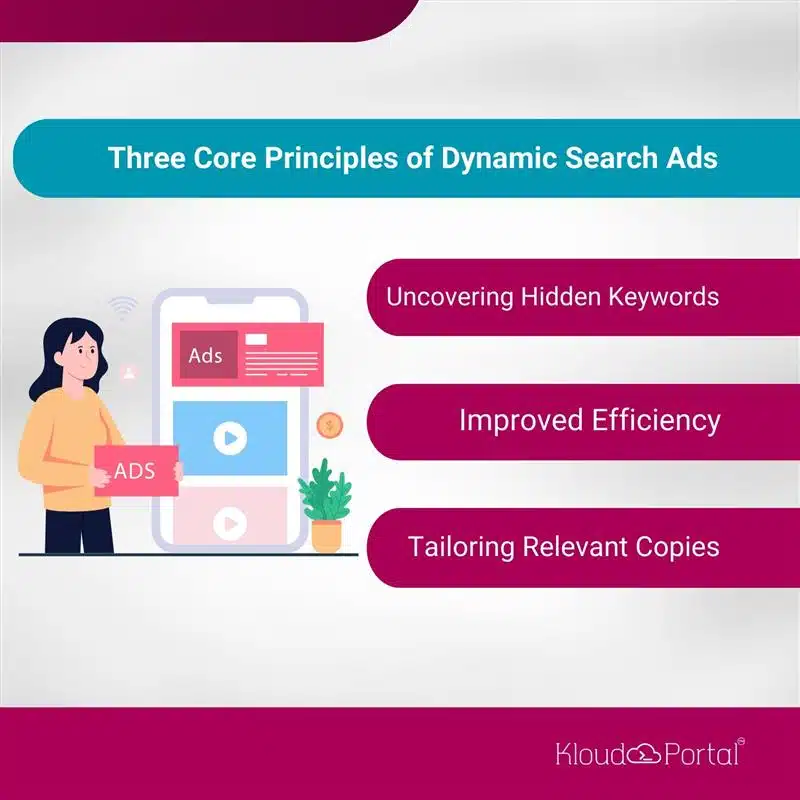
Three Core Principles of Dynamic Search Ads

1. Uncovering hidden keywords:  DSAs crawl your website, unearthing long-tail keywords and niche queries you’d never stumble upon manually. Imagine a blog post about repairing a vintage bike attracting customers searching for specific parts.

Result: broader reach, unexpected leads, and a richer customer base.

2. Improved efficiency: DSAs dynamically generate headlines and descriptions based on your website’s content, tailoring messages to match user searches.

Result: saved time, reduced workload, and the freedom to focus on strategic optimization.

3. Tailoring relevant copies: No more one-size-fits-all messaging. DSAs match ad copy to the specific page feed a user is searching for, boosting relevance and impact. A customer seeking a dog toy gets an ad showcasing your chewable dinosaur, not one for generic pet supplies.

Result: higher click-through rates, improved conversions, and a happier, well-targeted audience.

Five Keys to Unlocking Dynamic Search Ads: A Guide for Marketers

Dynamic Search Ads (DSAs) can be a potent tool for marketers, expanding reach to potential customers and uncovering valuable content within your website. But harnessing their power requires finesse, not just a set-and-forget approach. Here are five key insights to ensure your DSAs deliver impactful results:

Know your website’s potential

Not all websites are DSA-ready. Ensure your content is rich and informative, with well-described products, services, and company details. Google ads account needs clear text to craft relevant ads. If your page title and website are light on text and photos or rely heavily on multimedia, consider traditional keyword campaigns first.

An ideal website for Dynamic Search Ads (DSAs) would be a blog filled with detailed articles on various hiking boot types or an e-commerce platform offering comprehensive product descriptions and well-organized category pages.

In contrast, less suitable candidates for DSAs include one-page websites with minimal text or image portfolios lacking in-depth information.

Control your ad settings

Choose how Google selects URLs for your DSAs. By default, they crawl your entire site, which can be risky. A safer option is using “Page Feeds,” where you upload specific URLs you want them to target. This gives you greater control and prevents irrelevant pages from triggering ads.

Explore the synergy of Dynamic Search Ads with strategies from the Top Digital Marketing Agency in India.

Decode the ad copy mystery

With DSAs, you only write the descriptions; Google generates the headlines. To understand what headlines your ads display, review the “Search Terms” report under “Dynamic Ad Targets.” Here, you can see the search terms users typed, and the headlines triggered. If you’re unhappy with some headlines, consider optimizing your page title(s) & meta descriptions for better alignment.

Avoid keyword cannibalization

Don’t let DSAs steal the thunder of your existing keyword campaigns. Curate a “Negative Keyword List” of your exact URLs and phrase match keywords, and apply it to your DSA campaign.

Suppose you have an existing keyword campaign targeting “buy hiking boots for women.” To prevent DSAs from competing, add this keyword as a negative dynamic ad target to the search engine.

Tame the search term

Just like regular search ads, DSAs benefit from negative keywords. Monitor your “Search Terms” report and add negatives for irrelevant queries that trigger unwanted ads. By refining your targeting, you attract the right audience and maximize the impact of your DSA campaign.

For example, Your website sells running shoes, but your DSA triggers ads for “dancing shoes” due to irrelevant content on a blog post. Add “dancing shoes” as a negative keyword to avoid wasted spending.

Conclusion

Considering Dynamic Search Ads (DSAs)?

Evaluate your goals for Google presence expansion, the desire to increase search volume, the quality of your website, and its extensive content. If efficiency and quick campaign setup align with your needs, DSAs may be the right fit for your strategy.

Amplify your online presence with the right keyword research and Dynamic Search Ads with the best Digital Marketing Services today.

How to Build a High-Performing Software Sales Team from Scratch

How to Build a High-Performing Software Sales Team from Scratch

By Rasmita Patro

In the dynamic landscape of software sales, establishing a high-performing sales team demands a strategic blueprint that incorporates essential elements. Defining a streamlined sales process is paramount, ensuring a cohesive journey from prospect to conversion. Equally vital in sales metrics is the recruitment of skilled professionals, individuals who not only possess expertise but also align with the company’s standards. The incorporation of state-of-the-art sales tools serves as the cornerstone for operational efficiency, fostering improved communication and productivity.

Success depends on the coordination of these elements, with each aspect contributing to a harmonious symphony of business achievement. The sales process serves as a guiding framework, while the recruitment process of the right individuals propels the team toward excellence. The infusion of cutting-edge sales assets empowers the team, streamlining workflows and optimizing customer interactions. Together, these components form a nexus, shaping a dynamic and high-performing sales hiring team capable of navigating the intricate landscape of Software Sales.

Ultimately, the success of such a team is more than just a final stop but a continuous expedition, adapting to industry shifts and leveraging innovation to achieve and surpass business objectives consistently.

Proven Strategies for a Winning Software Sales Team

In this professional guide, we will delve into the meticulous steps and considerations for crafting a software sales team.

  • Define your objectives
    Before assembling your team, establish clear and measurable objectives. Understand the goals of your software sales efforts and outline the specific outcomes you aim to achieve. This clarity will guide your recruitment process and provide a benchmark for success. An adaptable sales process, informed by critical metrics and customer acquisition costs, ensures continuous improvement and resilience in the ever-evolving landscape of sales.
  • Recruitment of the right sales reps
    Success in your sales team starts with recruiting the right talent. Craft a comprehensive hiring process that assesses not only a candidate’s experience and skills but also their alignment with the company’s values. Seek sales professionals with a combination of expertise, enthusiasm, and a proven track record of achieving sales targets, ensuring a team that is not only skilled but also aligned with the ethos of the organization.
  • Sales performance
    Effective sales performance management is an ongoing process. Instill a performance-driven culture within your team by setting clear expectations, defining achievable sales targets, and consistently assessing both individual and team accomplishments. Recognizing and rewarding exceptional sales representatives not only acknowledges their contributions but also cultivates a positive and competitive compensation environment, further fueling motivation and success within the sales team.
  • The role of a sales manager
    A skilled sales team leader’s role is indispensable for the success of a sales team. Effective leadership extends beyond day-to-day activities, focusing on nurturing a team culture that prizes collaboration, professional growth, and the achievement of company objectives. A remarkable sales leader empowers their team members to excel by adeptly leveraging the right tools and techniques, like critical sales metrics, creating an environment conducive to sustained success and growth.
  • Ongoing development
    Strategic investment in professional development is imperative for sustaining high-performing sales talent. Providing tailored training programs, workshops, and resources enhances sales techniques and keeps the team abreast of industry trends, nurturing a culture committed to ongoing learning. This commitment not only sharpens skills but also significantly boosts morale and job satisfaction, cultivating a dynamic and motivated sales force poised for long-term success.
  • Sales goals
    Define specific and quantifiable key performance indicators (KPIs) that align with your sales goals. Regularly monitor these metrics to assess individual and team performance, providing valuable insights for continuous improvement. Harmonizing individual and team goals with the objectives of the company ensures a unified pursuit of a common purpose.Unlock unparalleled growth with our Digital Marketing Services, crafted to enhance your online presence and propel targeted traffic. Harness the power of strategic campaigns and data-driven approaches to achieve measurable success in the ever-evolving digital landscape.
  • Sales tools
    Empower your selling team by furnishing them with the appropriate tools to streamline processes and boost productivity. From cutting-edge systems to impactful sales enablement tools, ensure your team has access to technology facilitating efficient communication, customer attraction, and seamless deal closure. CRM systems, analytics tools, and communication platforms are essential for streamlining processes and improving collaboration. This technological support not only enhances operational efficiency but also equips your team to navigate the sales professional journey effectively, driving overall success.
Proven Strategies For A Winning Software Sales Team
  • Sales team structure
    Crafting a great sales team is crucial for optimizing workflows and maximizing efficiency. Consider factors such as the number of account executives, the strategic role of marketing teams in lead generation, and the seamless integration of sales functions within the overall business structure. A thoughtfully designed structure ensures alignment with business goals, facilitating smooth collaboration and enhancing the overall effectiveness of your sales team.
  • Foster a collaborative culture
    Crafting an effective sales team is crucial for optimizing workflows and maximizing efficiency. Consider factors such as the number of sales representatives, the strategic role of marketing teams in demand creation, and the seamless integration of sales functions within the overall business structures. A thoughtfully designed structure ensures alignment with business goals, facilitating smooth collaboration and enhancing the overall effectiveness of your sales team.
  • Retail empowerment tools
    Empower your sales force by providing essential resources through sales retail empowerment tools. These tools facilitate seamless knowledge sharing, streamline content creation, and enhance communication, empowering sales professionals to engage effectively with potential clients and customers during the entire marketing cycle. By leveraging these tools, your team can achieve greater efficiency and effectiveness, leading to improved customer interactions and increased success in closing deals. Experience the epitome of digital excellence with the Best Digital Marketing Company in Hyderabad. From innovative strategies to targeted campaigns, propel your brand to new heights, ensuring a commanding presence in the dynamic digital world.
  • Customer success stories
    Showcasing customer success stories serves not only as a potent marketing tool but also as a source of inspiration for your sales force. By sharing testimonials, case studies, and success metrics, you illustrate the tangible impact of your software solutions, motivating your team to aspire to similar achievements. Harnessing the power of real-world success stories reinforces the value of your products and energizes your sales force toward continued excellence. Fuel your B2B SaaS product’s success with the expertise of the Best B2B SaaS Product Marketing Agency in India. Our agency combines industry knowledge and innovative strategies to amplify your product’s reach and impact, ensuring unparalleled growth in the competitive landscape of the Indian market.

Conclusion

Creating a high-performing software selling team demands a comprehensive strategy, addressing every facet of the sales process. From the meticulous selection of talent to cultivating a positive company culture and facilitating ongoing development, each element is pivotal for achieving business success.

By incorporating these strategies and utilizing the appropriate tools, you can forge a sales force that not only meets but surpasses commercial goals, propelling the growth and prosperity of your software business to new heights.

What Is A+ Content and Its Significance in Amazon Marketplace Optimization

What Is A+ Content and Its Significance in Amazon Marketplace Optimization

By Amulya Sukrutha

In the ever-expanding realm of e-commerce, Amazon stands out as a giant, connecting millions of buyers with sellers around the globe. As registered brand owners or sellers on this platform, the competition is fierce, and making your product stand out is vital for success. One powerful tool in your Amazon marketplace optimization toolkit is A+ content.

In this blog, we will explore the A+ content guidelines and other crucial information for improving your sales.

What is A+ Content?

A+ Content, also known as Enhanced Brand Content (EBC), is a feature by Amazon that helps brand-registered sellers and Amazon vendors to enhance their product listings with multimedia elements, including high-quality images, comparison charts, and engaging product descriptions. This feature enables sellers to tell their brand story effectively, differentiate their products, and provide customers with a more immersive shopping experience.

Popular Ways to Create A+ Content

To create Amazon A+ Content, here are some simple and popular ways to follow.

Brand story: connecting with customers

Your brand’s unique story is a crucial element in building a connection with customers. A+ Content provides an opportunity to showcase this story, giving potential buyers insight into the values and mission that set your brand apart. Through compelling narratives and visual elements, you can form a brand identity that aligns with your target audience.

High-quality images: making a lasting impression

Images play a key role in online shopping, influencing customers’ purchasing decisions. With A+ Content, you can include high-quality images that showcase your product from every angle. These images not only help customers visualize the product better but also contribute to a professional and polished brand image.

According to the guidelines and specifications from Amazon Seller Central, Amazon suggests using images with a pixel dimension of at least 1600 x 1600 pixels for the main image and 800 x 800 pixels for the supporting images.

Additionally, Amazon may have introduced new features or changed existing ones, so staying informed about any updates to Amazon’s A+ Content guidelines is crucial for creating content that aligns with the platform’s requirements.

Amazon brand registry: securing your brand identity

Brand-registered sellers have the added advantage of being part of the Amazon Brand Registry, which not only helps protect your brand from counterfeits but also unlocks additional features, such as A+ Content. The registry adds credibility to your brand and assures customers of the authenticity of your products.

Boosting sales and conversion rates

The ultimate goal of any seller on Amazon is to boost sales. A+ Content has been proven to enhance product visibility, educate customers, and differentiate products in a crowded marketplace. The result is often a higher conversion rate and more positive customer reviews.

Comparison charts: setting your product apart

A+ content provides a unique opportunity to include a comparison chart module, a powerful tool for highlighting a unique selling point of your product. These charts can be used to showcase the advantages of your product over competitors, aiding potential customers in quick and informed purchasing decisions.

Product listings and descriptions: the key to visibility

Creating effective product listings and descriptions is an art. A+ content can help you to optimize your product listings with 2 to 6 additional product descriptions. Product comparison charts can be used to highlight product specifications, key features, and other important details that educate potential customers and encourage them to make informed decisions.

Brand loyalty and repeat purchases

Well-scripted A+ Content not only attracts potential new customers but also fosters loyalty to the brand. By educating customers about your products and brand, you increase the likelihood of repeat purchases. Satisfied customers are more likely to re-purchase your products, leading to long-term success on the platform.

Competing effectively

In the world of e-commerce, where competitors listings are just a click away, A+ Content gives your brand a competitive edge. By adhering to Amazon’s content guidelines and creating engaging content, you can outshine your competitors and form a strong brand story.

Amazon A+ content: going beyond the basics

While A+ Content is a valuable asset, Amazon A Content takes it a step further by offering 8 to 12 modules for detailed content creation. This comprehensive approach allows brand owners to build a rich narrative, incorporate more images, and thoroughly showcase the benefits of their products.

You can take the support of Content Marketing Services to market your brand and improve sales for your products.

Amazon A+ content effect on SEO

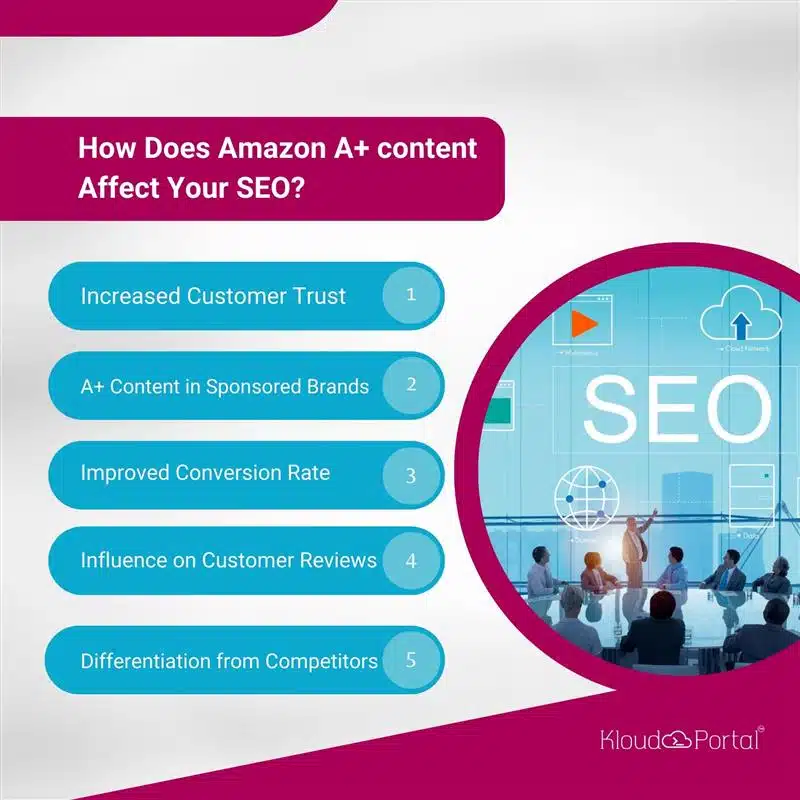
How Does Amazon A+ Content Affect Your SEO?

Amazon A+ content might not directly impact traditional search engine optimization (SEO) in the way that external search engines (Google) operate. However, it does impact your visibility and performance within the Amazon ecosystem, which is a critical aspect of e-commerce optimization. Let us dig into the effects of your visibility and performance.

Increased customer trust

A+ content allows you to build trust with potential customers by providing them with comprehensive understanding of your brand and product detail. Positive customer perceptions can lead to increased sales and better organic rankings over time.

A+ content in sponsored brands

When you run Sponsored brand campaigns on Amazon, A+ Content can be included in the ad creatives, which can lead to more visually appealing and informative advertisements, potentially improving the performance of your paid advertising campaigns.

Improved conversion rate

A+ Content allows you to create more engaging and informative product listings. When customers find your product, the enhanced content can contribute to a better understanding of your product’s features and benefits, potentially increasing the likelihood of a purchase.

Influence on customer reviews

A+ Content can positively influence customer satisfaction by providing them with a clear understanding of what to expect from your product and encourage customers to purchase. Satisfied customers are more likely to leave positive reviews, which can contribute to better organic rankings.

Differentiation from competitors

By utilizing A+ Content features such as comparison charts, high-quality pictures, and additional product descriptions, you can differentiate your products from competitors, which leads to a higher click-through rate (CTR) and increased visibility in search results.

While A+ content offers a plethora of benefits, it is essential to consider the approval process, potential additional cost, customer feedback, and overall impact on units sold. However, the investment often pays off in the form of more sales, improved brand presence, and a more compelling shopping experience for customers.

The best Enterprise SEO Agency in India offers SEO services to re-design content and product descriptions of your brand products, increasing your brand visibility and performance in the Amazon ecosystem.

Conclusion

A+ Content is a game-changer for branded registered sellers on Amazon. It empowers sellers to showcase their brand’s presence and its unique story, showcase products effectively, and stand out in a competitive marketplace. By leveraging the features provided by A+ Content, amazon sellers can create a lasting impression on potential buyers, ultimately driving more sales and building a successful online business.

A Best Digital Marketing Company In Hyderabad offers marketing services that help boost your online presence, integrate your online product profiles, and perform market research for your products.

Backlink Building: A Key Factor For SEO Success

Backlink Building: A Key Factor For SEO Success

By Rashmita Patro

In the expansive realm of the digital domain, where websites vie intensely for attention and acknowledgment from search engines, the importance of backlink building within the sphere of Search Engine Optimization (SEO) is undeniable. This in-depth exploration seeks to unravel the intricacies of backlinks, laying bare the dynamics that underscore effective link-building strategies.

The journey toward SEO success is akin to orchestrating a symphony, where backlinks play the role of each instrument, contributing to the harmonious whole. From crafting compelling content that magnetically attracts link-building to deploying strategic outreach and link-building techniques, the art of building backlinks is intricate and nuanced.

The pivotal significance of this process cannot be overstated, acting as the driving force that propels a website to the upper echelons of search engine results page (SERP). As websites endeavor to distinguish themselves, the art of backlink building emerges as a linchpin for success. This comprehensive journey aims to illuminate the nuanced tactics and profound impact of backlinking, offering a roadmap for websites to navigate the digital cosmos successfully and secure a commanding presence on SERPs.

Understanding Backlinks

At the heart of SEO lies the concept of backlinks, also known as inbound links or incoming links. These are the virtual connectors that weave the fabric of the internet, sites linking one website to another. From a search engine’s perspective, particularly the almighty Google, these website links are not mere virtual connections; they are indicators of a website’s credibility, authority, and relevance.

The fundamental premise is elegantly simple: if other websites are willingly linking to yours, it must signify that your content holds value. Consequently, search engines, in their quest to serve users with the most pertinent and trustworthy information, factor in these links when determining the website’s ranking of web pages.

Elevate your brand narrative and online visibility through premium Content Marketing Services and SEO strategies curated to resonate with your audience, foster engagement, and establish a lasting impact in the competitive digital landscape.

Backlinks Demystified

The following essential elements give the breakdown of the process for SEO’s success:

Website’s search engine ranking alchemy: The algorithms governing search engine is a mysterious alchemy of various factors, and not all backlinks play a starring role in this intricate dance. When a website amasses a substantial number of high-quality SEO backlinks, the search engine interprets this as a resounding vote of confidence from the online community. The implicit message is clear: the linked content is relevant, valuable, and deserving of recognition. As a consequence, the search engine crawls such websites with higher Google rankings on SERPs.

Referral traffic: Navigating The Digital Highways: Beyond their impact on search engine algorithms, backlinks serve as digital highways, directing traffic from one corner of the internet to another. Each click on a backlink represents a potential visitor navigating the online terrain. Quality backlinks, especially those originating from authoritative websites, can act as conduits for substantial reference traffic.

Organic search traffic harvesting: Backlinks are akin to seeds planted in the vast field of the internet. As they increase, so does the potential for organic traffic. Search engines, recognizing the interconnected web page of links, are inclined to display pages with robust backlink profiles more prominently in relevant search results. It, in turn, translates to increased authentic traffic as users discover and engage with the linked content.

Domain authority and page authority oracles: In the realm of SEO, the concepts of domain authority and page authority are akin to oracles guiding the fate of other websites. Websites linking boast a plethora of high-quality backlinks that are perceived as authoritative. This authority extends to individual pages, influencing their page authority. The cumulative effect is a virtuous cycle of enhanced search engine rankings.

Anchor text as the map: The anchor text accompanying a backlink is not a mere formality; it is the map guiding users and search engines to the destination pages. A well-optimized and relevant anchor text is a critical component of the SEO attributed to a backlink.

Strategies in link building and crafting the web of connectivity: Link building is not a haphazard endeavor; it’s a strategic craft. It involves the deliberate acquisition of backlinks through various methods, including guest posting, outreach, and content creation. A nuanced approach that diversifies link sources and employs ethical strategies is paramount for building a robust and sustainable backlink profile.

At the forefront of digital excellence, the Best Digital Marketing Agency in India leverages cutting-edge strategies and innovative solutions to propel businesses to new heights. With a track record of delivering unparalleled results, this agency stands as a beacon for those seeking unparalleled expertise in the dynamic realm of digital marketing.

Backlink Building For SEO Success

Key Factors for Quality Backlinks

Influence of authority: Backlinks from authoritative niche websites wield unparalleled influence. Search engines regard links from well-established and reputable sources as a gold standard of endorsement.

Authority of the linking site: Not every link carries the same weight; those from high-authority websites are the most valuable among backlinks. These endorsements from digital aristocracy carry immense weight in the eyes of search engines.

Symphony of relevance: The effectiveness of a backlink is heightened when seamlessly embedded within relevant content. Contextual integration within the narrative of the content not only adds authenticity but also amplifies the credibility of the linked page.

Dofollow vs. Nofollow Links: The eternal debate of nofollow versus dofollow links persists in the SEO realm. While dofollow links pass on SEO authority, nofollow links, though not directly impacting SEO, contribute to referral traffic and brand visibility. A judicious mix of both types fosters a natural and balanced backlink profile.

Quality over quantity: In the nuanced interplay of backlinks, quality unequivocally trumps quantity. Spammy or low-quality links can tarnish the reputation of a website link and erode its SEO standing. Regular monitoring and proactive disavowal of such links are imperative for maintaining a healthy backlink profile.

Anchor text: The text you click in a hyperlink, referred to as anchor text, needs to be relevant and informative. It aids search engines in comprehending the context of the linked page.

Link age: Older links may be seen as more stable and trustworthy. However, the freshness and relevance of links are also crucial, so a mix of both can be beneficial.

Social signals: While not direct backlinks, online indicators (likes, shares, or comments on social media) can indirectly influence a website’s credibility and visibility.

The Best Enterprise SEO Agency in India employs advanced strategies and tailored solutions to optimize online visibility and propel businesses to the forefront of their websites’ ranking power, ensuring unparalleled success in the digital landscape.

Crafting the Symphony of SEO Success

As website owners, marketers, and content creators, an intimate understanding of backlink building emerges as a necessity rather than a choice. It’s not merely a task on an SEO checklist; it’s an ongoing process that demands attention, creativity, and a steadfast commitment to providing value within the digital ecosystem.

In the vast landscape of the digital universe, backlinks are the threads that weave connections, creating a network of relevance and authority. They are not just hyperlinks but endorsements and votes of confidence from the vast digital community.

As the algorithms evolve and search engines become more sophisticated, the symbiotic relationship between backlinks and SEO will continue to shape the online landscape. The journey is ongoing, and as we traverse the digital highways, backlink building remains an indispensable vehicle propelling us toward the zenith of search engine prominence.

What Are Advertising Networks And How They Work?

What Are Advertising Networks And How They Work?

By Almaas Saleem

Advertising Networks (Ad Networks) are the unsung heroes of online advertising, acting as savvy middlemen between publishers and advertisers. In a century-long partnership, publishers and advertisers have been the dynamic duo, generating billions. Then came ad networks, the cool rescuers. When publishers have unsold ad space, ad networks step in, offering it to companies for slick ad campaigns.

Going straight to the publisher may seem tempting, but ad networks, with their bulk ad space purchases, make online advertising technology cost-effective. They’re like matchmakers, ensuring different types of ads reach the right audience in style.

Advantages of Ad Networks

1. Broadened reach:

  • It helps to connect advertisers with secure buyers, expanding your audience tenfold compared to direct advertising.
  • Using multiple networks taps into diverse demographics, giving you access to various ad exchange(s).

2. Laser focused targeting :

  • Ad networks offer impressive targeting options beyond the basics.
  • From location and age to interests and specific hobbies, many ad networks like Google AdSense and Adwords target multiple ad networks and sell inventory.

3. Better accessibility:

  • Modern ad networks prioritize simplicity and integration.
  • No coding knowledge is needed; point-and-click solutions are needed to create, fund, and launch ad campaigns.
  • Algorithms handle data analysis and testing, allowing marketers to go live with multiple creatives and a modest budget for efficient testing.

Traditional Ad Networks Vs. Programmatic Advertising:

1. Transaction method

Traditional: Supply-side platforms involve manual negotiations and direct transactions between advertisers and publishers.

Programmatic: Automated real-time auctions where ad space is bought and sold instantaneously.

2. Bidding and placement

Traditional: Manual bidding for digital ad space with placements based on direct agreements.

Programmatic advertising: Automated bidding and placement using algorithms for efficient and dynamic real-time optimization.

3. Targeting approach

Traditional: Personalized direct deals between advertisers and publishers for specific ad placements.

Programmatic: Data-driven targeting leveraging algorithms to reach precise audiences based on behavioral patterns.

4. Optimization and reporting

Traditional: Limited real-time optimization, with changes to ad campaigns taking time.

Programmatic: Demand Side Platforms (DSP) with automated algorithms, accompanied by real-time analytics and reporting.

Advantages Of Advertising Networks

Different Types of Ad Networks and Examples

1. Display networks:

  • The world’s biggest ad network, Google’s Display Ad Network, for instance, reaches a whopping 90% of all internet users globally.
  • Display ad formats are like the pictures you see on websites – banner ads, animated gifs, and even videos.
  • Most of the popular advertising network(s) run automatically, thanks to smart algorithms optimizing where and how they appear at the publisher sites.

2. Search networks:

  • These are the search engine heroes. Google, Microsoft, and YouTube are the cool kids in the digital ads category.
  • You pay only when someone clicks on your ad (pay-per-click or PPC), and it focuses on contextual targeting based on ad impressions.

3. Video networks:

  • Have you ever seen those short ads while watching YouTube? That’s video advertising, and it’s huge.
  • YouTube, Hulu, and Amazon videos are the popular kids in this playground.
  • Video ads are the cool cats of advertising, with digital marketers choosing top-tier publishers and networks like UnRuly to serve ads.

4. Mobile networks:

  • These are special types of ad inventory for mobile apps or any portable devices. Picture ads are popping up in your favorite apps.
  • Mobile networks gave a fresh vibe to push ads, especially in e-commerce and gaming.

5. Social media networks:

  • Facebook, Instagram, Snapchat, Reddit, and TikTok are the social media stars where marketers show off.
  • Direct deals with platforms are cool, but social media ad networks use AI to show your ads to the right crowd.
  • Tracking what people do online helps these networks nail retargeting – showing ads to people who’ve shown interest before.

Navigate the advertising space seamlessly with the expertise of the best social media marketing agency.

How Do the Ad Networks Work?

Ad networks serve as a dynamic tool, benefiting both advertisers and publishers. Here’s a simplified breakdown of the traditional ad network model, acknowledging that these steps may evolve with advancing technology:

1. Publisher aggregation:

Ad networks bring together a multitude of publishers, each with an available unsold ad inventory.

2. Advertiser’s campaign creation:

  • Advertisers craft campaigns using the ad network’s campaign panel.
  • Details such as budget, target audience, and more are specified during campaign creation.

3. Publisher integration:

Publishers embed ad network tags on their websites to integrate with the network.

4. Match and ad deployment:

Ad networks enable the connection between an advertiser’s campaign and a publisher’s site’s available inventory.

5. Revenue generation for ad networks:

Ad networks make their profit by either:

  • Taking a percentage cut from the generated ad revenue.
  • Applying a markup on the inventory before selling it to the advertiser.

6. Performance tracking for advertisers:

Once the ad is live, advertisers monitor and manage its performance through the ad network’s campaign panel. In essence, ad exchanges act as the glue connecting publishers and advertisers.

Ad network VS. Ad Server

Understanding the contrast between ad networks and ad servers can be tricky, given their simultaneous entry into the demand side platforms and the intricacies of the online advertising world. Let’s break it down:

Ad server overview:

  • An ad server is like the command center of digital advertising.
  • There are two types: first-party ad servers (for publishers) and third-party ad servers (for advertisers).
  • First-party ad server(s) empower publishers to manage their ad revenues, handle direct deals, sell unsold inventory to popular ad networks, and track ad performance.
  • Third-party ad server(s) assist advertisers in storing ad details, gauging campaign success across multiple publishers, and verifying metrics against publisher’s direct sales.

Ad Network insight:

  • An ad network is another piece of advertising tech but with a different role.
  • It acts as a mediator, facilitating transactions between advertisers and publishers.

In essence, while ad servers manage and report on campaigns, ad networks specialize in making the transactional magic happen. Ad servers are like the organizers, ensuring everything runs smoothly, while ad networks are the facilitators, connecting advertisers and publishers for a seamless exchange of ads and spaces.

Craft compelling connections through ad networks with the best digital marketing agency by your side.

Pro Tip for Choosing the Right Ad Network

Selecting the best ad network demands careful consideration. Begin by defining your target audience, allowing you to narrow down potential networks aligned with your campaign goals. Investigate the network’s inventory and targeting capabilities, opting for reputable names to ensure your ads land on high-quality websites.

Seek reviews and feedback from experienced digital marketers to gauge the network’s real-world performance. Cost considerations are crucial, so understand pricing models and evaluate the impact on your budget.

Wrap Up

As technology advances, advertising networks continue to evolve, promising a future marked by user-friendly experiences and AI-driven enhancements. The impact of user-friendly ad networks underscores their significance as the driving force behind effective, targeted, and efficient advertising campaigns.

Does this seem overwhelming, leaving you feeling a step behind?

The Best time to start was Yesterday. The next best time is Now!

How To Write A Killer Software Sales Proposal That Wins More Deals

How To Write A Killer Software Sales Proposal That Wins More Deals

By Rasmita Patro

Crafting a killer proposal is a crucial skill that can make or break deals in today’s fast-paced universe of software sales. Sales professionals, armed with the right knowledge and strategies, can create proposals that not only stand out but also resonate with potential clients. In this comprehensive guide, we’ll delve into the key elements and strategies for writing a killer software sales proposal that consistently wins more deals.

Understanding the Importance of a Winning Sales Proposal

An effective sales proposal is a comprehensive document containing information about your goods, personnel, products, service offerings, and the value you pledge to provide as a brand. It is crafted for prospective investors, vendors, and other internal stakeholders who significantly influence your business’s financial performance and revenue.

The significance of a great proposal cannot be overstated. It serves as a bridge between your software solution and the needs of your prospective client. A successful proposal not only outlines the proposed solution but also addresses the unique pain points and challenges faced by the target audience.

Successful sales proposals are tailored to the specific needs and preferences of the decision-makers and key stakeholders involved. Understanding the dynamics of the target audience allows the sales team to align their business proposal with the priorities of potential customers.

How do you Write a Winning Sales Proposal?

Writing winning sales proposals involves a strategic and customer-centric approach. Here’s a step-by-step guide to help you craft a compelling sales proposal:

  • Understand your prospect: Research your prospect’s business, industry, and concerns. Identify specific needs and challenges your solution can address.
  • Start with a strong introduction: Hook the reader with a compelling opening. Personalize the introduction to resonate with the prospect’s situation.
  • Clearly define the problem: Articulate the prospect’s concerns. Quantify the impact of the problem to highlight its significance.
  • Present your solution: Highlight the features and benefits of your solution. Clearly explain how your product/service addresses the prospective customers’ challenges.
  • Provide a detailed implementation plan: Outline the steps and timeline for implementation. Clearly define roles and responsibilities.
  • Pricing and terms: Be transparent about the cost breakdown. Offer different pricing options or packages.
  • Build trust: Include case studies or testimonials. Highlight your company’s credentials and expertise. Offer guarantees if applicable.
  • Visuals and formatting: Use a professional and visually appealing design. Incorporate visuals like charts or infographics to enhance understanding.
  • Address potential concerns: Anticipate and address potential objections in the proposal. Clearly outline risk mitigation strategies.
  • Call to action: Clearly state the next steps. Provide a deadline for their response.
  • Cover letter: Include an introductory letter that personalizes the proposal. Address the prospect by name and briefly summarize the key elements of the proposal.
  • Consistent tone: Maintain a steady tone throughout the proposal. A professional and engaging tone helps build a connection with the prospect, creating a positive impression.
  • Legal and compliance: Ensure the proposal complies with legal standards. Clearly state terms and conditions.
  • Pre-designed templates: Utilize ready-made templates to streamline the process. Templates ensure consistency in formatting and help maintain a professional appearance.

By following these steps and adapting them to the unique needs of each prospect, you can increase the effectiveness of your sales proposals and improve your chances of winning deals with a potential customer.

How to write a winning software sales proposal

Crucial Elements of a Successful Sales Proposal

  • Executive summary: capturing attention from the start The executive summary is the gateway to your proposal. It should be a compelling, concise overview that immediately grabs the attention of the reader. Highlight the main points, emphasizing how your software solution addresses the buyer’s problem.
  • In-depth research: the foundation of a winning proposal Thorough research forms the backbone of a fruitful sales proposal. Knowing the prospect’s industry, issues, and challenges enables sales teams to tailor their proposals effectively. Utilize market research to position your software as the optimal solution.
  • Unique selling proposition (USP): stand out in a crowded market Clearly define your software’s unique selling proposition. What sets it apart from the competition? Articulate the value proposition that makes your solution the ideal choice for prospective clients.
  • Visual elements: making an impact beyond words Incorporate compelling visuals into your proposal. Visual components such as charts, graphs, and infographics can convey complex information in a digestible format. A well-designed proposal not only enhances readability but also leaves a lasting impression.
  • Proposal content: addressing pain points and providing solutions The core of the proposal should focus on addressing the prospect’s challenges. Outline how your software solution directly resolves their challenges and improves their business processes. Use language that resonates with the target audience and emphasizes the positive outcomes they can expect.
  • Effective sales pitch: tailoring your message for impact Craft a persuasive sales pitch that speaks directly to the prospect’s problem. Customize your communication to align with their requirements and aspirations. Avoid technical jargon and maintain a steady tone that aligns with the prospect’s preferences.
  • Social proof: building trust through success stories Integrate social proof into your proposal by including case studies, testimonials, or references from satisfied clients. This not only builds trust but also provides evidence of your software’s effectiveness.
  • Pricing model: transparent and tailored to needs When presenting pricing plans, transparency is key. Clearly outline cost plans and models, ensuring that the prospect understands the value they receive for their investment. Tailor pricing options to accommodate different budget levels.

Customer Success and Follow-Up

  • Customer success: transitioning from proposal to implementation Once the proposal is accepted, the customer success team plays a crucial role in ensuring a smooth transition from proposal to implementation. Their expertise ensures that the client achieves the promised outcomes and experiences the full potential of your software solution.
  • Follow-up: nurturing relationships for future opportunities Establish a follow-up process to nurture relationships with clients. Regular communication demonstrates ongoing support and opens avenues for future collaborations. Gathering feedback also provides valuable insights for refining future proposals.

Conclusion

Writing a killer software sales proposal is a strategic process that requires a deep understanding of the prospect’s needs, effective communication, and a commitment to providing solutions. By incorporating the key elements discussed in this guide, sales reps can consistently create business proposals that not only win deals but also foster long-term relationships with satisfied clients.

Remember, a successful proposal is not just a formal document; it’s a powerful tool that showcases your software as the solution to the prospect’s concerns, ultimately closing deals and driving business success.

We use cookies to ensure that we give you the best experience on our website. If you continue to use this site we will assume that you are happy with it.

Cookies settings
Accept
Privacy & Cookie policy
Privacy & Cookies policy
Cookie name Active

Privacy Policy

What information do we collect?

We collect information from you when you register on our site or place an order. When ordering or registering on our site, as appropriate, you may be asked to enter your: name, e-mail address or mailing address.

What do we use your information for?

Any of the information we collect from you may be used in one of the following ways: To personalize your experience (your information helps us to better respond to your individual needs) To improve our website (we continually strive to improve our website offerings based on the information and feedback we receive from you) To improve customer service (your information helps us to more effectively respond to your customer service requests and support needs) To process transactions Your information, whether public or private, will not be sold, exchanged, transferred, or given to any other company for any reason whatsoever, without your consent, other than for the express purpose of delivering the purchased product or service requested. To administer a contest, promotion, survey or other site feature To send periodic emails The email address you provide for order processing, will only be used to send you information and updates pertaining to your order.

How do we protect your information?

We implement a variety of security measures to maintain the safety of your personal information when you place an order or enter, submit, or access your personal information. We offer the use of a secure server. All supplied sensitive/credit information is transmitted via Secure Socket Layer (SSL) technology and then encrypted into our Payment gateway providers database only to be accessible by those authorized with special access rights to such systems, and are required to?keep the information confidential. After a transaction, your private information (credit cards, social security numbers, financials, etc.) will not be kept on file for more than 60 days.

Do we use cookies?

Yes (Cookies are small files that a site or its service provider transfers to your computers hard drive through your Web browser (if you allow) that enables the sites or service providers systems to recognize your browser and capture and remember certain information We use cookies to help us remember and process the items in your shopping cart, understand and save your preferences for future visits, keep track of advertisements and compile aggregate data about site traffic and site interaction so that we can offer better site experiences and tools in the future. We may contract with third-party service providers to assist us in better understanding our site visitors. These service providers are not permitted to use the information collected on our behalf except to help us conduct and improve our business. If you prefer, you can choose to have your computer warn you each time a cookie is being sent, or you can choose to turn off all cookies via your browser settings. Like most websites, if you turn your cookies off, some of our services may not function properly. However, you can still place orders by contacting customer service. Google Analytics We use Google Analytics on our sites for anonymous reporting of site usage and for advertising on the site. If you would like to opt-out of Google Analytics monitoring your behaviour on our sites please use this link (https://tools.google.com/dlpage/gaoptout/)

Do we disclose any information to outside parties?

We do not sell, trade, or otherwise transfer to outside parties your personally identifiable information. This does not include trusted third parties who assist us in operating our website, conducting our business, or servicing you, so long as those parties agree to keep this information confidential. We may also release your information when we believe release is appropriate to comply with the law, enforce our site policies, or protect ours or others rights, property, or safety. However, non-personally identifiable visitor information may be provided to other parties for marketing, advertising, or other uses.

Registration

The minimum information we need to register you is your name, email address and a password. We will ask you more questions for different services, including sales promotions. Unless we say otherwise, you have to answer all the registration questions. We may also ask some other, voluntary questions during registration for certain services (for example, professional networks) so we can gain a clearer understanding of who you are. This also allows us to personalise services for you. To assist us in our marketing, in addition to the data that you provide to us if you register, we may also obtain data from trusted third parties to help us understand what you might be interested in. This ‘profiling’ information is produced from a variety of sources, including publicly available data (such as the electoral roll) or from sources such as surveys and polls where you have given your permission for your data to be shared. You can choose not to have such data shared with the Guardian from these sources by logging into your account and changing the settings in the privacy section. After you have registered, and with your permission, we may send you emails we think may interest you. Newsletters may be personalised based on what you have been reading on theguardian.com. At any time you can decide not to receive these emails and will be able to ‘unsubscribe’. Logging in using social networking credentials If you log-in to our sites using a Facebook log-in, you are granting permission to Facebook to share your user details with us. This will include your name, email address, date of birth and location which will then be used to form a Guardian identity. You can also use your picture from Facebook as part of your profile. This will also allow us and Facebook to share your, networks, user ID and any other information you choose to share according to your Facebook account settings. If you remove the Guardian app from your Facebook settings, we will no longer have access to this information. If you log-in to our sites using a Google log-in, you grant permission to Google to share your user details with us. This will include your name, email address, date of birth, sex and location which we will then use to form a Guardian identity. You may use your picture from Google as part of your profile. This also allows us to share your networks, user ID and any other information you choose to share according to your Google account settings. If you remove the Guardian from your Google settings, we will no longer have access to this information. If you log-in to our sites using a twitter log-in, we receive your avatar (the small picture that appears next to your tweets) and twitter username.

Children’s Online Privacy Protection Act Compliance

We are in compliance with the requirements of COPPA (Childrens Online Privacy Protection Act), we do not collect any information from anyone under 13 years of age. Our website, products and services are all directed to people who are at least 13 years old or older.

Updating your personal information

We offer a ‘My details’ page (also known as Dashboard), where you can update your personal information at any time, and change your marketing preferences. You can get to this page from most pages on the site – simply click on the ‘My details’ link at the top of the screen when you are signed in.

Online Privacy Policy Only

This online privacy policy applies only to information collected through our website and not to information collected offline.

Your Consent

By using our site, you consent to our privacy policy.

Changes to our Privacy Policy

If we decide to change our privacy policy, we will post those changes on this page.
Save settings
Cookies settings