If your Snowflake bill keeps climbing while your dashboards keep lagging, you are not alone. Teams roll out Snowflake expecting elastic scale and lower total cost of ownership, only to hit walls within months. Most Snowflake implementation mistakes are not about the platform itself. They are about how it gets set up. A rushed migration, an ignored warehouse strategy, or governance treated as an afterthought can quietly turn a powerful data cloud into an expensive headache. Here is what trips up even experienced data teams, and what actually works to avoid it in 2026.

Why Snowflake Implementations Go Off Track

Snowflake is often sold as plug and play. It is not. Its architecture separates compute from storage, organizes data into micro-partitions, and bills by the second, rewarding teams who plan intentionally. Most production pain is not caused by Snowflake’s limitations. It comes from legacy habits carried over from older warehouses, rushed timelines, and governance pushed to “phase two.”

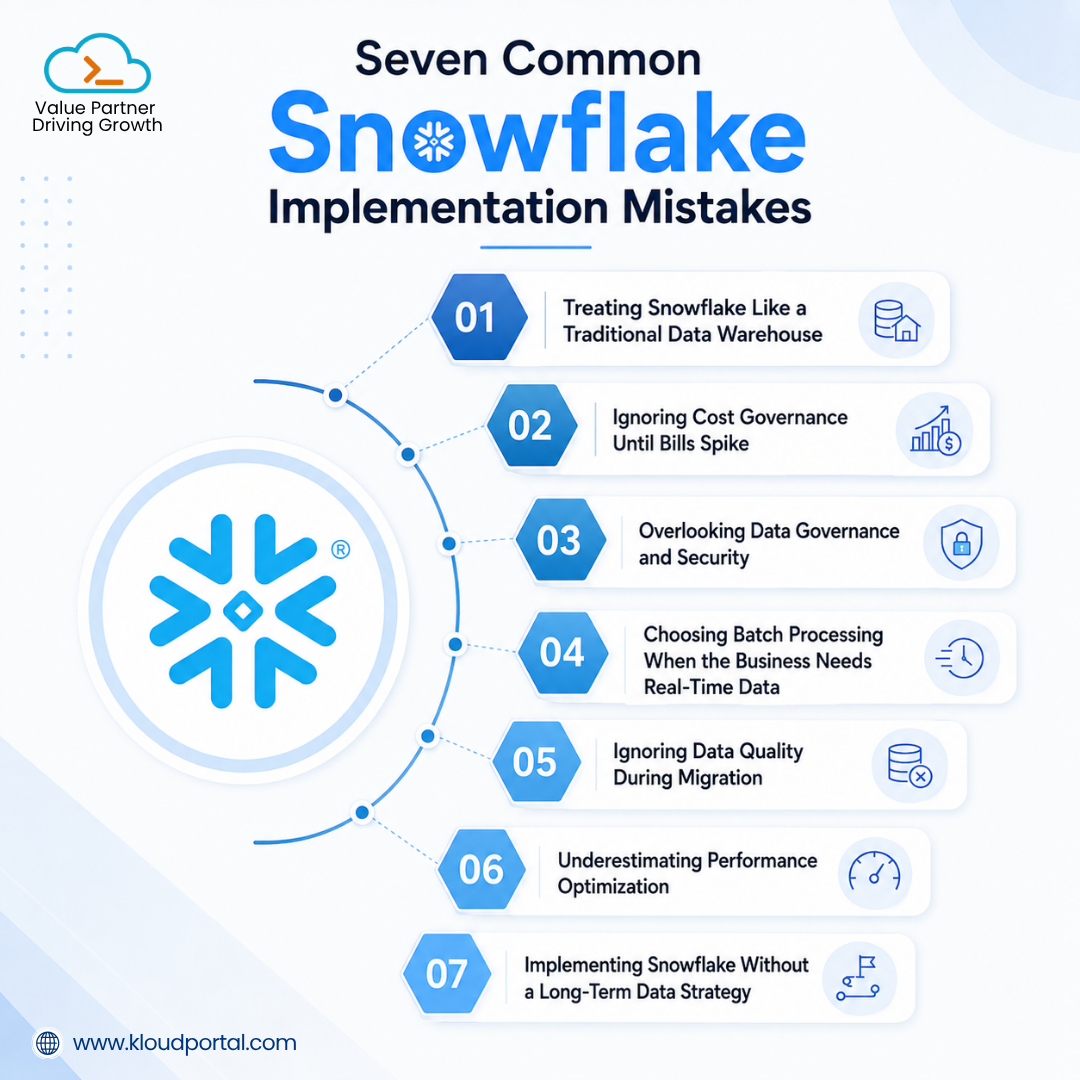
Seven Common Snowflake Implementation Mistakes and How to Fix Them

1. Treating Snowflake Like a Traditional Data Warehouse

Migrating existing databases “as-is” ignores Snowflake’s core advantage: separated storage and compute. Traditional warehouses couple these tightly, so lifting workloads over without redesigning them leads to wasted spend and poor performance.

Fix: Separate ETL, BI, and data science into dedicated virtual warehouses, enable auto-suspend and auto-resume, and modernize legacy schemas instead of a straight lift-and-shift.

2. Ignoring Cost Governance Until Bills Spike

Consumption-based pricing is a strength until warehouses run continuously, clusters are oversized, or queries go unoptimized. Most teams only start governing costs after an unexpectedly high bill arrives.

Fix: Put governance in place from day one with Snowflake warehouse sizing best practices, Resource Monitors, auto-suspension, query history analysis, and cost dashboards, with regular workload reviews to catch waste early.

3. Overlooking Data Governance and Security

As more teams onboard to Snowflake, inconsistent access controls and metadata management create duplicate datasets, conflicting reports, and compliance risk — problems that compound once AI applications start depending on that same data.

Fix: Establish role-based access control and data governance, data classification policies, consistent naming conventions, lineage tracking, and centralized metadata management (Snowflake Horizon Catalog where applicable) early rather than retrofitting governance later.

4. Choosing Batch Processing When the Business Needs Real-Time Data

Overnight batch pipelines still work for some reporting, but use cases like fraud detection, inventory management, and personalization need near real-time data. A retailer relying on nightly inventory updates, for example, can show items as in stock hours after they’ve actually sold out.
Fix: Match ingestion strategy to business need. Combining real-time data pipelines with Snowpipe Streaming and Dynamic Tables lets time-sensitive data flow into dashboards within minutes rather than overnight.
7 Snowflake Implementation Mistakes to Avoid in 2026

5. Ignoring Data Quality During Migration

Duplicate records, missing values, schema inconsistencies, and late-arriving data can undermine analytics and AI models no matter how capable the platform is.

Fix: Build automated validation into every pipeline stage, and use continuous monitoring and data observability tools to catch issues before they reach business users.

6. Underestimating Performance Optimization

Snowflake doesn’t automatically make every query efficient. Oversized or undersized warehouses, poor partitioning, unnecessary joins, and competing workloads on shared warehouses all erode performance and drive up cost.

Fix: Right-size warehouses by workload, separate ETL, reporting, and data science compute, optimize SQL and eliminate redundant transformations, use clustering strategically, and monitor Query History and Query Profile continuously.

7. Implementing Snowflake Without a Long-Term Data Strategy

Focusing only on migration, without planning for AI, advanced analytics, self-service reporting, or data sharing, means the platform will need significant rework as needs evolve.

Fix: Build a roadmap that ties the implementation to long-term business goals: AI initiatives, real-time analytics, secure data sharing, governance, and scalable architecture.

A Real-World Scenario: When “It Works” Is Not Enough

Picture a mid-sized retail company migrating its analytics warehouse to Snowflake. The migration succeeds, dashboards load, but three months in, monthly credit consumption has tripled. Once traced, the cause is one oversized warehouse running every workload, an ungoverned ingestion pipeline pulling in thousands of tiny files daily, and zero clustering on the largest fact table. None of it was a Snowflake failure. It was an implementation gap, exactly what experienced data engineering teams are trained to catch before go-live.

How KloudPortal Helps You Get More from Snowflake

A successful Snowflake implementation is measured by business outcomes, not migration speed. KloudPortal’s Snowflake implementation services take an engineering-first approach — architecture design, data migration, governance, performance optimization, and cost management — built to scale with evolving needs.

Whether you’re implementing Snowflake for the first time, modernizing a legacy warehouse, or optimizing an existing deployment, our team works to keep your platform secure, high-performing, and aligned with your business objectives.

Conclusion

Snowflake provides a powerful foundation, but success depends on implementation, not technology alone. Organizations that prioritize architecture, governance, cost optimization, and performance from the outset are better positioned for reliable analytics, strong AI outcomes, and confident scaling.

Frequently Asked Questions

What is the most common Snowflake implementation mistake?

Migrating legacy schema designs into Snowflake without adapting them for its columnar, micro-partitioned architecture. This single habit accounts for much of the performance and cost pain teams see after migration.

How can I avoid overspending during Snowflake implementation?

Segment warehouses by workload type, enable auto-suspend, right-size instead of defaulting to one large warehouse, and monitor usage with Query Profile from week one.

Why do Snowflake governance issues cause implementation delays?

Skipped access controls and data cataloging create rework once teams try to scale, often adding two to six months to a project timeline as gaps get patched retroactively.

Should I hire a Snowflake implementation partner or handle it in-house?

It depends on existing in-house Snowflake architecture experience. Complex migrations and cost optimization tend to benefit from a partner with a proven delivery history rather than a team learning Snowflake on a live project.

We use cookies to ensure that we give you the best experience on our website. If you continue to use this site we will assume that you are happy with it.

Cookies settings
Accept
Privacy & Cookie policy
Privacy & Cookies policy
Cookie name Active

Privacy Policy

What information do we collect?

We collect information from you when you register on our site or place an order. When ordering or registering on our site, as appropriate, you may be asked to enter your: name, e-mail address or mailing address.

What do we use your information for?

Any of the information we collect from you may be used in one of the following ways: To personalize your experience (your information helps us to better respond to your individual needs) To improve our website (we continually strive to improve our website offerings based on the information and feedback we receive from you) To improve customer service (your information helps us to more effectively respond to your customer service requests and support needs) To process transactions Your information, whether public or private, will not be sold, exchanged, transferred, or given to any other company for any reason whatsoever, without your consent, other than for the express purpose of delivering the purchased product or service requested. To administer a contest, promotion, survey or other site feature To send periodic emails The email address you provide for order processing, will only be used to send you information and updates pertaining to your order.

How do we protect your information?

We implement a variety of security measures to maintain the safety of your personal information when you place an order or enter, submit, or access your personal information. We offer the use of a secure server. All supplied sensitive/credit information is transmitted via Secure Socket Layer (SSL) technology and then encrypted into our Payment gateway providers database only to be accessible by those authorized with special access rights to such systems, and are required to?keep the information confidential. After a transaction, your private information (credit cards, social security numbers, financials, etc.) will not be kept on file for more than 60 days.

Do we use cookies?

Yes (Cookies are small files that a site or its service provider transfers to your computers hard drive through your Web browser (if you allow) that enables the sites or service providers systems to recognize your browser and capture and remember certain information We use cookies to help us remember and process the items in your shopping cart, understand and save your preferences for future visits, keep track of advertisements and compile aggregate data about site traffic and site interaction so that we can offer better site experiences and tools in the future. We may contract with third-party service providers to assist us in better understanding our site visitors. These service providers are not permitted to use the information collected on our behalf except to help us conduct and improve our business. If you prefer, you can choose to have your computer warn you each time a cookie is being sent, or you can choose to turn off all cookies via your browser settings. Like most websites, if you turn your cookies off, some of our services may not function properly. However, you can still place orders by contacting customer service. Google Analytics We use Google Analytics on our sites for anonymous reporting of site usage and for advertising on the site. If you would like to opt-out of Google Analytics monitoring your behaviour on our sites please use this link (https://tools.google.com/dlpage/gaoptout/)

Do we disclose any information to outside parties?

We do not sell, trade, or otherwise transfer to outside parties your personally identifiable information. This does not include trusted third parties who assist us in operating our website, conducting our business, or servicing you, so long as those parties agree to keep this information confidential. We may also release your information when we believe release is appropriate to comply with the law, enforce our site policies, or protect ours or others rights, property, or safety. However, non-personally identifiable visitor information may be provided to other parties for marketing, advertising, or other uses.

Registration

The minimum information we need to register you is your name, email address and a password. We will ask you more questions for different services, including sales promotions. Unless we say otherwise, you have to answer all the registration questions. We may also ask some other, voluntary questions during registration for certain services (for example, professional networks) so we can gain a clearer understanding of who you are. This also allows us to personalise services for you. To assist us in our marketing, in addition to the data that you provide to us if you register, we may also obtain data from trusted third parties to help us understand what you might be interested in. This ‘profiling’ information is produced from a variety of sources, including publicly available data (such as the electoral roll) or from sources such as surveys and polls where you have given your permission for your data to be shared. You can choose not to have such data shared with the Guardian from these sources by logging into your account and changing the settings in the privacy section. After you have registered, and with your permission, we may send you emails we think may interest you. Newsletters may be personalised based on what you have been reading on theguardian.com. At any time you can decide not to receive these emails and will be able to ‘unsubscribe’. Logging in using social networking credentials If you log-in to our sites using a Facebook log-in, you are granting permission to Facebook to share your user details with us. This will include your name, email address, date of birth and location which will then be used to form a Guardian identity. You can also use your picture from Facebook as part of your profile. This will also allow us and Facebook to share your, networks, user ID and any other information you choose to share according to your Facebook account settings. If you remove the Guardian app from your Facebook settings, we will no longer have access to this information. If you log-in to our sites using a Google log-in, you grant permission to Google to share your user details with us. This will include your name, email address, date of birth, sex and location which we will then use to form a Guardian identity. You may use your picture from Google as part of your profile. This also allows us to share your networks, user ID and any other information you choose to share according to your Google account settings. If you remove the Guardian from your Google settings, we will no longer have access to this information. If you log-in to our sites using a twitter log-in, we receive your avatar (the small picture that appears next to your tweets) and twitter username.

Children’s Online Privacy Protection Act Compliance

We are in compliance with the requirements of COPPA (Childrens Online Privacy Protection Act), we do not collect any information from anyone under 13 years of age. Our website, products and services are all directed to people who are at least 13 years old or older.

Updating your personal information

We offer a ‘My details’ page (also known as Dashboard), where you can update your personal information at any time, and change your marketing preferences. You can get to this page from most pages on the site – simply click on the ‘My details’ link at the top of the screen when you are signed in.

Online Privacy Policy Only

This online privacy policy applies only to information collected through our website and not to information collected offline.

Your Consent

By using our site, you consent to our privacy policy.

Changes to our Privacy Policy

If we decide to change our privacy policy, we will post those changes on this page.
Save settings
Cookies settings