
Maximizing ROI With SaaS: Strategies For Success

Maximizing ROI With SaaS: Strategies For Success

By Aparna Sushumna

SaaS marketing

Software as a Service (SaaS) is an approach to distributing software content online, where service providers maintain a number of servers and databases as source code for web applications that users of connected devices can access.

As most SaaS are web-based applications, it brings the product of the firm’s workflow onto the screen of users’ desktops or mobile phones. These apps are also cloud-based, thus, are accessible from anywhere, secure, cost-effective, easy to deploy, and scalable. Any software that is web-based or available on demand is a SaaS application offered by the SaaS vendor.

According to studies, the global SaaS market is estimated to grow from $251.17 billion to $883.34 billion from 2022 to 2029, accounting for a CAGR(compound annual growth rate) of 19.7%.

Roi in SaaS marketing

ROI in SaaS is the correlation of profits to the marketing efforts from the marketing costs or the marketing efforts in composition to the invested money in content marketing.

In the world of SaaS business, cross-selling and upselling to customers are powerful ways of expanding revenue and boosting sales for SaaS marketing. SaaS marketing strategy is all about customer experience and customer retention. Saas product marketing team can use CRMs, online demo platforms, marketing intelligence tools, google analytics, and lots more to obtain a closer look into the customer journey and to develop closer relationships with them.

The principle to successful ROI can be measured as recurring customer data or customers imply recurring revenue. Return on investment(ROI) means comparing marketing spend to business results. It is important to calculate ROI for the companies who adopted SaaS marketing to calculate the marketing efforts at the bottom line. It is important to know in what ways and how the marketing results are impacting or aligning with the overall business results. Integrating ROI with SaaS marketing gives insights into the marketing strategies that are with the company’s time and money.

SaaS companies work in a customer-centric economy, and providing personalized, valuable, and effective solutions are core to customer success. Modern-age businesses quickly invest large chunks of investment towards customer retention and delivering great value to customers. Measuring customer lifecycle and customer success efforts is a great way to measure customer success ROI.

An efficient customer success team with a combination of customer success strategy, chief customer officers, customer experience specialists, and customer success software directly implies revenue growth, customer base, annual recurring revenue amount, and customer loyalty.

Measuring the ROI of CS efforts determines the efficacy of the marketing strategy.  A comprehensive ROI report that includes KPI, adoption and retention rates, etc., is essential for evaluation. These key metrics help in identifying gaps in problem areas.

Customer success ROI gives an overall picture of the team’s performance and only highlights their efforts for customer success. Customer acquisition costs and customer lifetime value are two crucial indicators of customer success ROI (CLV). The more the CLV than CAC, the more the business valuation.

ROI-focused SaaS marketing strategies should be data-driven and comprehensive data gathered from each customer engagement. The obtained information provided an ongoing revenue score for the entire customer experience. The CLV is measured as the gross margin of average monthly recurring revenue (MRR) divided by the revenue churn rate, either monthly or yearly.

Strategies for maximizing ROI with SaaS

1. Leveraging B2B practices

The key metrics for growing SaaS product revenue and successful deals are leveraging best practices from the B2B sales world, such as building relationships, consultative selling, managing expectations, and understanding customer needs. Understanding customer data and integrating these practices into SaaS strategies is critical to business.

2. Collecting and analyzing customer data

Using data insights plays a vital role in targeting new customers effectively. Collecting data on when how, and how a customer is purchasing a product and how much the customers are willing to spend on their needs provides a vision of offers that should be made available to potential customers to increase the deal size time. These prospects, if used properly, can be converted into customers.

3. Automated strategies

Adopting marketing automation processes reduce the uphill manual mundane tasks of framing logistics or operation, increase the time to focus on prospects of new and existing customers, and efficiently increase conversion rates. The SaaS marketing automation market is booming as more and more SaaS companies spend their revenue on marketing.

4. Hiring and training the sales team

A well-trained sales team closes deals faster, increasing the company’s revenue at earlier stages. Also, training the team to focus on long-term goals and customer experience ensures that customers are accompanied in their overall product or service journey from the initial contact point to the renewal through the upsell opportunities.

SaaS market growth

5. Email marketing

In order to nurture leads in the sales funnel, email marketing is essential. Utilizing an email subscriber list to send each customer personalized emails about offers and discounts at different points in the sales process would greatly increase their interest in businesses.

6. Customized solutions

Offering a tailor-made solution to fit customer needs achieves a satisfactory rate among customers, closes the deal faster, and builds customer confidence that their requirements have been taken care of and addressed.

7. Onboard process

The onboarding process is the first step to help new customers get familiar with the product and process right away. Key performance indicators (KPIs) must be established, customer adoption must be continuously monitored, management training must be coordinated with customers, significant milestones must be celebrated, onboarding progress must be measured and understood, and bottlenecks must be identified and analyzed with the assistance of a SaaS product marketing agency.

Additionally, maintaining a post-sale customer management program is essential. This continuous adoption and upselling involve constant onboarding, nurturing, renewal, and expansion.

How KloudPortal assists SaaS companies?

KloudPortal is the leading digital marketing solution expert with expertise in SaaS strategies. They are the best B2B SaaS Product Marketing Agency in Hyderabad that assists companies adopting SaaS marketing techniques with the required third-party apps, KPIs, search engine optimization (SEO), and CRM system (customer relationship management) and help the companies with smooth digital transformation.


1. CAGR(compound annual growth rate)

 

What Is Programmatic Advertising? How Does It Work?

What Is Programmatic Advertising? How Does It Work?

By Deepa Kesavan

Programmatic advertising is an effective way to boost brand awareness that keeps up with the metrics of any business site. It also makes a blocklist and an allowlist of websites.

The blocklist is to avoid fraud by blocking suspicious websites, where the brand must not appear because it might turn off the audience. The allowlist is the approved website to increase audience traffic. This segmentation list augments in providing better results than traditional demographics.

Programmatic advertising in simple terms

Unlike the conventional manual digital or online advertising methods, programmatic advertising works by automating technology for buying ad space in online media. Programmatic media acquisition uses data insights and algorithms to serve ads to the right consumer at the right time and price.

How does it work?

Businesses in this form of advertising target consumers across the internet space. For instance, the algorithm used in advertising makes placing the ad on YouTube or Instagram effective.

Similarly, if the algorithm points out that the most effective use of the funds meant for ads is to direct the ad to a more specialized website with a high concentration of targeted consumers, it will be placed on that website.

  • The programmatic ad tech process begins with the advertiser setting their audience and budget.
  • Programmatic ad strategies require an overwhelming learning curve, but working with partners or agencies helps advertisers ease their foray into the programmatic advertising process.
  • With potential challenges, businesses find it easy and beneficial to adopt programmatic ad strategies to gain efficiency, reach, transparency, and accountability.
  • Decisions on online ad placements are made using data that includes the target consumers’ age, interest, location, and occupation. Companies use this data to launch targeted, effective ad campaigns like online video ads with the highest profits.

Benefits of programmatic advertising

  • Target advertising: One of the key benefits of the programmatic media ad process is its ability to target a specific audience. Programmatic advertising platforms use consumer data to identify and target users most likely to engage with the ad. This targeting can be based on a wide range of data, including demographic information, browsing history, and search queries.
  • Commoditized: Programmatic ads are commoditized just like any commodity. Businesses are in the same online ad space, making some types of ad supply scarce. But the increasing use of programmatic ads has increased the amount of non-commoditized inventory becoming available to advertisers with software programs.
  • Saves time: Programmatic advertising has benefits over traditional media buying. One of the main benefits is its efficiency, as the buying and selling process automation reduces the time and effort required for purchasing ad space. Online marketing also provides greater targeting capabilities, allowing advertisers to reach a specific audience more precisely.
  • Optimizing: Additionally, programmatic advertising platforms offer real-time advertising and report the programmatic ecosystem analytics. This allows advertisers to optimize their campaigns to sell ads based on performance data.
  • Safety, visibility, and transparency in programmatic targeting: While the programming of ads gives consumers greater control over visibility and where their digital ads appear, brand safety and transparency remain the top priority. Programmatic technology like Amazon Ads, a third-party solution, addresses these issues with safety visibility and transparency.

Programmatic platforms-dsp and dmp

The technology used in programmatic marketing has gained worldwide momentum in how advertisers buy ad space, making it easier to reach their desired audience with precision targeting and more cost-effective. With Demand-side platforms (DSP) and Data management platforms (DMP), digital advertising has become a staple in the digital advertising space. The programmatic ad-buying process uses DSP, a software platform that allows advertisers to buy or change in real time through advertisement exchanges.

The DSP connects to multiple ad exchanges and uses algorithms to automatically bid on inventory that matches the target audience criteria for ads. The DSP can also use DMPs to help manage and analyze consumer data. DSP identifies the inventory that matches the audience criteria and automatically bids on the inventory in real-time. If the bid succeeds, the ad is served to the user in the placement.

Buying advertisement inventory

Programmatic ad platforms use technology to automate the buying and selling of advertisement inventory. These inventories refer to the space on a website or app where ads can be displayed.

Businesses prefer to market on suitable ad spots before considering the private or open market. This private market is known for ‘spot buying,’ or buying ad space immediately. Advertisers use programmatic ad platforms to buy inventory of ads in real-time through the exchange of ads, which connects buyers and sellers of ad space.

Why is programmatic advertising important?

Programmatic ad exchanges

Multiple ad exchanges are available in the programmatic ad ecosystem for programmatic buying, including Google’s Ad Exchange (one of the largest and most well-known). These exchanges provide access to a wide range of real-time inventory, including internet, video, and native ads.

Programmatic adverts make an essential part of the internet advertising space, with eMarketer projecting that programmatic advertising costs will reach $59.45 billion in the US by 2023. This growth is partly due to the increasing use of programmatic technology to automate the buying and selling of inventory and the ability to reach a highly targeted audience.

Google’s ad network is a major player in the programmatic advertising ecosystem. The Google Display Network provides access to various ad inventory across millions of websites and apps. Google AdWords also offers programmatic advertising capabilities, allowing advertisers to purchase google ads inventory through the Google Ad Exchange.

Programmatic advertising makes use of AI and ML algorithms to automate the buying and selling of ad inventory. These algorithms analyze data and ad performance data to make real-time bidding decisions, optimizing campaigns for maximum performance.

Digital marketing platform

The rise of digital display advertising, media buying, and the increasing use of data management platform technology to automate the buying and selling of advertisement inventory, banner ads, and ad placements have made programmatic advertising essential to any modern marketing strategy.

KloudPortal is the best digital marketing agency that provides social media marketing, programmatic marketing, and advertising advantages to organizations for greater efficiency, targeting capabilities, real-time reporting, ROI, and analytics. KloudPortal creates content to automate the buying and selling of advertisement inventory by exchanging ads with audience data to target specific users. It has transformed how the marketing industry buys and sells ads by providing an efficient and effective way to reach a specific audience.

Why Is Customer Value Realization Analysis Important For Your Business?

Why Is Customer Value Realization Analysis Important For Your Business?

By Chaitanya Kummamuru

Value and success are co-related in the business world these days. An organization’s business value may be defined as its worth in terms of financial performance, competitive differentiation, and customer satisfaction. Furthermore, the true business potential lies in achieving the business objectives through short-term and long-term goals. At this point, value realization becomes very important for successful business outcomes.

KloudPortal, the top digital marketing company, conducts Customer Value Realization (CVR) analysis annually to determine how much value their product or service contributes to the client.

Value Realization: Why It’s Important

Value realization occurs when the customer truly understands the value of the product or service they used. It is the ability to measure quantifiable value such as cost-Benefit analysis, ROI (Return on Investment), NPV (Net Present Value), Utilization, Product Adoption, and qualitative outcomes their organizations have achieved using a product/service.

Value realization is accomplished by implementing the assessment of customer success. It demonstrates the actual business value the stakeholder receives by consuming a product/service. Customer value realization ensures customer retention with the slightest effort and helps cross-selling and upselling, which are necessary for a profitable business. The value realization cycle ensues successful business outcomes when successfully implemented.

Value Realization Cycle

Every value realization strategy contains steps the organization takes with its customers or stakeholders. This sequence, from value definition to optimization, is called Value Realization Cycle.

It is segregated into five sections, and a successful cycle would have all the stages completely accomplished.

Value definition:

The foremost step is to define the value of Return On Investment(ROI) to the customers based on their expectations during the sales process. Value definition is when the sales team gives a clear picture of the benefits to the customers.

Value delivery:

Derivation of the maximum value to the customer’s benefit after the product’s sale is called Value Delivery. The delivery process should include benefits, training, support, customer experience, and attributes that create value for the customer.

Value realization:

A tangible way to track the actual business impact is through value realization. Value realization is when the customer realizes the value of the product bought and the value it accrued to the organization. It’s a measure of how the customers perceive the value delivered by the purchase of the product.

The top digital marketing company, KloudPortal, understands the obstacles and mitigates the necessary steps to ensure a successful CVR.

Value validation:

Value validation is a confirmation by the customer that the expected value has been received. Additional value is added to the product at this stage while realizing the actual value of the product. The customer comprehends what more value is expected of the product beyond the value realized.

Value optimization:

Customers seek ways to optimize revenue by understanding and maximizing the Customer Lifetime Value (CLV). Customers can be repeated, and loyalty points are gained by optimization of value. It helps in retention, thereby increasing the value to the companies further.

Emphasis on Customer Value Realization Analysis

  • Customer loyalty increases when trust is gained through value realization. They tend to stick to the brand even during times of crisis.
  • Customers can convey their success stories to other stakeholders, opening new horizons for selling the products/services.
  • Value realization leads to the renewal of customer agreements through customer satisfaction.
  • Businesses can gain insights from value realization, which can help in post-sales processes and the beginning of a new cycle.
  • Customers can take any corrective actions necessary to fulfill the next set of business objectives.
  • In addition, companies can design and create a Value Realization Framework, which is critical for a company to work together towards a single goal.
  • All the information collected can further be used in a business’s pre-sales process, resulting in further customer success.
  • Value realization can enhance the brand value of the products the business is selling through the success of its customers.
  • Implementation of the VR cycle improves productivity while keeping the risks minimal.

At Kloud Portal, apart from the digital marketing services, we provide services that include Customer Value Realization (CVR) analysis to understand how much value is added to the product/service utilized. It is the Top Digital Marketing Company and an Enterprise SEO Company providing the best digital marketing services and SEO services.

KPIs for customer value realization

Key Metrics for Value Realization

In addition to the Value Realization Cycle, it is a good practice to build value realization metrics or key performance indicators (KPIs) that help measure the business’s overall health and performance. These key performance indicators will map out the business outcome in every stage of work, ensuring value realization.

Time to Live (TTL)

Time taken for the product to be implemented after the contract signing is called Time To Live (TTL). The lesser time, the better the performance.

Time to Value (TTV)

The time taken from contract signing to value extraction is called Time to Value (TTV).

Net Revenue Retention (NRR)

The revenue retained from existing customers is known as NRR, and it is a crucial KPI for SaaS and subscription-based companies.

Return On Investment (ROI)

It is the value received against the investment made on a particular product/service. A high ROI shows the product’s high performance and a profitable business.

Customer Success Kpis

There are other KPI’s like Customer Acquisition Score (CAS), Monthly Recurring Revenue (MRR), Customer Lifetime Value (CLV), etc… that measure customer success.

Saas Business Model: An Example of CVR

Value realization in SaaS Business Model is no different from any other business value model, and it gives the ability to look beyond the software product. A good value realization framework will formulate a good strategy with solid objectives, tasks, tools, and metrics. The successful execution of the framework will result in increased revenue, decreased costs, and enhanced productivity with minimized risks.

Kloudportal: A CVR Service Offering

KloudPortal, the top digital marketing company, has the right medium for long-term success through customer value realization (CVR). We ensure maximized customer lifetime value (CLV) by customer value realization analysis provided by our team of experts at KloudPortal.

Our digital marketing services include content writing, public relations, PPC management, reputation management, and social media marketing and advertising. As an Enterprise SEO Company, we offer services like SEO strategy and services, keyword research and analysis, content development and optimization, etc. Please go through our website for more information on SEO services.

Conclusion

Customer Value Realization (CVR) is more than just a business metric—it is a strategic approach to building long-term relationships with customers by consistently delivering and optimizing value. By implementing a structured Value Realization Cycle and tracking the right KPIs, businesses can ensure that their products and services not only meet but exceed customer expectations. As customers begin to recognize and validate the value they receive, it drives loyalty, retention, and overall brand success. A well-executed CVR strategy empowers businesses to align their goals with customer outcomes, ensuring mutual growth and sustained success in today’s competitive landscape.

How To Use Google’s APIs For Monitoring The Performance Of Your Site In Search?

How To Use Google’s APIs For Monitoring The Performance Of Your Site In Search?

By Almaas saleem

The Google Ads Application Programming Interface (Google’s API) provides a range of APIs that can help website owners monitor the performance of their sites in search. It can provide valuable insights into how well your site performs, how users find and interact with your content, and what improvements you can make to increase your site’s visibility and engagement.

Before discussing the steps required to use Google’s APIs to monitor the regular expression in search, let us understand what Google Search Console and Google Analytics provide to amplify SEO and website analytics:

Google Search Console (GSC)

Google Search Console is a web service query provided by Google that allows site owners to monitor their websites by giving performance reports using keyword searches. It uses machine learning algorithms to query how users find and interact with the website, including keyword rankings, bounce rates, click-through rates, and average position. Using Google Search Console, website owners can improve their google rankings and total impressions.

Some specific features and tools to optimize a website’s performance include:

  1. Search Analytics – This tool lets you see your site’s performance in Google search results. You can view clicks, impressions, click-through rates, and position data for specific keywords, average positions, and pages. This information can help you identify opportunities to improve your site’s content, structure, and overall search strategy.
  2. Sitemaps – Google Search Console allows you to submit a sitemap of your web pages to help Google better understand your site’s structure and average position content. It can help improve your site’s indexing in search results, increasing visibility and traffic.
  3. Crawl Errors – GSC can alert you to crawl errors on your site, such as broken links or pages that can’t be accessed. You can improve your site’s user experience and Keyword Effectiveness Index (KEI) by identifying and fixing these errors.
  4. Mobile Search Usability – With the high number of users accessing the internet from mobile devices, ensuring your site is optimized for mobile viewing is important. Google Search Console provides a Mobile Usability report that can help you identify issues with your mobile performance and provide suggestions for improvement.

Google Analytics (GA)

GA is a free web analytics service provided by Google that allows website owners to analyze and track the search type, user behavior, and search traffic. It provides important metrics into how users find and interact with your site, the average number of page views, including where they’re coming from, what pages they visit, and how long they stay.

Some specific features and tools provided by GA include:

  1. Acquisition Reports: This tool lets you see where your site’s visitors are coming from, including query engines, social media, and other websites. You can also see which keywords drive traffic to your site and which pages are most popular.
  2. Conversion Reports: This tool allows you to track specific goals and conversions on your site, such as form submissions or e-commerce purchases. You can see which pages lead to conversions and which marketing channels drive the most traffic.

Google APIs for Site Search Performance Report

Google’s APIs can provide valuable insights into your site’s visibility in search. By setting up Google Search Console and integrating the relevant API with your site, you can retrieve data from the performance report and use this data to make informed decisions about improving your site’s visibility and engagement in search. With regular monitoring and analysis of your site’s search tool ranking using Google’s APIs, you can ensure that your site remains competitive and relevant in the ever-changing web search landscape.

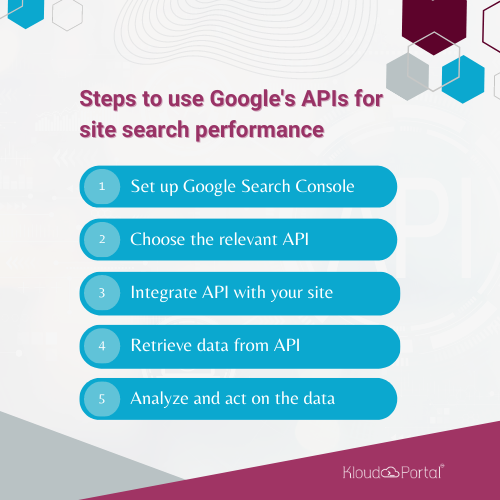
Google’s APIs for site search performance
Step 1: Set up Google Search Console.

To access Google’s APIs for the Search Engine Results Page (SERP) position, you must set up a Google Search Console account. The free tool provides a range of insights into your search visibility, including keyword rankings, average CTR, and more. Visit the GSC website and sign in with your Google account. Follow the prompts to verify ownership of your website, and you’ll be ready to access the APIs.

Step 2: Choose the API you want to use.

Google offers several APIs to monitor search performance, including the Search Console API, the Pagespeed Insights API, and the Custom Search API. The Search Console integration interface is the most comprehensive, providing detailed information on your site’s search tool ranking, keywords ranking, click-through rates, and more. Pagespeed Insights provides information on how fast your site is loading, which can harm your search rankings. The Custom Search system interface allows you to create custom search engines that can be used to search your site and others.

Step 3: Integrate the API with your site.

Once you’ve chosen the API you want to use, you’ll need to integrate it with your site. These typically involve installing a plugin or adding code to your site’s HTML. The exact steps will depend on the application interface and platform you’re using to build your site. Google provides the complete guide and tutorials for each API, so consult these resources for guidance.

Step 4: Retrieve data from the API.

Once the API is integrated with your site, you can retrieve data on your site’s search index. It typically involves sending requests to the middleware using a programming language like Python or Java. Again, the exact steps will depend on the API you’re using and the programming language you’re working with it.

Step 5: Analyze and act on the data.

The data you retrieve from the API can provide valuable insights into your site’s performance in search. You can use this data to identify areas for improvement, such as optimizing your content for specific keywords, improving your site’s load times, or building more backlinks. You can also use the data to track the impact of changes you make to your site, such as updating your content or implementing technical SEO efforts. Regularly monitoring your site’s ranking metrics ensures that your site remains visible and engaging to users.

Conclusion

KloudPortal, the best digital marketing agency, offers tailored digital marketing solutions that cater to each client’s unique needs. Our services include content writing, Enterprise Search Engine Optimization (SEO), and social media marketing (SMM), all focusing on optimizing digital marketing efforts.

Our development team utilizes various tools, including the Google search console, to help our clients achieve the best return on investment (ROI). This knowledge allows us to make informed technical decisions for the site and optimize Google trends. So, reach out to our experts and explore the services.

Why is Ethical Digital Marketing Important

Why is Ethical Digital Marketing Important

By Priyamvada Bulusu

Digital marketing has become popular in recent times due to its wide reach. Entrepreneurs started using digital marketing services such as social media marketing, pay-per-click, content writing, SEO services, and online reputation management to reach and appeal to a huge audience. The best social media marketing agency is the one that follows ethical marketing despite challenging situations and witnesses good results in the long term.

Ethical Business Practices In Digital Marketing And Social Media Platforms

Ethical principles are important in the business world for two major reasons.

  1. To win customer trust and loyalty: Customers tend to switch brands when an organization’s business practices appear shady. People are usually more willing to spend an extra few dimes for a product from a trustworthy brand than to purchase the same product at a significantly lower cost from a lesser-known label.
  2. To enhance brand image: A business grounded in strong core values wins people’s trust and respect. A good image also enhances the brand value and increases its value in the share market. Unethical practices can cause long-term negative impacts on a business and damage its reputation.

The best digital marketing services can help you adhere to the following business ethics:

Honesty in product representation

Sometimes, we find online marketers giving product descriptions that are far from truthful advertising. The false statements increase the customers’ expectations and lure them into purchasing, while the actual product differs from what is described on the website. A common practice in the marketing industry is editing product images using Photoshop to make them look very appealing. Some sellers go as far as posting fake online customer reviews for their products to attract sales. They fail to understand that though their unethical business operations may bring them quick profit, it impacts the customers’ trust in making large purchase decisions.

Consumers’ privacy and data confidentiality

Consumer data collection is a business practice that most organizations follow to know their clients’ preferences to serve them better. Most seller websites place cookies in the user’s browser to study consumer behavior, including their online behavior, most-searched keywords, geographic location, contact details, and more. While the capture of this data is justified, many users today are concerned about sharing the data with third-party websites for monetary purposes, which is the leading cause of cybercrime and identity theft.

A host of ethical issues would pop up if the business does not work towards maintaining the data confidentiality of its clients.

Transparency

E-commerce sites should maintain transparency by notifying consumers before collecting their personal information, including email addresses which they could use later for email marketing. They should also make the users aware of the purpose of collecting their details and give an option for them to exit if they are not willing to share their details.

The return and refund policies of most e-commerce sites remain unclear, with hidden terms and conditions. It carries a reputational risk to the business, and the customer may no longer find the business good enough. It is the social responsibility of digital platforms to maintain transparency in their policies and procedures.

Accountability/ Ownership

Artificial intelligence has replaced a lot of professional capabilities of traditional media today. Almost every business model uses a well-formatted algorithm to make quick and important decisions. The downside to this technological advancement is the lack of accountability for any undesirable consequences that decisions made through machine learning capabilities may bring forth. Ethical practices require businesses to take up ownership of the decisions.

Avoid discrimination

After thorough market research, many marketing campaigns today follow target-based advertising by choosing a group audience to display their products and build a customer base. This effective online marketing strategy is legally acceptable if it filters the target audience only based on their ‘need’ for certain products or services. However, target advertising becomes ethically diluted if the choice of target consumers is based on their race, color, or other discriminatory factors.

Content marketing ethics

At times, a digital marketer may copy the intellectual property of other e-commerce stores, including their online content, website design, images, etc. Replication of the marketing strategies of other businesses could mean a lack of your own digital marketing efforts from the consumers’ perspective. It could also lead to legal issues that negatively impact your credibility.

It is good to partner with digital marketing services to provide strategic plagiarism-free content for your website.

Laws That Combat Unethical Marketing Practices

As reported by Microsoft in 2021, 21% of cyber attacks targeted consumers, and 79% of attacks aimed at enterprises. Social media sites are easy bait for online hackers, where they target several social media users through luring adverts. There are federal laws in place to combat ethical issues in digital and traditional marketing that may also be the first level of cybercrime. A few of the laws are listed below.

Importance Of Business Ethics In Digital Marketing

The FTC Act

It prohibits deceptive advertising and false promises that can mislead consumers.

Copyright, Designs and Patents Act 1988

It regulates the rules to follow in a digital marketing campaign and safeguards the use of cookies. It also defines a content owner’s copyrights on their written content and images and the legal actions for violating them.

Data Protection Act 1998

It ensures accuracy, data integrity, confidentiality, and accountability. It covers the right of access to personal data and outlines the principles that digital marketers must follow if they deal with personal information. Revisions of this act are expected soon to accommodate new clauses.

Electronic Communications Act 2000

It defines the use of automated message systems in an electronic system.

Laws may vary among different political zones.

The Best Digital Marketers For Your Business

KloudPortal is the best digital marketing agency that provides an array of services using effective marketing tools. It has a dedicated marketing team that strategically leverages its digital marketing expertise while implementing the principles of ethical marketing to deliver outstanding results. Connect with them to avail of the best digital marketing services that pull up your e-commerce site to the topmost results on search engines.

Conclusion

Ethical digital marketing is no longer optional — it is essential in building long-term trust, sustaining customer relationships, and maintaining a credible online presence. In an age where information spreads rapidly and scrutiny is high, businesses must commit to honesty, transparency, and accountability in their digital strategies. Respecting consumer privacy, avoiding misleading content, and promoting inclusivity are not just moral choices but strategic advantages. As technology continues to evolve, so should the ethical frameworks that guide how we engage with audiences online. Practicing integrity in every campaign is the surest path to building a brand that people not only notice, but genuinely respect.

6 Checklist Items For B2B Content Marketing

6 Checklist Items For B2B Content Marketing

By Chaitanya Kummamuru

B2B Content Marketing is a major player in flourishing businesses. B2B, an abbreviation for Business to Business, mainly occurs between a company and a wholesaler or a company and a retailer. It is one of the most economical ways to market your company.

Companies have used content marketing services to keep consumers updated on their business developments, products, and services. The content marketing services include strategy development, research, creating content, editing, and publishing. B2B businesses can market content through blog posts, emails, podcasts, editorials, ads, and online video content. As a part of content marketing services, social media can build brand awareness about the products on social media platforms.

A digital marketing agency can provide content marketing services that include emailing newsletters to keep the consumers informed and posting promotional offers to attract them to come back while ensuring they avoid spam folders. The marketing methods mentioned above aim at the same goal of promoting, marketing, advertising a product, generating leads to the business, directing traffic to the website for promoting business growth, etc.

SEO or Search Engine Optimization can be of great use for generating traffic to the website by improving the website’s position in search results. If further visibility is required, an SEO company can be approached. B2B Content marketing aims at pleasing specific consumers using the content posted on the website.

Digital Marketing can achieve the goals of both content marketing and SEO. In this blog post, our focus is on Content marketing strategies.

Best Six Tips For Content Marketing

  • Find the right target audience through research.
  • Conduct a content audit to learn where you need to improve and what your next steps should be
  • Create content relevant to the present market situation and the target market.
  • Create a publishing pace for your content, so readers know what to expect.
  • Optimize your content for search engines through SEO tools.
  • Be ready to adapt to the changing online environments like algorithm updates, etc.

Five Essential Elements Of Content Marketing Strategy

  • Formulating your strategic plan with well-defined and realistic goals.
  • Knowing who your target audience should be.
  • Evaluate your competitors to gain a niche audience.
  • Setting your brands right, promoting the products with the right focus
  • Reviewing your results.

Checklist Items For The B2B Content Marketing Process

Goal-oriented content planning

Every business has specific goals as to what it wants to achieve. According to these business goals, you must align your B2B content marketing goals with your B2B content marketing strategy. It is good to see if your goals are specific to your business requirements and are attainable. Depending on your content type, the content marketing manager may use a team of experts dedicated to specific tasks or hire a B2B content marketing agency.Use a content calendar to plan promotional activities, organize the content to be published, and contain status updates and partnerships.

Right target audience

Creating buyer personas will give a better picture of the target audience. Based on the understanding of personas, you can divide your potential customers depending on specific behaviors, pain points, challenges, goals, and concerns. Through these personas, it’s easy to know what your buyers aim to reach. Plan your B2B content marketing strategy accordingly to pave the way for becoming an industry leader.

Keyword research and higher ranking on SERPs

Once you decide on the topic to create the content, it’s important to determine the keywords that should go into the blog content. SEO tools enable finding the relevant keywords for the business, products, and services offered. Using a keyword phrase at the beginning of the title of your blog post will ensure higher ranks in search engine results pages (SERPs) and generate more traffic. Long tail keywords and phrases are crucial as they make up most of the search queries.

Attribution model and conversion count

High-quality content

Once you are ready with your content ideas for your topic, formatting your content becomes crucial. Content formats may contain blogging, video, podcasting, infographics, email, visual content, and eBooks. In the case of blog posts, you can have internal links to sources providing valuable information about the content of your blog posts. While keeping your audience engaged, quality content can boost your leads and increase sales.

Content promotion tactics

Content promotion tactics help your business get noticed. Depending on the type of content, the promotion tactics vary. Some of them are marketing on social media, influencer marketing, email marketing, and paid promotion. Persons of great importance in their field, like celebrities and sportspeople, can help in influencer marketing through their endorsements and product placements. Providing the link to your landing page on social media may increase traffic to your website, and the number of email subscribers provides good statistical data on where your brand stands in the competition.

Reviewing and optimizing the results

A sales pipeline is a great way to review and optimize your business to generate better revenues for the upcoming financial years. It is a visual representative model that allows you to

  • Track and handle your sales activities, thus improving your sales process.
  • Business forecasting and analysis of sales strategies can be done.
  • You can gauge your business revenue and results for the current financial year.

Apart from the checklist mentioned above, one thing to include in your B2B content marketing strategy is your offline presence. It will gain customer leads. Personal relationships and networking are the keys to a great business. The offline presence will build trust among the customers and improve reliability.

More On B2B Content Marketing Strategy

Well-formulated marketing funnels and good campaigning can lead to a better B2B content marketing buying process.

Marketing Funnels & Campaigning

Marketing funnels provide a stage-wise marketing plan. A well-structured marketing funnel will make understanding the buyer’s journey easy, formulating a better marketing strategy and improving sales growth. Compelling content can be created at every funnel stage to boost the content marketing process.

The marketing team can conduct marketing campaigns yearly to get customer feedback and keep your brand on top of the competition. They facilitate lead generation by creating awareness among customers. Proper evaluation of customer feedback on products leads to improving the existing products and innovation of new products.

KloudPortal In B2B Content Marketing

Being a digital marketing agency and an SEO company, KloudPortal has the best talent pool to assist you in growing your business through our marketing solutions, which include B2B content marketing services and SEO services. As a digital marketing agency, we provide diverse solutions like SEO, content writing, social media marketing, paid ads campaign management, email marketing, and digital PR. Get our best strategist at KloudPortal to formulate the right business solution for you and augment your ROI.

We use cookies to ensure that we give you the best experience on our website. If you continue to use this site we will assume that you are happy with it.

Cookies settings
Accept
Privacy & Cookie policy
Privacy & Cookies policy
Cookie name Active

Privacy Policy

What information do we collect?

We collect information from you when you register on our site or place an order. When ordering or registering on our site, as appropriate, you may be asked to enter your: name, e-mail address or mailing address.

What do we use your information for?

Any of the information we collect from you may be used in one of the following ways: To personalize your experience (your information helps us to better respond to your individual needs) To improve our website (we continually strive to improve our website offerings based on the information and feedback we receive from you) To improve customer service (your information helps us to more effectively respond to your customer service requests and support needs) To process transactions Your information, whether public or private, will not be sold, exchanged, transferred, or given to any other company for any reason whatsoever, without your consent, other than for the express purpose of delivering the purchased product or service requested. To administer a contest, promotion, survey or other site feature To send periodic emails The email address you provide for order processing, will only be used to send you information and updates pertaining to your order.

How do we protect your information?

We implement a variety of security measures to maintain the safety of your personal information when you place an order or enter, submit, or access your personal information. We offer the use of a secure server. All supplied sensitive/credit information is transmitted via Secure Socket Layer (SSL) technology and then encrypted into our Payment gateway providers database only to be accessible by those authorized with special access rights to such systems, and are required to?keep the information confidential. After a transaction, your private information (credit cards, social security numbers, financials, etc.) will not be kept on file for more than 60 days.

Do we use cookies?

Yes (Cookies are small files that a site or its service provider transfers to your computers hard drive through your Web browser (if you allow) that enables the sites or service providers systems to recognize your browser and capture and remember certain information We use cookies to help us remember and process the items in your shopping cart, understand and save your preferences for future visits, keep track of advertisements and compile aggregate data about site traffic and site interaction so that we can offer better site experiences and tools in the future. We may contract with third-party service providers to assist us in better understanding our site visitors. These service providers are not permitted to use the information collected on our behalf except to help us conduct and improve our business. If you prefer, you can choose to have your computer warn you each time a cookie is being sent, or you can choose to turn off all cookies via your browser settings. Like most websites, if you turn your cookies off, some of our services may not function properly. However, you can still place orders by contacting customer service. Google Analytics We use Google Analytics on our sites for anonymous reporting of site usage and for advertising on the site. If you would like to opt-out of Google Analytics monitoring your behaviour on our sites please use this link (https://tools.google.com/dlpage/gaoptout/)

Do we disclose any information to outside parties?

We do not sell, trade, or otherwise transfer to outside parties your personally identifiable information. This does not include trusted third parties who assist us in operating our website, conducting our business, or servicing you, so long as those parties agree to keep this information confidential. We may also release your information when we believe release is appropriate to comply with the law, enforce our site policies, or protect ours or others rights, property, or safety. However, non-personally identifiable visitor information may be provided to other parties for marketing, advertising, or other uses.

Registration

The minimum information we need to register you is your name, email address and a password. We will ask you more questions for different services, including sales promotions. Unless we say otherwise, you have to answer all the registration questions. We may also ask some other, voluntary questions during registration for certain services (for example, professional networks) so we can gain a clearer understanding of who you are. This also allows us to personalise services for you. To assist us in our marketing, in addition to the data that you provide to us if you register, we may also obtain data from trusted third parties to help us understand what you might be interested in. This ‘profiling’ information is produced from a variety of sources, including publicly available data (such as the electoral roll) or from sources such as surveys and polls where you have given your permission for your data to be shared. You can choose not to have such data shared with the Guardian from these sources by logging into your account and changing the settings in the privacy section. After you have registered, and with your permission, we may send you emails we think may interest you. Newsletters may be personalised based on what you have been reading on theguardian.com. At any time you can decide not to receive these emails and will be able to ‘unsubscribe’. Logging in using social networking credentials If you log-in to our sites using a Facebook log-in, you are granting permission to Facebook to share your user details with us. This will include your name, email address, date of birth and location which will then be used to form a Guardian identity. You can also use your picture from Facebook as part of your profile. This will also allow us and Facebook to share your, networks, user ID and any other information you choose to share according to your Facebook account settings. If you remove the Guardian app from your Facebook settings, we will no longer have access to this information. If you log-in to our sites using a Google log-in, you grant permission to Google to share your user details with us. This will include your name, email address, date of birth, sex and location which we will then use to form a Guardian identity. You may use your picture from Google as part of your profile. This also allows us to share your networks, user ID and any other information you choose to share according to your Google account settings. If you remove the Guardian from your Google settings, we will no longer have access to this information. If you log-in to our sites using a twitter log-in, we receive your avatar (the small picture that appears next to your tweets) and twitter username.

Children’s Online Privacy Protection Act Compliance

We are in compliance with the requirements of COPPA (Childrens Online Privacy Protection Act), we do not collect any information from anyone under 13 years of age. Our website, products and services are all directed to people who are at least 13 years old or older.

Updating your personal information

We offer a ‘My details’ page (also known as Dashboard), where you can update your personal information at any time, and change your marketing preferences. You can get to this page from most pages on the site – simply click on the ‘My details’ link at the top of the screen when you are signed in.

Online Privacy Policy Only

This online privacy policy applies only to information collected through our website and not to information collected offline.

Your Consent

By using our site, you consent to our privacy policy.

Changes to our Privacy Policy

If we decide to change our privacy policy, we will post those changes on this page.
Save settings
Cookies settings