
Can AI Replace Human Content Creators?

Can AI Replace Human Content Creators?

By Rasmita Patro

The evolution of technology, particularly artificial intelligence (AI), has sparked intriguing debates surrounding its potential to replace content developers. Content creation, a cornerstone of modern marketing strategies and online engagement, has traditionally relied on human ingenuity, creativity, and intuition.

However, with advancements in AI, particularly in natural language processing (NLP) and machine learning, there’s a growing curiosity about whether Artificial Intelligence can match or even surpass content creators in generating engaging and higher-quality content. While AI models may produce very convincing text, human content creators continue to be important and beneficial in many domains.

Key Takeaways

  • The future of content creation involves collaboration between humans and AI, not competition.
  • AI aids in content generation, optimization, and research, streamlining processes.
  • Content creators add value by injecting originality, creativity, and brand voice into AI-generated text.
  • Combining AI insights with human creativity leads to innovative content strategies tailored to audience needs.

AI Revolution: Friend or Foe for Content Creators?

The key to implementing Generative AI in content strategy is to view it as a valuable tool that can be used to expedite the writing process. It can increase your team’s productivity by providing helpful suggestions, from brainstorming new ideas and creating initial versions to recycling information in creative ways. It should not replace the content writers but rather help them produce higher-quality material more effectively.

Here’s how an AI tool boasts some advantages-

  1. Efficiency: By taking over iterative tasks like content generation and optimization, AI tools are freeing up human creators to tackle more strategic aspects of their work.
  2. Data-driven insights: AI empowers content writers by sifting through vast amounts of data to unearth hidden patterns, user trends, and audience preferences. This newfound knowledge shapes content strategies, and fuels informed decision-making.
  3. Scalability: AI-powered content generators can produce vast quantities of content in a short period, catering to intended audiences and niches with minimal human input.
  4. Personalization: AI algorithms can tailor content based on user behaviors and demographics, delivering personalized experiences that resonate with individual users.

However, while Artificial Intelligence offers undeniable benefits in the creation of content, it also raises significant questions and challenges, particularly concerning creativity, originality, and the human touch.

Experience exponential growth for your business by partnering with the Best Digital Marketing Agency in India.

Can AI Replace Human Creativity?

As AI technology evolves, there is growing anxiety about the fate of human content creators such as copywriters, fiction writers, and other writers. However, here are some reasons why human content writers/creators are expected to stay significant in the future.

1. Creative thinking

One of the most valuable qualities of human content creators is their ability to add a distinct viewpoint and voice to their work. While AI models can create grammatically correct and factually accurate material, they may fail to add creativity or emotional resonance to their work.

2. Compassion and perception

Content creators can understand and connect with their target audiences on a deeper level, giving empathy and sensitivity to their work that AI models may not be able to replicate.

3. Situational understanding

Human authors can add a degree of contextual knowledge to their writing that AI tools may not be able to simulate. They may use their personal experiences, cultural background, and other influences to produce content that is both relevant and intriguing.

4. Editorial assessments

While AI tools can create text, they lack the level of editorial expertise and strategic thinking abilities required for producing excellent content. Human content creators may review their own and others’ work, deciding what stuff to include and what to leave out.
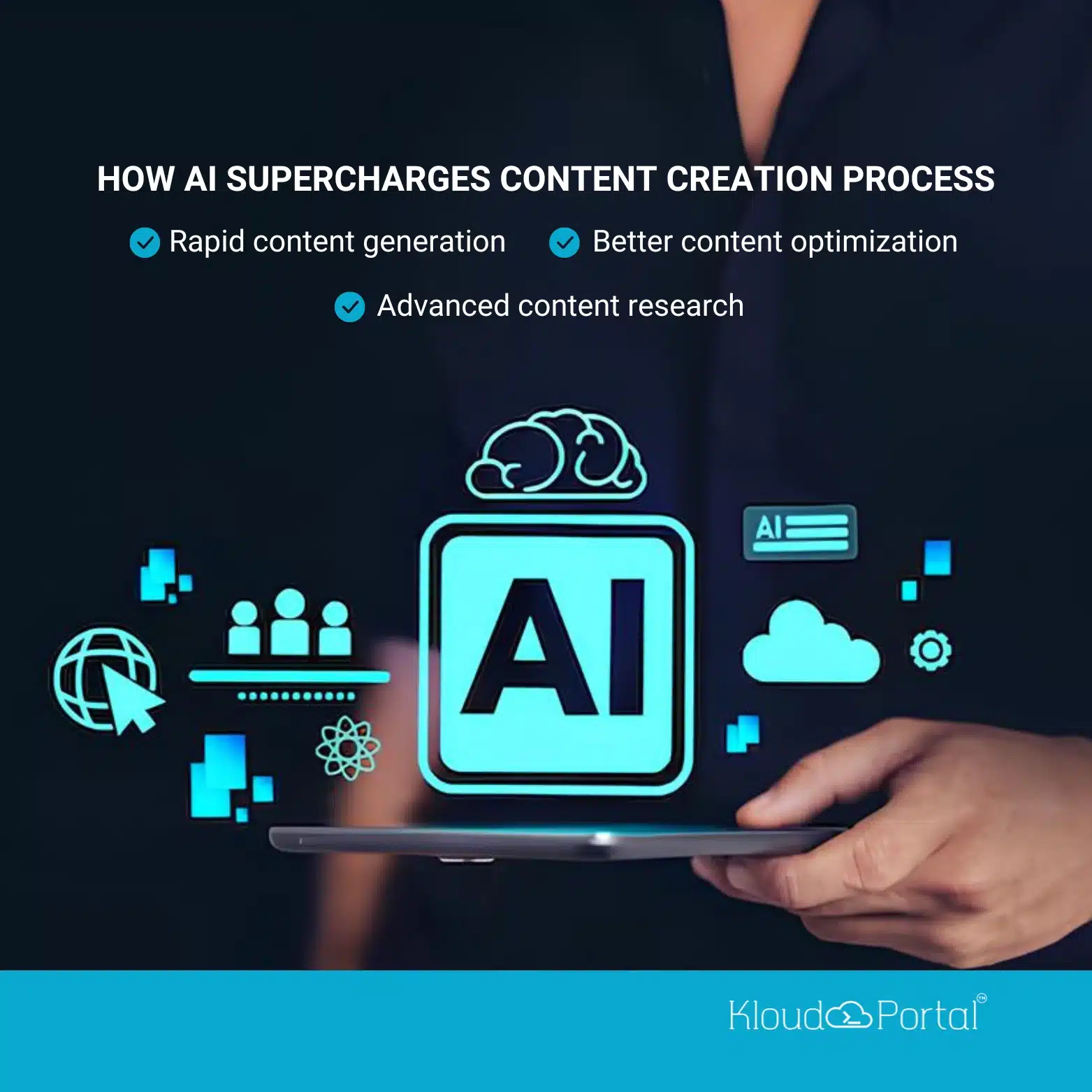
How AI Supercharges Content Creation Process

Human + AI: A Symbiotic Relationship

The future of creating content lies not in a battle between humans and AI but in a synergistic partnership. Artificial Intelligence can be an invaluable tool, assisting with:

  • Content generation: AI can churn out drafts, summaries or scrape data to generate basic content frameworks.
  • Content optimization: AI can analyze user data and search engine trends to optimize existing content for better reach.
  • Content research: AI can sift through vast amounts of information, compiling relevant data and statistics for research purposes.

Content creators can then leverage this generated text to:

  • Inject originality and brand voice: Human writers can personalize the content generated from AI by infusing it with their unique voice and brand personality.
  • Develop creative strategies: Humans can use AI insights to develop creative content strategies, understanding user behavior at a deeper level.
  • Craft compelling narratives: Machines may generate facts, but humans weave those facts into captivating stories that resonate with readers.

The Future: A Collaborative Content Creation Landscape

Content marketing relies on human marketers to craft website content that resonates with audiences, whether it’s through unique perspectives, brand voices, or the use of generative AI to produce high-quality content that makes a significant impact, proving to be a powerful tool in the digital landscape.

Hence, the content creation landscape of tomorrow will likely see a collaborative environment where AI and humans work together.

  • AI will handle repetitive tasks, data analysis, and generating basic content outlines.
  • Content developers will use AI insights to develop strategic approaches, craft compelling narratives, and inject a human element.
  • Marketers and content writers will focus on understanding market segments at a deeper level, tailoring content to specific needs and preferences.

This synergistic approach can lead to the creation of high-quality, targeted content that resonates with audiences and drives engagement.

Bottomline

While AI tools can be useful for content creators, they are unlikely to replace human content creators in the near future completely. Human writers offer a degree of originality, empathy, and editorial judgment to their writing that AI tools may not be able to match. However, AI tools can assist in streamlining the content development process, allowing human creators to concentrate on areas where they can provide the most value.

Instead of perceiving AI as a threat, content creators should embrace its potential as a valuable tool and collaborator in the creative process. By harnessing AI’s analytical capabilities and efficiency alongside ingenuity and intuition, content writers can elevate the quality, relevance, and impact of their content. Ultimately, the future of content creation relies on the symbiotic relationship between ingenuity and generative AI technology. This partnership fosters innovation and allows storytelling to evolve in new and unforeseen directions.

FAQS

Can AI create content in bulk?

AI-powered content generators can produce vast quantities of content in a short period, catering to specific audiences and niches with minimal human contribution.

Can AI personalize content for users?

AI can tailor content based on user preferences, behaviors, and demographics, delivering personalized experiences that resonate with individual users.

Can AI-generated content raise legal concerns?

Yes, AI-generated content can pose legal risks related to copyright infringement, plagiarism, and data privacy. Human oversight is essential to ensure ethical content creation.

Can generated text be unoriginal?

Yes, AI-generated content can feel formulaic and derivative, lacking the spark of original ideas that human creativity brings.

Leveraging Generative AI for SEO

Leveraging Generative AI for SEO

By Rasmita Patro

The digital marketing landscape is constantly transforming, with search engine algorithms becoming more sophisticated and user expectations rising ever higher. In this competitive environment, leveraging generative AI for SEO presents a unique opportunity to streamline processes, enhance content creation, and achieve superior search engine rankings.

Key Takeaways

  • Streamline keyword research, content creation, and SEO tasks with AI.
  • Analyze competitor content and user trends for high-value keywords.
  • Generate drafts, product descriptions, and blog posts efficiently with AI tools.
  • Improve content quality and readability through AI-driven analysis.
  • Personalize user interactions using AI, enhancing SEO performance.

What Is Generative AI?

Generative AI is a division of artificial intelligence that is focused on creating new content, be it text, images, code, or even music. Such AI models undergo training on extensive datasets, empowering them to discern patterns and correlations within the data. It allows them to generate human-quality content that is both creative and informative.

By analyzing user data and competitor strategies, SEO experts can enhance searchability and gain a competitive edge by optimizing voice search queries, user engagement, and online visibility through effective content strategy and voice search optimization while considering user preferences.

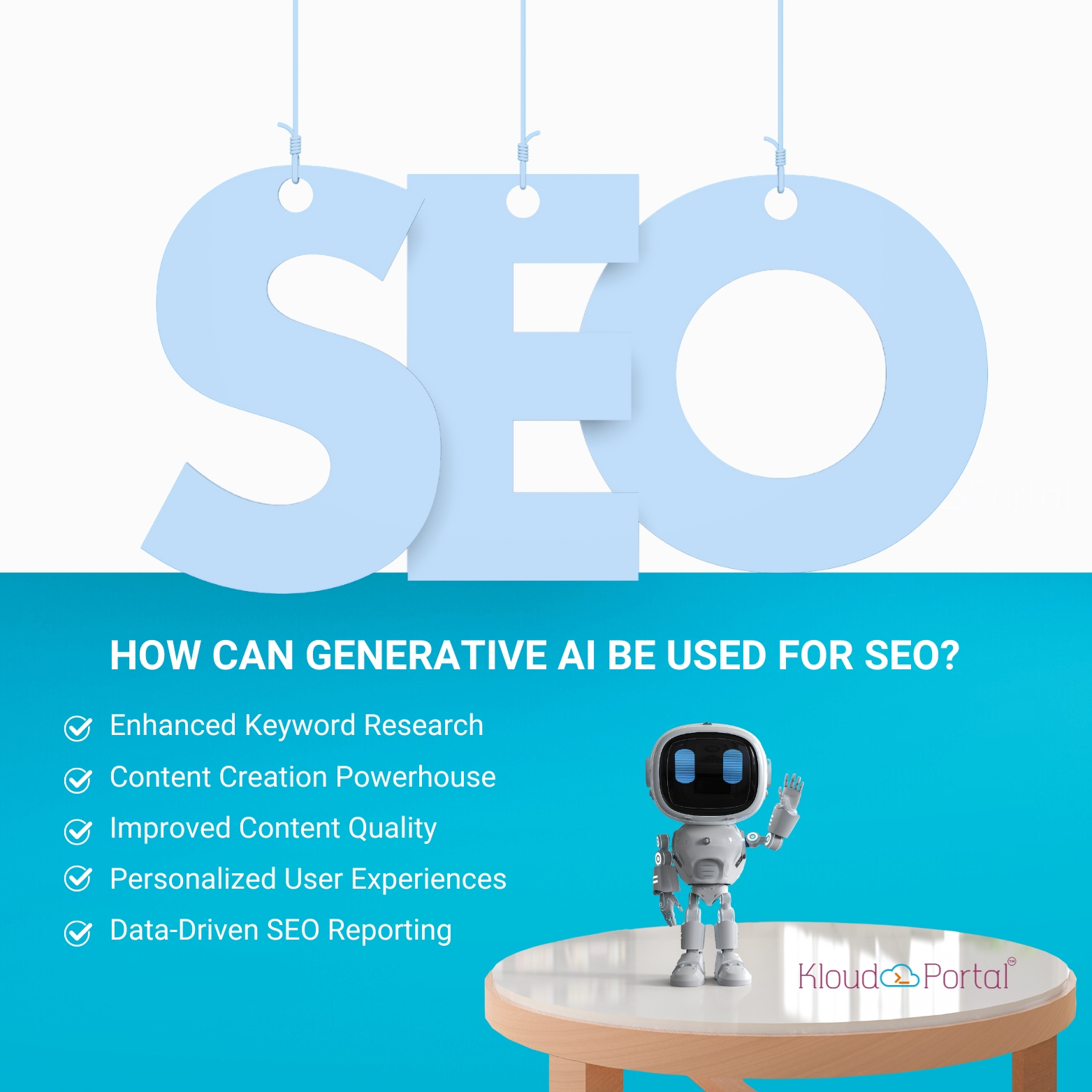
How Can Generative AI Be Used for SEO?

Generative AI tools are revolutionizing the way SEO tasks are approached, offering valuable insights and augmenting human creativity with machine learning capabilities. Through the utilization of generative AI algorithms, SEO experts can amplify their content development and comprehensive SEO tactics to boost their position on search engine results and increase organic web traffic.

The SEO applications using generative AI are vast and continually expanding. Here are some key ways SEOs can leverage this powerful technology:

1. Enhanced keyword research

Traditional research of keywords involves identifying relevant keywords and their search volumes. Generative AI can advance this further by analyzing competitor content, user search patterns, and industry trends to predict high-value, emerging keywords that your target audience is actively searching for.

2. Content creation powerhouse

For SEOs, the creation of content is a constant battle against time and resource constraints. Generative AI can prove to be a significant resource in this regard. AI can be used to generate drafts, outlines, product descriptions, meta descriptions, and even entire blog posts based on specific topics and keywords.

3. Improved content quality

While AI can generate content at scale, it’s important to remember that human oversight remains crucial. However, generative AI can be used to analyze existing content and suggest improvements in terms of structure, readability, and keyword optimization. It ensures that your content is not only informative but also technically sound for search engines.

4. Personalized user experiences

Generative AI can create personalized user experiences on your website, further boosting SEO performance. For instance, AI can be employed to generate chatbots that can answer user queries in a natural and informative way.

5. Data-driven SEO reporting

Generating valuable SEO insights is made easy with generative AI, which automates data analysis, identifies trends, tracks progress, and highlights areas for improvement. It allows SEOs to present clear, concise, and data-driven reports to clients, improving transparency and demonstrating the value of their work, driving organic traffic and boosting SEO success.

The importance of Content Marketing Services in the context of leveraging Gen AI for SEO is in harnessing advanced algorithms to generate and disseminate valuable and consistent content that captivates and involves a clearly defined audience.

How-can-Generative-AI-be-used-for-SEO

Call To Action

Are you ready to leverage generative AI for SEO? Here are some steps you can take to get started:

  • Research generative AI tools: Explore the various Gen AI tools available, such as copywriting software, content optimization platforms, and AI-powered SEO platforms. Select tools that match your particular requirements and budget.
  • Start small & experiment: Don’t try to overhaul your entire SEO strategy overnight. Begin by using generative AI for specific tasks, such as researching keywords or content ideation. As you accumulate experience and confidence, you can progressively broaden your utilization of AI.
  • Focus on human-AI collaboration: Remember, generative AI is a tool to enhance your SEO efforts, not replace them. Sustain human oversight across the content creation process to uphold quality and brand consistency.

By embracing generative AI as a valuable partner, SEOs can unlock new levels of efficiency, creativity, and success in the competitive world of search engine optimization.

Leveraging Generative AI Responsibly

While generative AI offers a powerful toolset for SEO, it’s important to use it responsibly and ethically. Here are some key considerations:

  • Focus on quality, not quantity: Don’t be tempted to churn out vast quantities of AI-generated content. Search engines prioritize high-quality content that delivers value to users. Focus on using AI to create informative, engaging content that is well-edited and tailored to your target audience.
  • Maintain human oversight: While AI can generate content, human expertise remains essential. Use AI as a tool to assist with the creation of content, but always ensure human editors review and refine the output to ensure accuracy, brand consistency, and a natural writing style.
  • Prioritize user experience: Don’t resort to keyword stuffing or other black-hat SEO tactics when using generative AI. The ultimate objective is to craft a positive user experience, and search engines are becoming increasingly adept at identifying and penalizing manipulative tactics.

When considering the utilization of Gen AI for SEO, the significance of Content Marketing Services is exemplified by the ability to position oneself as the Best digital marketing agency in India through the creation and distribution of highly engaging and optimized content.

The Future of SEO With Generative AI

The integration of generative AI into SEO is still in its early stages, but the potential is undeniable. With the ongoing advancement of AI, we can expect the emergence of increasingly complex applications. Here are some potential future trends:

  • AI-powered content optimization: Imagine AI that can not only generate content but also optimize it in real time based on user behavior and search engine ranking factors.
  • Personalized SEO strategies: Generative AI could analyze a website’s content and audience to create personalized SEO strategies tailored to each user segment.
  • Evolving keyword research: AI could become adept at not just identifying keywords but also understanding user intent behind search queries, allowing for highly targeted content creation.

In the realm of leveraging Gen AI for SEO, the significance lies in positioning as the top Enterprise SEO Services provider in India, utilizing AI-generated content to engage and captivate target audiences effectively.

Conclusion

Generative AI presents a powerful new weapon in the SEO arsenal. By leveraging its capabilities for research on keywords, content creation, data analysis, and personalization, SEOs can streamline workflows, enhance content quality, and achieve superior search engine rankings. However, it’s crucial to utilize AI responsibly, focusing on quality content and user experience. The future of SEO promises to be exciting and full of possibilities.

FAQs

How does leveraging Generative AI benefit SEO strategies?

Generative AI enhances SEO strategies by streamlining tasks such as research on keywords, content creation, and trend analysis, ultimately improving search engine visibility and driving organic traffic.

Can Gen AI tools effectively analyze user data for SEO purposes?

Yes, Gen AI tools can analyze vast amounts of user data to identify trends, preferences, and emerging topics, providing valuable insights for optimizing and enhancing SEO strategies.

How does Generative AI contribute to voice search optimization?

Generative AI algorithms can analyze queries on voice search and user behaviors to optimize content for voice search, ensuring that websites rank higher for voice-based searches and improving overall SEO performance.

What competitive advantages does leveraging Generative AI offer in terms of SEO?

By leveraging Generative AI, SEO experts can gain a competitive edge by automating repetitive tasks, refining content strategies based on data-driven insights, and staying ahead of competitors in search engine rankings and user engagement.

Five Creative Ways To Use Social Media For Storytelling

Five Creative Ways To Use Social Media For Storytelling

By Rasmita Patro

In the age of information overload, capturing attention and building a connection can be tough. But there’s one powerful tool that can help you cut through the noise: storytelling. Weaving stories into your social media presence not only entertains your audience but also fosters a deeper connection and makes your brand, cause, or personal message more memorable. Storytelling has surfaced as a powerful tool for brands to establish a personal bond with their audience.

The widespread use of social media user platforms has provided brands that strike a chord with their target audience. Methods to harness the power of social media for storytelling encompass platforms such as Instagram, Facebook, Twitter, Snapchat, etc. Over the past few years, social media platforms have transformed from simple communication channels into robust platforms for storytelling. Businesses are incorporating social media storytelling into their marketing strategies to engage followers, fortify their brand identity, and expand broader audience reach.

Let’s explore these five innovative techniques to utilize social media for storytelling.

Key Takeaways

  • Leveraging visual storytelling on social media platforms like Instagram and Pinterest proves to be a potent tool for businesses.
  • Engage audience with interactive polls and quizzes on Twitter and Facebook.
  • Host live Q&A sessions on Instagram Live or Facebook Live will encourage interaction and keep your audience connected.
  • User-generated content with strategic hashtags enhances your brand storytelling.

1. Visual Storytelling

Instagram and Pinterest serve as ideal platforms for the art of visual storytelling. Create a series of related images that tell a story over time, or use a photo grid to showcase different parts of a bigger narrative. It allows brands to craft engaging narratives through the vibrant medium of Instagram captions. Facilitating user engagement and interaction becomes achievable by incorporating interactive elements like polls, questions, and quizzes.

Insta stories offer a unique format for visual narrative, enabling the use of multiple photos or brief videos to build a significant narrative. Creative tools like filters, stickers, and text options further enrich the storytelling experience on these platforms.

2. User-Generated Content (UGC)

User-generated content is a treasure trove for narrative creation. It offers genuine and captivating narratives that echo your demographic target and add authenticity to the story. Motivate your social media followers to share their interactions with your brand and highlight these narratives in your social media posts. Please encourage them to share their experiences using their own hashtag and curate the best ones on your feed.

Collect and display these authentic narratives on your social platforms, fostering a sense of camaraderie and trust around your brand. The significance of Content Marketing Services lies in crafting and disseminating valuable, relevant, and consistent content to captivate and involve a clearly defined audience, ultimately motivating profitable customer actions.

3. Utilize Stories for Live and Ephemeral Content

Story features on various platforms allow you to share real-time updates, behind-the-scenes peeks, and personal moments. Twitter highlights present a chance to curate and share impactful stories in a concise format. Companies can leverage this functionality to showcase pivotal moments, industry updates, or company achievements and to connect with their audience instantly, ensuring that their narrative aligns seamlessly with the latest trends and ongoing conversations. This feature empowers you to curate tweets around a specific theme or event, providing an effective means to share a story that unfolds progressively over time.

4. Through History and Values

Social media tools like Facebook allow an ideal platform for brands to share in-depth stories about their company history, values, and mission. Posting content that delves into the company’s roots, growth, and core principles humanizes the brand, fostering a stronger connection with the audience. Combining text, images, and video content helps create a comprehensive brand narrative.

Creating your hashtag is a creative way to curate stories related to your brand. Encourage your social media users to use this hashtag in their posts. It not only engages your followers but also helps you collect UGC.

5. Stories for Authentic and Impermanent Narratives

Snapchat’s ephemeral nature lends itself to authentic storytelling. Brands can use Snapchat updates to provide behind-the-scenes glimpses, exclusive content, or limited-time offers. It creates a sense of urgency and exclusivity, encouraging followers to stay engaged and regularly check for updates. Sharing your enterprise history or the journey of your brand is another effective way to tell your brand’s story. This fosters a deeper connection between your audience and your brand, cultivating trust.

A successful Social Media Marketing strategy revolves around tactically creating and distributing content across multiple platforms to captivate, attract, and nurture relationships with the intended audience.

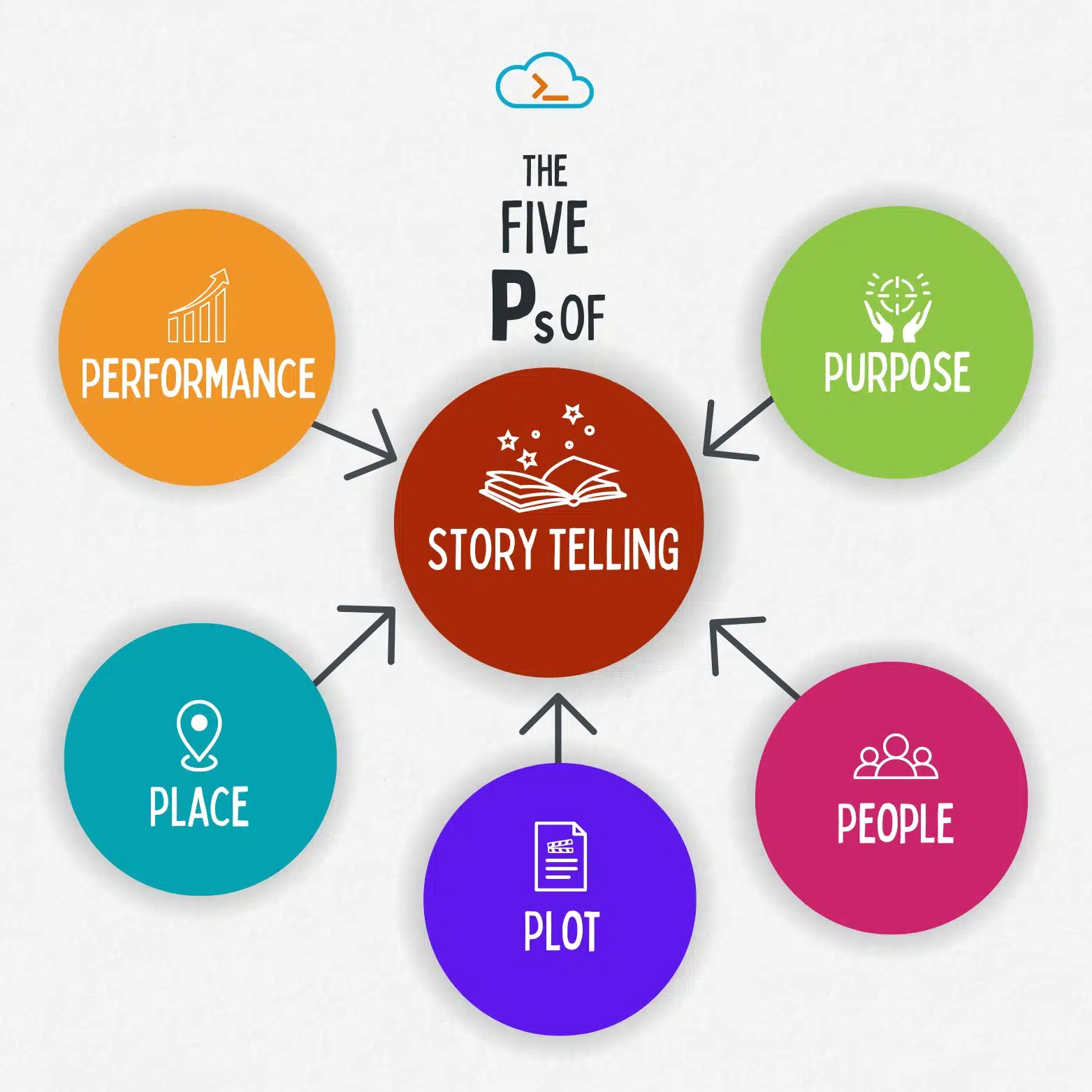
The Five P’s of Good Storytelling

The 5 P’s of Storytelling:

The 5 P’s of Storytelling refer to the essential elements that contribute to crafting a compelling narrative. These elements guide storytellers in creating engaging stories that resonate with their audience.

  1. Purpose: Clearly define the purpose of your story. Whether it’s to entertain, educate, or inspire, having a clear purpose ensures that your narrative resonates with your customer base.
  2. People: Place your audience at the center of your story. Comprehend their interests, needs, and preferences in order to generate content that genuinely resonates with them.
  3. Plot: Craft a compelling story arc that captivates your audience from beginning to end. Develop a narrative structure that keeps engaged and eager to discover what happens next.
  4. Place: Choose the right social media platforms for your storytelling. Each platform has its unique strengths, and tailoring your content to fit the characteristics of each one maximizes its impact.
  5. Performance: Continuously evaluate the performance of your storytelling efforts. Monitor engagement metrics and audience feedback, and adapt your strategy to better align with your brand’s goals.

Always remember the following:

  • Authenticity is key: Let your unique voice and personality shine through your stories.
  • Engage your audience: Ask questions, hold polls, and encourage interaction to keep them coming back for more.
  • Be consistent: Regularly share stories to build anticipation and keep your audience connected.

These elements are essential for crafting a compelling story that will captivate an audience and keep them engaged. 

Conclusion

Leveraging social media storytelling proves to be a potent tool for businesses. Crafting a compelling brand story through meaningful storytelling on various platforms like Twitter Moments, Snapchat Stories, and Facebook storytelling is essential to capture the audience’s interest in today’s dynamic news feed, imparting a moral lesson, and reinforcing the brand’s values—a perfect example of effective content marketing that highlights key points and resonates with the audience. By employing an innovative approach to brand storytelling, businesses can distinguish themselves in the saturated social media landscape and make a lasting impact on their audience.

FAQs

Why is social media storytelling important?

The significance of social media storytelling lies in its ability to enable brands to forge a deeper connection with their audience. It humanizes the brand, builds trust, and fosters customer loyalty.

How can I improve my social media storytelling?

You can improve your social media storytelling by understanding your audience, being authentic, using visuals, keeping your story simple, and engaging with your audience.

Can social media storytelling help in boosting sales?

Yes, effective social media storytelling can help in boosting sales by building trust, fostering customer loyalty, and enhancing brand reputation.

How can brands effectively use Instagram for storytelling?

Brands can use Instagram Stories, Multiple images, and engaging captions to tell their story. Consistent visuals, interactive features, and a well-defined aesthetic contribute to a compelling storytelling strategy on Instagram.
Understanding The Rule Of 40 In SaaS Valuation 

Understanding The Rule Of 40 In SaaS Valuation 

By Rasmita Patro

For aspiring SaaS entrepreneurs and private equity investors, navigating the murky waters of valuation can feel like a high-stakes guessing game. Thankfully, some guiding principles exist, and the Rule of 40 stands tall among them. This metric acts as a financial compass, providing profound insights into how public SaaS companies navigate the delicate equilibrium between revenue growth and profit margin. Let’s dive into the intricacies of the Rule of 40, exploring its definition, calculation, and the pivotal role it plays in the SaaS sector.

Key Takeaways

  • The Rule of 40 states that a SaaS firm’s revenue growth rate plus profit margin should be 40% or higher.
  • It is calculated by adding the recurring revenue growth rate (%) and EBITDA margin (%).
  • This rule assesses the equilibrium between growth rate and profitability in a SaaS company.
  • For fast-growing SaaS startups, the Rule of 40 serves as a practical tool to balance between rapid growth and profitability improvement.

The Rule of 40

As per the Rule of 40, the total value of a SaaS company’s profit margin plus its rate of revenue growth should be more than 40%. It serves as a financial metric employed by venture capitalists, equity investors, and management teams to assess the financial well-being of SaaS businesses.

Let’s break down how to calculate your company’s revenue growth rate and EBITDA margin.

1. Revenue growth rate

It is the year-over-year percentage increase in total revenue growth. This growth rate usually relates to the Annual Recurring Revenue (ARR) or Monthly Recurring Revenue (MRR) instead of a company’s gross or net revenue.

MRR = Average revenue per account (ARPA) × Total number of active accounts

To obtain ARR from MRR, multiply by 12.

ARR = MRR × 12 Months

After annualization, the growth rate in the recurring revenue metric is calculated.

Recurring Revenue Growth (%) = [(Current Period ARR – Prior Period ARR) ÷ Prior Period ARR] × 100

2. EBITDA margin

In terms of profit margins, the most frequent indicator is the EBITDA margin for the relevant period.

It refers to the company’s earnings before interest, taxes, depreciation, and amortization, divided by the overall revenue.

EBITDA Margin (%) = EBITDA ÷ Revenue

Formula for the Rule of 40

The Rule of 40 states a simple calculation in which the formula adds the recurring revenue growth rate to the EBITDA margin over a certain time.

Rule of 40 (%) = Recurring Revenue Growth Rate (%) + EBITDA Margin (%)

If the sum of these two metrics is 40% or more, your SaaS business is considered healthy according to the Rule of 40. It indicates that the company is effectively balancing its growth and profitability. In short, the Rule of 40 can assist a SaaS company in determining when to prioritize growth or profitability at present.

Maximize brand visibility and customer success with our SaaS Product Marketing Company , ensuring targeted audience reach and impact in the competitive market.

The Rule of 40 for a healthy SaaS business

Significance of Rule of 40

High growth often comes at the expense of profitability margin. This is because fast-paced growth usually involves significant investment in customer acquisition costs, professional services, and intangible assets.

The Rule of 40 serves as a growth input, providing a benchmark for balancing growth and profitability. It helps companies ensure they are not over-investing in growth at the expense of profitability or vice versa.

Example:

Let’s take four SaaS companies: A, B, C, and D. Given the monthly recurring revenue (MRR) growth rates for each company:

  • SaaS Company A Growth Rate: 30%
  • SaaS Company B Growth Rate: 0%
  • SaaS Company C Growth Rate: 40%
  • SaaS Company D Growth Rate: 70%

Given that the Rule of 40 requires a minimum threshold of 40%, we can determine the minimum EBITDA margin by subtracting the MRR growth from the target of 40%.

Calculating the minimum EBITDA margin by subtracting the MRR growth from the target of 40%.

Calculating the minimum EBITDA margin for each company:

  • SaaS Company A: 40% – 30% = 10%
  • SaaS Company B: 40% – 0% = 40%
  • SaaS Company C: 40% – 40% = 0%
  • SaaS Company D: 40% – 70% = (-30%)

These calculated EBITDA margins represent the minimum profit margins necessary for the Rule of 40 to be met.

For example, Company A, with a 30% MRR growth rate, requires a corresponding EBITDA margin of 10% to meet the Rule of 40.

SaaS Company A: 30% + 10% = 40%

Alternatively, Company D can afford to have a negative 30% EBITDA margin and still attract capital at a high valuation due to its robust growth profile, as reflected in the negative EBITDA margin calculation.

This should be: “SaaS Company D: 40% – 70% = –30%

The top-notch B2B SaaS product marketing agency in India brings strategic expertise to propel your brand with tailored marketing approaches driving success in the SaaS business.

Caveats of the Rule of 40

While the Rule of 40 is a useful benchmark, it’s not a one-size-fits-all metric. It’s most relevant to high-growth public SaaS business companies with recurring revenue models. For companies at different stages or in other industries, the Rule of 40 may not apply.

Moreover, the Rule of 40 doesn’t consider factors like customer retention, sales techniques, or the competitive landscape. Therefore, it should be used as a guideline rather than a strict rule. It’s also important to note that the Rule of 40 doesn’t account for cash flow, which is a critical factor in assessing a company’s financial health.

As the Top B2B SaaS Product Marketing Agency in India , we bring unparalleled expertise to elevate your brand’s presence.

Conclusion

The Rule of 40 serves as a significant indicator for SaaS companies aiming for resilient growth. It helps the management balance the high cash flow demands of rapid growth with the need for profitability and growth rates. As a company matures, other SaaS metrics like customer success, subscription revenue, revenue multiples, and non-tangible assets become increasingly important. In the high-stakes world of SaaS valuations, understanding and effectively using the Rule of 40 can be a game-changer. It guides companies toward sustainable growth, helps investors make informed decisions, and ultimately contributes to the success of the SaaS industry.

Rule of 40 FAQs

How Growth Rate Can Be Calculated?

It is typically measured as the year-over-year percentage increase in revenue. Choose a metric and a time frame, such as MRR growth over 12 months. Subtract the initial value from the final value, then divide by the initial value. Multiply the result by 100 for the percentage growth rate.

How profit margin can be calculated?

Top management uses various SaaS metrics, such as EBIT, free cash flow, and net income, to compute a company’s profit margin. However, EBITDA is typically the most suitable calculation for SaaS companies.

What is the Rule of 40 in SaaS?

It evaluates a company’s sustainability by combining recurring growth rates and profitability. Crucial for business decisions and securing venture capital, a score of 40% or more signifies a robust and healthy company, shaping strategic approaches and financial viability in the long run.

What is a good SaaS company’s growth rate?

A good Software as a Service (SaaS) company’s growth rate can vary based on several factors, including the company’s stage of development, market conditions, and industry benchmarks. However, a common metric used to evaluate SaaS companies is the Rule of 40.

Everything You Should Know About The 67 Types Of SEO

Everything You Should Know About The 67 Types Of SEO

By Rasmita Patro

SEO is a field in perpetual evolution, encompassing a broad spectrum of methods and tactics designed to enhance a website’s visibility in search engine results. This dynamic domain involves a variety of strategies with the primary objective of improving a site’s presence on search engines. The ever-changing nature of SEO services requires continuous adaptation of techniques to remain effective in the dynamic digital landscape.

From content optimization to technical enhancements, SEO employs a versatile range of methods, all geared toward elevating a website’s traffic and performance in search engine rankings. The ongoing evolution of SEO underscores its crucial role in online success.

In this blog, we will explore 67 types of SEO, covering everything from the basics like search engine optimization, search engine results, and generating quality links to more advanced aspects such as technical SEO and keyword research.

All About 67 Types of SEO

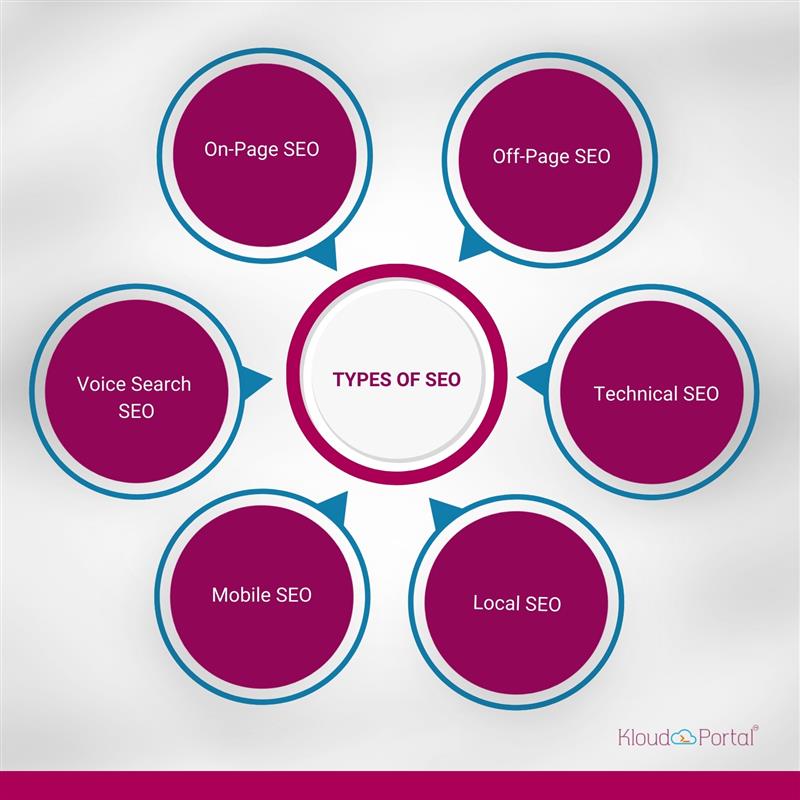
  1. On-page SEO – Optimizing elements within your website’s pages, such as content, code, and structure, to enhance search engine understanding and relevance.
  2. Off-page SEO – Off-page SEO focuses on activities outside your website that impact your rankings. It includes building backlinks, social media advertising, and influencer collaborations to increase your site’s authority.
  3. Technical SEO – Technical SEO encompasses refining the technical aspects of a website to guarantee efficient crawling, indexing, and comprehension by search engines of the presented content.
  4. Local SEO – Local SEO targets local search results and aims to increase visibility for businesses serving specific geographic areas. It involves optimizing Google My Business profiles, local citations, and encouraging customer reviews.
  5. International SEO – For businesses targeting a global audience, international SEO is crucial. It involves content for different languages, using hreflang tags, and considering regional search engine optimization.
  6. Mobile SEO – Ensure your website is mobile-friendly for seamless performance on all devices, catering to the ever-growing mobile audience
  7. Voice Search SEO – With the rise of voice-activated devices, it is crucial to optimize content for voice search queries. It involves using natural language, providing concise answers, and optimizing for conversational search.
  8. E-commerce SEO – E-commerce SEO involves optimizing online stores for search engines, including product pages and images, and ensuring a smooth user experience during the shopping process.
  9. Video SEO – Given the widespread popularity of video content, video marketing SEO focuses on optimizing videos for search engines. It includes using descriptive titles, relevant tags, and providing transcripts to increase organic traffic.
  10. Image SEO – Enhancing user experience and visibility relies heavily on optimizing images for search engines. This process includes employing descriptive filenames, adding alt text, and compressing images to ensure swift loading times.
  11. App store optimization (ASO) – ASO plays a crucial role in the realm of mobile apps, necessitating the optimization of app titles, descriptions, and relevant keywords to enhance visibility within app store search results.
  12. Social media SEO – Social media signals can impact search rankings. Social Media SEO involves optimizing your social profiles, sharing content across platforms, and engaging with your audience.
  13. Brand SEO – Building a strong online brand presence can positively impact SEO. It involves creating a consistent brand image, gaining brand mentions, and managing online reputation. For businesses seeking unparalleled online visibility and strategic optimization, our agency offers the Best Enterprise SEO services in India, ensuring top-notch solutions tailored for large-scale success
  14. PR (Public Relations) SEO – Public relations efforts can contribute to SEO by earning high-quality backlinks and enhancing brand visibility.
  15. Schema markup – Utilizing schema markup aids search engines in comprehending the context of your content, thereby enhancing the presentation of rich snippets in search results.
  16. Rich snippets – Enriching search offers supplementary information that renders your listing more appealing and informative.
  17. Accelerated mobile pages (AMP) – AMP is a Google-backed project that creates faster-loading mobile pages, positively impacting mobile SEO.
  18. Breadcrumb navigation – Breadcrumb navigation enhances user experience and helps search engines understand the site’s structure.
  19. Canonical tags – Canonical tags play a role in averting problems related to duplicate content by indicating the preferred version of a page.
  20. 301 Redirects – Redirects are crucial for preserving SEO value when changing URLs or consolidating pages.
  21. 404 Error page optimization – Customize 404 error pages for a better user experience and prevent negative SEO impact.
  22. Keyword research SEO – Thoroughly researching keywords is essential for identifying pertinent terms and phrases to optimize content.
    Being a Top Digital Marketing Company in India, we utilize state-of-the-art approaches, incorporating inventive applications of ChatGPT, to boost your online visibility and provide outstanding outcomes in the ever-evolving social media marketing strategy.
  23. Long-tail SEO – Targeting longer, specific keyword phrases to attract a more targeted audience.
  24. Latent semantic indexing (LSI) – Using related keywords to improve content relevance and search engine understanding.
  25. User experience (UX) SEO – Optimizing website design and navigation for a positive user experience.
  26. Page load time optimization – Enhancing site speed to improve user experience and search engine rankings.
  27. Link building – Building high-quality backlinks to improve authority and rankings.
  28. Link juice – Understanding and optimizing the flow of authority through external and internal links.
  29. Link earning – Focusing on creating valuable content to attract backlinks naturally.
  30. Broken link building – Identify and replace broken links with your content for link acquisition opportunities.
  31. Competitor analysis SEO – Analyzing competitor strategies to identify opportunities and gaps in your SEO approach.
  32. Content gap analysis – Identifying content gaps in your industry and creating content to fill those voids.
  33. Content quality SEO – Prioritizing high-quality, relevant content for better search engine rankings.
  34. Duplicate content management – Preventing and managing duplicate content issues for improved SEO.
  35. Google Analytics Setup – Implementing Google Website Analytics to track and analyze website performance.
Few of the 67 types of SEO to elevate online visibility
  1. Google Search Console Setup – Using Google Search Console to monitor and improve website presence in search results.
  2. User intent optimization – Aligning content with user intent to provide more relevant results.
  3. Featured snippets optimization – Organizing content to enhance the likelihood of being featured in snippets in search results.
  4. Local citations – Building consistent business citations to improve local search rankings.
  5. Google maps optimization – Optimizing Google Maps listings for local businesses.
  6. Knowledge graph optimization – Structuring content to enhance the likelihood of appearing in Google’s Knowledge Graph.
  7. Entity SEO – Focusing on building authority around specific entities to improve search visibility.
  8. User-generated content (UGC) SEO – Leveraging user-generated content to enhance engagement and search engine rankings.
  9. Social proof SEO – Utilizing social proof, which incorporates testimonials and reviews, to instill a sense of trust and credibility.
  10. Google my business posts – Utilizing Google My Business posts to engage with the local audience and improve rankings.
  11. Transactional SEO – Optimizing for transactional queries to drive conversions and sales.
  12. SERP features optimization – Tailoring content to appear in various SERP features like snippets, carousels, and knowledge panels.
  13. Influencer SEO – Engaging with influencers to enhance brand visibility and acquire authoritative backlinks.
  14. Podcast SEO – Optimizing podcast content for search engines to attract a wider audience.
  15. Guest posting for SEO – Distributing content across external platforms to cultivate backlinks and broaden audience reach.
  16. Brand mentions SEO – Monitoring and leveraging brand mentions for SEO and online reputation management.
  17. User-intent optimization – Aligning content with the specific intent of users to enhance relevance.
  18. User retention SEO – Implementing strategies to retain users and reduce bounce rates for improved rankings.
  19. Customer reviews and ratings SEO – Encouraging and managing customer reviews for enhanced online visibility.
  20. Inbound marketing SEO – Integrating SEO strategies into inbound marketing efforts for a holistic approach.
  21. Social signals – Regard social media engagement as a factor influencing rankings and optimize strategies accordingly.
  22. Niche SEO – Tailoring SEO strategies to specific niches for targeted audience reach.
  23. Brand identity SEO – Incorporating brand identity elements into SEO strategies for brand recognition.
  24. Exit intent optimization – Implementing strategies to retain users who are about to leave the website.
  25. Brand ambassador SEO – Brand ambassadors boost brand visibility while partnering with an Enterprise SEO Agency empowers large businesses to enhance online visibility, optimize web pages effectively, and stay competitive in the digital landscape.
  26. Content diversification SEO – Diversify content types, such as text, images, videos, and infographics, to cater to various audience preferences.
  27. Evergreen content optimization – Updating and optimizing evergreen content to maintain relevance and search visibility over time.
  28. Mobile-first indexing – Adjusting to Google’s mobile-first indexing, prioritizing the ranking of mobile versions of websites in search results.
  29. Vertical SEO – Tailoring SEO strategies for specific industry verticals to address unique challenges and opportunities.
  30. Local link building – Building location-specific backlinks to boost local search rankings.
  31. Pinterest SEO – Optimizing content for Pinterest search to tap into the platform’s visual discovery audience.
  32. Twitter SEO – Leveraging SEO strategies on Twitter to improve tweet visibility in search results.

Conclusion

Implementing a comprehensive SEO strategy involves optimizing meta tags and site structure, utilizing long-tail keywords, and incorporating a robust content marketing strategy. This ensures improved Google rankings, higher organic traffic, and enhanced brand visibility on SERP rankings through guest blogging, all aligned with search intent and catering to specific search volumes, ultimately contributing the overall success of your own website and the effectiveness of your SEO initiatives.

Understanding and implementing the 67 types of SEO discussed in this guide will empower businesses to succeed in the competitive online marketing team.

We use cookies to ensure that we give you the best experience on our website. If you continue to use this site we will assume that you are happy with it.

Cookies settings
Accept
Privacy & Cookie policy
Privacy & Cookies policy
Cookie name Active

Privacy Policy

What information do we collect?

We collect information from you when you register on our site or place an order. When ordering or registering on our site, as appropriate, you may be asked to enter your: name, e-mail address or mailing address.

What do we use your information for?

Any of the information we collect from you may be used in one of the following ways: To personalize your experience (your information helps us to better respond to your individual needs) To improve our website (we continually strive to improve our website offerings based on the information and feedback we receive from you) To improve customer service (your information helps us to more effectively respond to your customer service requests and support needs) To process transactions Your information, whether public or private, will not be sold, exchanged, transferred, or given to any other company for any reason whatsoever, without your consent, other than for the express purpose of delivering the purchased product or service requested. To administer a contest, promotion, survey or other site feature To send periodic emails The email address you provide for order processing, will only be used to send you information and updates pertaining to your order.

How do we protect your information?

We implement a variety of security measures to maintain the safety of your personal information when you place an order or enter, submit, or access your personal information. We offer the use of a secure server. All supplied sensitive/credit information is transmitted via Secure Socket Layer (SSL) technology and then encrypted into our Payment gateway providers database only to be accessible by those authorized with special access rights to such systems, and are required to?keep the information confidential. After a transaction, your private information (credit cards, social security numbers, financials, etc.) will not be kept on file for more than 60 days.

Do we use cookies?

Yes (Cookies are small files that a site or its service provider transfers to your computers hard drive through your Web browser (if you allow) that enables the sites or service providers systems to recognize your browser and capture and remember certain information We use cookies to help us remember and process the items in your shopping cart, understand and save your preferences for future visits, keep track of advertisements and compile aggregate data about site traffic and site interaction so that we can offer better site experiences and tools in the future. We may contract with third-party service providers to assist us in better understanding our site visitors. These service providers are not permitted to use the information collected on our behalf except to help us conduct and improve our business. If you prefer, you can choose to have your computer warn you each time a cookie is being sent, or you can choose to turn off all cookies via your browser settings. Like most websites, if you turn your cookies off, some of our services may not function properly. However, you can still place orders by contacting customer service. Google Analytics We use Google Analytics on our sites for anonymous reporting of site usage and for advertising on the site. If you would like to opt-out of Google Analytics monitoring your behaviour on our sites please use this link (https://tools.google.com/dlpage/gaoptout/)

Do we disclose any information to outside parties?

We do not sell, trade, or otherwise transfer to outside parties your personally identifiable information. This does not include trusted third parties who assist us in operating our website, conducting our business, or servicing you, so long as those parties agree to keep this information confidential. We may also release your information when we believe release is appropriate to comply with the law, enforce our site policies, or protect ours or others rights, property, or safety. However, non-personally identifiable visitor information may be provided to other parties for marketing, advertising, or other uses.

Registration

The minimum information we need to register you is your name, email address and a password. We will ask you more questions for different services, including sales promotions. Unless we say otherwise, you have to answer all the registration questions. We may also ask some other, voluntary questions during registration for certain services (for example, professional networks) so we can gain a clearer understanding of who you are. This also allows us to personalise services for you. To assist us in our marketing, in addition to the data that you provide to us if you register, we may also obtain data from trusted third parties to help us understand what you might be interested in. This ‘profiling’ information is produced from a variety of sources, including publicly available data (such as the electoral roll) or from sources such as surveys and polls where you have given your permission for your data to be shared. You can choose not to have such data shared with the Guardian from these sources by logging into your account and changing the settings in the privacy section. After you have registered, and with your permission, we may send you emails we think may interest you. Newsletters may be personalised based on what you have been reading on theguardian.com. At any time you can decide not to receive these emails and will be able to ‘unsubscribe’. Logging in using social networking credentials If you log-in to our sites using a Facebook log-in, you are granting permission to Facebook to share your user details with us. This will include your name, email address, date of birth and location which will then be used to form a Guardian identity. You can also use your picture from Facebook as part of your profile. This will also allow us and Facebook to share your, networks, user ID and any other information you choose to share according to your Facebook account settings. If you remove the Guardian app from your Facebook settings, we will no longer have access to this information. If you log-in to our sites using a Google log-in, you grant permission to Google to share your user details with us. This will include your name, email address, date of birth, sex and location which we will then use to form a Guardian identity. You may use your picture from Google as part of your profile. This also allows us to share your networks, user ID and any other information you choose to share according to your Google account settings. If you remove the Guardian from your Google settings, we will no longer have access to this information. If you log-in to our sites using a twitter log-in, we receive your avatar (the small picture that appears next to your tweets) and twitter username.

Children’s Online Privacy Protection Act Compliance

We are in compliance with the requirements of COPPA (Childrens Online Privacy Protection Act), we do not collect any information from anyone under 13 years of age. Our website, products and services are all directed to people who are at least 13 years old or older.

Updating your personal information

We offer a ‘My details’ page (also known as Dashboard), where you can update your personal information at any time, and change your marketing preferences. You can get to this page from most pages on the site – simply click on the ‘My details’ link at the top of the screen when you are signed in.

Online Privacy Policy Only

This online privacy policy applies only to information collected through our website and not to information collected offline.

Your Consent

By using our site, you consent to our privacy policy.

Changes to our Privacy Policy

If we decide to change our privacy policy, we will post those changes on this page.
Save settings
Cookies settings