Digital Marketing Agency Vs. In-House Digital Marketing Team: Know The Difference! 

Digital Marketing Agency Vs. In-House Digital Marketing Team: Know The Difference! 

By Rasmita Patro

Digital Marketing has become an indispensable component of any successful business strategy in the digital era. However, when implementing digital marketing initiatives, organizations often decide whether to hire a digital marketing agency or build an in-house digital marketing team. Both options have merits and drawbacks, and understanding the difference can help businesses make an informed decision aligning with their goals and resources.

A digital marketing agency is an external marketing team that provides clients with a wide range of marketing services. These agencies typically have teams with expertise in various aspects of digital marketing, such as search engine optimization (SEO), content marketing, pay-per-click (PPC) advertising, and more. They work closely with clients to develop and execute digital marketing strategies tailored to their needs and objectives.

On the other hand, an in-house digital marketing team has an internal marketing department to handle all aspects of online marketing. These team members are dedicated solely to the organization’s web marketing efforts and work closely with other departments to align marketing strategies with overall business goals. In-house marketing utilizes an internal team to market the business, while agency marketing involves hiring an external team to handle the marketing efforts for the business.

The Differences Between Digital Marketing Agency and An In-House Digital Marketing Team

1. Expertise and skills

Digital marketing agencies are known for their expertise and specialization in various areas of web marketing. They often have professionals with diverse skill sets who stay updated with the latest industry trends and best practices. By working with experienced agency teams, businesses can access experts with a wide range of skills, ensuring comprehensive coverage of their internet marketing needs.

In contrast, an in-house marketing team may have limited expertise and require continuous training and development to keep up with the rapidly evolving digital landscape. While it deeply understands the organization’s products, services, and brand, its expertise in specific web marketing areas may vary.

2. Cost

Cost plays a pivotal role in making business decisions. Hiring a digital marketing agency team involves a financial investment. Agencies charge fees based on their services, which can vary depending on factors like the scope of work, the size of the marketing agency, and the level of expertise required. The pricing options for digital marketing services can be either a fixed monthly retainer or project-based.

On the other hand, building an in-house marketing team involves the following:

  • Recruiting and hiring qualified professionals.
  • Providing salaries.
  • Benefits.
  • Investing in training and development.

This option can be costlier initially but may provide long-term cost savings as the in-house team skills and capabilities grow.

3. Scalability

Digital marketing agencies offer scalability and flexibility, allowing businesses to adjust their internal marketing team’s efforts based on changing needs. They can easily ramp up or down resources, expand into new channels or markets, or adapt to seasonal demands. Agencies have access to a wide network of professionals, making it easier to scale marketing campaigns or add specialized expertise as required.

The in-house marketing team, on the other hand, may face limitations in terms of scalability. Hiring new employees, especially those with specialized skills, can be time-consuming and costly. Scaling campaigns or venturing into new areas may require additional resources and training, which may not always be readily available.

Unlike internal marketing teams at small-to-midsized businesses, digital marketing agencies often possess unmatched skills. These capabilities encompass a wide range, from accessing beta features in Google Ads to having valuable data on effective tactics and strategies.

Digital marketing strategies like SEO and SEM enhance brand visibility, while social media marketing allows for real-time interaction and adjustments. LinkedIn is a popular platform for professional networking, while content marketing, including personalized brand-centric content, improves brand recall and engagement. These online methods work together to build brand awareness and effectively reach target audiences in the digital landscape.

4. Time and efficiency

Agencies providing Digital Marketing Services are accustomed to working on multiple projects simultaneously. They have streamlined processes, access to industry tools, and established workflows that allow them to execute campaigns efficiently. Since they are external entities, they often have a quicker turnaround time, enabling businesses to launch marketing initiatives faster.

In-house marketing agencies have limited team members and may require more time to plan, strategize, and execute campaigns. They may face resource constraints and internal coordination challenges, which can impact the speed and efficiency of marketing campaign execution. However, an in-house marketer provides greater control over the marketing process and allows immediate adjustments or modifications

Digital marketing agency Vs In-house digital marketing team

5. Communication and collaboration

Effective communication and collaboration are essential elements in a partnership with a digital marketing agency. Businesses must establish clear communication channels, provide comprehensive briefs, and maintain regular contact with the agency team. It ensures alignment of goals, transparency in progress, and effective coordination throughout the project.

With an in-house team, communication and collaboration can be more streamlined since team members are within the same organization. These teams directly access the human resources department, stakeholders, and internal marketing team, facilitating seamless collaboration and faster decision-making.

6. Focus and attention

Outsourced marketing teams often work with multiple clients simultaneously. While this allows them to gain exposure to various industries and challenges, it may also mean that attention and focus can be divided among different projects. The attention given to a particular client’s campaign may vary depending on the marketing agency’s workload.

An in-house marketing team is dedicated solely to the organization’s online marketing efforts. They have an in-depth understanding of the brand, its target audience, and business objectives. This exclusive focus can lead to deeper dedication and attention to detail.

Hyderabad’s leading Digital Marketing Agency, is a pioneer in elevating brands outreach. Our expertise in conversion rate optimization, content strategy, marketing, and Google Ads will enhance brand visibility, engage your target audience, and drive business growth.

7. Control and ownership

Working with a digital marketing agency means relinquishing some control and entrusting the agencies executing the marketing strategy. While the agency provides expertise and guidance, the final decisions and approvals lie with the client. However, the client may not have direct control over every aspect of the campaign’s execution.

Contrastingly, in-house marketing teams offer complete control and ownership over digital marketing initiatives. Businesses have direct oversight of the strategies, execution, and outcomes. This control allows quicker adjustments, customization, and aligning in-house marketing efforts with the organization’s vision and values.

Conclusion

Agencies and in-house marketing teams have their unique advantages and considerations. Choosing between the two depends on the marketing budget, desired expertise, scalability needs, control preferences, and the organization’s long-term goals. Some businesses may opt for a hybrid model, combining the strengths of both approaches. Regardless of the choice, investing in effective digital marketing is essential to stay competitive in today’s digital landscape.

Choose the leading Digital Marketing Company, for the right approach to your brand. Partnering with us provides specialized skills, expertise, and scalability. Our experts excel in SEO, SEM, social media marketing, and content creation to enhance brand awareness, increase conversions, and drive growth. Contact us for a consultation today.

SaaS Security: Best Practices For Keeping Your Data Safe

SaaS Security: Best Practices For Keeping Your Data Safe

By Rasmita Patro

Due to the global pandemic that started in early 2020, there was a significant transition towards remote work. Because of this, companies became more reliant on the cloud and, consequently, on providing SaaS Endpoint Security. Ensuring SaaS data security is crucial for any SaaS company, as it involves implementing robust security measures that regulate data access, protect the data stored on SaaS resources, and minimize the risk of security breaches.

SaaS developers must proactively track and protect data assets within their organization and across third-party services and implement appropriate SaaS security models to achieve this. KloudPortal, the best SaaS Product Development Agency, offers a range of benefits, including cost savings, flexibility, and scalability. However, along with these benefits, potential security risks must be addressed to ensure the safety of the data.

What Is SaaS Security?

SaaS (Software as a Service) is a software distribution model where users subscribe to a service on a cloud infrastructure. One of the most important aspects of a SaaS service is the security service implemented to guarantee the privacy and safety of user data. With vast amounts of customer data being accessed, manipulated, and analyzed by SaaS companies daily, failure to implement security can directly impact the user experience.

A crucial responsibility for SaaS security professionals is to ensure the discovery, classification, tagging, mapping, and monitoring of all data, whether in transit, in use, or at rest. It includes identifying and safeguarding intellectual property and sensitive information collected in unmanaged data and cloud shadow IT and protecting them from unauthorized access, disclosure, or misuse.

Cloud Access Security Brokers (CASBs) are security solutions that mediate between an organization’s on-premise or cloud-based systems and public cloud service providers to enhance the security of data and applications accessed in the cloud.

A Cloud Access Security Broker must provide the safety measures implemented to safeguard SaaS applications and their users from cyber threats. While cloud providers bear responsibility for ensuring the security of their systems, it is also crucial for businesses using these services to take proactive measures to protect their data.

Best Practices for Keeping Your Data Safe In SaaS Applications

1. Choose a reputable SaaS provider

Choosing a reputable SaaS provider is the first step in ensuring the security of your data. Look for SaaS vendors with a proven track record of providing secure services and certifications such as ISO 27001, SOC 2, or PCI DSS.

It’s also important to carefully read the service provider’s privacy policy and terms to understand how they handle your data. Ensure they have clear policies on data encryption, privacy, retention, and access.

2. Implement strong passwords and multi-factor authentication

KloudPortal, the best B2B SaaS Product Development Agency follows best practices for keeping your data safe. Researching and vetting potential providers thoroughly is important to ensure they have a strong track record of precautions and compliance with industry standards. Opting for well-established and highly-rated providers can minimize the risk of data leaks or security lapses.

Weak passwords are one of the biggest security risks for any online account, even in SaaS applications. Implementing strong passwords and multi-factor authentication (MFA) can significantly reduce the risk of unauthorized access to your account.

3. Regularly update software and applications

Software updates often contain important network security patches that address vulnerabilities and protect against cyber threats. It’s important to regularly update your web applications and any other software you use.

Many SaaS product marketing companies automatically update their applications, but you should still check that the updates have been installed and are functioning correctly. Keep any other software you use up to date, including your operating system and web browser.

4. Use encryption for data online

Encryption is a technique used to transform data into an encoded form, which can be decoded only by individuals possessing the appropriate decryption key.

The majority of trustworthy vendors implement data encryption to safeguard data online. However, you can use external encryption tools to protect your data.

5. Conduct regular security assessments

Regular security assessments are crucial for identifying vulnerabilities in your cloud applications or other systems like access management. Such assessments can comprise penetration testing, vulnerability scanning, and risk assessments.

6. Monitor your systems for suspicious activity

Monitoring your systems for suspicious activity can help you detect and respond to cyber threats before they cause damage. The best SaaS Product Development Company offers built-in monitoring tools to help you identify unusual activity on your account.

You can also use third-party tools to monitor your systems, including intrusion detection systems (IDS) and security information and event management (SIEM) systems. These tools can help you detect and respond to potential security breaches in real-time.

Best practices for SaaS security

Key Data Security Challenges that SaaS Applications Face

1. SaaS apps face security challenges from data breaches and unauthorized access. SaaS providers need strong security tools, like encryption and access controls, to prevent breaches and educate users on safe practices.

2. SaaS apps face data security challenges due to the need for control over stored customer data. Providers must ensure proper data governance and compliance measures to prevent data loss and unauthorized access.

3. Insufficient backup and recovery processes are a top data security challenge for cloud computing. Without proper backups, data loss can occur in a breach, system failure, or human error, resulting in irreparable damage to businesses.

4. Browser-based applications face compliance and regulatory challenges due to varying data protection laws across regions. Ensuring compliance requires a comprehensive understanding and adherence to local regulations, which can be complex and time-consuming.

5. Integrating the SaaS security model with other systems and applications can pose security best practices, such as vulnerabilities in third-party software or issues with data syncing. Proper testing and monitoring can help mitigate these risks.

6. Cloud software’s top data security challenge is weak password management and access control. Vendors must implement strong password policies, two-factor authentication, and access controls to prevent unauthorized access to sensitive user data.

7. Difficulty in tracking and monitoring data usage and access can lead to potential data exposure and unauthorized access. Cloud vendors should implement transparency and visibility measures, such as audit logs and access reports, to ensure users’ data is protected and compliant with regulations.

Customers must also take responsibility for their data security by carefully selecting reputable SaaS vendors and implementing strong security best practices, such as using strong passwords and limiting access to sensitive data.

Conclusion

SaaS security is a critical aspect that should be taken seriously by businesses of all sizes. With the increasing use of cloud-based software, it is essential to implement best practices to keep data safe from potential threats such as hackers, malware, and data breaches.

By following the best practices outlined in this article, including using strong passwords, encrypting data, monitoring activity logs, and regularly updating software, organizations can minimize the risk of a security breach and safeguard their sensitive data.

Ultimately, take action to prioritize SaaS security and proactively communicate them to customers. KloudPortal is the best SaaS Product Development company that provides ultimate security with its distinguished list of products and services. Try us and secure your business with us.

The Pros And Cons Of SaaS Adoption For Small Businesses 

The Pros And Cons Of SaaS Adoption For Small Businesses 

By Rasmita Patro

SaaS is a modern software deployment model that allows third-party providers to create cloud-based computing accessible to customers via the Internet connection. Unlike traditional software applications installed on a local machine, SaaS business applications can be accessed from any device with an internet connection and a web browser.

The focus of this article is to explore the definition of SaaS, its advantages for organizations, the obstacles it poses, as well as popular use cases and up-and-coming technologies.

To analyze, evaluate, and design cloud computing solutions, it is crucial to understand the different types of cloud computing services, such as Infrastructure as a service (IaaS), Platform as a service (PaaS), and SaaS. SaaS offers organizations numerous advantages, including flexibility and cost savings. Let SaaS market vendors handle tasks such as software licensing, software maintenance, project management, and employees can concentrate on other priorities.

Product marketing is critical in ensuring that the SaaS product is successful. Since SaaS applications/products are delivered over the Internet, they require a different marketing approach than traditional software products. Software as a service (SaaS) essentially extends the idea of the Application Service Providers model.

SaaS Deployment Models

SaaS can be deployed in three models:

Private Cloud: A single organization comprising multiple consumers uses cloud software running on infrastructure that is provisioned for their exclusive use. The physical location of the infrastructure may be on or off the premises. The ownership, management, and operation of the infrastructure can be carried out by either the organization, a third party, or both.

Public Cloud: The cloud software is built on IT infrastructure that is provisioned for open use by the public. The infrastructure may be under the ownership, management, and operation of a business, academic or government organization, or a combination of them, and is located on the cloud providers’ premises.

Hybrid Cloud: The cloud software delivery model is primarily built on one type of infrastructure, but can switch to another in times of high demand. Standardized or proprietary technology enables data centers and application portability.

What Are the Pros and Cons of Businesses Adopting Saas?

In today’s cloud market, businesses prefer SaaS applications due to ease of use, higher convenience, flexibility, and accessibility. These factors have made SaaS applications increasingly popular among organizations seeking to streamline their activities and enhance their workflow efficiency. All we need is an internet browser and an internet connection.

SaaS providers handle all the technical issues, eliminating the need for in-house IT expertise. As companies continue to embrace cloud computing, SaaS solutions are gaining traction. Although certain users are capable of independently provisioning SaaS technology, others necessitate third-party aid for integrating, customizing, and ensuring security.

Let’s explore some advantages and disadvantages of adopting SaaS in businesses.

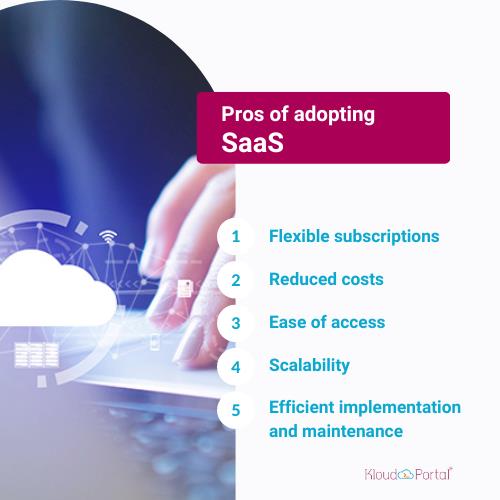
Pros of adopting SaaS:

1. Flexible subscriptions: Software as a Service replaces the traditional software method of purchasing on-premises software with a subscription model that can meet customers’ individual needs. Most commonly, subscriptions are paid monthly, quarterly, or annually, providing a recurring operating expense that can be modified based on evolving operating costs.

2. Reduced costs: Customers can enjoy lower initial costs by replacing the licensing costs associated with purchasing software with more flexible subscription fees. Allows companies to focus their investments on operating systems expenses rather than capital expenditures. Additionally, since SaaS providers manage the IT infrastructure that administers the software, customers have reduced reliance on hardware and software updates, resulting in lower costs.

3. Ease of access: SaaS business apps, being cloud-based, only require an internet connection, browser, mobile access, and user authentication, making them easily accessible from anywhere at any time. This convenience saves time and effort, decreasing significant workload, reducing costs, and increasing productivity.

4. Scalability: The modifiable nature of SaaS subscription-based models allows companies to optimize their budgets and gain access to the latest technology and professional services. Subscriptions can be adjusted to match a company’s changing volume, enabling optimized performance and enhanced expansion opportunities.

5. Efficient implementation and maintenance: Traditional on-premise software resources typically require extensive deployment periods for software installation across an organization. With SaaS solutions, a functional system and access initiation during an active subscription period are all that’s required, saving effort and boosting productivity. Maintenance, including regular software updates to mitigate bugs and errors, is also handled by SaaS, reducing labor and costs.

Pros Of SaaS marketing

Cons of adopting SaaS:

While there are numerous advantages to using SaaS browser-based applications, organizations need to consider the potential drawbacks before adopting a SaaS provider. These disadvantages include the following:

1. Reduced control: Outsourcing implementation and management to a third party, organizations may lose control over certain aspects of the software solution. Customization options may be limited, and the organization may have to rely on the software versions provided by the SaaS provider.

2. Connectivity challenges: Software as a Service applications rely on access to the internet and cloud sources, so internet outages or cloud failures can impact performance and productivity.

3. Security concerns: Storing confidential information in a cloud-based environment outside of the organization’s server raises concerns about data security, privacy protection, and access management, making industries that work with sensitive data cautious about SaaS services.

4. Service agreements: With various SaaS providers offering different service level agreements, organizations must navigate the details of each agreement, including issues like data breaches and service failures, resulting in time expenditure and potential confusion about their impact on the business processes.

The Future of Software as a Service (SaaS)

The popularity of Software-as-a-Service (SaaS) is undeniable, with estimates indicating that nearly 90% of businesses are currently utilizing some form of SaaS application. This trend is expected to continue as more companies develop and implement new technologies to meet growing demand.

Predictions suggest that SaaS technology will experience a resurgence with a heavy focus on mobile devices. In contrast, others believe that artificial intelligence (AI) will dominate the logistics, transport, and retail market.

As technology continues evolving, so will the SaaS application and implementation models. Out-of-the-box and ready-made tools will always have a business place, and SaaS offers a wide range of benefits for suppliers and users.

Conclusion

In today’s digital age, cloud computing is widely regarded as the future of technology. For SaaS software implementation, KloudPortal represents an exceptional opportunity for businesses as a leading SaaS product development company. By leveraging SaaS, organizations can effectively scale their operations, achieve higher, and sustainable revenues.

To keep up with the demand for cloud computing solutions, KloudPortal helps companies with qualified IT professionals to analyze, evaluate, and design suitable solutions for their current and future needs.

How To Retain Your Customers With Optimum Customer Services?

How To Retain Your Customers With Optimum Customer Services?

By Rasmita Petro

Customer service is one of the most important factors that can influence the success of any business. Providing optimum customer care can help you retain your customers and build a loyal customer base. Companies selling their products must provide robust services to their end users, and the consumer must be immediately heard.

Effective communication and patience with customers while resolving their issues are good signs of providing optimum service. Customer care professionals should be friendly, attentive, and empathetic towards and guide customers, making them feel valued and respected. KloudPortal is a pioneer in providing its valued customers with the best Digital Marketing services.

Providing optimum customer care through personalized assistance will ensure client satisfaction. Prioritizing digital marketing is more crucial than ever in a highly competitive marketplace. To retain customers, businesses must exceed their expectations by delivering exceptional customer service experiences, catering to their needs, and creating positive interactions that leave a lasting impression. Delivering outstanding customer service is essential for retaining customers, building a loyal customer base, and growing a successful business.

How To Retain Your Customers?

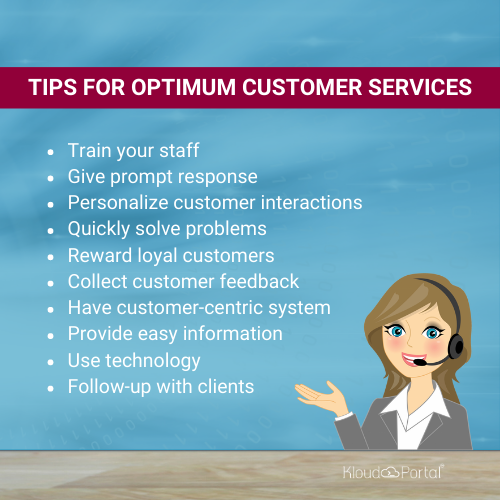
Train your staff

One of the key elements of providing excellent customer service is having a team of well-trained staff. Your staff should be knowledgeable about brand building, products, and services, and importantly, be patient and have excellent communication skills. A customer representative is the face of your organization. Train them on how to handle different situations, how to empathize with customers, and how to resolve customer issues.

Paying attention to and empathizing with their grievances is key to gaining trust and customer loyalty. It can give us the advantage of pre-empting potential issues or challenges, allowing us to proactively address them before they escalate into major problems. Regular staff training will help them provide the best possible customer service.

Respond promptly to customers

It is crucial to heed customers’ inquiries and worries as they expect prompt attention. Research reveals that 90% of consumers anticipate an immediate response when they contact customer service.

It is imperative to reach out to them promptly through various communication channels such as email, chat, phone, or social media to foster trust and establish a strong rapport with your clients. By doing so, your clients will feel valued, increasing the likelihood of repeat business.

Personalize your customer interactions

It is crucial to personalize customer interactions by tailoring them to individual needs to enhance the consumer experience. Contact customers by name, show that you pay attention to their preferences, and personalize your interactions accordingly. This approach creates a unique customer experience that makes them feel valued and appreciated, fostering a stronger customer relationship. Personalized communication during events, sign-ups, or other interactions can further enhance customer loyalty and satisfaction.

Solve problems quickly

Professionally dealing with customers is essential to maintaining a positive relationship. When communicating with customers, being mindful of the person on the other end of the line is important. Personalizing your approach can go a long way in building trust and loyalty.

Additionally, pricing can be a sensitive issue for some customers, so it’s essential to be transparent and clear when discussing costs. Being upfront about the price can prevent misunderstandings and potential conflicts down the line. Overall, you can establish a strong relationship and promote customer satisfaction by handling interactions with customers courteously and respectfully.

Reward your loyal customers

Rewarding your loyal customers is a great way to retain them. Offer loyalty programs, discount coupons, discounts on select products, free products, sales, and rewards to customers who have been with you for a long time. The reward will show your clients that you appreciate the business and respect the value of their patronage.

Loyal consumers are also more likely to refer new customers to your business, which can help you grow your customer base. A simple “thank you” can go a long way when providing customer service.

Use customer feedback

Collecting consumer feedback is crucial for improving customer service. You can obtain feedback through surveys, social media, or phone. Addressing any customer issues and implementing necessary changes to enhance their experience with your company is mandatory. Consistently seeking and acting on customer feedback can help build customer loyalty and trust.

A customer-centric culture

Having a customer-centric support system is crucial to a company’s success. Every employee, from the CEO to the receptionist, should understand the importance of the customer service process. Encourage your team to prioritize client needs and develop a customer-first mindset.

Understanding your customer’s needs is also essential to providing excellent customer service. By using a fixed system of asking questions and offering good deals, you can get to know your customers better. Social media can also provide insights into your customers’ likes, habits, and purchasing behavior. Use these tips to retain customers and stand out from the competition while enhancing your understanding of your clients.

Tips for optimum customer services

Provide easy access to information

Customer retention is essential to the success of any company, and making information easily accessible is one way to retain consumers. To achieve this, ensure that customers can quickly access data about your products or services. Providing clear and concise details on your website, manuals, and other materials can help consumers better understand your company’s offerings.

Additionally, offering good deals can also help retain customers. Understanding your customers’ needs and preferences is crucial to retaining them. Utilizing these strategies can enhance client satisfaction and promote long-term loyalty.

Use technology to enhance customer service

Technology can be a valuable tool for enhancing customer service. For example, you can use chatbots to provide customers with quick answers to their inquiries. You can also use social media to interact with clients and cater to their complaints or concerns. Technology can also be used to personalize customer service. You could use data analytics to personalize offers and promotions for individual customers.

Follow up with clients

Companies must follow up with customers after a purchase or interaction to retain them. Show consumers that you care about their satisfaction and are willing to go the extra mile to ensure they are happy with your products or services. You can follow up with customers through email, phone, or mail. You can also use customer surveys to gather feedback on their experience with your business.

Conclusion

Providing exceptional customer service is critical to brand building and marketing strategy. It can create a positive brand image, improve customer engagement, and increase loyalty and retention rates. Digital marketing platforms can help businesses interact with customers, gather feedback, and address concerns in real-time to enhance satisfaction.

Prioritizing excellent customer service and leveraging platforms can help enhance brand reputation and build long-term customer relationships. KloudPortal is a one-stop solution if you are looking for an optimum customer service experience. So, contact us today.

KloudPortal provides the best digital marketing services and also delivers exceptional customer service that goes above and beyond.

We use cookies to ensure that we give you the best experience on our website. If you continue to use this site we will assume that you are happy with it.

Cookies settings
Accept
Privacy & Cookie policy
Privacy & Cookies policy
Cookie name Active

Privacy Policy

What information do we collect?

We collect information from you when you register on our site or place an order. When ordering or registering on our site, as appropriate, you may be asked to enter your: name, e-mail address or mailing address.

What do we use your information for?

Any of the information we collect from you may be used in one of the following ways: To personalize your experience (your information helps us to better respond to your individual needs) To improve our website (we continually strive to improve our website offerings based on the information and feedback we receive from you) To improve customer service (your information helps us to more effectively respond to your customer service requests and support needs) To process transactions Your information, whether public or private, will not be sold, exchanged, transferred, or given to any other company for any reason whatsoever, without your consent, other than for the express purpose of delivering the purchased product or service requested. To administer a contest, promotion, survey or other site feature To send periodic emails The email address you provide for order processing, will only be used to send you information and updates pertaining to your order.

How do we protect your information?

We implement a variety of security measures to maintain the safety of your personal information when you place an order or enter, submit, or access your personal information. We offer the use of a secure server. All supplied sensitive/credit information is transmitted via Secure Socket Layer (SSL) technology and then encrypted into our Payment gateway providers database only to be accessible by those authorized with special access rights to such systems, and are required to?keep the information confidential. After a transaction, your private information (credit cards, social security numbers, financials, etc.) will not be kept on file for more than 60 days.

Do we use cookies?

Yes (Cookies are small files that a site or its service provider transfers to your computers hard drive through your Web browser (if you allow) that enables the sites or service providers systems to recognize your browser and capture and remember certain information We use cookies to help us remember and process the items in your shopping cart, understand and save your preferences for future visits, keep track of advertisements and compile aggregate data about site traffic and site interaction so that we can offer better site experiences and tools in the future. We may contract with third-party service providers to assist us in better understanding our site visitors. These service providers are not permitted to use the information collected on our behalf except to help us conduct and improve our business. If you prefer, you can choose to have your computer warn you each time a cookie is being sent, or you can choose to turn off all cookies via your browser settings. Like most websites, if you turn your cookies off, some of our services may not function properly. However, you can still place orders by contacting customer service. Google Analytics We use Google Analytics on our sites for anonymous reporting of site usage and for advertising on the site. If you would like to opt-out of Google Analytics monitoring your behaviour on our sites please use this link (https://tools.google.com/dlpage/gaoptout/)

Do we disclose any information to outside parties?

We do not sell, trade, or otherwise transfer to outside parties your personally identifiable information. This does not include trusted third parties who assist us in operating our website, conducting our business, or servicing you, so long as those parties agree to keep this information confidential. We may also release your information when we believe release is appropriate to comply with the law, enforce our site policies, or protect ours or others rights, property, or safety. However, non-personally identifiable visitor information may be provided to other parties for marketing, advertising, or other uses.

Registration

The minimum information we need to register you is your name, email address and a password. We will ask you more questions for different services, including sales promotions. Unless we say otherwise, you have to answer all the registration questions. We may also ask some other, voluntary questions during registration for certain services (for example, professional networks) so we can gain a clearer understanding of who you are. This also allows us to personalise services for you. To assist us in our marketing, in addition to the data that you provide to us if you register, we may also obtain data from trusted third parties to help us understand what you might be interested in. This ‘profiling’ information is produced from a variety of sources, including publicly available data (such as the electoral roll) or from sources such as surveys and polls where you have given your permission for your data to be shared. You can choose not to have such data shared with the Guardian from these sources by logging into your account and changing the settings in the privacy section. After you have registered, and with your permission, we may send you emails we think may interest you. Newsletters may be personalised based on what you have been reading on theguardian.com. At any time you can decide not to receive these emails and will be able to ‘unsubscribe’. Logging in using social networking credentials If you log-in to our sites using a Facebook log-in, you are granting permission to Facebook to share your user details with us. This will include your name, email address, date of birth and location which will then be used to form a Guardian identity. You can also use your picture from Facebook as part of your profile. This will also allow us and Facebook to share your, networks, user ID and any other information you choose to share according to your Facebook account settings. If you remove the Guardian app from your Facebook settings, we will no longer have access to this information. If you log-in to our sites using a Google log-in, you grant permission to Google to share your user details with us. This will include your name, email address, date of birth, sex and location which we will then use to form a Guardian identity. You may use your picture from Google as part of your profile. This also allows us to share your networks, user ID and any other information you choose to share according to your Google account settings. If you remove the Guardian from your Google settings, we will no longer have access to this information. If you log-in to our sites using a twitter log-in, we receive your avatar (the small picture that appears next to your tweets) and twitter username.

Children’s Online Privacy Protection Act Compliance

We are in compliance with the requirements of COPPA (Childrens Online Privacy Protection Act), we do not collect any information from anyone under 13 years of age. Our website, products and services are all directed to people who are at least 13 years old or older.

Updating your personal information

We offer a ‘My details’ page (also known as Dashboard), where you can update your personal information at any time, and change your marketing preferences. You can get to this page from most pages on the site – simply click on the ‘My details’ link at the top of the screen when you are signed in.

Online Privacy Policy Only

This online privacy policy applies only to information collected through our website and not to information collected offline.

Your Consent

By using our site, you consent to our privacy policy.

Changes to our Privacy Policy

If we decide to change our privacy policy, we will post those changes on this page.
Save settings
Cookies settings