How To Run Content Audit?

How To Run Content Audit?

By Bishnu Priya

When was the last time you thoroughly analyzed and did a complete inventory of your content? The process of doing this analysis and assessing all the content on your website is called a content audit.

Nowadays, most content creators are so preoccupied with producing new content that they don’t pay more attention to auditing their earlier work. And if it has been more than a year, then your content strategy can be based on out-of-date data.

Moreover, Google introduced the ‘Helpful Content Update’ in August 2022, a brand-new ranking factor intended to lessen the visibility of subpar content. And, if your website gets hit with that penalty, then the only method to get out of it is to do content audits.

Simply put, content audits are a clever and strategic approach to assess your previous content marketing efforts and gain a clear understanding of how they aid or impede your goals.

Why Should you do a Website Content Audit?

A website content audit has a heap of advantages, such as:

  1. Assisting you in making data-backed decisions about which pages should be properly optimized.
  2. Highlight the web pages on your site that have poor SEO.
  3. Locating SEO opportunities and content gaps that you can replace with fresh content.
  4. Enhancing the reader experience by raising the standard of the content on your website.
  5. Identify the content you can reuse.
  6. Make a thorough inventory of your content to simplify future content marketing strategies.
  7. Enhancing the diversity and accessibility of your content.

How to Run a Website Content Audit?

You should review your content marketing strategy at least once a year to ensure your methods and activities align with your business’s objectives. Although a complete content audit process may be time-consuming, dividing it into small steps is simple.

1. Determine your goals

The first step is to consider your business goals, such as improving your search engine optimization (SEO), content quality, increasing audience engagement, and conversion optimization. Once your goals have been established, you must align them with pertinent content metrics.

Content metrics include SEO metrics (organic traffic, backlinks, keyword rankings, dwell time, etc.), user behavior metrics (page views, average session duration, bounce rate, etc.), engagement metrics ( likes, shares, comments, mentions, etc.) and sales metrics (number of leads, ROI, conversion rates, etc.).

For instance, if you want to identify the most popular topic and provide more content to them, then you should analyze user behavior and engagement metrics. And if you intend to concentrate on your SEO performance, check the number of backlinks and examine your rankings in search engines. Then place the most engaging and effective content on your homepage for your website visitors to win in organic search.

2. Perform a content inventory

Before compiling a list of URLs and metrics, reviewing the existing content is critical. You may check the internal content, such as blog posts, news articles, instructional materials, product descriptions, landing pages, and external publications.

Then, begin your inventory by gathering all the URLs for the websites you wish to analyze. The best approach to collect these is to utilize an online content audit tool that can swiftly audit your content based on your sitemap data and provide you with a list of URLs and related metrics.

A reputed digital marketing agency can guide you in selecting the best analytics tools.

After gathering your URLs, using a content auditing tool or content audit templates, catalog your content by the following categories:

  • Content types like blog posts, product descriptions, website pages, or a landing page
  • Content format like text only, images or videos present, with or without a call to action
  • Word count
  • Meta descriptions
  • Date of publication or latest modified
  • Author

Finally, establish columns with your metrics to identify content for each web page and ensure all pertinent data points are included.

How to run a website content audit

3. Collect data

Obtain data from several sources, then manually enter it into your content audit spreadsheet or download a content audit template. And if you want to save time, use content audit tools that automatically gather information based on your objectives and KPIs.

To expand and deepen your data, link your Google Analytics account and Google Search Console. It provides in-depth insights, and for each URL, you can examine more stats, such as sessions, average session length, page views, page title tags, average time on page, bounce rate, and search queries.

4. Analyze your data

At this point, it’s time to examine your data closely. This stage will provide you with a reliable assessment of your content assets. Some factors to consider while assessing your data include missing information, underperforming content, outdated information, and home run content.

Then, based on the findings of this study, sort the information in the spreadsheet. Depending on your examination, you may assign various colors and highlight the rows with those colors.

5. Create an action plan

At this phase, based on the analysis, you now know what to prioritize and can go forward. Consider which old site content you should edit, rewrite, or reorganize. For example, remove low-quality pages that don’t target keywords or offer your readers little value.

Also, individual pages may not receive organic traffic, but they may offer valuable context to Google through internal links. In that case, choose where you think it is viable to raise page quality and optimize older content for certain organic searches.

After you’ve sorted your priority list, make an action plan for each piece of content. And to ensure that you can monitor it, add one last column to the spreadsheet, preferably one towards the top. You may use this column to determine what to do on a URL. For instance, will you rewrite, update, delete, or keep that blog post?

You can also utilize a website content audit checklist to ensure your audit is done correctly.

How Can KloudPortal Help?

KloudPortal’s top digital marketing services outline which approach is best for your company, which strategy is geared at, and how to reach the audience. Its free website SEO audit provides you with information and areas for improvement.

How To Ensure Cultural Sensitivity in Your Digital Marketing? 

How To Ensure Cultural Sensitivity in Your Digital Marketing? 

The value of culture in the field of digital marketing is enormous. As many smaller marketplaces make up the global market, the cultures and languages of these smaller marketplaces are distinctive and significant.

For instance, American culture and Indian culture are highly dissimilar, and many things accepted in America aren’t accepted in India. Indians do not favor the style of clothing, or cuisine American consumers prefer. Therefore, a company that markets itself in many countries needs different digital marketing tactics based on individual cultures. Because all of these factors have an impact on how well a corporation performs internationally. So, how can International brands ensure culturally sensitive advertising that appeals to every target audience member? Let’s discuss it from this article.

What Is cultural sensitivity?

Cultural sensitivity, also called cross-cultural sensitivity or cultural awareness, is the understanding, acceptance, and appreciation of various cultures and cultural sensitivities.

For instance, when McDonald’s first opened in India, they came up with the Mc Aloo Tikki because some Indian consumers were vegetarians. Similarly, IKEA made certain adjustments to its business cycle, philosophy, products, and prices to achieve acceptability when it wished to enter the US market.

The digital marketing services from KloudPortal outlines which approach is best for your company and how to reach the target audience.

Why is cultural sensitivity important in marketing?

Adopting cultural sensitivity in marketing is important to satisfy the local customers’ requirements and expectations. Plus, it recognizes the cultural variations and parallels between the new market. Also, scaling businesses globally helps the organization to understand how to reach potential customers and new audiences.

Besides, historically numerous minority groups have experienced marginalization. So, businesses can gain their trust by showing them that they are empathetic in this way. Plus, when greater representation provides a wider diversity of viewpoints, multicultural consumers see a company as inspiring and helpful.

Consider a scenario in which your multicultural marketing approach emphasizes the difficulties that a minority group encounters while simultaneously highlighting their contribution to society. In that instance, your organization will gain more support from that group, and they will feel as though they have an ally who is sincere and caring because of your awareness of their difficulties.

KloudPortal’s digital marketing services understand your products and services and deliver digital excellence through strategic execution.

How do you improve cultural sensitivity?

While some organizations opt to maintain a homogeneous business structure that minimizes cultural differences, others take this as an opportunity to diversify their client base and enter new markets. Here are some ideas for improving cultural sensitivity in your marketing strategy:

Train employees to be sensitive

Training lays the foundation for understanding and appreciating others’ viewpoints and backgrounds. It also develops empathy, which is the capacity to understand and relate to others’ ideas, feelings, and life experiences. Ensuring that employees are aware of other cultures established in the company’s code of conduct, rules, and policies helps avoid discrimination and other types of misconduct.

Research different viewpoints and ideas

Diverse nationalities and origins have different approaches to business problems. And an effective corporate connection can be greatly facilitated by developing a marketing environment that supports and encourages cultural differences. This marketing strategy will support your business’s marketing initiatives to attract and retain a diverse talent pool. Plus, this will present your business as a worthy alternative to job seekers, clients, and investors worldwide.

Remove obstructions to intercultural communication

One of the most common communication obstacles in cross-cultural collaboration is language. To bridge the communication gap, consider offering basic language training to staff members who frequently interact with clients or partners who speak a foreign language or other languages.

Train your staff to communicate with people from other cultures in various ways, especially those they interact with frequently. Remind staff members of the company’s principles and guidelines regarding how they are expected to treat one another.

Serve advertising by region

Instead of being reactive, brands should be proactive, and getting it right should be their main priority. For instance, in a barbeque commercial, Americans don’t like to see images of live animals being killed for their meat (such as live pigs or live baby calves, or pork chops and veal). Hence, to ensure that an advertisement meets the cultural relevance test, it is important to carefully examine its verbal and visual messaging before it is released.

In digital marketing, execution is crucial, and the digital marketing services from KloudPortal put a lot of effort into implementing plans to connect with your audience, ultimately boosting revenue.

Why Is Cultural Sensitivity Important In Marketing?

What strategies can you use to support cultural sensitivity in your practice?

Here are some of the most important tactics that companies could use when incorporating cultural sensitivity into international marketing campaigns or introducing products in new markets:

Beware of gender stereotyping

In western countries, one of the most popular themes brands use to engage with consumers is undoubtedly staying away from gender stereotypes. The reason being marketers understand that modern customers in the twenty-first century lead more varied, complicated lifestyles and aren’t always limited by the typical gender roles of the past.

For example, In an athleisure marketing campaign by ASOS called ”More Reasons to Move,” women were portrayed as dominating sports like football and boxing that males typically dominate.

Investigate the words and phrases

Do a quick Google search to find the meaning of a word you’re considering using in your marketing campaign. For example, if you use a foreign language in your advertisement, make sure you understand every word or phrase. Words like peckish, and quid, which English speakers frequently use in the UK, may have little sense to someone from the US, Canada, or Australia.

Hence, try to collaborate with people native to your target market or join forces with a respected language service provider who has native, in-country linguists with Transcreation experience and can negotiate the tricky waters of cultural differences.

Keep out of controversial images

To avoid offending clients in markets abroad, an organization must be cautious while selecting its items’ graphics, iconography, or religious symbols. For example, an American store, GAP, had to issue an apology after releasing a T-shirt with a wrong map of China and immediately had to pull the product from the Chinese market.

So, if you cannot interpret symbols or text from different cultures, it would be wise to have them verified by a native speaker of the target language. Because when utilizing imagery that only sometimes corresponds to their own culture, brands can still run into problems.

Revise your product packaging

Product packaging is vital, particularly when you launch new products or a brand in international markets. It will significantly impact how a product differentiates itself from the competition and how your brand is viewed. Hence, companies must assess the appropriate cultural values to comprehend how various cultures react to particular imagery, ideas, and symbols.

Establish communication with ethnic influencers

Consumers from a certain cultural background are more prone to seek advice from recognized experts and members of their community. Therefore, utilizing these influencers’ expertise and authenticity is the most successful multicultural marketing strategy to present your company to a diverse target audience. It will also improve the sensitivity training for your staff.

How can kloudportal help?

In today’s global economy, culture has a significant impact on marketing. Ignoring the value of culture can be disastrous for your brand and prevent your company from expanding. So, creating native-language materials to inform your audience about your product or service and adapting marketing messaging to fit the needs of each culture are essential components of the process.

KloudPortal, one of the best digital marketing agency focuses on enabling companies to contact potential consumers through brand awareness and promotions. It provides SEO services and custom content creation to reach your marketing objectives. So, reach out to your experts and explore our digital marketing services.


Cultural sensitivity, Cultural sensitivity

What Is The Helpful Content Update From Google?

What Is The Helpful Content Update From Google?

Often frustrated users express on social media or blogs that they land on pages that provide no solutions to their search questions but rank on top pages in Google search engines. So, how can you ensure that your website conforms to the most recent search engine guidelines? What is the best strategy to satisfy your visitor’s expectations while keeping up with ongoing algorithm changes? The answer to these questions is given by Google’s most recent update on helpful content, which emphasizes the significance of offering customers interesting and useful content.

Google developed algorithms to reward creators who provide people-first content to their readers. And for this, they started rolling out on August 25, 2022 and took up to two weeks to complete on September 9, 2022.

In addition to utilizing SEO rules and maintaining keyword rankings, your content strategy should be beneficial to people and pertinent to their search results. Hence, it would be best if you adapted your plan following the algorithm to achieve a position on Google’s highly sought-after first page. If you are looking for content marketing services, KloudPortal delivers content in the first person, and their content speaks to a customer like an influencer.

In this article, we will learn what Google’s helpful content update is and how you can prepare.

What is google’s helpful content update?

The ‘Helpful Content Update‘ is an algorithm update that assists users in finding more useful and valuable content when searching with Google. It aims to reward content creators that provide users with a better and more satisfying experience.

Google introduced a new site-wide signal, which means the update will apply to the entire website rather than just specific pages. It implies if the update flags your site as having a lot of ‘unhelpful content’ or if it doesn’t meet users’ expectations, it will reduce the visibility of the content and affect the overall performance in SEO rankings and search traffic.

KloudPortal is the best enterprise SEO service in India that has a thorough understanding of how to position your website in the industry.

Who does this impact?

Although Google stated that the upgrade directly targeted no particular niche, it did state that these categories of material will be most affected:

  1. Online learning resources
  2. Entertainment & arts
  3. Tech-related content
  4. Shopping

What does ‘people-first’ content mean?

Google coined the phrase ‘people-first’ content. To give searchers more value, you should concentrate on producing high-quality content, not just ranking web pages.

Google advises you to ask yourself the following questions to ensure your website and its content put ‘people first.’ If you can say yes to them, you’re headed in the correct direction.

Does your existing or intended audience find the content useful because it originated from your company website?

  • Does your helpful written content demonstrate first-hand expertise and in-depth knowledge?
  • Is the goal or aim of your website evident?
  • Will someone who reads your content believe they have learned enough to accomplish their goal without looking elsewhere?
  • Will someone who reads your article feel satisfied with the experience?
  • Do you consider the advice for both core upgrades and product reviews?
 KloudPortal is the best enterprise SEO service in India that has a thorough understanding of how to position your website in the industry.| KloudPortal

How to abide by ‘the google’s helpful content’ update

Although it may still need to be widely used, this upgrade has produced changes in google search results as the system tries to reclassify websites and newly launched sites. So, by implementing these suggestions for creating satisfying content, you’ll make sure to put your readers first and, indirectly, satisfy Google.

  1. Prioritize your readers: Avoid creating content for search engines. Your content marketing should always prioritize the target audience. The primary purpose or focus should be to provide information that clarifies the readers’ concerns or directs them to finish their tasks. For example, if you’re writing a how-to, keep it as concise and to the point as possible. As Google says, you are not required to attain a particular word count. Instead, consider your reader’s time and make each preferred word count.
  2. Write from experience: Do not publish articles on popular themes about which you need to gain knowledge. If a subject interests you, but you are unfamiliar with it, research it or get some first-hand expertise. For instance, while writing an app review, download it and give it a go. Avoid the temptation to copy and paste from other sites only to participate in the current buzz.
  3. Focus on your niche: Did you choose to create content without having any real expertise, but mostly because you believed it would attract search engine traffic and audience for your business? Well, the days of search engine first content are now over. If websites that rank for keywords are not related to their niche or primary value proposition, they may be more vulnerable during this update. Hence, you can explore the most relevant stuff in greater detail if you concentrate on your topic.
  4. Add valuable content: By focusing on questions like ‘how’ and ‘why,’ you can enhance the value of your content. These articles offer a thorough examination or a fresh viewpoint on helpful content. So, when writing content, instead of repeating the content which is already said, assist your existing audience by offering insightful commentary, sharing enlightening tales, offering fact-based analysis, or resolving issues. Not only will your visitor appreciate having all the information they need in one location, but Google will reward you by elevating your page in the SERPs.
  5. Prune existing unhelpful content: Content pruning should be done with care. Consider several things when deciding whether to remove unhelpful content from your site. When comparing the performance of specific pages on your website to its overall performance, using tools like Google Analytics is a good first step. Metrics like organic traffic, target keywords, rankings, conversions, session duration, and bounce rate are just a few that you should consider. Before putting URLs on the cutting edge, consider the quantity and caliber of backlinks pointing to specific pages.

Get people-first content written from KloudPortal

KloudPortal, a digital marketing company in Hyderabad, aims to provide people-first content for clients. To help you grow your business, we strive to give you the best content possible. Additionally, our SEO content writers recognize Google’s algorithm as a valuable asset. It means that we make sure to put your audience first with each piece of content we create. Doing this can ensure that you have a positive experience every time. Set up a meeting with our experts immediately, and let us assist you in resolving your issues.

1. Google’s new helpful content update targets sites creating content, Google’s new helpful content update targets sites creating content
How Does SaaS Marketing Help The Sales Team? 

How Does SaaS Marketing Help The Sales Team? 

Marketing is not just challenging but tough. But how about marketing something that is not physically present or something that changes all the time? SaaS or Software as a Service Marketing is the same as mentioned above. And selling SaaS products needs a different strategy.

Usually, a B2B SaaS company is often sustainable with a strong sales team. Even if your product is ground-breaking, its value is ultimately based only on the sales it generates. While the SaaS marketing department generates leads and ROI, the sales team is responsible for converting leads into customers and closing deals throughout the sales process, thereby leading to business growth.

Do you know? SaaS companies spend a good amount of their monthly recurring revenue on marketing.

However, with the growing popularity of SaaS in the past few years, it has become challenging for a SaaS business to set itself apart from rivals and succeed in the SaaS industry. Hence, this is where a SaaS marketing strategy can be of use. KloudPortal is a B2B SaaS product marketing agency committed to expanding your SaaS Product and bringing more leads, prospective customers, and paying clients.

What is saas marketing?

SaaS Marketing  is a type of marketing primarily targeted at generating leads and promoting subscription-based SaaS products. It is a method by which a SaaS marketing team offers its product in cloud-based programs with regular upgrades and new features.

Advantages of saas marketing strategy

The SaaS business model allows one to upend established marketplaces while utilizing just SaaS price structures. However, the advantages of marketing SaaS are:

  • Accessibility: Able to operate via an internet browser around-the-clock on any device.
  • Operational Management: Absence of installation, equipment upgrades, or conventional licensing administration.
  • Cost-effective: There are no upfront hardware fees and numerous flexible payment options, including pay-as-you-go models.
  • Scalability: The ability to quickly scale up a solution to meet changing needs.
  • Data Storage: The cloud is frequently used to store data.
  • Analytics: Availability of instruments for data reporting and insight.
  • Increase security: SaaS project management invests significantly in security-related technologies.
A B2B SaaS company is often sustainable with a strong sales team.|KloudPortal

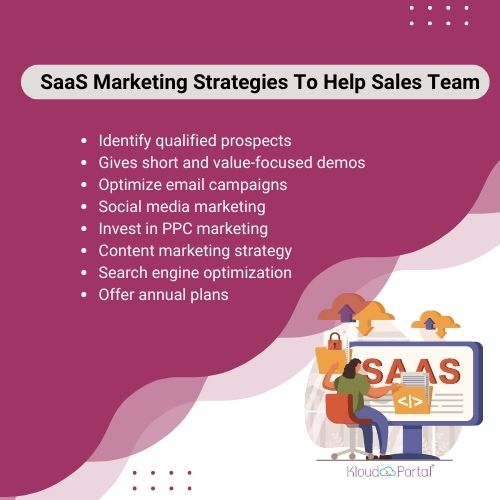
SaaS marketing strategies to help sales team

The basics of any SaaS marketing plan depend on your company’s stage. Also, in addition to attracting new customers, educating existing customers with new features takes up many marketing efforts. Listed are a few strategies that can help the sales team.

  1. Identify qualified prospects: Sales agents are expected to make more phone calls, knock on more doors, and send more emails. But the main effect of this is a small rise in sales. Also, it becomes challenging to attract the correct clients if you are a great face-to-face salesperson but cannot recognize qualified leads. However, there are more effective marketing methods to attract more prospects and build a rich funnel pack of qualified leads, such as:
    • Referrals from current customers.
    • Connecting with salespeople from related industries.
    • Web-based advertising, such as newsletters and blogging.
  2. Gives short and value-focused demos: A demo demonstrates the product’s effectiveness to a potential customer. A successful software demo should highlight its features, have a clear and concise narration that is well-paced and have a call to action regarding the next course of action with the product. Although video demos are a fantastic method to convey much information to potential clients, only some have the entire day to spend on your page. It is advisable to limit your demo to 15 to 20 minutes.
  3. Optimize email campaigns: Using the right email marketing tools, the sales team can optimize the emails by creating marketing content that is pertinent and highly effective. Make the email easy to scan and use catchy subject lines. Ensure the tone is tailored while establishing the appropriate triggers based on the potential customers’ actions.
  4. Social media marketing: Using social media for SaaS is a potent approach to expanding the business. It assists the sales team in establishing relationships, building communities, and promoting several SaaS companies globally for free. Additionally, it aids in bringing organic traffic to the website, which ultimately makes it simpler to turn that traffic into purchases.
  5. Invest in PPC marketing: With PPC digital marketing, the best aspect is that the sales team gets user-specific about who you’re putting your SaaS products on beforehand, which helps to develop excellent tracking stats. Also, when your marketing channels reach a target audience, the sales team need not exert much effort to win over that potential client, making managing customer retention easier. Through this process, SaaS revenue and sales growth are increased.

    Check out the  strategic PPC services  KloudPortal digital marketing services offer.

  6. Content marketing strategy: Many SaaS marketers have started using content as a crucial component of their SaaS sales and marketing strategies due to the effectiveness of content marketing. Running a blog can assist marketing teams in becoming recognized and helps the sales team to generate quality leads and potential clients.
  7. Search engine optimization (SEO): By utilizing on-page SEO strategies, you may raise your website’s search rankings and ensure that users who conduct searches relating to your company can find it. Additionally, SEO can create high-quality backlinks to your website and increase referral traffic which ultimately helps the sales team with lead generation.
  8. Offer annual plans: The annual prepaid model generates more revenue than monthly plans, easing cash flow. Additionally, sales reps can be certain that each customer who enrolls in the yearly plan will pay for at least one year. Doing this lowers churn while attracting high-quality clients with greater purchasing power.

Why KloudPortal?

KloudPortal is the best B2B SaaS Product marketing agency in India dedicated to assisting software-as-a-service companies to generate quality leads and accelerate growth. We offer SEO, SMM, PPC, and content marketing services and a customized marketing approach to assist SaaS Product marketing companies to stand out from the competition and increase conversions, signups, and revenue. Also, our digital marketing team pinpoints your target customers and plans out unique strategies to increase your ROI. So, want a free sales and marketing consultation for your business? Contact our experts now.

1. SaaS, Software as a Services

We use cookies to ensure that we give you the best experience on our website. If you continue to use this site we will assume that you are happy with it.

Cookies settings
Accept
Privacy & Cookie policy
Privacy & Cookies policy
Cookie name Active

Privacy Policy

What information do we collect?

We collect information from you when you register on our site or place an order. When ordering or registering on our site, as appropriate, you may be asked to enter your: name, e-mail address or mailing address.

What do we use your information for?

Any of the information we collect from you may be used in one of the following ways: To personalize your experience (your information helps us to better respond to your individual needs) To improve our website (we continually strive to improve our website offerings based on the information and feedback we receive from you) To improve customer service (your information helps us to more effectively respond to your customer service requests and support needs) To process transactions Your information, whether public or private, will not be sold, exchanged, transferred, or given to any other company for any reason whatsoever, without your consent, other than for the express purpose of delivering the purchased product or service requested. To administer a contest, promotion, survey or other site feature To send periodic emails The email address you provide for order processing, will only be used to send you information and updates pertaining to your order.

How do we protect your information?

We implement a variety of security measures to maintain the safety of your personal information when you place an order or enter, submit, or access your personal information. We offer the use of a secure server. All supplied sensitive/credit information is transmitted via Secure Socket Layer (SSL) technology and then encrypted into our Payment gateway providers database only to be accessible by those authorized with special access rights to such systems, and are required to?keep the information confidential. After a transaction, your private information (credit cards, social security numbers, financials, etc.) will not be kept on file for more than 60 days.

Do we use cookies?

Yes (Cookies are small files that a site or its service provider transfers to your computers hard drive through your Web browser (if you allow) that enables the sites or service providers systems to recognize your browser and capture and remember certain information We use cookies to help us remember and process the items in your shopping cart, understand and save your preferences for future visits, keep track of advertisements and compile aggregate data about site traffic and site interaction so that we can offer better site experiences and tools in the future. We may contract with third-party service providers to assist us in better understanding our site visitors. These service providers are not permitted to use the information collected on our behalf except to help us conduct and improve our business. If you prefer, you can choose to have your computer warn you each time a cookie is being sent, or you can choose to turn off all cookies via your browser settings. Like most websites, if you turn your cookies off, some of our services may not function properly. However, you can still place orders by contacting customer service. Google Analytics We use Google Analytics on our sites for anonymous reporting of site usage and for advertising on the site. If you would like to opt-out of Google Analytics monitoring your behaviour on our sites please use this link (https://tools.google.com/dlpage/gaoptout/)

Do we disclose any information to outside parties?

We do not sell, trade, or otherwise transfer to outside parties your personally identifiable information. This does not include trusted third parties who assist us in operating our website, conducting our business, or servicing you, so long as those parties agree to keep this information confidential. We may also release your information when we believe release is appropriate to comply with the law, enforce our site policies, or protect ours or others rights, property, or safety. However, non-personally identifiable visitor information may be provided to other parties for marketing, advertising, or other uses.

Registration

The minimum information we need to register you is your name, email address and a password. We will ask you more questions for different services, including sales promotions. Unless we say otherwise, you have to answer all the registration questions. We may also ask some other, voluntary questions during registration for certain services (for example, professional networks) so we can gain a clearer understanding of who you are. This also allows us to personalise services for you. To assist us in our marketing, in addition to the data that you provide to us if you register, we may also obtain data from trusted third parties to help us understand what you might be interested in. This ‘profiling’ information is produced from a variety of sources, including publicly available data (such as the electoral roll) or from sources such as surveys and polls where you have given your permission for your data to be shared. You can choose not to have such data shared with the Guardian from these sources by logging into your account and changing the settings in the privacy section. After you have registered, and with your permission, we may send you emails we think may interest you. Newsletters may be personalised based on what you have been reading on theguardian.com. At any time you can decide not to receive these emails and will be able to ‘unsubscribe’. Logging in using social networking credentials If you log-in to our sites using a Facebook log-in, you are granting permission to Facebook to share your user details with us. This will include your name, email address, date of birth and location which will then be used to form a Guardian identity. You can also use your picture from Facebook as part of your profile. This will also allow us and Facebook to share your, networks, user ID and any other information you choose to share according to your Facebook account settings. If you remove the Guardian app from your Facebook settings, we will no longer have access to this information. If you log-in to our sites using a Google log-in, you grant permission to Google to share your user details with us. This will include your name, email address, date of birth, sex and location which we will then use to form a Guardian identity. You may use your picture from Google as part of your profile. This also allows us to share your networks, user ID and any other information you choose to share according to your Google account settings. If you remove the Guardian from your Google settings, we will no longer have access to this information. If you log-in to our sites using a twitter log-in, we receive your avatar (the small picture that appears next to your tweets) and twitter username.

Children’s Online Privacy Protection Act Compliance

We are in compliance with the requirements of COPPA (Childrens Online Privacy Protection Act), we do not collect any information from anyone under 13 years of age. Our website, products and services are all directed to people who are at least 13 years old or older.

Updating your personal information

We offer a ‘My details’ page (also known as Dashboard), where you can update your personal information at any time, and change your marketing preferences. You can get to this page from most pages on the site – simply click on the ‘My details’ link at the top of the screen when you are signed in.

Online Privacy Policy Only

This online privacy policy applies only to information collected through our website and not to information collected offline.

Your Consent

By using our site, you consent to our privacy policy.

Changes to our Privacy Policy

If we decide to change our privacy policy, we will post those changes on this page.
Save settings
Cookies settings